Image source: wikiart.org
Introduction
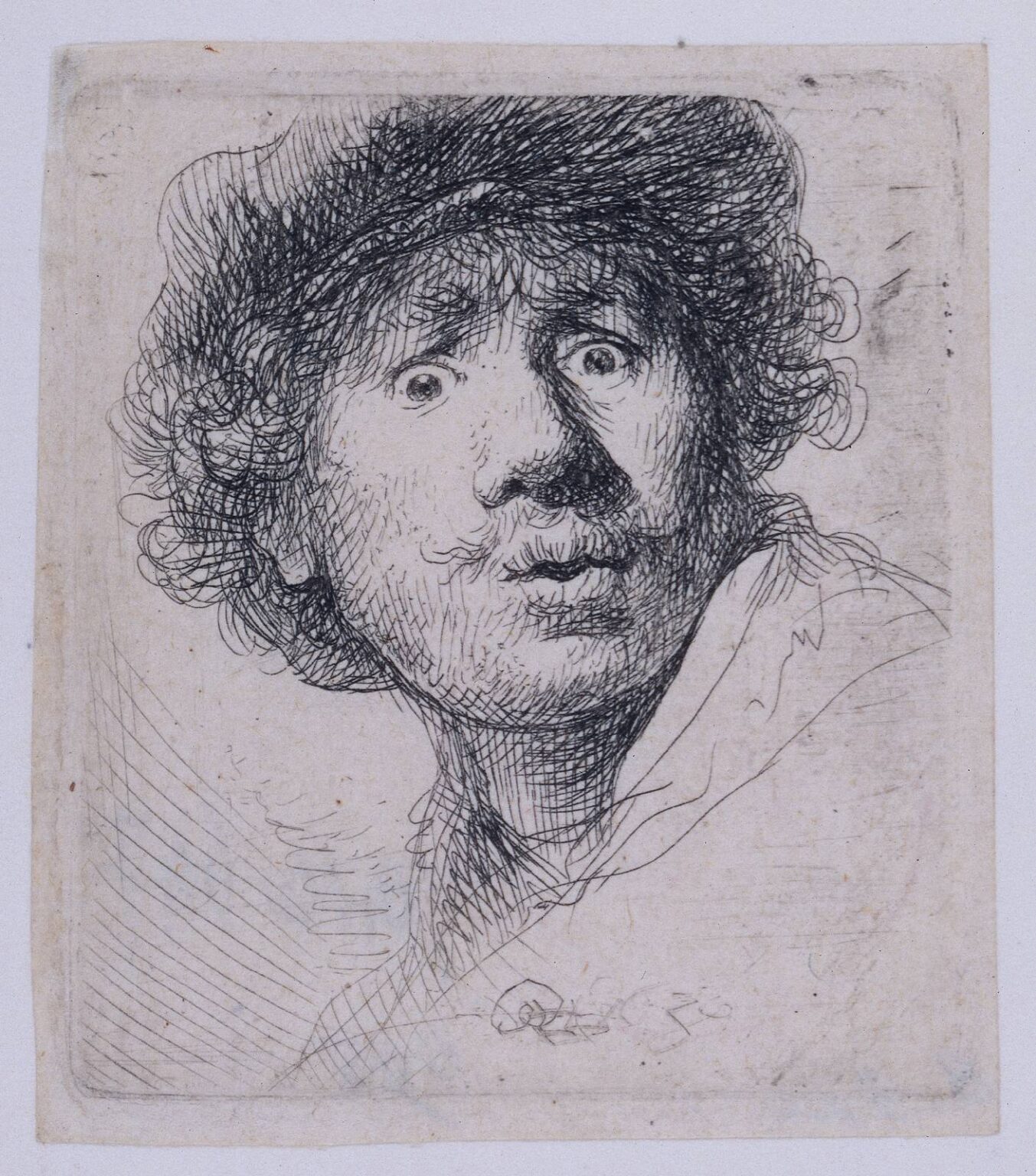
Rembrandt’s 1630 “Self-portrait” is a small etching with oversized energy. The young artist thrusts his head toward the viewer, eyes wide, brows sprung, mouth puckered as if he has just drawn breath to speak or to whistle in surprise. The lines that shape his face move with the speed of a quick intake of air. Paper white becomes burst and glare; dark cross-hatching presses forward like a stage curtain. In a square only inches across, Rembrandt stages a full drama of seeing and being seen, of performance and investigation. Rather than asking us to admire a poised likeness, this print makes us feel a first encounter, the instant when you turn and someone is suddenly there.
A Young Artist Invents His Vocabulary
The date places this sheet near the end of the Leiden period, when Rembrandt relentlessly tested what etching could do. He drew himself over and over, not to celebrate status but to stock his studio with a repertoire of faces. These were tronies—studies in expression and character—circulating among collectors who valued virtuoso mark-making and psychological bite. In this particular study he abandons the dignified self-presentation of painted portraits and adopts the open curiosity of the laboratory. The startled, comic expression is not self-mockery; it is a tool. By wrenching his features into extremes, the artist learns how cheek, brow, nostril and lip behave under stress and how a handful of strokes can persuade a viewer that muscle has just moved.
The Composition That Jumps Off the Plate
The head fills the sheet almost to the edges, cropped at the neck and hat brim so that it feels close enough to touch. That proximity is crucial to the sensation of surprise. There is hardly any buffer of background; the gaze arrives abruptly at the face. The diagonal wedge of parallel lines in the lower left acts like a thrust stage, shooting the chin and jaw toward us. The upper right remains relatively open, an airy counterweight that prevents the image from feeling claustrophobic. Even the mild rotation of the head contributes to the jolt. We catch him in three-quarter view just as he turns, giving the eyes asymmetrical intensity—one slightly more exposed to light, both alive with alarm.
Etching as a Recorder of Breath
Etching is uniquely equipped to register pace and pressure. A copperplate covered in wax accepts the needle with little resistance; marks can be as quick as a gasp. Rembrandt’s line here is restless and varied. Long, curving strokes sweep through the hat and curls, while short, nervy ticks whisker the cheeks and upper lip. The cross-hatching at the neck tightens into a mesh that grips the head like a collar of darkness. Ink rests in these bitten channels, and when pressed to paper the plate transmits not only a likeness but the momentum of the hand. You can almost reconstruct the order in which marks were made: hat first, then hair, then eyes and mouth, then the netting that locks the head into space.
Paper White as the Brightness of Alarm
Because etching constructs darkness and leaves light as uninked paper, blankness matters. The brightest field in the print is not a sunbeam but the untouched paper of the forehead, nose ridge, and the whites of the eyes. That brightness is emotionally legible. It reads as a flash of alertness on skin and as the wide gleam of eyes that have dilated to take in a shock. The surrounding hatching compresses those lights and makes them pop, the way a sudden noise seems louder in a quiet room. Rembrandt does not draw the light; he preserves it, and that restraint gives the face its instantaneous quality.
The Eyes as the Engine of the Scene
The eyes are simple ovals with dark cores, yet their force is immense. Each iris is set slightly off-center within its white, which makes them feel moving rather than fixed. A few small strokes thicken the upper lids into weight; tiny dots and commas along the lower rims suggest moisture. Their asymmetry matters. The nearer eye catches more white and thus more alarm, while the farther eye, nudged under the hat’s shadow, shows the pause after the first jolt. Together they complicate the emotion. This is not cartoon surprise; it is an unfolding perception, half-startle and half-assessment.
The Mouth that Shapes Sound
Rembrandt’s famous puckered mouth is a lesson in economy. Short, curved dashes describe the upper lip; a small dark triangle defines the philtrum; a suspended line hints at the lower lip rounding forward and catching light. The configuration could be a whistle, an exclamation, a whispered “oh.” It is sound made visible. Around it, a stubble of flickering lines—etched with quick, broken gestures—gives skin the granular resistance that makes the shape credible. The mouth’s oddity also has a studio logic: by exaggerating the orbicularis oris, he studies how flesh pulls and pushes under tension, knowledge he will spend throughout his career on saints, beggars, scholars, and brides.
Hair and Hat as Orchestration
The hat’s mass is drawn with broad loops and thicker lines that establish the largest dark. It behaves like a proscenium arch for the face. Beneath it, hair explodes in small spirals whose density rises and falls like a musical phrase. Where the curls thin, paper glints through, giving the haloed softness that oil paintings achieve with scumbles. Etching cannot smear light; instead, it alternates stroke and reserve to simulate glow. The crown of hair around the forehead thus becomes a luminous buffer between hat shadow and skin brightness, a narrow zone where the eye can rest before plunging back into the features.
The Wedge of Lines and the Staging of Space
At lower left, a wedge of parallel lines—unrelated to architecture—creates the illusion of a platform or edge. This is not a depiction of a real surface; it is a compositional device that aims our attention and anchors the head in depth. By pushing darkness forward in one corner, Rembrandt makes the face feel even closer, as if it has eclipsed the world behind it. The wedge also balances the heavy hat and hair at the top; without it, the head might float. With it, the figure seems to lean over a threshold between image and viewer, perfectly suited to the subject of self-startled recognition.
A Tronie with the Stakes of a Portrait
Collectors of the time would have recognized the print as a tronie rather than a formal portrait. Yet the emotional stakes are high. By using his own face, Rembrandt turns experimental expression into autobiography. He is at once actor and audience, anatomist and patient. The result sidesteps vanity. Instead of broadcasting status, the image asks, “What does a face look like when it wakes?” The question is painterly but also philosophical. It anticipates his later interest in moments when consciousness tilts—prophets hearing, scholars pausing, fathers suddenly understanding their sons.
Printing Variants and Changing Weather
As with most Rembrandt plates, impressions can vary dramatically. A plate tone left on the copper can fog the background with a gray veil, making the hat heavier and the eyes shine more fiercely. A cleaner wipe sharpens all reserves of paper white, cooling the mood into a more analytical study. Heavier inking thickens the wedge at lower left and the cross-hatching at the neck, pulling the head forward; lighter inking lets the curls breathe and the skin glow. These variables are not mere accidents of printmaking; they are interpretive tools that allow single copper to record different states of mind—the first shock, the second thought, the dawning grin.
Kinship with Other 1630 Self-Studies
Rembrandt returned obsessively to his own features that year, etching grimaces, smiles, yawns, and sidelong glances. In contrast with his painted self-portraits of the same period—calmer, weightier, set in soft chiaroscuro—the etchings embrace swiftness and risk. This sheet sits near the most theatrical end of the spectrum, but it shares with the others a commitment to truth of effect. Even when the expression is extreme, the anatomy is convincing, and the light behaves like real light. The prints as a group are a syllabus for his later portraiture, which will rely less on spectacular expression and more on the quiet complexity he practiced here.
The Ethics of Self-Scrutiny
There is humor in the face, but there is no cruelty. Rembrandt neither flatters nor mocks. The lines simply tell what the muscles do. That stance—curious, unsparing, and kind—will become the moral center of his art. In this print we watch him adopt it for the first time with full clarity. He looks at himself the way he will look at everyone else, from Jeremiah grieving to old women praying: with the confidence that careful attention is a form of respect.
The Audience Inside the Studio
Because the head is so near and the expression so present tense, the viewer feels like a participant. We become the person who has just arrived, the friend who made a noise, the mirror that betrayed him. The print turns the studio into a reversible theater: he reacts to us, and we to him. That reciprocity is rare in early modern portraiture, which often fixes the viewer at a formal distance. Here the distance collapses into conversation range, where small changes in mouth and brow carry the weight of human contact.
Line as Music and Time
Spend time with the etching and it becomes audible. The curls crackle in high register, the hat hums, the neck’s cross-hatching drones like a bass pedal, the wedge at left strikes a chord that propels the phrase forward. The paper white between strokes acts as rests, preventing noise from becoming static. Rembrandt’s control of rhythm is as important as his control of anatomy. It is the secret that makes the print feel like an instant rather than a diagram.
The Lasting Modernity of the Image
The sheet looks startlingly contemporary because it trusts essentials. There is no elaborate backdrop, no emblem to read, no captioned narrative to decode. A head, a few dozen kinds of line, a field of paper, and the electricity of attention—these are things any era can understand. The work’s modernity also lies in its candor about process. You can see thinking happen: the quick changes of direction in the hair, the exploratory flicks around the nostrils, the places where the needle paused and dug in. The honesty of making is part of the meaning.
Lessons for Draftsmen and Designers
The print is a compact manual for expressive drawing. It demonstrates how to switch line character to separate materials, how to preserve paper for the brightest light, how to use a single diagonal field to anchor a composition, how to suggest moisture in an eye with almost nothing, and how to make a mouth round without closing the line. It shows that a likeness is built less from contour than from the calibrated pressure of small strokes. Above all, it argues for stopping early. The face is most alive where Rembrandt refrains from filling in.
Why This Small Sheet Endures
Ultimately the etching endures because it answers an ancient wish: to feel another person’s presence across time. In a moment of staged surprise, a young artist invites us to share a breath with him. Nothing intervenes—no gilded frame, no institutional distance. We are inches from his gaze. The image is a handshake whose pressure has not slackened in nearly four centuries. We leave it with the sense that attention itself can be an art, and that to draw a face well is to reach it.
Conclusion
“Self-portrait” of 1630 transforms copper, acid, ink, and paper into an encounter. The head lunges forward, line leans and tangles, light is left pristine, and expression sits between comic and profound. The print is part rehearsal, part manifesto. It announces that Rembrandt will make character out of light and time out of line; that he will study himself in order to see others more truthfully; and that the nearest subject—a face a hand’s breadth away—can yield the farthest meanings when looked at with intelligence and mercy.