Image source: wikiart.org
Introduction
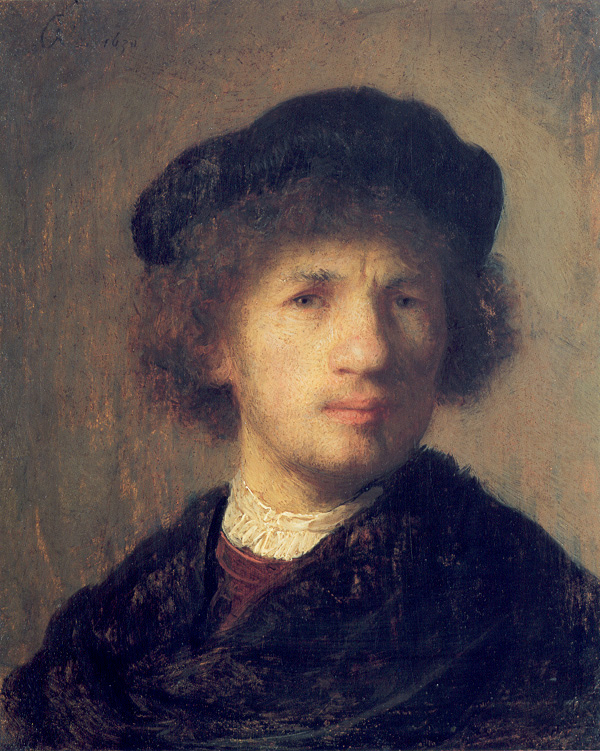
Rembrandt’s “Self-portrait” of 1630 is a compact painting that feels astonishingly expansive. In a bust-length view, the young artist turns slightly to the viewer’s left, his head illumined by a raking light that grazes cheek, nose, and lower lip before dissolving into the soft dusk of a modest background. He wears a dark beret and a mantle whose deep tones pool around the base of the neck; a crisp white collar and a hint of a red garment provide measured accents. Nothing about the work is ostentatious, yet it contains much of what would make Rembrandt one of art’s most searching observers: a trust in natural light, a fascination with the textures of skin and cloth, a willingness to let mood remain ambiguous, and a painterly surface that records the very thinking of the hand.
A Young Master in Leiden
Dated 1630, this self-portrait belongs to Rembrandt’s final Leiden years, just before his move to Amsterdam. The artist is in his early twenties, freshly engaged in a string of tronies—character heads and self-studies—through which he explored expression, light, and the possibilities of paint. These images were not formal commissioned portraits; they were laboratories where he could scrutinize his own face as endlessly available subject matter. In this canvas, the experimental air remains, but the execution is already assured. The head is monumental without being large; the presence is intimate without feeling informal. We encounter a painter who has learned to make a small picture carry the scale of a life.
Composition and the Authority of a Turned Head
Rembrandt chooses a three-quarter pose, a format that allows him to balance revelation and reserve. The orientation lets the nose project into space, defines the planes of forehead and cheek, and creates a gentle parabola from the shadowed ear through the cheekbone to the lit mouth. The head sits high on the panel, with a generous collar and mantle forming a dark base that anchors the composition. That base is not an afterthought; it acts as a plinth for the face, a pool of gravity against which the light-filled skin can vibrate. The decision to leave the background largely unarticulated amplifies the head’s presence—no objects, no setting, just a human encounter suspended in air.
Light as a Maker of Character
Chiaroscuro in this self-portrait is less theatrical spotlight and more physiological revelation. A warm beam from the upper left grazes the forehead and cheek, catches the down on the upper lip, and sinks into the soft crevices beside the nose and mouth. The light’s path is a tour of anatomy: how bone lies under skin, how pores break the reflection, how fine hair at the temple disperses the glow. Rembrandt refuses to smooth the surface to a porcelain ideal. He prefers the granular reality of living flesh, an approach that reads as candor rather than cruelty. The light does not flatter or accuse; it persuades us that the person in front of us breathes.
The Language of Paint
Up close, the painting reveals a rich variety of handling. The beret and mantle are laid in with broader, more opaque strokes that absorb light; the collar’s strokes sharpen into small, bright ridges that mimic crisp linen; the face is built from layered, semi-translucent passages whose edges soften and knit, with tiny peaks of pigment at highest highlights. This microtopography is not mere virtuosity. It acts as a visible record of choice: where to insist, where to yield, where to stop. The paint’s surface becomes a parallel portrait—of the painter’s decisions—running alongside the likeness of his features.
Color and Temperature
The palette favors earths and warm grays, punctuated by the cool white of the collar and the subdued red at the neckline. That restrained harmony allows the eye to perceive temperature shifts within the flesh tones: the warm flush of the lit cheek, the cooler half-tones along the jaw, the slightly bluish cast in the eye sockets. The beret’s deep black-green and the mantle’s brown-black keep the upper and lower edges of the composition stable, so the face can feel luminous without seeming detached. This calibration of temperature is central to the painting’s realism. You sense blood, breath, and the subtle climate of skin under lamplight.
Expression Between Moods
Rembrandt’s expression is famously hard to pin down. The mouth tilts toward a wry firmness; the eyes do not quite fix the viewer yet are not lost in reverie; the brow creases slightly, as if appraising something just outside the frame. It is a face mid-thought, neither openly friendly nor guarded, and therefore persistently interesting. This refusal to settle on a single theatrical emotion is a hallmark of Rembrandt’s mature art. He is already more interested in states of mind than in masks, in the play between seeing and being seen.
The Beret and the Mantle as Roles
While not a costume piece, the self-portrait nods to the artist’s habit of trying on identities. The soft beret and dark mantle echo the dress of humanist scholars and painters’ self-presentations across the Low Countries. They provide a dignified frame that sidesteps fashionable specificity, freeing the likeness from the dating of apparel. At the same time, they signal the self-awareness of a young painter who understands that how he appears will shape how viewers read his work. These are not props; they are part of an identity under construction—craftsman, intellect, and image-maker fused.
Structure of the Head and the Craft of Modeling
Look at how the head is built. The forehead arcs out and gently recedes under the beret; the plane of the temple turns convincingly into the eye socket; the side of the nose is a measured slope, not a hard edge; the philtrum and upper lip carry small, precise highlights that give the mouth body. Rembrandt models these planes with tiny temperature and value shifts rather than harsh outlines, a choice that anchors the face in convincing space. The neck is thickened by the mantle and collar, which serve both form and meaning: they support the head physically and set off its fragility as the seat of thought.
Background Silence and the Ethics of Focus
The background is a grayed, softly mottled field that does little more than admit and reflect the light. That silence is an ethic. It keeps the painting from becoming anecdotal and preserves the encounter’s intensity. Nothing distracts, nothing decorates. The figure exists against the simplest of spaces, and the viewer’s role is similarly simple: attend. Such restraint carries the authority of confidence. The artist trusts that a face alone can fill a panel.
Comparison with Other 1630 Self-Portraits
Rembrandt produced several self-studies around this year—some with armor-like gorgets, others with theatrical shock or laughter. This 1630 painting sits between bravura role-play and sober self-scrutiny. It uses the gravitas of dress without tipping into costume and the intimacy of a close view without the exaggerations of expression studies. The balance proves durable. Decades later, in the late self-portraits, the format will return with greater weathering and philosophical weight, but the principles—honest light, focused background, painterly surface—are already established here.
Psychological Nearness
Despite its calm, the painting feels close—conversation distance. That nearness comes from scale (bust-length, cropped just beyond the shoulders), from the high placement of the head within the frame, and from the candid light that refuses to hide texture. The result is a psychological intimacy unusual for portraits of the time, which often preferred more elaborate settings or flattered conventional idealizations. Rembrandt invites the viewer to stand with him in the studio’s quiet, in the interval between strokes, one person to another.
The Self as Subject and Tool
For a young painter, self-portraiture is both honest subject and practical instrument. The face in the mirror is always available, patient, and free. But in Rembrandt’s hands the convenience never turns rote. He uses his own head to solve universal problems of painting: how a form turns in light, how a flesh tone keeps its inner warmth, how a contour can remain soft and believable without losing clarity, how the smallest flick of highlight asserts the presence of moisture, life, and breath. The self provides rehearsal for every face he will paint thereafter.
The Dialogue Between Paint and Perception
Rembrandt orchestrates a subtle dialogue: where the viewer expects detail, he sometimes leaves a general tone (the far eye is soft, barely defined); where one expects generality, he inserts a sharp glint (the collar’s lace); where the boundary could harden, he lets hair dissolve into air. This constantly shifting contract between paint and perception keeps the portrait alive. It acknowledges that seeing is not a fixed transaction but a living process, and it welcomes the viewer into that process.
The Signature of Time on a Young Face
Even at twenty-four, Rembrandt does not present himself as a polished prodigy. The skin shows pores; the brow furrows; the lips are slightly chapped; the jaw carries the soft under-shadow of adolescent beard. He is not interested in masking youth but in studying how youth occupies a face that is already vigilant and working. The painting reads as a pledge to truthfulness—the truth of light on an actual person—over the incentives to aggrandize status or beauty.
Surface, Edge, and the Craft of Stopping
One of Rembrandt’s great gifts is knowing when to stop. The beret’s back edge is allowed to melt into the ground; the lower right of the mantle fades before reaching the frame; the far cheek avoids hard specular points. These “incompletions” feel right because they honor how the eye actually sees, focusing and softening in different zones. The portrait feels finished not because every square inch is elaborated, but because the visual relationships are complete. The painter’s restraint gives the image air.
The Ethics of Looking at Oneself
Implicit in any self-portrait is a stance toward self-scrutiny. Rembrandt’s is neither self-punishing nor self-congratulatory. It is inquisitive. He looks at himself as he will look at others: curiously, mercifully, with an appetite for specificity and a disdain for flattery. That approach will serve him in every genre he touches, from biblical scenes to portraits of merchants, scholars, and brides. The habit established here—of letting light lead judgment—becomes an ethical as well as a technical foundation.
Influence and Anticipation
While grounded in the Northern tradition of character heads and in the painterly freedom of contemporaries, this self-portrait points forward. The looseness at the margins, the robust control of mid-tones, and the refusal of a single, legible “expression” anticipate the psychological density of later Rembrandt and even the modern portrait’s interest in ambiguity. The painting feels classical and contemporary at once because it anchors itself in observed truth rather than in the tastes of a moment.
What the Viewer Brings
Part of the work’s power lies in how much it leaves for the viewer. The slight turn of the head invites us to complete the circle and imagine the unseen ear, the invisible side of the studio. The soft eye on the shadowed side makes us test our own focus. The unelaborated background becomes a screen for our own memories of quiet rooms. Rembrandt trusts us to meet him halfway, to let the painting adjust to our presence.
Conclusion
The 1630 “Self-portrait” condenses into a modest rectangle the values that would define Rembrandt’s lifelong art: attention to real light on real skin; a painterly surface that thinks as it moves; a composition that honors presence without fuss; and an expression that resists finish-line emotions in favor of lived, unsettled thought. What begins as a young man looking into a mirror becomes an encounter with painting’s central promise—that a handful of pigments can hold a human being with honesty and care.