Image source: wikiart.org
Introduction
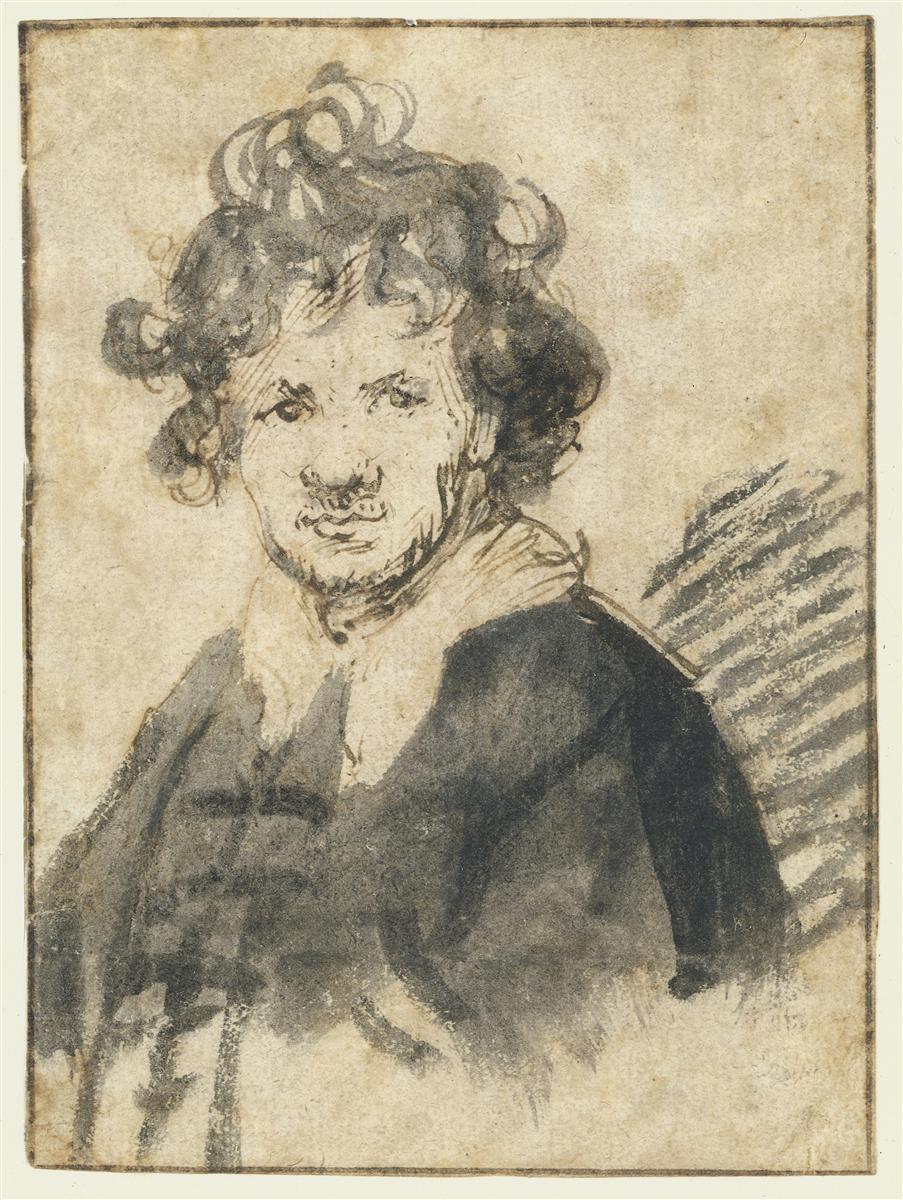
Rembrandt’s “Self-portrait” of 1629 captures a young artist on the brink of fame testing how far a few swift marks can go. The drawing shows him bust-length, turned slightly to the side, hair in unruly curls, with a dark cloak and a bright collar that catches the light. The sheet is small, and the means are modest—ink, wash, and possibly touches of chalk or heightening—yet the result is astonishingly alive. What we see is not a careful, polished likeness intended for patrons but an exploratory image made for himself: a rehearsal of persona, a study of light and shadow, and a declaration of the expressive power of drawing. This early self-portrait belongs to Rembrandt’s Leiden years, when he was in his early twenties and already obsessed with facial expression, character, and the drama of illumination. Its intimacy and nervous energy reveal how he built a public identity through private experiments.
The Moment in Rembrandt’s Career
In 1629 Rembrandt worked in Leiden, often alongside the slightly older Jan Lievens. He had returned from a brief apprenticeship in Amsterdam with Pieter Lastman and was forging his own language. The pictures and drawings from this period are small in scale but ambitious in effect. He studied faces in every mood, made pose studies in the mirror, and pushed chiaroscuro toward a theatrical pitch. The early 1630s would bring a breakthrough: celebrated tronies, the first famous etchings, and eventually the move to Amsterdam in 1631–1632. This self-portrait stands at the threshold. It is both an inward exercise and a public prototype, the kind of image from which he would craft prints and paintings that circulated widely. Even at this stage, he treats his own face as a laboratory for expression and a calling card for the market.
First Impressions and the Force of the Likeness
The portrait strikes us with a combination of quickness and specificity. Rembrandt’s gaze is direct, the mouth slightly open, as if caught between thought and speech. The hair is a riot of curls described with loops and scumbles of ink that refuse to settle into tidy order. Around that animated mass, the collar and cloak form a quiet counterweight, broad shapes sunk in wash. The background is little more than hatched diagonals, perhaps indicating a studio screen or simply vibrating darkness. From a distance the head pulls forward like a lantern; up close, the entire surface teems with the movements of hand and brush. The effect is to make the viewer aware of two realities at once: the living presence of a young man and the lively construction of marks that summon him.
Paper, Medium, and the Language of Speed
Rembrandt uses the sheet like a stage for speed. A brownish pen line lays down contours, then a brush broadens forms with watered ink. In the cheeks and forehead, thin washes pool and evaporate, suggesting soft flesh and uneven illumination. Where he wants a crisper edge—the ridge of the nose, the shadowed upper lip—he punctuates with darker dashes. Here and there he lets the paper stand for reflected light, most notably on the collar where a few light-edged strokes bring up a flash. The left shoulder tapers away in a dissolving silhouette, the brush almost dry. It reads as accident, but it is controlled accident, a planned elision that throws attention to the head.
This medium choice is not accidental. Ink and wash allow the artist to explore transitions between line and tone with no delay. The pen sets the tempo; the wash orchestrates the volume. The combination mirrors Rembrandt’s wider ambition in these decades: to make light a character that shapes the drama. Even without oil paint’s impasto, he creates a sense of weight pressing into shadow and light scraping across surfaces.
Chiaroscuro as Identity
In 1629, Rembrandt’s self-portraits already treat chiaroscuro as a form of self-definition. Rather than lay himself bare in even light, he embeds identity in the contest between brightness and obscurity. The collar and portions of the cheek catch the brightest tones, while the eye sockets and hair swallow light, turning the head into a relief carving emerging from dusk. The darkness is not only background; it is an active presence that presses on the sitter. Just as important, the light is not purely descriptive. It favors accidents and edges: the curl that flips forward, the corner of the mouth that tenses, the cheekbone that breaks the wash. The portrait therefore reads as a mind lit by experiment, a person assembled by the very spots where light catches on the medium.
The Gaze, the Mouth, and the Psychology of Youth
Rembrandt’s eye contact engages without being confrontational. He is not staring down the viewer; he is testing how the viewer receives him. The slight parting of the lips suggests either a breath taken to speak or the remnants of a smile, complicated by a shadow that gives the mouth grit. This ambiguity is typical of Rembrandt’s approach to psychology. He grants us a specific moment but chooses one in which multiple interpretations can float. Is the young artist amused, skeptical, or simply taking stock of his flow of marks? The portrait refuses to decide. What it asserts is a temperament unafraid of mixed signals and a curiosity about how features perform emotion.
Hair as a Field of Gesture
One of the drawing’s marvels is the hair, which becomes a miniature drama of gesture. Each curl is a tendril of ink that twists, doubles back, and dissolves. The rhythm is irregular yet coherent, like a bit of improvised music held together by a steady pulse. In later self-portraits, Rembrandt often dramatizes hair with glowing edges or a cap that concentrates light. Here, without props, he uses hair to broadcast energy. It frames the face not as a tidy border but as a storm that throws the head into relief. By binding spontaneity to structure, he shows how the “unfinished” can feel complete because it captures the experience of seeing a real, moving person.
Costume, Station, and the Early Branding of Self
The collar and cloak hint at a certain status, but they are not elaborate. In Leiden, Rembrandt frequently posed in historical or exotic dress to create tronies that mingled portrait with character type. This drawing sits closer to a plain studio moment, yet it still plays with self-fashioning. The collar brightens the center, granting the figure a note of refinement, while the cloak’s mass gives him painterly authority. The implication is subtle but important: even when he looks like a working artist rather than a grand gentleman, he stakes a claim to distinction through pictorial force. The brand is not fabric; it is handling.
The Mirror, the Hand, and the Discipline of Repetition
A self-portrait drawing begins with the mirror and the discipline of doing it again and again. Rembrandt understood that the face he knew best—his own—was also the most accessible instrument for studying light, anatomy, and expression whenever the need struck. Repetition did not bore him; it trained his eye to notice minute variations. The 1629 sheet participates in that routine. It likely formed part of a sequence of trials in which he tried out different tilts of the head, different degrees of shadow, and different emotional inflections. That habit would pay dividends in his etched self-portraits of the early 1630s, where he multiplied his image for a wide audience and set a template for the self-portrait as serial narrative.
Drawing as Thinking in Public
The visible process—pentimenti, uneven wash, pressure shifts—makes the sheet read like thought happening in real time. Rather than hide means, Rembrandt turns them into content. The viewer sees how the eye socket deepens with one pass of darker wash, how a single line under the nostril firms the structure of the face, how a ragged stroke on the shoulder creates the illusion of cloth. These are didactic pleasures: the drawing teaches us how to build a head with almost nothing. It also models a kind of artistic character, one that values the candid revelation of process over polished illusion. For Rembrandt, this frankness would become a hallmark. Even major paintings preserve traces of the brush as signifiers of presence, not blemishes to be smoothed away.
Light, Paper Tone, and the Feel of Time
The present tone of the paper, with its warm cast and scattered spots, interacts with the ink to produce a mellow atmosphere. Some of that warmth may be the patina of age; some may be inherent to the sheet and the choice of brown ink. The interaction contributes to the sense that light in the drawing is not a spotlight but a weather, a condition through which the figure appears. This atmospheric quality foreshadows the temporal depth of Rembrandt’s mature work, where light often seems to carry the weight of memory. Even here, in a quick self-portrait, light is not purely optical. It suggests duration: a young man who has been looking and will keep looking, his features coalescing through time.
Comparisons with Later Self-Portraits
Looking ahead to the painted self-portraits of the 1640s and the introspective masterpieces of the 1650s and 1660s, we can see how much of the later Rembrandt is already encoded in 1629. The preference for oblique lighting, the emphasis on the eye as a dark, thinking well, the willingness to let hair and cloth dissolve into painterly evocation—all are present in embryo. What changes is the emotional register. Later self-portraits carry the gravity of experience, the weight of financial trouble and personal loss, and an almost confessional candor. The 1629 drawing, by contrast, carries the impatience of ambition. It shows an artist impatient with polish because he wants to get to the heart of seeing. The shift from youthful urgency to mature contemplation draws a line through his career, and this sheet marks the starting point of that arc in an unusually transparent way.
Utrecht Caravaggisti, Lastman, and the Drama of Light
Although Rembrandt did not travel to Italy, he absorbed the lesson of Caravaggio indirectly through Dutch painters who had. The Utrecht masters returned with a taste for chiaroscuro and a stagecraft of figures emerging from darkness. Rembrandt adapted that taste to more intimate subjects and to the discipline of drawing. In this self-portrait, the dark ground is less a theatrical backdrop than a partner in modeling the head. The line of descent from his teacher Lastman is also evident in the attention to narrative suggestion: even a single face seems to carry a story. The half-open mouth and alert eyes hint at a narrative moment—speech beginning, a thought forming—without any explicit script. Light becomes the author of that moment.
The Ethics of Self-Scrutiny
Rembrandt’s self-portraits are not acts of flattery. From early on he resists the temptation to smooth his features or idealize his mien. Instead he adopts a principle of honesty that allows awkwardness, asymmetry, and vulnerability to register. In 1629, that honesty is tempered by the velocity of drawing; the marks themselves carry much of the expression. But the principle is already there, and it is ethical as well as aesthetic. By refusing to present a staged, heroic version of himself, he aligns his art with truthfulness about human presence. The viewer senses this integrity and responds not merely to likeness but to candor.
Market Context and the Value of the Artist’s Face
The Dutch art market of the 1620s and 1630s was vibrant and competitive. Artists needed to distinguish themselves not only by subject matter but by style and persona. Rembrandt’s repeated self-portrait practice can be understood, in part, as early branding. His face becomes an emblem of a way of painting and drawing—bold in light and shade, acute in expression, confident in the visibility of the hand. This drawing, even if never shown to buyers, anchors that emblem. It trains the moves that will populate his etchings and paintings, the images that patrons will come to recognize instantly as “Rembrandt.” The strange alchemy here is that extreme intimacy becomes public identity: the closer he looks at himself, the more distinctive his signature becomes.
The Role of the Mirror as Adversary and Ally
Every self-portrait transforms the mirror into both adversary and ally. It reverses the face, insists on the left-right inversion, and throws the painter into a feedback loop of looking, marking, and judging. The 1629 sheet reveals how Rembrandt negotiates that loop with agility. He accepts the reversal, even amplifies it by accentuating the asymmetry of the features, and uses the mirror’s delay—eye to hand to paper—to provoke new solutions. The curls that seem to have minds of their own, the shadow that gathers too quickly and is then tamed by a lifted brush, the edges that disappear and are recovered by a single line: all are products of the mirror’s game. The drawing is a record of that game and a testament to the pleasure he took in it.
Technical Cues: Hatching, Wash Edges, and the Breath of the Line
A close reading of the surface reveals three technical cues that give the drawing its breath. First, the hatching in the background runs at a slant and stops short of the head, creating a vibratory halo that pushes the face forward. Second, the wash edges around the cheek and jaw form tidemarks—slightly darker rims left as the liquid dried—that cue the eye to believe in volume. Third, the pen line varies in pressure, thickening on the shadowed side of forms and thinning where light falls, a calligraphic modulation that replaces conventional shading. Together these cues model the head with minimal means. They also articulate Rembrandt’s conviction that the medium’s behavior—how ink dries, how paper drinks—can serve the illusion rather than fight it.
Condition, Aging, and the Persistence of Presence
The sheet’s wear—softened edges, possible foxing, small stains—adds to its aura without diminishing its clarity. The face remains legible and forceful because it is constructed out of decisions rather than delicate effects. That resilience is part of Rembrandt’s genius in works on paper. He builds the image so that time can pass over it without erasing the essential. The same is true of many of his prints and oil sketches. The persistence of presence here communicates across centuries not by preserving perfection but by preserving intention. We can still feel the speed and the decisions; those are harder to age than any pigment.
What This Self-Portrait Teaches About Rembrandt’s Art
If one were to distill Rembrandt’s method from this early self-portrait, several lessons emerge. He trusts the viewer’s eye to complete forms that he only suggests. He treats shadow not as a lack but as a shaped, positive force. He regards the human face as a landscape of expressive opportunities, where a single line can turn mood. He is willing to exchange finish for vitality when the trade produces a more convincing presence. And he believes that drawing is not merely preparation for painting but a full medium of invention. These beliefs will guide him through the masterpieces to come, from portraits of sitters in Amsterdam to the late meditations on his own aging face.
Legacy and Continuing Appeal
Part of the lasting appeal of this 1629 “Self-portrait” lies in its intimacy with the act of making. Viewers who love draftsmanship can delight in the fluency of the line and the economy of the wash. Those drawn to psychology can read a youthful mind at work, alert and self-aware. Those interested in art history can see an early node in the long network of Rembrandt’s self-images, a point from which many later choices radiate. The sheet contains both the private and the emblematic: it is a glimpse into the studio and a foundation stone for a public image. Its modest scale belies its conceptual reach.
Conclusion
Rembrandt’s early “Self-portrait” is a compact manifesto. It states that likeness need not depend on polish, that character can spring from contradictions in light and line, and that drawing can host drama equal to painting. Made when he was still testing his limits, the sheet shows him already in command of an approach that fuses frank observation with daring mark-making. Across the loose curls and dark planes, a young artist assembles himself—curious, unsatisfied, and quick. That is the Rembrandt who would soon transform portraiture and printmaking, and we meet him here in the act of becoming.