Image source: wikiart.org
Introduction
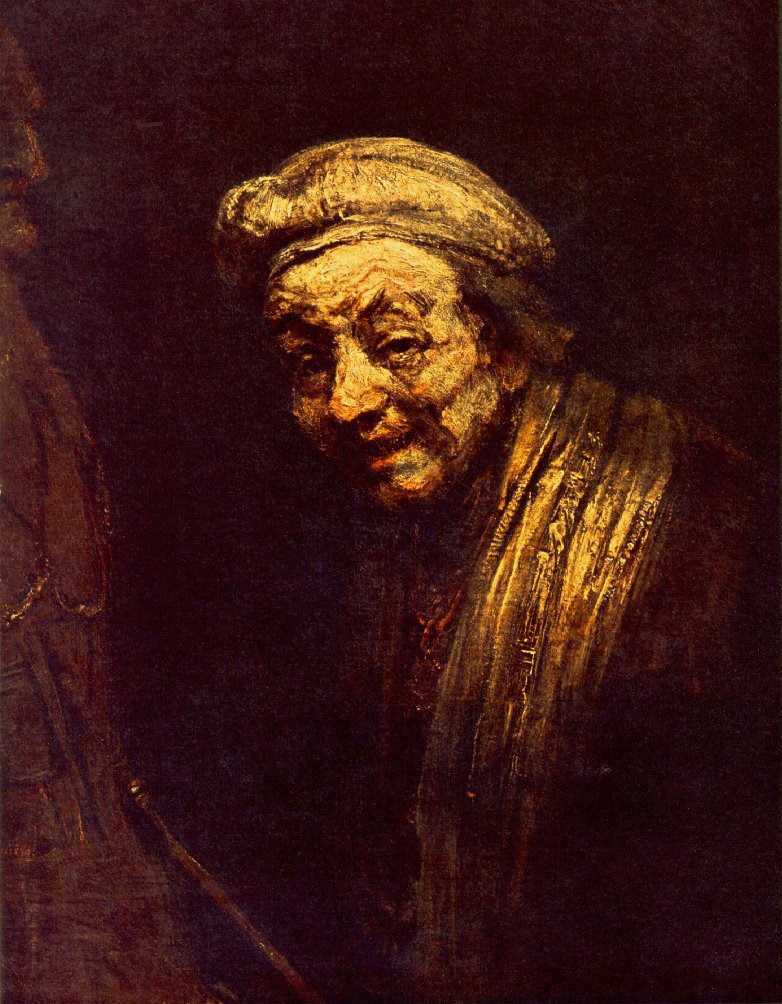
Rembrandt’s “Self-portrait” of 1665 is a compact burst of late style: a head glimmering out of darkness, a quicksilver expression suspended between amusement and fatigue, a few slashing strokes of paint that read as a scarf or mantle, and an atmosphere so thick that the figure seems to step forward from the void. This is not the ceremonious Rembrandt with palette and brushes or the stately master in black. Here the artist appears closer, looser, caught in a moment of alert curiosity, his features modeled by concentrated light while the rest dissolves into shadow. The picture feels improvised and inevitable at once—an image of an aging painter who has nothing left to prove except the truth of seeing.
Date, Circumstances, and Late Career Confidence
The mid-1660s found Rembrandt personally battered yet creatively fearless. Bankruptcy and bereavement had narrowed his worldly prospects, but his painting became more independent, material, and psychologically acute. By 1665 he had spent four decades interrogating his face on panel and canvas. The late self-portraits no longer court patrons or theatrical roles; they present a working artist reflecting on the condition of being alive. In this version, the head turns toward us from a pool of dusk, a white cap catching the light like a crescent moon. Even the hint of a smile reads as the afterimage of thought rather than social performance. The painting compresses a lifetime’s experiment into a single encounter—direct, unguarded, and humane.
Composition and the Architecture of Focus
The composition is radical in its economy. A dark field occupies nearly the entire surface. Within it, the head, turban-like cap, and a vertical ribbon of garment establish a triangular scaffold that stabilizes the image. The face sits slightly off center, pushing toward the right, while a vague, shadowed presence on the left edge hints at studio clutter or a figure barely suggested. This asymmetry is purposeful: the emptiness magnifies the intensity of the head, and the diagonal fall of the garment pulls the body into the depth of shadow. There is no elaborate interior, no narrative prop; all architecture is made from light and paint. The result is a portrait that feels at once spontaneous and carefully staged, like a thought suddenly struck by illumination.
Light as Drama and Diagnosis
Rembrandt’s light in this canvas behaves like a probing hand. It touches the brow, cheekbones, nose, and upper lip, glances along the cap’s fold, and then dives into darkness where the eye completes what the brush merely suggests. The beam is narrower than in many of his earlier self-portraits, producing a theatrical chiaroscuro that is nevertheless tender rather than sensational. Crucially, the light is diagnostic: it maps the terrain of age—the soft pouch beneath the eye, the crease beside the nose, the network of fine lines around the mouth—without cruelty. Because the background refuses to offer spatial clues, light alone must carry depth, and it does so by stacking values in delicate increments from blazing impasto to translucent half-tones.
Palette and Temperature
The color world is Rembrandt’s late earth symphony: umbers and bitumens that warm toward deep mahogany, resinous blacks that contain smoky reds, and a limited range of ochers and lead whites that flare into brilliance on the cap and forehead. The scarf or mantle is not so much colored as sculpted from light—golden strokes that surge and subside across darker layers. Small temperature shifts do crucial work. A slightly cooler gray sinks the shadowed eye socket; a warmer orange note rides the cheek; a reddish ember at the earlobe or lip edge brings blood back into the flesh. The palette’s restraint concentrates feeling; within these compressed means every variation matters.
Brushwork and the Material Intelligence of Paint
Up close, the surface looks almost reckless: ridges of thick paint dragged by a loaded brush across resistant underlayers; quick, calligraphic slashes that crystallize into the pleats of fabric; crumbly, dry sweeps that catch on the weave of the canvas like scuffed velvet. The cap’s highlights are laid on with buttery impasto that physically catches light, so the painting itself participates in illumination. Around the eyes and mouth, the touch tightens, but Rembrandt never polishes away the hand’s presence. He allows the strokes to stand, letting matter speak. Step back and the marks fuse into likeness; step forward and they become a record of decisions—where to insist, where to suggest, where to leave the void to do the work.
Expression, Gaze, and Psychological Ambiguity
The expression is one of the most arresting in the entire self-portrait series. The eyes narrow, glinting with amused concentration; the mouth bends toward a half-smile that could be wry humor, weary patience, or the lingering echo of conversation. Nothing is fixed. The face changes as you look: friendly from one angle, guarded from another, suddenly old when the light shifts, suddenly young when the glint in the eye catches you. This calculated ambiguity is Rembrandt’s psychological genius. He avoids caricature, refuses flattery, and presents a self in motion—thought coursing through muscle and skin.
Costume, Headgear, and the Inward Studio
The white cap functions as a beacon and a frame. Unlike the grand berets and fur collars of earlier years, this headgear speaks of work, not ceremony. The garment below—perhaps a robe or mantle—falls in long, bright passages that function as a vertical chord against the darkness. There is no palette, no brushes, no easel to perform “the painter”; and yet everything here declares the studio. The black surrounding space is a working darkness, the environment of making where the artist studies faces and objects waiting at the edge of visibility. By stripping down to cap and cloth, Rembrandt makes the visu al act itself the subject.
Space, Depth, and the Poetics of the Void
The painting’s void is not emptiness but active silence. It swallows contour lines, erases distractions, and delivers the head toward us as if from backstage. The left edge whispers of another presence—perhaps the torso turned away, perhaps a reflection—but the suggestion remains ghostlike. This vagueness amplifies the sense of immediacy: we feel as though we have surprised the painter mid-turn. The picture plays a subtle game with depth, hollowing the space just behind the head while flattening the rest so the face floats forward like a buoy on dark water. That spatial ambiguity keeps perception alert and the portrait’s drama alive.
Technique, Layers, and the Time in the Surface
The surface reads as layered over time. A warm mid-tone likely blocks in the field; the head is modeled with semi-opaque flesh pigments, then enlivened by small, high impastos on brow and nose; the garment receives broader sweeps; finally, transparent glazes deepen the surrounding dark and unify the image. In places, Rembrandt seems to have scored into wet paint with the back of the brush or a dull tool to articulate folds. This accumulation of maneuvers creates a sense that the picture is not a single instant but a sediment of instants—the memory of making preserved in ridges and veils.
Relationship to Other Late Self-Portraits
Compared with the stately “Self-Portrait with Two Circles,” this 1665 canvas is smaller in ambition but not in intensity. Where the former declares a theory of mastery, the present picture offers a quick, intimate presence: a head caught under a studio lamp, a flicker of humor, a scarf rushing toward abstraction. Compared with the somber, frontal self-portraits of the early 1660s, it feels more improvisatory—less monument, more encounter. Across the group runs a common thread: candor without cruelty, paint that remains gloriously paint, and a steady refusal to make age decorous. This version adds a rare playfulness, reminding us that gravitas and wit are not opposites.
The Ethics of Looking and the Refusal of Flattery
A late Rembrandt self-portrait always poses an ethical question: how to look at oneself truthfully. The answer here is not to flatten flaws or to dramatize them, but to accept the face’s history as material for art. The crow’s feet and creases are neither hidden nor emphasized; they are simply seen. The small smile is not a saleable charm but a human flicker. This refusal of flattery becomes a gift to the viewer. We are invited to look at an aging face not as a problem to be solved but as a field of meaning—evidence of time, work, and attention.
Viewing Notes for Encountering the Painting
The best way to meet this picture is to let your eyes acclimate to its depth of dark. Start with the cap, where the thickest whites shine; follow the light down the forehead to the bridge of the nose; pause at the bright, wet edge of the lower eyelid; then slip into shadow and feel how your mind completes the jawline the brush refuses to draw. Track the bright strokes that tumble down the garment—each a single, confident motion—and feel how they tether the head to the body. Step back until the smirk softens into calm; step forward again to rediscover the lively grain of the paint. The portrait is a dance between matter and apparition, asking you to move with it.
Legacy and Modern Resonance
This small, fearless painting continues to shape modern ideas about artistic self-representation. It gives later painters permission to let facture carry meaning, to trust ambiguity, and to place character over costume. It anticipates modern portraiture’s interest in the fleeting, the candid, the half-glimpsed. For viewers, it offers a model of aging that is neither sentimental nor despairing: a face brightened by curiosity, sustained by craft, and anchored by the knowledge of work well done. The pleasure of the picture lies in its combination of discipline and play—the practiced hand letting itself improvise, the serious mind allowing a smile.
Conclusion
Rembrandt’s 1665 “Self-portrait” is a concentrated testament to what painting can do with very little: a head, a scarf, a hat, and a darkness alive with air. The light studies the face without cruelty, the color stays within a narrow register yet blooms with warmth, and the brushwork alternates between minute tenderness and audacious speed. What emerges is not a public persona but a private encounter—an artist acknowledging the viewer with a glinting eye and a half-smile from within the studio dusk. The picture’s greatness rests in its ability to hold contraries: immediacy and reflection, austerity and richness, aging and vitality. It is a small canvas with the weight of a life.