Image source: wikiart.org
Introduction
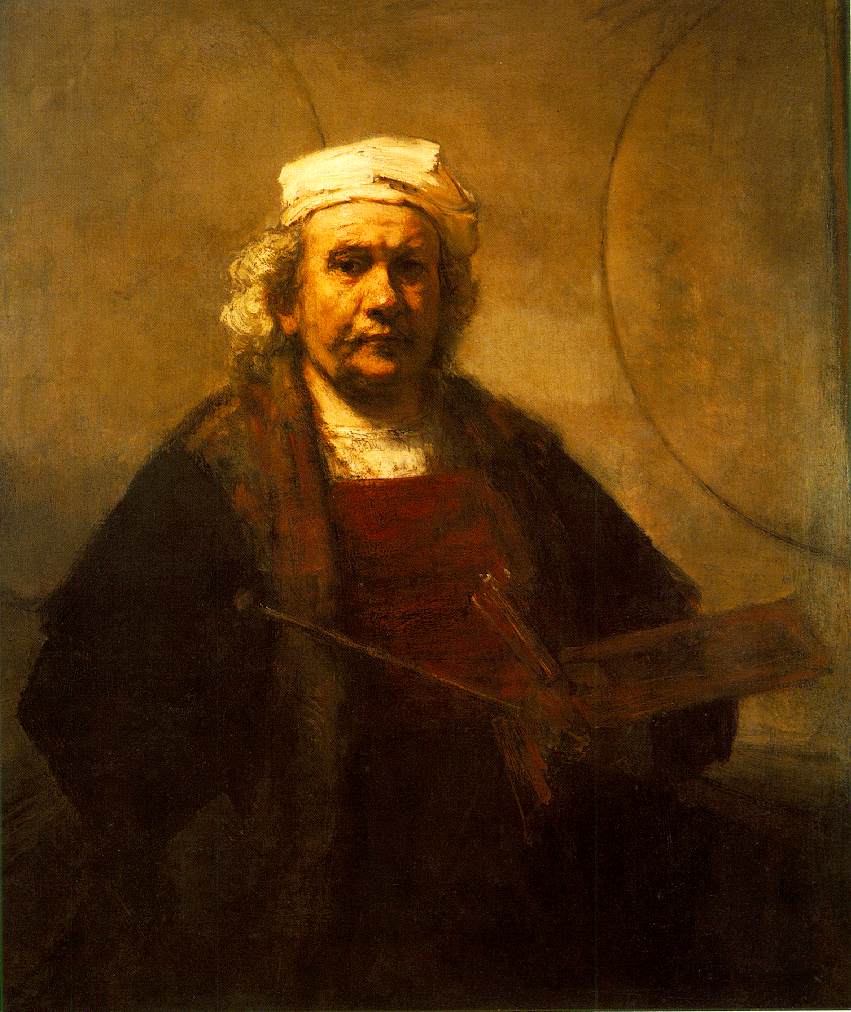
Rembrandt’s “Self-Portrait” of 1665 belongs to the astonishing group of late images in which the artist turns his scrutiny on himself and, at the same time, speaks about the nature of painting. The figure stands before a pale wall inscribed with two faint circles. Dressed in a dark studio mantle with a white painter’s cap, he faces us directly, a palette and bunch of brushes crossing his chest like a carpenter’s tools. The surface is earthy and tactile; the light is concentrated and humane. Here is not a youthful virtuoso but a master who allows the weight of years, losses, and experience to settle on the canvas as knowingly as the pigments themselves. This self-portrait is not only a likeness; it is a statement about craft, authorship, and the hard-earned authority of an artist at the end of his career.
Subject, Date, and Circumstances
The 1660s were the final decade of Rembrandt’s life, a period marked by personal hardship and creative fearlessness. He had suffered bankruptcy, the death of those closest to him, and a decline in fashionable patronage. Yet his painting grew ever more independent, deeper in psychology and looser in facture. The 1665 self-portrait condenses that late manner. The face is modeled with restrained clarity, the garments dissolve into shadow, and the studio emblems—palette, brushes, white cap—appear with matter-of-fact simplicity. The picture’s authority arises not from luxury or theatrical setting but from the honest, frontal encounter between artist and viewer. The canvas becomes a mirror that reflects both a single person and a lifetime of looking.
The Two Circles and the Question of Meaning
Behind the figure, two ghostly circles occupy the wall. Their meaning has been debated for centuries. Some see an allusion to a Renaissance challenge of drawing a perfect circle freehand, a legendary test of mastery associated with Giotto and Apelles. Others understand them as compositional scaffolds or as traces of a studio exercise in proportion. Whatever their origin, the circles function symbolically in the painting. They assert abstraction within a portrait, geometry within flesh, order behind the unruly facts of age. Their incomplete arcs also echo the untidiness of life: perfect in idea, imperfect in the visible world. Rembrandt does not point to them explicitly; he lets them hover like a quiet thesis—painting as the meeting of embodied presence and pure form.
Composition and the Architecture of Authority
The figure is arranged in a commanding triangle: head at the apex, shoulders forming the base, the palette and brushes cutting a dynamic diagonal that stabilizes the whole. The left shoulder, turned toward us, anchors the body in the foreground, while the right side recedes into warmth and shadow. The wall’s circles curve behind the head like an understated halo, conferring dignity without sanctimony. The painter’s cap creates a bright crown that catches and reflects light, making the head the inevitable focal point. Even the rectangular palette, clutched at an angle, acts as a counterweight to the roundness of the background forms. The design reads as the visual grammar of self-possession.
Light, Tone, and the Staging of Presence
Light arrives from the left and rests absolutely on the face and cap, sliding across the chest to strike the ocher-red tunic. The rest of the garment melts into a near-black that retains warmth, suggesting fur and felt without tedious description. The wall behind is neither blank nor detailed; it is an atmosphere of warm gray suffused with the memory of brushwork. Rembrandt’s tonal hierarchy is deliberate: the face is the brightest center; the red bib of the garment provides the middle register; the lower half withdraws into shadow that protects the image from overstatement. This distribution of light is not only optical but ethical—it asks the eye to attend where character, not costume, resides.
Palette and the Poetics of Restraint
Late Rembrandt works within a limited palette, yet the range feels expansive. Earth pigments—umbers, siennas, and ochers—interact with blacks and lead white to create a world of glowing half-tones. In this self-portrait, the white cap and neckband, the small flashes of lead-tin yellow in the flesh, and the brick-red frontispiece of the garment punctuate a field of browns that shimmer from cool gray-brown to hot russet. The effect is orchestral. The restrained color compels attention to value and temperature; a faint bluish note in a shadow and a warmer flicker across the cheek carry profound expressive weight. The palette’s modesty mirrors the artist’s stance—nothing showy, everything necessary.
Brushwork and the Material Intelligence of Paint
The surface records a choreography of touches. The face is built from supple, semi-opaque strokes that leave the skin luminous and mobile. Around the eyes and mouth, tiny dabs thicken into impasto that catches actual light and makes the gaze sparkle. Hair and beard are evoked with dragged, wiry passages that alternate with soft scumbles. The garment is a field of broader, loaded sweeps that foreground the physicality of pigment. The wall, with its faint circles, is brushed thinly, as if to reject theatrical depth and keep the figure in the viewer’s space. Everywhere, the paint seems to know what it is doing—declaring itself as substance while partnering with illusion. The picture breathes because the brushwork refuses the mechanical; it allows the human hand to remain legible.
Expression, Gaze, and Psychological Depth
The face is not masklike but changeable. The eyes meet us directly, placed with minute asymmetry that animates the gaze. The brows knit lightly, not in theatrical frown but in concentration. The mouth settles into a line that reads as resolve more than resignation. This is an artist who has weathered fortune’s changes and set his attention on the present act of painting. Rembrandt’s psychological truth emerges from small departures from symmetry and from the way light grazes the topography of brow and cheek. He neither flatters nor dramatizes. Instead, he presents a living face that adjusts as we look, its intelligence felt rather than announced.
Costume, Tools, and the Identity of the Painter
The white cap, the dark studio mantle, and the red frontispiece create a uniform that is both practical and emblematic. The cap’s brightness isolates the head as a site of thought; the mantle’s darkness grants the painter’s body gravity; the red chest asserts life and warmth. The angled palette and bundle of brushes cross the torso like the arms of a heraldic device. They are not mere props. They affirm that the subject and his vocation are identical. The painting thus refuses the glamour of societal titles and replaces it with the dignity of craft.
Space, Scale, and the Viewer’s Distance
The shallow room, pared to wall and implied stool, keeps the encounter intimate. There is no elaborate studio vista to mediate the meeting. We are placed within conversational distance, close enough to read the texture of the paint and, by extension, the texture of the life it records. The circles on the wall assert the plane of the surface, drawing attention to the painting’s flatness even as the figure projects forward. This push-pull between surface and depth keeps the eye alert, preventing passive consumption and encouraging a slow, searching kind of looking.
Technique, Layers, and the Time in the Surface
The painting likely developed in stages: an underlayer laid in broadly, middle tones worked wet-in-wet to block the masses, glazes to deepen shadow, and impastos to ignite highlights. Evidence of revisions—adjusted contours at the shoulder, altered edges along the palette—testifies to Rembrandt’s habit of thinking in paint. The circles themselves may have been inscribed early, a promise to keep the background structurally alive, and then allowed to fade under scrims of tone. The surface therefore contains the duration of its making, a sedimented record of decisions and corrections that contributes to the sense of lived experience.
Comparisons Within the Self-Portrait Series
Across four decades Rembrandt painted himself repeatedly. In youth he explored role-playing and exotic costume; in middle age he projected professional stature; in late years he cultivated an almost confessional frankness. The 1665 canvas is emblematic of this last phase. Compared with the darker, inward self-portraits of the early 1660s, it opens the space with a pale wall and introduces the circles—one of the few explicit tokens of theory in his oeuvre. Compared with the heroic 1640s images, it refuses rhetorical costume and settles on the plain uniform of work. The continuity is the unwavering commitment to presence; the change is the move from public persona to studio truth.
Allegory of Mastery and the Artist’s Creed
Read allegorically, the painting states a creed. The two circles propose measure and ideal. The tools propose labor. The face proposes accountability. Together they say that art is not trickery or courtly display but a long practice of craft, judgment, and self-knowledge. The near-monochrome palette suggests austerity; the living touch of the brush suggests freedom. The self-portrait thus collapses the distance between the painter as person and the painter as principle. It is as if Rembrandt were placing himself on the wall of tradition—between geometry and flesh—saying simply: here I stand, and this is what painting is.
Viewing Notes for Encountering the Painting
When standing before the canvas, allow your eyes to adjust to the subdued lower half before fixing on the face. Trace the diagonal of the palette and brushes to feel how the composition braces the figure. Move closer and watch how the cap’s thick white ridges catch gallery light, how the tiny impastos along the eyelids glimmer like moisture, how the red over the chest is built from layered earths that bloom into warmth without turning garish. Step back until the circles behind the head, almost invisible up close, assert themselves as gentle geometry. The picture rewards this dance of distance, moving from matter to likeness and back again.
Influence and Continuing Relevance
The late self-portraits profoundly shaped later notions of the artist. Goya, Courbet, Van Gogh, and Lucian Freud found in Rembrandt permission to combine material candor with psychological depth. The 1665 painting in particular models an identity grounded in craft rather than celebrity. In an era saturated with self-images, it remains disarmingly plain: an older man in work clothes, paint on his instruments, light on his face, thought in his eyes. Its message is timeless. Mastery does not glitter; it endures.
Conclusion
Rembrandt’s 1665 “Self-Portrait” is a quiet manifesto. With a narrow palette, a pared-down studio, and a handful of resonant forms—the two circles, the white cap, the palette and brushes—it declares the essence of painting: disciplined seeing, embodied making, truthful presence. The face does not plead or boast; it simply meets the viewer with gravity and clarity. The wall behind, scored with geometry, hints that art aspires to order even as life remains imperfect. In the thick and thin of the brushwork, in the warmth of the earth colors, and in the unwavering gaze, the painting gathers a lifetime into a single, steady moment. Few self-portraits look less theatrical and feel more monumental.