Image source: wikiart.org
Introduction: Late Style Candor In A Warm, Earthy Key
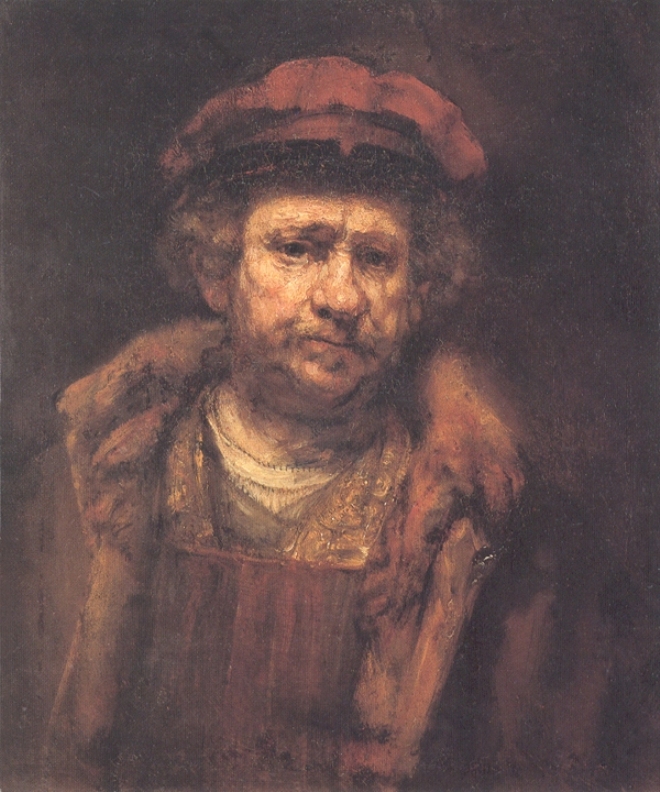
Rembrandt’s “Self-portrait” of 1660 presents the artist at conversational distance—frontally lit, shoulders turned slightly, gaze steady but unperformed. A low beret caps his graying hair; a fur-trimmed mantle spreads across the shoulders; under it, layered fabrics and a squared apron-like panel create a vertical anchor at the chest. He stands in brown air rather than in a mapped studio, his face modeled by a soft, embered light that turns skin into topography. The effect is immediate intimacy without flattery. The portrait reads like a pause between brushstrokes, a check-in with the person who has done the work and intends to keep doing it.
Historical Moment: Bankruptcy Survived, Vision Clarified
The year 1660 falls in Rembrandt’s uncompromising late period. He had endured bankruptcy, lost fashionable clientele to smoother rivals, and settled into an independent practice with a pared-down household run by his partner Hendrickje Stoffels and his son Titus. Freed from the need to flatter patrons, he honed an ethic of attention that valued presence over polish and mercy over show. This self-portrait belongs to the cluster of late images—1658 to 1664—in which he reconsiders his own likeness as a site to test paint’s ability to carry truth. Instead of regalia, we get tools of warmth and work: fur for insulation, layered clothes for the studio, a beret that keeps chalk and oil from hair and eye. The drama is not costume but character.
Composition: A Pyramid of Shoulders and a Square of Resolve
The composition rests on a simple, robust geometry. The fur mantle builds a broad pyramid whose apex is the head, reinforcing stability and calm. Nested within that triangle, the rectangular bib or apron provides a vertical mass that pulls the eye back from the shoulders to the chest, then up to the face. This square-within-triangle structure makes the image feel grounded. The head is slightly off center—enough asymmetry to keep the picture alive—while the shoulders angle so that the right side recedes gently into shadow. Cropping is close, eliminating anecdote; the painting becomes a conversation between a face and the medium that builds it.
Light and Chiaroscuro: Illumination as Human Temperature
Light falls from upper left, opening the forehead and cheek, slipping across the philtrum and lower lip, and losing itself along the jaw into a dusk that protects the neck and shoulder. Nothing is theatrical. The illumination behaves like the kind you get from a high studio window late in the day: soft, directional, acknowledging texture without interrogating it. Rembrandt’s chiaroscuro is ethical more than spectacular. Darkness grants privacy; light grants presence. The half-tones around the eyes—warm grays veiling brown—carry the portrait’s psychology. They let the gaze remain steady without hardening into a stare.
Color and Tonal Harmony: Embered Golds, Browns, and Quiet Reds
The palette is a late-Rembrandt orchestra of earth. Umber and raw sienna shape the air; honeyed golds and ochres warm the skin; a deep brick red animates the beret and the chest panel; the fur glows with foxlike russets sinking into brown. Because chroma is restrained, value and temperature do the expressive work. Warm highlights cluster on the forehead, nose, and lower lip; cooler browns quiet the periphery. Small accents—a pale glint along the eyelid, a warmer lick on the cheekbone, a thin strike at the collar—keep the eye moving without noise. The result is a climate rather than a color show: the room feels lived-in, the person at home in it.
Surface and Brushwork: Paint That Remembers Touch
Late Rembrandt turns paint into biography. Across the fur mantle, strokes are laid thick and dragged, catching real light and reading as rough pile. The beret is handled more broadly, almost patch-like, so that its red-brown breathes through thin veils. The apron panel is built with longer vertical pulls that suggest worn fabric without counting threads. In the face, handling tightens into elastic marks and layered glazes, the painter knitting earlier strokes into living skin. Small, assertive touches—a ridge at the nose’s crest, a bristle mark along the mustache, a scumble that softens a crease—let the face breathe. Nothing is overly smoothed. The surface keeps the record of revision, allowing viewers to watch seeing become likeness.
The Face: Plain Truth, No Performance
What makes the portrait moving is the refusal of performance. The mouth sits in a relaxed, slightly downward turn, neither frown nor smile; the cheeks carry the weight of age without complaint; the eyes meet ours with attention but without challenge. The brow is open, the look alert. This is the gaze of a working person deciding what to do next. Because edges soften and tighten in calibrated measure, the features cohere from a few steps back and dissolve into strokes up close, teaching the viewer the rhythm by which the painter himself saw the image arrive.
Costume and Meaning: Warmth Over Splendor
The fur-trimmed mantle has less to do with pomp than with comfort. It muffles the shoulders, adds breadth to the pyramid, and picks up the warm light that climbs from the chest to the face. The beret’s red-brown crown acts like a quiet halo of work, echoing earlier self-portraits while toning down the theatrical plume and brocade of youth. The layered collars and decorated undergarment admit a memory of earlier finery but keep it subdued beneath the square of practical cloth. Material here serves mood: solidity, warmth, and a kind of earned ease.
Background and Space: A Room of Brown Air
There is almost no architecture, only a modulated dusk that breathes. Scumbles and translucent passes keep the background from flattening into mere black; the eye senses depth without seeing walls. This brown air is Rembrandt’s late chapel: a space made of tone in which a sitter’s presence can gather. Against that hush, the head and shoulders come forward not as a cutout but as a person sharing the room.
Psychology: Stamina Without Drama
The portrait’s emotional temperature is steady. It owes its force to stamina rather than spectacle. The set of the mouth suggests fortitude; the eyes carry curiosity without defensiveness; the head’s forward tilt implies attention more than defiance. Having endured reversals, the painter declines bitterness. He answers time’s roughness with a way of seeing that turns wear into depth. The picture is not an apology nor a complaint. It is simply company—good, exact company.
Kinships and Contrasts Within the Self-Portrait Series
Compared with the monumental 1658 self-portrait, where Rembrandt appears enthroned with scepter-like staff, this 1660 canvas is humbler and more domestic. Compared with the raw, almost sculptural head of 1660 where features are carved from heavy impasto in the dark, this work offers fuller context and warmer light. It shares with the 1659 pair the beret and the frontal candor, but replaces their intense scrutiny with a calmer, more companionable look. Across the series, one sees an artist experimenting with how little he can do to say the most—reducing ornament, concentrating light, trusting texture.
Technique and Revisions: Edges That Think
Pentimenti remain legible in places that matter. Along the mantle’s outer contour, softened restatements allow air to slip between figure and background. The beret’s rim carries an underpainted cooler red beneath the warmer final pass, a late decision to pull the crown forward. Around the mouth and nasolabial fold, thin gray glazes temper an earlier, sharper modeling, gentling the expression without erasing age. These choices are audible in the surface like afterthoughts that become the thought. The portrait’s authority grows from this visible process of correction.
The Viewer’s Place: Conversational Distance, Mutual Respect
We stand at a human distance, as if the painter had just glanced from canvas to mirror to us. Because the gaze is level and the mouth unposed, our position feels neither subordinate nor challenged. It feels invited. The painting provides a model for looking at people: steady, merciful, without decoration, without fear. The space asks for patience; in return it offers the calm of being with someone who has stopped pretending.
Material Symbolism: Flesh, Fur, and Red Cloth
Materials carry meaning by behaving truthfully. Flesh, built from earths and honeyed whites, invites closeness while admitting time’s work. Fur, drafted with dragged bristles, confers warmth rather than status—an emblem of the practical shelter an artist builds around the self. The red cloth at the chest is the composition’s heart: a square of labor and resilience, recalling a work apron more than a court tabard. Color becomes biography: reds for stamina, browns for humility, light for grace.
Modern Resonance: Authenticity Over Image
In a culture of curated personas, this late self-portrait feels startlingly contemporary. Its power lies in the refusal of polish as a substitute for presence. Photographers study the way one soft source sculpts form; painters emulate the economy of marks that yield breathing flesh; designers learn from the orchestration of near-monochrome into richness. Ordinary viewers keep returning because the picture keeps them company without demanding any posture in return. It is an image that trusts us to meet it honestly.
Lessons For Painters and Viewers
The canvas offers a syllabus of late-style craft. It demonstrates how a limited palette can sing when values and temperatures are tuned; how a single, decisive highlight can anchor a plane; how transitions rather than outlines build volume; how texture can carry meaning without showiness; how revision, left visible, becomes part of truth. For viewers, it models a way of seeing others that is precise but gentle, aware of flaw without cruelty, alive to small glories.
Conclusion: A Covenant Between Light and Character
“Self-portrait” (1660) gathers Rembrandt’s hard-won wisdom into a modest scale: a head under a red beret, a mantle to keep the chill away, a square of cloth at the chest, brown air for a room, and a light that behaves like understanding. He stands before us not as a monument but as a person who kept faith with work. The painting leaves no manifesto—only the durable warmth of presence and a method for looking that remains among the most humane bequests in European art.