Image source: wikiart.org
Introduction
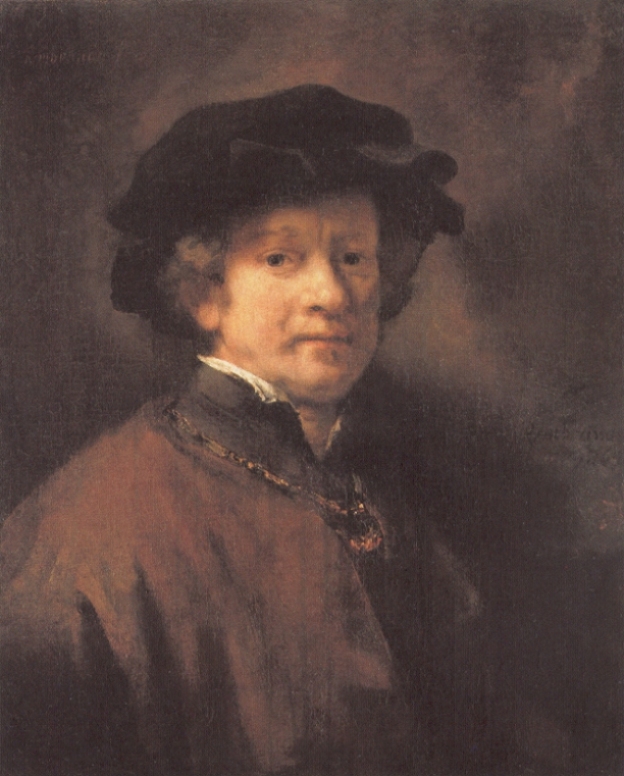
Rembrandt’s 1654 “Self-portrait” is a compact summation of the artist’s late manner: painterly yet precise, modest in staging yet immense in presence. He appears three-quarter length against a warm, breathing ground, wearing a soft black cap and a reddish brown mantle whose folds dissolve into the surrounding dusk. No prop advertises his trade; there is no easel, palette, or brush. What remains is the essential exchange the painter prized most—a face meeting a viewer’s gaze in honest light. In this picture Rembrandt studies himself not as celebrity or allegory but as a working mind and body moving through time. The surface bears traces of swiftness and revision; the expression records courtesy, fatigue, and steadiness. It is an image made not to impress but to persuade, and it persuades by truth.
The Year 1654 and the Turn to Essentials
By 1654 Rembrandt had passed through triumphs and reversals. The exuberant theatricality of the 1630s and the civic ambition of the early 1640s had yielded to financial and personal strain, yet his art felt newly free. In place of crowded compositions and jewelled finish he now cultivated an intimate chamber of tone, a sober palette, and a touch that trusted the viewer to complete forms. The self-portraits from this middle-late decade mark an inward turn: the artist as his own most available and exacting model. This canvas participates in that turn. It does not rehearse the bravura of youth; it concentrates on presence and on the ability of a small number of decisions—about light, edge, and color—to carry an entire life.
Composition and the Architecture of Calm
The composition is triangular. A broad cap supplies the top line; sloping shoulders form the base; the head occupies the apex slightly left of center. The body turns away even as the face pivots toward us, establishing a gentle counter-movement that energizes the stillness. A chain or collar glints at the sternum like a subdued pendant, a minor accent that anchors the torso. The background is Rembrandt’s familiar warm dusk, neither wall nor void but an acoustic space in which features sound clearly. The off-center placement gives the portrait conversational poise: he is with us in the room, not pinned to a central axis like a heraldic emblem.
Light as Moral Weather
Rembrandt’s light is a form of character. It enters from the left, rides across the brow and cheek, and gathers at the nose and lip before slipping into the shadow under the cap. There is no hard spotlight; edges soften and reappear in a rhythm that feels like breath. Highlights are small and deliberate—at the inner corners of the eyes, along the nostril, at the damp seam of the lower lip. This illumination does not flatter. It reveals the skin’s roughness, the slight puffiness beneath the eyes, and the lived matte of the cheeks. Yet the overall effect is merciful. Light attends the face the way a friend’s attention does, with candor and care.
The Face as a Record of Time
The head is modeled with economy and precision. One eye sits fractionally higher than the other; one corner of the mouth rides lower, hinting at habitual reserve; the nose flares asymmetrically. Such irregularities are neither caricature nor accident; they are the means by which the painting refuses type. The gaze is direct but not confrontational. It recognizes the viewer rather than interrogating them. There is a faint contraction between the brows, the remnant of concentration rather than worry. The portrait communicates a temperament: patient, observant, unwilling to waste emphasis. If earlier self-portraits performed role—prince, soldier, gentleman—this one performs attention.
Color, Temperature, and the Atmosphere of Work
The palette is restrained—umber and warm brown in the ground, reddish notes in the garment, black in the cap, and a set of quiet flesh tones that shuttle between warm peach and cool gray. Rembrandt leverages temperature contrasts rather than chromatic fireworks. A cool half-tone folds under the cheekbone; a warmer note rises at the temple; a faint greenish cast at the jaw sets off the flare of the nose. The garment’s color is less a hue than a climate: it envelops the figure in a workshop warmth, the heat of oil and turpentine and the softened light that leaks through north windows. Within this atmosphere the face reads not as a mask but as a working surface.
Brushwork and the Evidence of Making
Look closely and the painting reveals its construction. The mantle is laid in with broad, dragging strokes that leave ridges like woven ribs, a painterly shorthand for cloth. The cap is handled more dryly so that it absorbs light rather than flinging it back. In the face Rembrandt alternates soft, fused passages with crisp accents. The transitions at the eyes and mouth are blended just enough to feel alive, while small, loaded touches mark the glint on the pupil and the wetness of the lip. Edges are “lost and found”: the far shoulder dissolves into the ground; the near cheek and jaw sharpen just enough to carry focus. The surface is not uniform; it is a record of looking, a series of revisions that admit the viewer to the process.
The Hat, Chain, and the Poetics of Minimal Costume
Rembrandt equips himself with minimal costume. The soft cap broadens the head and creates a dark halo that quiets the top of the canvas. The robe or mantle supplies bulk without specificity, allowing the face to float from a field of red-brown. A modest chain or clasp registers social aspiration without grandiloquence. These pieces do not announce identity; they frame it. They hint at the roles the painter has played in the previous decades—burgher, gentleman, artist of ambition—while refusing to let role eclipse person.
The Gaze and the Social Contract with the Viewer
The most modern element of the portrait is the gaze. It is level, collaborative, and intimate. Rembrandt does not command or plead; he shares the room. The expression holds the viewer in a social contract based on attention: I will look at you if you will look at me, and we will each agree to be present without masks. That pact is reinforced by the scale—neither miniature nor monumental—and by the closeness of the cropping. We stand at a distance a conversation would require. The painting’s ethical claim is that such nearness is the condition of understanding.
Comparison with Earlier and Later Self-portraits
Set against the earlier “Self-portrait in Oriental Costume” or the youthful canvases that mimic Titianesque splendor, the 1654 picture is stripped of pageantry. It anticipates the late self-portraits from the 1660s where Rembrandt appears with palette and brush, a sovereign of his craft and a witness to his own aging. Yet this intermediate canvas is distinctive. It keeps tools out of sight and lets the viewer consider a face at mid-course: a man who knows what he can do and what the world has done to him, who sits neither triumphant nor abashed. If the 1660s images are summations, this one is a chapter—quiet, steady, provisional in the best sense.
Space, Silence, and the Intimacy of the Background
The background is a resonant silence—warm umber modulated by soft scumbling, little eddies of tone that keep the field from feeling dead. That silence is strategic. It redirects the viewer from spectacle to presence and makes small accents potent: the chain’s glimmer, the collar’s tiny triangle of white, the faint lift where the mantle’s seam catches light. Rembrandt turns the absence of narrative into a moral choice. Nothing competes with the person.
The Psychology of Midlife
The face bears neither the smooth confidence of youth nor the stoic gravity of old age. It registers a midlife equilibrium. The brows are less furrowed than in the later self-portraits; the mouth is firmer than in youthful displays. The expression suggests a man who has learned what deserves energy and what can be set aside. You sense the workshop just beyond the frame and the give-and-take of daily life—students, patrons, debts, friends, a child’s voice—and yet the head floats free of noise. The painting becomes an instrument for composure.
Material Presence and the Sense of Touch
Rembrandt’s late manner is tactile. You can feel the nap of the mantle, the suede of the cap, the cool slickness of the chain, the soft resistance of skin. These sensations arise not from cataloguing detail but from the calibration of pressure and load in the brush. Thick paint catches on the weave and flashes at the right angle; thin scumbles haze the ground; semi-opaque flesh allows undercolor to breathe through. The image persuades because it corresponds to bodily memory—how things actually look and feel in lamplight at arm’s length.
A Studio Without Tools
By withholding the props of labor, Rembrandt implies rather than shows his profession. The decision keeps the portrait from becoming a studio still life and pushes interpretation toward character. The painter trusts that the intelligence of the gaze and the honesty of the surface will announce authorship more convincingly than brushes or palettes could. The result is a likeness that cares less about what he does and more about how he is.
The Ethics of Self-Representation
Rembrandt’s self-portraits are often praised for honesty. In 1654 honesty takes the form of moderation: the artist avoids both performative humility and self-congratulation. He neither exaggerates defects nor sands them away. He accepts his face as a field where light happens and where time writes in small strokes. This ethic is as technical as it is moral. It dictates the scale of highlights, the refusal of theatrical edges, and the discipline of leaving passages rough where smoothness would lie.
Time Held in Suspension
Though a single instant is pictured, duration inhabits the canvas. You sense that Rembrandt has paused after working, stepped back, looked into a mirror, and then painted the act of looking. The softened edges and layered paint imply minutes rather than seconds, a slow accumulation rather than an arrest. That temporality separates the portrait from later photographic conventions and aligns it with conversation. The viewer is invited to stay, not just glance.
Influence and Afterlives
This self-portrait has served as a touchstone for artists seeking an alternative to grand manner portraiture. Its intimacy influenced late Goya, certain heads by Courbet, and the modern insistence that painterly facture can be a subject of its own. For viewers it offers a standard of presence: that a single head, simply lit, can fill a room with human temperature. The painting’s afterlife proves that restraint is not the enemy of eloquence; it is its condition.
Conclusion
Rembrandt’s 1654 “Self-portrait” is a lesson in how little a great portrait needs. A warm ground, a soft cap, a red-brown garment, and a face rendered with living transitions—these components compose an image that feels truer than likeness. The gaze acknowledges, the light forgives, the surface breathes. In refusing theatrics and trusting essentials, Rembrandt achieves a kind of authority that survives fashion. We come away with the sensation of having met him in his room, not as legend or victim of biography but as a neighborly intelligence who knows the worth of a steady look.