Image source: wikiart.org
Introduction to Rembrandt’s 1645 “Self-Portrait”
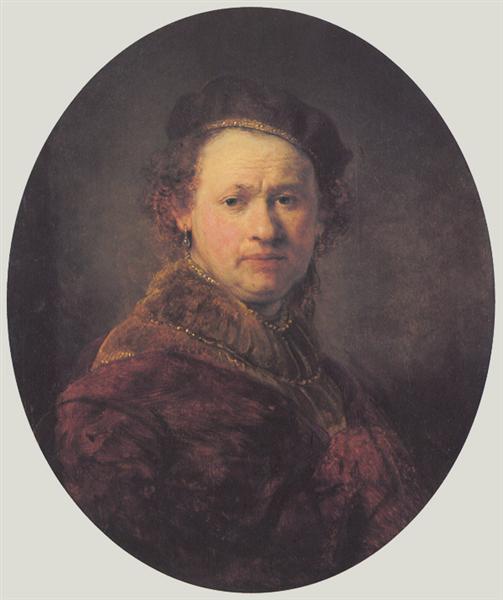
Rembrandt’s 1645 “Self-Portrait” belongs to the most revealing sequence in European art: a decades-long dialogue in which the artist turns to the mirror not to advertise status but to interrogate selfhood. Painted in an oval format, the work sets the head and bust close to the surface, wrapped in warm, dusk-colored clothing, the face illuminated by a tempered light that clarifies form without flattening character. The expression is steady rather than dramatic—a searching gaze that seems to meet the viewer with equal parts scrutiny and candor. This is the Rembrandt of the mid-1640s, after the triumphs of his early Amsterdam years and in the midst of personal upheavals, testing paint’s capacity to register a life in progress.
The Oval as Stage for Intimacy
The oval frame is more than a decorative choice; it is a compositional engine. Its gentle curvature echoes the roundness of the beret, the looping contour of the shoulders, and the fleshy oval of the face. By trimming the corners of the rectangle, the format removes peripheral distraction and pushes the figure forward like a cameo cut from shadow. Rembrandt exploits this enclosure to heighten intimacy: the viewer’s attention enters a closed room where only light, flesh, and fabric converse. The oval’s continuous edge also encourages a slow, clockwise reading of the figure, moving from the left shoulder’s dark mass up along the hat, down the bright plane of forehead and cheek, and back across the cloak’s heavy folds. The geometry welds the painting into a single, breathing unit.
Light as Character Rather Than Spotlight
The light in this portrait is not a theatrical beam but a living climate. It approaches from the upper left, glancing off the forehead, thinning across the bridge of the nose, warming the cheeks, and sinking softly into the creases around the mouth. There is no hard contour where light ends and shadow begins; Rembrandt lets tone grade with the subtlety of weather. The result is psychology rendered through illumination. The eyes emerge from half-shadow with quiet alertness, and the slight sheen on the nose and lower lip reads as human temperature rather than cosmetic highlight. Light here is the means by which a mind becomes legible.
Palette and the Temperature of Flesh
The color range is restrained—terra-rosas, umbers, deep claret, muted golds, and the creamy notes of skin. These hues intertwine to create a warmly nocturnal atmosphere. The cloak’s reds are not loud; they are wine-dark, almost brown where they recede, glowing like embers where light touches broken impasto. Threads of gold—chains, trimming, and a glint at the collar—introduce points of brightness that punctuate the field without tipping into ostentation. The skin tones mix warm pinks with cooler grey-greens and faint blues at the temples and under the eyes, mimicking the variegation of actual flesh. Rembrandt’s chromatic restraint makes the face feel vascular and alive.
Brushwork and the Tactile Illusion
The painting’s wizardry lies in Rembrandt’s orchestration of surface. Close up, the cloak is a pelt of thick, dragged strokes; the collar bristles with darted touches; the hair dissolves into wiry skeins laid wet-in-wet; and the gold chain is little more than dabs of thick paint catching the light. Against this material bravura, the face tightens into small, patient strokes that melt at a normal viewing distance into pliant skin. The contrast is intentional: the world around the face vibrates with painterly assertion, while the face itself—source of identity—settles into focused clarity. Paint does not hide; it declares itself as the means of presence.
The Gaze and the Ethics of Looking
Rembrandt’s gaze in 1645 is neither confrontational nor diffident. The eyes steady the viewer as if measuring their attention. Slight asymmetry—one eyelid marginally heavier, one brow more arched—keeps the look alive, resisting the deadness of posed symmetry. This frankness shapes the viewer’s own stance. We do not consume the image at a glance; we negotiate with it, meeting another intelligence across a modest distance. The portrait becomes a compact about looking: candor offered, patience requested.
Costume as Studio Theater
Rembrandt dresses himself not in fashionable Amsterdam black but in studio wardrobe—beret, furred collar, layered fabrics, a modest chain—garments that announce the role of artist while nodding to historical or “antique” dress. Such costumes are not deception; they are tools that let him study form, texture, and the play of light on varied materials. The fur collar’s soft density absorbs illumination; the chain bounces it; the broad hat shields the upper forehead, complicating the modeling of the brow. Through costume he builds a laboratory of optical problems whose solution becomes style.
Mid-Career Self-Scrutiny
By 1645, Rembrandt had seen meteoric success and piercing loss. The exuberant self-portraits of the 1630s—with jewel-bright fabrics and swaggering poses—give way here to a quieter voice. The face holds adult weight; the mouth is set with purposeful neutrality; the overall tonality is low, as if the day has cooled. Yet there is no bitterness. The expression suggests a craftsman committed to the work of seeing accurately, beginning with himself. The mid-career self-portrait settles into an ethic: to paint truth without self-pity or flattery.
The Architecture of the Head
Rembrandt builds the head as a structure rather than a mask. Planes interlock: rounded temples, the shelf of the brow, the cubic nose, the subtle depressions at the corners of the mouth, the thrust of the chin. The forms are not diagrammatic; they breathe. Halftones taper so delicately along the jawline that flesh seems to turn in air. This insistence on the head’s architecture has an ethical dimension. A face is not a surface for effect; it is a site of thought housed in bone and muscle. The painter’s respect for that fact grants the image its moral weight.
The Role of Shadow and the Hospitality of Darkness
Shadow in this portrait is hospitable. It gathers behind the hat, under the chin, and along the left cheek in soft, granular pools that cradle light without swallowing it. Darkness is not threat but depth, suggesting a reserve of unspoken feeling. Rembrandt’s darkness is never empty; it is a repository for what words (and paint) cannot fully articulate. The portrait’s mood depends on this generosity—the sense that the person before us is more than the sum of visible facts.
The Oval Edge as Silent Frame
The painted oval cuts through background space like a window, yet Rembrandt softens its edge, allowing the figure to graze the boundary in places and retreat from it in others. This subtle breathing between figure and frame prevents the cameo effect from feeling rigid. Where the hat nearly touches the oval and where the shoulder slips back, we sense motion—a tiny tide of approach and recession that animates the composition. The oval thus acts not as a hard container but as a harmonic curve echoing the body’s rhythms.
Surface History and the Trace of Time
Rembrandt’s mid-period technique often leaves palimpsests: pentimenti where a contour was revised, layers where thin underpaint shows through thicker touches, granular passages where the brush stuttered. These textures do more than delight connoisseurs; they register time in the painting’s skin. The picture looks made, not manufactured—an object with a history of decisions. In a self-portrait, this material candor mirrors the psychological candor of the face. Neither surface pretends to perfection; both bear the record of having been worked.
Dialogues with Earlier and Later Self-Portraits
Seen against the sparkling bravura of the 1630s self-images and the monumental meditations of the 1660s, the 1645 canvas stands as a hinge. The youthful actor has matured into a steady observer; the late philosopher is prefigured in the careful modeling and the gravity of light. It is the moment when role-playing (berets, chains, fur) still serves as studio theater, but the real subject—character under judgment of experience—dominates. By revisiting himself across decades, Rembrandt demonstrates that identity is not a fixed essence but an unfolding conversation.
The Neck Chain and Questions of Status
The chain, modest but deliberate, has provoked much commentary. It can be read as a mark of professional dignity, echoing the gold chains worn by earlier court artists, or as a piece of studio costume adopted for its optical value. Rembrandt refuses to let it function as ostentation. The links disappear into shadow, reemerge in glints, and subordinate themselves to the shimmer of skin. If the chain claims status, it is the status of the craft itself: a sign that art earns adornment because it makes meaning.
Hair, Hat, and the Theatre of Edges
Edges tell the truth of the medium. Along the outline where hair meets background, Rembrandt sets down a ragged halo—coppery curls caught in half-light—softened and then reasserted in flicks of the smallest brush. The beret’s soft brim, darker than the hair, compresses the upper head, creating a nest for the brain and a shadow that enriches the eyes. These micro-theatricals of edge—hard against the chain, soft at the cheek, broken around the curls—give the image its pulse. They ensure that the head is not pasted onto background but grows out of the surrounding air.
The Mouth and the Discipline of Neutrality
Rembrandt avoids the temptations of smile or scowl. The mouth rests in a controlled neutral, corners neither lifted nor sagging, lips gently closed. This disciplined middle—so easy to overlook—shapes the portrait’s entire temperature. It prevents sentimentality and warns off bravado, creating a platform where the eyes can do their more nuanced work. Neutrality is not blankness; it is an active decision to hold expression in reserve, and in that reserve the viewer senses adult judgment.
The Psychology of Proximity
The cropping of the shoulders and the closeness of the head create a sensation of standing within arm’s length of the painter. Yet the slightly turned torso and the face keyed toward three-quarter view preserve a necessary distance. We are close enough to read pores but far enough to respect boundaries. This negotiated proximity may be the portrait’s most modern feature: it simulates the etiquette of an honest conversation between strangers—direct, warm, but not invasive.
Technique as Philosophy
Rembrandt’s technique embodies a philosophy of truthfulness. He declines smooth idealization; instead, he composes a mosaic of thick and thin marks calibrated to the eye’s own habits, which dart to detail and relax into field. The face, the privileged site of recognition, receives the highest resolution; fabric and background slip toward painterly shorthand. This priority ladder enacts the belief that painting’s moral task is to render the human person convincingly before all else. Genre details, props, and architecture must serve that end or fall away.
The Self as Model and Mystery
No artist has interrogated his own face as relentlessly as Rembrandt, and yet the result is not narcissism but anthropology. In this 1645 picture, the self is both model—available, practical, eternally present—and mystery, a subject whose interior cannot be exhausted. By painting himself, he indexes the universal: the fatigue and resilience of middle age, the negotiation between public role and private weather, the acceptance that a life must be carried in skin that records time. The painting speaks not only about Rembrandt but also about what it is to look honestly at oneself.
Legacy and the Contemporary Eye
For contemporary viewers accustomed to the camera’s documentary claim, Rembrandt’s portrait offers a different truth. It does not freeze a moment; it distills a temperament. The visible brushwork reminds us that seeing is an act, not a capture, and that the most faithful likeness may be the one that acknowledges its own making. In museum light, the picture glows like a banked fire, and the face—calm, self-respecting, alert—meets our era with undiminished authority. It has survived shifting fashions because it refuses flattery and insists on sympathy.
Conclusion: A Compact of Honesty and Craft
The 1645 “Self-Portrait” is a pact between painter and viewer: I will show you how I am made—in bone, in light, in history—if you will look with patience suited to the subject. Everything in the picture honors that compact: the oval’s embrace, the climate of light, the ethical neutrality of expression, the textures that admit labor. Standing before it, we encounter not an advertisement for genius but a human presence built from paint, quietly persuasive and inexhaustibly alive.