Image source: wikiart.org
Introduction
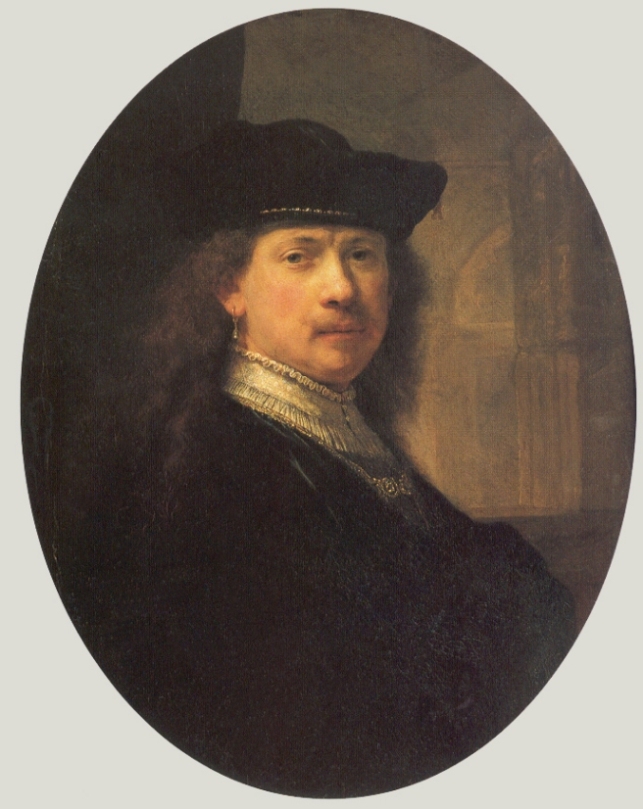
Rembrandt’s “Self-portrait” of 1639 is a concentrated demonstration of how the painter fused likeness, performance, and light into an image that feels startlingly alive. Set within an oval, the artist turns slightly toward us, the left shoulder receding into darkness, the right side of the face receiving a steady, northern glow. A soft-brimmed hat throws a measured shadow over the brow; a lace-edged collar and chain glimmer just enough to announce refinement without stealing attention from the gaze. Nothing in the picture shouts, yet everything asserts presence. This is not a self-advertisement so much as a self-accounting—Rembrandt looking, measuring, and accepting what the light reveals.
The Oval as Psychological Stage
The oval format is more than an elegant frame; it acts like a viewing aperture, a window that disciplines our attention. Rembrandt exploits the curve to cradle the head and shoulders, pushing them forward while keeping the surrounding space hushed. Unlike a rectangular canvas that may tempt the eye sideways, the oval promotes concentration and proximity. The head sits slightly off-center, a fraction to the left, where the curvature amplifies the turn of the body. The composition reads as a quiet pivot into our space, a mid-moment between reserve and address, whose poise is key to the portrait’s enduring magnetism.
A Persona Forged from Dress
Rembrandt’s clothing is carefully chosen to communicate position and sensibility without theatrical excess. The dark velvet of the doublet absorbs light with a soft, matt dignity; the lace-trimmed collar provides a cool chord of pale tones against the warm face; a slender chain or clasp at the chest hints at status. The hat—a broad, dark, pliant cap—serves as both stylistic signature and optical tool, throwing a gentle shadow that deepens the eye sockets and focuses illumination on the cheek and mouth. Costume here is not masquerade but architecture for the face, a controlled setting that allows the physiognomy to carry meaning.
Light That Judges and Consoles
Rembrandt’s light enters from the upper left and behaves with exquisite tact. It does not flatten; it models. A soft highlight maps the curve of the forehead, descends the bridge of the nose, grazes the upper lip, and rests on the rounded plane of the cheek. The far side of the face slips into a warm penumbra, never black, allowing features to remain legible while acknowledging the turn away from the source. This chiaroscuro is not Caravaggesque spectacle; it is ethical illumination. It exposes what is there with neither flattery nor cruelty, making the portrait feel truthful and humane. In Rembrandt’s hands, light becomes a way of thinking.
The Eyes and the Work of Looking
The portrait pivots on the gaze. The eyes do not glitter; they attend. They meet the viewer from a slight reserve, as if Rembrandt has spent hours with the mirror and now, finally, considers what we might make of the result. The lower lids carry a tiny, moist glint, a painterly punctuation that turns anatomy into presence. The angle of the head—neither frontal nor a dramatic profile—lets the gaze travel diagonally across the pictorial space, creating a line of conversation rather than confrontation. Many self-portraits drag the beholder into an artist’s self-assertion; this one invites us into the discipline of seeing.
Texture, Paint, and the Intelligence of Surface
Up close, the portrait is a concert of surfaces. The face is built with layered, semi-translucent tones that allow warmth to glow up through the skin, while minute firmer strokes articulate nostril, eyelid, and lip. The hat is handled more broadly, its softness registered by long, dark strokes that drink light. The lace collar combines cool, opaque touches and delicate scumbles so that it neither dazzles nor deadens. Hair along the cheek spreads into the surrounding air with feathery transitions, one of Rembrandt’s favorite devices for dissolving edges and preventing any hard contour from imprisoning a living head. Everywhere the paint behaves like the thing it represents—flesh breathing, velvet absorbing, lace catching.
The Architecture in the Shadows
Behind the sitter a faint architecture emerges: an arch or niche that keeps the background from becoming an undifferentiated void. These ghosted forms matter. They provide a tonal middle ground that the head can push against, and they suggest an environment without tying the portrait to a specific room. The dignified hint of masonry places the artist in a world of durable structures, echoing the oval’s classical grace and reinforcing the sense that this is not the fleeting likeness of a dandy but a considered image of a professional within a tradition.
Dialogue with Renaissance Models
Rembrandt’s 1639 self-portrait converses with Italian precedents he knew from prints and paintings seen in Amsterdam collections—Raphael’s refined profiles, Titian’s patrician half-lengths. He borrows their calm address, elevated costume, and architectural sobriety, but he replaces courtly smoothness with felt texture and moral candor. The chain across the chest, the controlled pose, and the soft cap recast the Renaissance ideal in Dutch terms. The painting says, in effect, that a modern artist from the Republic can stand with the ancients—not through borrowed rhetoric but through mastery of light and a fearless eye.
Identity as Craft
From the late 1630s onward, Rembrandt produced numerous self-portraits in paint and print, assuming different roles—courtier, soldier, biblical actor, gentleman, artisan. In this image the role is subtler: the artist as responsible observer. There is no palette, no brush, no studio accessories. Identity is argued not through props but through workmanship. The calm rigor of the drawing, the persuasive skin tones, and the orchestration of values function as a signature more legible than monogram or inscription. He demonstrates what an artist is by the way he paints himself.
The Ethics of Restraint
The portrait’s power lies partly in what it refuses. There is no startling gesture, no bravura flourish to claim attention. The lace does not flare into virtuoso display; the chain does not sparkle with showy impasto; the hair is not exaggerated into a theatrical mane. Instead, each element contributes to a whole that feels effortless because it is so deeply considered. Restraint reads here as confidence. By refusing to decorate himself, Rembrandt declares faith in painting’s essential language—light, form, and human regard.
The Mouth and the Untold Thought
Rembrandt’s mouth is one of the portrait’s most eloquent features. It is closed but not tight, curved slightly downward at the corners, as if mid-thought rather than mid-speech. That reticence aligns with the gaze to create a mood of inwardness. Viewers sense a mind that has been working invisibly—a painter’s planning, a human’s weighing of experience—and is now content to let the face carry its residue. Portraitists often struggle to avoid caricature in the area around the mouth; Rembrandt solves the problem by letting tiny shifts of value suggest softness and breath, creating expression without theatrical line.
The Chain and the Collar as Emblems
The chain or jeweled clasp and the refined collar do more than mark rank; they articulate a philosophy of the studio. The chain can be read as an analogue to guild insignia, a symbol of membership in a lineage of masters. The collar, with its crisp edge, accents the threshold between public presentation and private self—the seam where the costume stops and the vulnerable skin begins. Their subdued gleam clarifies the message: honor the craft, present yourself decently, but let the face remain the true declaration.
A Color World of Warmth and Air
The palette is restrained: warm ochres and umbers in the flesh; cool, gray-greens whispering in the background stone; blacks and near-blacks in the hat and garment; small milky notes in lace and highlights. This limited range produces a calm climate around the head, where transitions are so carefully managed that the air seems to circulate. The flesh feels neither lacquered nor waxen; it breathes. Rembrandt’s chromatic restraint underscores the portrait’s honesty; he is not dazzled by color into decoration, but uses it as atmosphere for a personality.
The Turn of the Body
Though the head provides the portrait’s focus, the body’s turn and the recession of the shoulder into shadow are essential to its poise. The triangle formed by head, collar, and shoulder creates a stable structure that supports the delicacy of facial expression. The slight twist introduces the hint of motion, reminding us that a person is never a diagram. It also opens a penumbra along the right edge where the garment dissolves into darkness, permitting the oval to function as a kind of proscenium arch. The body’s geometry and the frame’s curve collaborate to create a living platform for the face.
Comparison with the Etched Self-portrait of the Same Year
In 1639 Rembrandt also created the famous etched “Self-portrait Leaning on a Stone Sill.” There, arms folded on a parapet, he projects a more public persona, drawing on Renaissance models and highlighting the virtuosity of etched fabric and hair. The painted self-portrait is more hushed and interior. Where the print negotiates space with a trompe-l’oeil ledge and sparkling line, the painting negotiates it with breath, tone, and the quiet of oil. Seen together, the two works show the artist’s range: the public conversation on paper and the private accounting in paint.
The Mirror and the Habit of Self-Scrutiny
Every self-portrait is also a confession of studio practice: it tells us the painter keeps a mirror nearby and returns to it. In the 1639 image, years of looking are visible not as vanity but as discipline. The flesh around the eye has learned how paint sits; the soft shadow on the far cheek has been studied and earned. This habit of scrutiny feeds Rembrandt’s empathy for other faces—sitters of every class, biblical actors, beggars, and scholars. By holding himself to the same standard of attention he brings to them, he makes the self-portrait a moral exercise as well as a technical one.
The Viewer’s Role in Completing the Presence
Rembrandt always builds a role for the viewer. Here, our eyes must bridge the small distance between the bright cheek and the shadowed temple, translating the soft shift in values into a turn of the head. We supply the sense of breath in the nostril highlight and the humidity in the eye. The portrait thus becomes a collaboration: the painter provides the cues; the viewer’s perception completes the person. This shared work is one reason the image remains alive across centuries; it never collapses into mere depiction because it requires our ongoing participation.
Time in the Image
The painting captures multiple temporalities at once. There is the instantaneous present of the gaze; the longer clock of a sitting session; and the deep time of tradition invoked by costume and pose. The face bears no explicit narrative of hardship or triumph, yet time’s texture is evident in the calm of the expression and the seasoned patience with which the painter attends to it. The portrait is not dramatic because it does not need to be. It trusts the dignity of duration—the slow accumulation of craft and personhood.
Influence and Afterlife
Rembrandt’s self-portraits shaped the Western imagination of what an artist’s image could be. Later painters—from Goya and Courbet to Van Gogh and Freud—have learned from this equilibrium of candor and artistry. The 1639 work in particular offered a model for how to command a viewer without theatricality: meet the eye, trust the light, and let the paint carry character. Its oval restraint and measured glow recur in countless portraits that aspire to moral weight rather than mere likeness.
Why the Portrait Still Feels Present
What keeps this painting perpetually fresh is its perfect pitch between intimacy and formality, simplicity and richness. We meet a person without being forced into biography. We admire technique without being asked to admire tricks. The picture’s voice is steady, like someone speaking quietly in a crowded room and winning attention through sense rather than volume. In an age saturated with images of self, Rembrandt’s 1639 self-portrait continues to teach by example: the self is not a spectacle but a presence, achieved by attention and offered with restraint.
Conclusion
Rembrandt’s “Self-portrait” of 1639 is an art of measure. Within the elegant oval he calibrates costume to face, light to shadow, and self-presentation to self-scrutiny. The gaze is firm but not aggressive; the paint is sumptuous but never showy; the background suggests a world without overwhelming the person. Everything serves the act of seeing—his seeing of himself, and our seeing of him. In that disciplined exchange lies the portrait’s durable power. It is as if the painter has stepped from his work for a moment, looked up, and allowed us to witness the calm center from which his art proceeds.