Image source: wikiart.org
Introduction
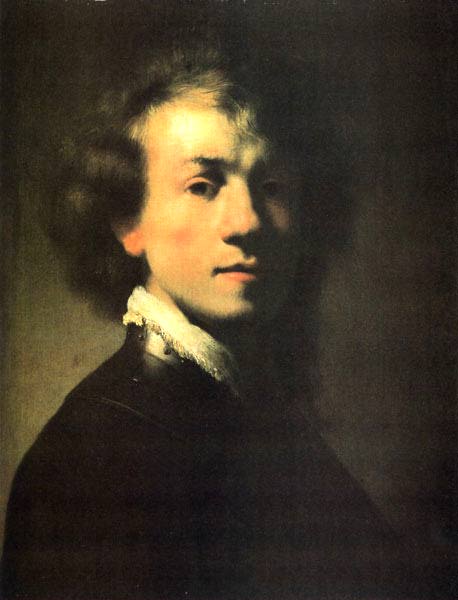
Rembrandt’s “Self-portrait” from 1629 is a youthful declaration of identity and intention. Painted when he was about twenty-three in Leiden, it compresses ambition, craft, and psychological curiosity into a small, radiant field of light. The composition is stripped to essentials: a dark ground, a half-lit face turned slightly toward the viewer, a soft ruff, and a silhouette that dissolves into shadow. Yet the simplicity is deceptive. Every adjustment of light, every soft edge and sudden highlight, articulates a young artist thinking aloud with paint—testing how far chiaroscuro can carry meaning and how much of a person can be revealed by what remains concealed. This picture stands at the front of a lifelong conversation Rembrandt would conduct with himself about time, work, and the human face as a vessel of truth.
The Leiden Context And A Young Painter’s Agenda
The year 1629 belongs to Rembrandt’s Leiden period, a time of concentrated experiment before he moved to Amsterdam. In Leiden he made compact narrative scenes, tronies, and a cluster of self-portraits that probe states of mind as much as likeness. The choice to paint himself so early is not narcissism but a practical and philosophical decision. The most available sitter is always the artist, and the face one knows most intimately is one’s own. More importantly, painting oneself frees the artist from social obligation: no patron dictates costume or flattery. The picture becomes a laboratory where technique and identity can evolve together. In this work, Rembrandt calibrates his voice: he prefers warm earths and a glowing carnal light; he is drawn to surfaces that catch and release illumination; and he treats the face not as a polished mask but as a living terrain.
Composition That Builds A Theater Of Light
The composition is a near-profile turned toward three-quarters, a classic device that allows the far cheek to sink into shadow while the near cheek presents itself to the light. The head floats against a field of darkness that reads less like emptiness and more like air steeped in dusk. The body turns away, the collar flares softly, and the shoulder line slides out of sight. This recession leaves the face as the primary event. The small triangle of lit flesh—forehead, cheek, and the tip of the nose—functions as a stage upon which light performs.
The asymmetry is deliberate. Most of the mass occupies the lower right, while the main illumination arrives from the upper left, moving diagonally across the head. This setup causes the eye to enter at the brightest plane of the forehead, travel along the ridge of the nose, settle on the mouth—cooler and quieter—and then drift back into shadow at the jaw. The route mimics an encounter with a person: first impression, close scrutiny, and finally a retreat into privacy. Composition thus becomes a choreography of attention.
Chiaroscuro As A Language Of Character
The picture’s lighting scheme reveals Rembrandt’s early mastery of chiaroscuro. The darks are not flat; they breathe. Glazed browns and blacks absorb light unevenly so that the silhouette never hardens. Within the illuminated zone he modulates value with notable restraint. The forehead is a soft plane; the cheek is slightly rosier; a pale glint touches the lower eyelid; the nostril is shadowed, giving depth to breath. Nothing is over-described. The result is not photographic realism but the sensation that light is discovering a person in real time. The face emerges the way a thought emerges—from obscurity into clarity—then partially withdraws.
Chiaroscuro here also suggests temperament. The half-shadowed eye does not leer or conceal; it simply affirms that a self cannot be totally presented. The darkness stands for interiority, for the reserve of someone aware of being looked at and curious about what looking can accomplish. Light tells us what he offers; shadow reminds us of what he keeps.
The Palette And The Feel Of Paint
The color world is restrained to earth pigments warmed by a gentle golden light. Flesh notes are built from ochres and lead white with a whisper of vermilion, while the surrounding ground sinks into umbers and blacks. Against this low-key harmony the small note of the lace collar—the single cool accent—freshens the entire chord. Rembrandt handles paint as if sculpting air. The ground appears thin and absorbent; over it he lays flesh with slightly thicker strokes that hold micro-highlights. On the collar he flicks bright, dry touches that catch like dew. The hair is a marvel of suggestion: not drawn hair by hair, but a halo of soft strokes and enlivened edges that tell how light disperses in curls. The tactile variety is central to the picture’s allure; you feel skin, cloth, and air as distinct substances without being distracted by bravura.
Pose, Gaze, And The Psychology Of Self-Presentation
The sitter’s head tilts subtly upward, an angle that avoids both deference and swagger. The mouth is closed, the lips relaxed; the gaze is direct but quiet, a young man testing the authority of his own presence. There is curiosity in the eyes and a guardedness too—the alert look of someone measuring how he appears under scrutiny. Because the body turns away and the face turns toward us, the portrait carries a faint resistance that reads as dignity. It is not a confession and not a performance; it is a poised arrival, the consciousness of being seen.
This air of poise distinguishes the work from purely technical self-studies. Many artists’ early self-portraits show tightness in the features, a will to accuracy that can stiffen the expression. Here the features relax under the light. Rembrandt allows small asymmetries—the fall of the upper lip, the irregular rhythm of the eyelids—to register as human truth. He has learned early that likeness is a function of living irregularity.
The Interface Between Tronie And Portrait
In the late 1620s Rembrandt made numerous tronies—studies of heads with varied expressions, costumes, and lighting. This canvas sits near that genre but crosses decisively into autobiography. Costume is minimal; no exotic turban or armor intervenes. The image pursues character rather than role. Yet the tronie heritage contributes to its freshness. The artist retains the experimental freedom of the studio sketch, then folds it into a resolved likeness. We sense the swift decisions of a student of faces and the deliberation of a self-aware portraitist. That fusion—freedom plus responsibility—becomes a signature of his mature work.
The Role Of Edges And The Subtle Invention Of Space
Edges drive the painting’s spatial credibility. Where the lit cheek meets the background, the contour sharpens, while at the jaw and hairline the boundary blurs into atmosphere. Rembrandt alternates these kinds of edges to imply breath between figure and ground. The head is not a cutout; it inhabits space. This is particularly evident at the nose and cheek, where a narrow, illuminated rim turns into darkness with a softness that feels like air touching skin. The illusion is delicate but persuasive. Without inserting a single explicit cast shadow on the wall, the painter convinces us of depth, temperature, and air movement.
What The Painting Reveals About Ambition
A self-portrait at twenty-three announces ambitions beyond the craft of representation. The choice to occupy only a small pool of light in a large dark field makes a claim: the artist is willing to be measured against nothingness, against the profound silence that surrounds every face. It also implies a program for the future. The rest of Rembrandt’s career will amplify this principle—figures cupped by warm darkness, light as a moral actor, paint handling that maps flesh and feeling together. In this early work the themes appear like prototypes: the sympathetic gaze, the warm tonal world, the elastic boundary between self-study and drama.
Relation To Later Self-Portraits
Comparing this canvas with later self-portraits reveals a biography in technique. In his forties and fifties Rembrandt will thicken paint into sculptural brio, sometimes carving highlights with the brush handle itself; he will widen the palette, stage himself in elaborate costumes, and record age’s taxation on flesh without vanity. The 1629 image is quieter and smoother, its surface more decorous. Yet the essential commitment—to respect the face as a site of truth—remains constant. The youthful glow here is a seed that will bloom into the grave warmth of later years. You can already glimpse the older man in the steady gaze, the refusal to idealize, the tenderness toward his own imperfection.
Light As Self-Knowledge
The direction and quality of light matter because they dramatize a philosophy of self-knowledge. Illumination falls from beyond the picture, not from a depicted lamp, implying that the act of seeing oneself requires an external measure. At the same time, the light is gentle. It does not interrogate the face like a court, but visits it like morning. This gentleness suggests a way of looking at the self that is neither punitive nor flattering. The painter allows himself to be observed by his own art and accepts the partiality of what can be seen. That humility, paradoxically, is a source of authority.
The Collar And The Ethics Of Detail
The small lace collar is a strategic flourish. It locates the portrait socially—neither grand nor poor—and acts as a hinge between face and garment. Its brightness clarifies the chin’s contour and prevents the head from sinking entirely into darkness. But its role is more than functional. Lace in Dutch painting often served as a demonstration of skill; here the restraint itself is the demonstration. Instead of meticulously diagramming every loop, Rembrandt offers a handful of quick, high notes that persuade the eye of intricacy without pedantry. The ethics of detail are clear: show enough to honor reality, stop before the showmanship smothers the life of the image.
Hair, Skin, And The Poetics Of Texture
The hair’s soft aura is a triumph of implication. Slightly lifted, feathery strokes suggest how curls catch and scatter light. This halo frames the head with a delicate vibrato, a visual music that softens the rigorous geometry of skull and jaw. In contrast, the skin is rendered with smoother, weightier mixtures that transmit warmth. The cheeks hold a faint blush, not theatrical but physiological. Such contrasts give the portrait rhythm and tactile credibility. Texture becomes poetry—an argument that painting is not only about shapes in space but also about the felt nature of things.
Silence, Breath, And The Implied Soundscape
Although the picture is quiet, it is not mute. The half-open nostril and the gentle recess of the mouth make the presence of breath almost palpable. One senses the barely audible sounds of a studio: the faint rasp of bristles on panel, the hush of a body holding still. This auditory imagination heightens the intimacy. The sitter and the painter are the same person, and yet the painting creates a third presence—the viewer—who shares the room. The self-portrait is therefore an invitation to a triangular conversation: self, maker, witness.
Intimacy Without Confession
What the image gives is closeness without disclosure. Rembrandt does not stage an anecdote or costume himself as a character from history. He also refrains from narrative clues about profession—no palette, no brushes in hand. Instead, the identity asserted is simply a face thinking in light. This restraint is courageous because it risks seeming bare. But it is precisely in this bareness that the painting acquires dignity. The claim it makes is that a person, before any role, merits attention; a young man can be significant because he is human and because he looks and lets himself be looked at truly.
The Viewer’s Role And The Ethics Of Looking
The portrait positions the viewer close enough to feel seen in return. The gaze meets ours at a slight angle, avoiding confrontation while refusing evasiveness. In this exchange Rembrandt models an ethic of looking: we are to attend carefully, to accept partial knowledge, and to resist the urge to dominate with interpretation. The viewer does not possess the sitter; the sitter does not court the viewer. Instead, a fragile reciprocity holds. That reciprocity—crucial to portraiture—becomes one of Rembrandt’s lasting gifts to the genre.
A Small Scale With Monumental Resonance
Although modest in size, the work carries a surprising monumentality. Large paintings often derive authority from architectural settings or elaborate narratives. Here grandeur arises from concentration. The emptiness surrounding the head reads as silence and depth; the face’s small continent of light becomes a world. If monumentality means the capacity to bear repeated, sustained attention, this little canvas qualifies. Its wealth lies not in the number of details but in the intensity of relations among a few elements—light, flesh, cloth, and air.
Echoes Of Tradition And A Personal Rewrite
Rembrandt knew precedents: chiaroscuro from Caravaggio’s followers, sober portrait conventions from Dutch and Flemish models, and the practice of self-portraiture from earlier northern masters. Yet in 1629 he is already rewriting that inheritance. Instead of theatrical shadow, he offers living darkness. Instead of polished finish, he favors a supple surface that lets the act of painting remain visible. Instead of emblematic props, he chooses the unadorned face. Tradition becomes a language he speaks with an accent distinctly his own.
Conclusion
The 1629 “Self-portrait” distills a young artist’s audacity and sensitivity into a luminous half-face emerging from night. Composition, palette, edge, and texture work in concert to propose a way of seeing the self that is rigorous, tender, and deeply human. The painting does not proclaim achievement with costume or pose; it achieves by the quality of attention it embodies. Four centuries later, the skin still glows as if newly discovered, the darkness still hums with air, and a young man still meets our gaze with a look that is at once curious and composed. This small image inaugurates one of art history’s most profound autobiographical cycles and remains a touchstone for how painting can transform light into self-knowledge.