Image source: wikiart.org
Introduction to Peter Paul Rubens’s “Self-Portrait”
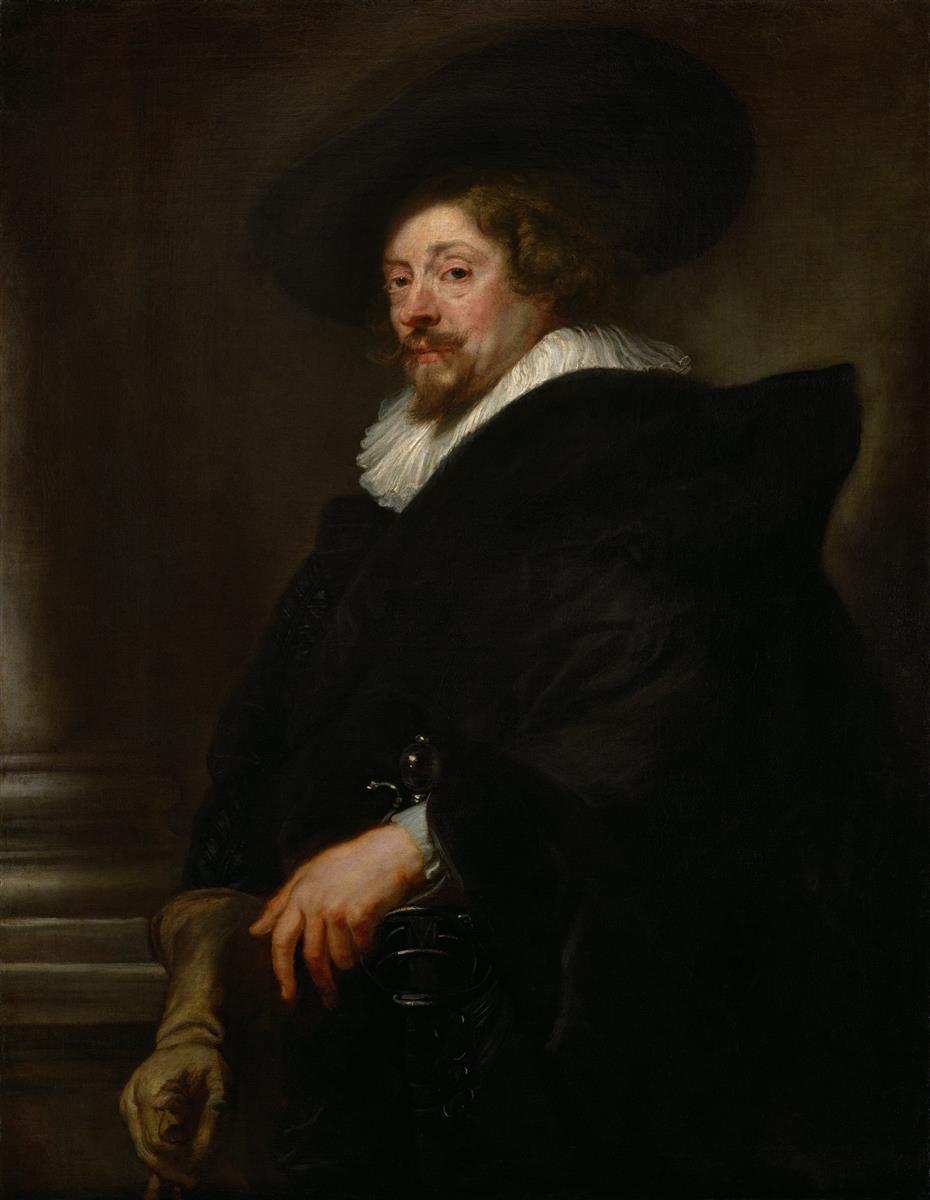
Peter Paul Rubens’s “Self-Portrait,” painted around 1639, stands as one of the most revealing images of the artist at the end of his life. Unlike earlier, more informal likenesses, this portrait presents Rubens as a dignified gentleman and statesman, not merely as a painter in his studio. Dressed in black with a broad-brimmed hat, a white ruff, and a heavy cloak, he turns slightly toward the viewer, his right hand resting on the hilt of a sword and his gloved left hand holding a walking stick.
The subdued setting, restrained color palette, and controlled lighting create a mood of quiet authority. Yet the face, softly illuminated and carefully modeled, conveys alert intelligence and a hint of weariness. Rubens looks directly at us with a calm, appraising gaze, as if aware of his achievements and responsibilities, and also of the passage of time. This “Self-Portrait” is not a display of bravura brushwork or flamboyant costume alone; it is a considered statement about identity, social status, and the role of the artist in seventeenth-century Europe.
Historical Context: Rubens as Courtier and Diplomat
By 1639 Rubens was near the end of an extraordinarily successful career. He had served as court painter to the Archdukes Albert and Isabella in Brussels, received commissions from kings and princes across Europe, and undertaken delicate diplomatic missions between Spain, England, and the Low Countries. He was knighted by both the Spanish and English crowns and owned a grand townhouse in Antwerp as well as the country estate of Steen.
This background is crucial to understanding the self-portrait. Rubens no longer needed to prove himself primarily as a craftsman. Instead, he sought to assert the elevated social position he had won through art and diplomacy. The sword and walking stick, the elegant costume, and the architectural column behind him all point toward the image of a cultivated nobleman. At the same time, the sensitive handling of the face and hands reveals the observing eye and practiced hand of the painter.
Thus, the painting is both a portrait of a specific individual and a manifesto: the artist as gentleman, intellectual, and man of the world. Rubens presents himself in a way that challenges older stereotypes of artists as mere laborers and insists on the dignity and social importance of his profession.
Composition and Posing: Authority in Three-Quarter View
Rubens uses a classic three-quarter pose, turning his body slightly away from the viewer while his head pivots back to engage us directly. This creates a dynamic interplay of angles that animates the figure and prevents it from feeling stiff. The large dark cloak sweeps across most of the canvas, forming a powerful triangular mass that anchors the composition.
The figure is placed slightly off-center, leaving a narrow area of space on the left where a column rises. This architectural element adds depth and suggests an interior of status—perhaps a hall or gallery—without distracting from the sitter. It also reinforces the impression of solidity and stability, much as columns in classical architecture support a building. Rubens aligns his own form visually with the column, hinting that he, too, is a pillar of his society and culture.
His right hand, pale and carefully articulated, rests on the hilt of a sword, which emerges from the dark cloak. The left hand, encased in a glove, grips a cane. These diagonally placed accessories break up the large dark area of the cloak, introducing lines that guide the viewer’s eye through the composition. Together, they emphasize the sitter’s readiness to move and act, suggesting a life of travel and engagement rather than withdrawal.
Costume and Symbols of Status
Clothing plays a central role in the painting’s meaning. Rubens wears a voluminous black cloak that envelops his torso, falling in heavy folds that catch subtle highlights. Black was an expensive, fashionable color in the seventeenth century, associated with sobriety, wealth, and Spanish-influenced court dress. The cloak’s rich material and generous cut speak of affluence and rank.
Around his neck, Rubens sports a crisp white ruff, its pleats rendered with delicate strokes. The ruff frames his face, intensifying the contrast between luminous skin and surrounding darkness. It also marks him as a man of refinement, attentive to style.
The broad-brimmed black hat, pulled low yet revealing his curls, adds a touch of nonchalance. It softens the formality of the cloak and suggests outdoor life and travel. The hat’s dark silhouette also helps frame the face, focusing attention on the eyes and expression.
The sword at his side is more than a fashionable accessory. In many European courts, the right to wear a sword signified noble status. For Rubens, it proclaimed his rank as knight and gentleman, aligning him with aristocratic patrons rather than with workshop assistants. The walking stick or cane, held by the gloved hand, reinforces this image of a dignified, mature man who moves through the world with authority.
Taken together, these elements construct a carefully curated self-image: Rubens is at once artist, courtier, and nobleman, fully integrated into the elite society for which he painted.
Light, Color, and the Baroque Use of Shadow
One of the painting’s most striking features is its restrained color palette. The dominant tones are deep blacks, warm browns, and soft creams, punctuated by the faint pinks and reds of the sitter’s face and hand. This limited range heightens the drama of light and shadow, a hallmark of Baroque portraiture.
A gentle, focused light source from the left illuminates Rubens’s face, ruff, and right hand. These areas stand out against the surrounding darkness, creating a powerful chiaroscuro effect. The play of light across the features brings out subtle textures: the sheen on the nose, the faint shadows under the eyes, the glint in the pupils, the softness of the beard.
The dark hat merges with the equally dark background, so that the top of the composition feels like a shadowed canopy around the face. The cloak, too, absorbs much of the light, but Rubens uses a few well-placed highlights to suggest its folds and volume. The result is a portrait that feels both intimate and monumental: intimate because the light concentrates on a small area of the canvas, monumental because the large dark forms create a sense of mass and presence.
This careful control of light focuses our attention on what matters most—the thinking, feeling face and the expressive hands—while allowing the rest to recede into a dignified obscurity.
Facial Expression and Psychological Insight
Rubens’s face in this self-portrait is a masterpiece of nuanced expression. He gazes slightly to the side, meeting our eye with a calm, almost conversational directness rather than a confrontational stare. There is a gentle narrowing of the eyelids that suggests shrewd observation, as if he is both evaluating the viewer and inviting us to look closely at him in return.
The mouth is relaxed, with the hint of a smile and a small upward turn at one corner. This lends the face a touch of warmth and humor, counterbalancing the solemnity of the dark clothes. The neatly trimmed mustache and pointed beard frame the mouth and soften the outline of the chin.
Fine lines around the eyes and forehead, along with the slightly reddened tone of the skin, suggest age and the physical toll of a long, active life. Yet there is no sense of frailty. Instead, Rubens appears self-possessed and alert, a man who has seen much and remains engaged.
Through this expression Rubens communicates both self-confidence and introspection. He is aware of his achievements but does not flaunt them. The portrait feels reflective rather than boastful, as if he is taking stock of his life and career while there is still time to paint himself one more time.
Hands and Gesture: Silent Indicators of Character
In portraiture, hands often tell as much about a sitter as the face does. Rubens gives careful attention to his right hand, which rests lightly on the sword hilt. The fingers are slightly curved, relaxed yet controlled, indicating ease with the weapon but not aggression. The hand’s pale color contrasts with the dark metal and fabric, drawing the viewer’s eye.
The left hand, gloved, grasps the walking stick with a firmer hold. The glove suggests readiness to go outdoors, to travel or appear at court. The difference between the bare right hand and gloved left may subtly indicate the dual nature of Rubens’s life: one hand dedicated to art, the other to social and diplomatic duties.
The overall gesture of the arms—one bent and resting, the other extended down the cane—creates a diagonal line that stabilizes the composition and reinforces the impression of poised readiness. The body is at rest but could easily move. Rubens shows himself as a man accustomed to action, currently pausing for a moment before resuming his path.
Comparison with Earlier Rubens Self-Portraits
When compared to earlier self-portraits, this late painting reveals a shift in emphasis. In previous works, Rubens sometimes depicted himself with painter’s tools or in more informal settings. These images stress his profession and his status within his workshop.
In the 1639 portrait, the trappings of the studio are absent. Instead, we see the mature Rubens emphasizing his social identity as a knight and gentleman. The sword replaces the brush as the visible symbol; the column and cloak replace easel and canvas.
Yet the artist’s professional pride is still present, though more subtly. The refined handling of paint, the sensitivity to light and texture, and the psychological depth all testify to his mastery. The self-portrait thus fuses two identities: the craftsman who cannot help painting brilliantly, and the courtly figure who wishes to be seen as an equal among nobles.
This evolution reflects broader changes in the status of artists in Europe. Figures like Rubens helped elevate painting from a manual trade to a liberal art practiced by educated gentlemen. His self-portrait is both personal record and cultural manifesto.
The Baroque Ideal of the Learned Gentleman
Rubens’s “Self-Portrait” also engages with a broader Baroque ideal: the learned, versatile gentleman who combines artistic skill, classical learning, and political savvy. Rubens spoke multiple languages, collected antiquities, corresponded with scholars, and participated in high-level diplomacy.
The portrait communicates this breadth not through books or classical statues but through attitude and bearing. The dignified posture, expensive clothes, and confident gaze all say that this is a man at ease in royal courts and intellectual circles alike. His art has given him access to power, and he has used that access responsibly.
In this sense, the painting participates in a long tradition of artists asserting their intellectual status. By composing himself in a manner similar to portraits of nobles and statesmen, Rubens visually argues that he belongs in their company. The viewer is invited to see not only a painter but a cultural leader, a figure whose contributions extend beyond individual canvases to the shaping of European taste and politics.
Intimacy and Distance: The Viewer’s Relationship to Rubens
Despite its aristocratic trappings, the “Self-Portrait” maintains a sense of intimacy. The close cropping of the figure, the soft focus of the background, and the gentle lighting on the face all create a feeling that Rubens is standing quite near, perhaps in a quiet corner of a room.
At the same time, there is a certain distance. The dark cloak and hat create a barrier of formality; the sword and cane mark him as someone of rank. We are allowed to see him clearly but only within the frame he has chosen. This careful balance between access and reserve mirrors the way public figures often manage their image: revealing enough to be known and admired, yet maintaining a protective aura.
For viewers today, this play of intimacy and distance makes the painting compelling. We sense a real human presence behind the costume and symbols, someone whose self-awareness and lived experience speak across centuries. The portrait succeeds because it is more than a mask; it is a thoughtful presentation of a life lived at the intersection of art, power, and culture.
Legacy and Significance of Rubens’s “Self-Portrait”
Rubens’s 1639 “Self-Portrait” is often considered one of the masterpieces of Baroque portraiture. It encapsulates key themes of the period: the expressive use of light and shadow, the fusion of realism and idealization, and the exploration of individual psychology within a framework of social status.
For art historians, the painting provides invaluable insight into Rubens’s self-conception. We see how he wished to be remembered: not only as the creator of vast altarpieces and mythological cycles, but as a dignified, cultured gentleman whose life bridged the worlds of art and diplomacy.
The portrait also influenced later artists who grappled with their own public image. Painters such as Van Dyck, Rembrandt, and, much later, Velázquez and Goya created self-portraits that similarly negotiate between personal introspection and social statement. Rubens’s example demonstrated that an artist could fashion his own image with the same sophistication he applied to royal patrons.
For contemporary viewers, the painting retains its power because it speaks to enduring questions: How do we present ourselves to the world? How do we balance our professional identity with our private sense of self? Rubens’s calm, knowing gaze invites us to consider these questions even as we admire his artistry.
Conclusion
Peter Paul Rubens’s “Self-Portrait” of 1639 is far more than a record of physical appearance. It is a carefully composed statement about status, character, and legacy. Through controlled composition, rich yet restrained color, and subtle psychological insight, Rubens presents himself as a cultured gentleman, a knight, and a master painter who has successfully navigated the worlds of art and power.
The dark cloak, sword, and hat proclaim his social achievements, while the luminous face and expressive hands reveal the sensitive, observant mind behind them. The painting encapsulates the Baroque ideal of the artist as an educated, versatile figure whose influence reaches beyond the studio.
As a final self-image near the end of his life, this portrait stands as a quiet triumph. It invites viewers to acknowledge Rubens’s brilliance not only on the canvas but in the crafting of his own persona. In doing so, it continues to illuminate how art can shape identity—and how a single painted face can still speak with clarity and grace across the centuries.