Image source: wikiart.org
Introduction
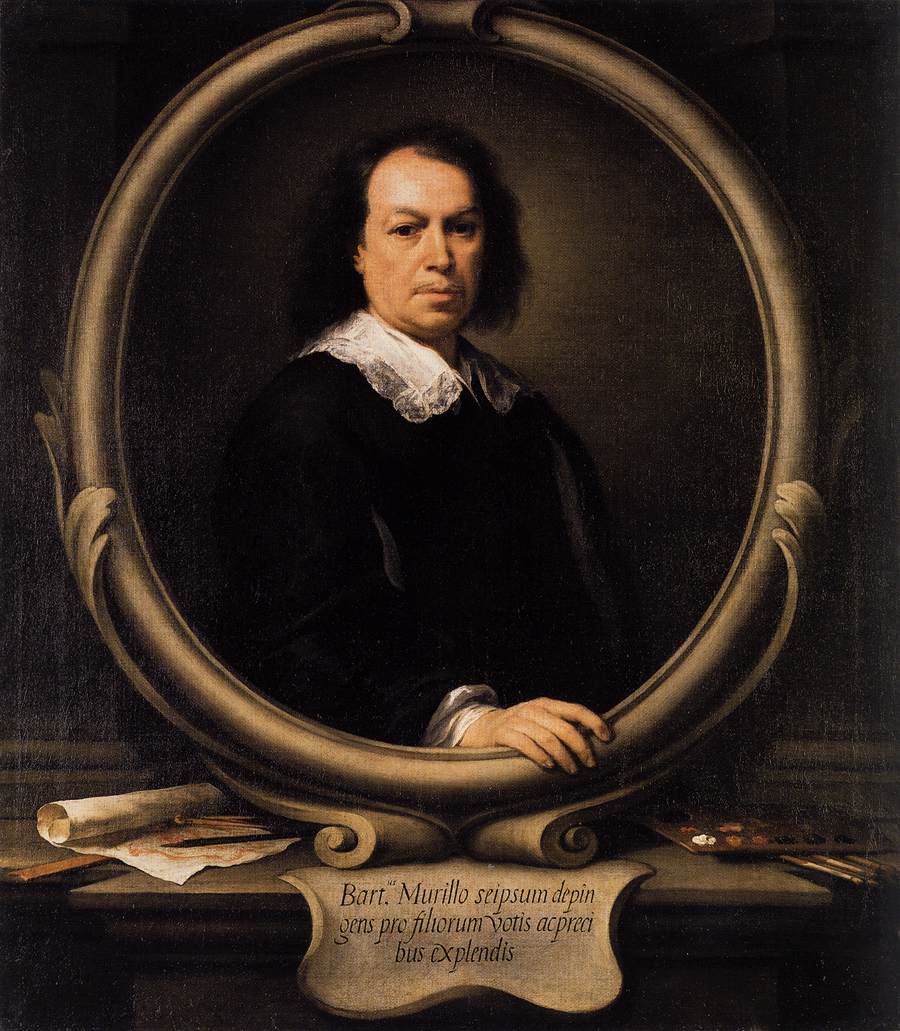
Bartolome Esteban Murillo’s “Self portrait,” painted around 1673, is more than a simple likeness of the celebrated Sevillian master. It is a carefully constructed image of identity, status and legacy. The painter presents himself within an elaborate stone oval that appears to be mounted on a ledge in real space. Below, a Latin inscription identifies the sitter and explains that he painted this work at the request of his children. To the sides appear a folded drawing and a painter’s palette, subtle reminders of his profession.
The painting is at once intimate and formal. Murillo looks directly at the viewer with a calm, steady gaze, dressed in sober black with a delicate white lace collar. There is no flamboyant gesture, no clutter of symbolic attributes. Instead, the composition relies on a quiet play between illusion and reality. The artist seems to step forward out of the feigned stone frame, his hand resting on its edge as if he were leaning on a balcony.
This quietly theatrical device allows Murillo to assert his presence while maintaining a sense of dignity and restraint. The painting becomes a meditation on how an artist of seventeenth century Spain wished to be remembered by his descendants and by posterity.
Historical Context and the Place of the Self Portrait
Murillo created this self portrait in his mature years, when he had already reached considerable fame in Seville. He was known for his tender religious scenes and genre paintings of street children. Commissions from churches, convents and private patrons ensured his professional success. By the early 1670s he was the leading painter of his city and a respected citizen.
In this context, a self portrait was both a personal statement and a professional declaration. European artists of the Baroque period increasingly used self portraits to present themselves as learned, dignified figures, closer to scholars and gentlemen than to manual laborers. Murillo follows this tradition. He is not shown in the act of painting. He does not wear a work apron or hold brushes. Instead he appears in respectable, dark clothing suitable for a man of standing.
The Latin inscription at the bottom adds another layer of context. It tells us that Murillo painted himself to fulfill the wishes of his children. This suggests a domestic motive. The self portrait was meant to hang in a family home, perhaps to preserve his image for them and future generations. Yet the care and sophistication of the composition indicate that he also understood it as a public image of his artistic identity.
Composition and the Trompe l’Oeil Frame
The most striking feature of the painting is the illusionistic frame that surrounds Murillo’s bust. Rather than simply paint himself inside the real rectangular frame of the canvas, he invents a stone oval with scrolls and decorative flourishes. This frame sits on a ledge that appears to project into the viewer’s space.
Murillo’s hand rests on the lower edge of the oval, breaking the boundary between portrait and surrounding world. This clever device, known as trompe l’oeil, was popular among Baroque artists who enjoyed playing with the viewer’s perception. It suggests that the artist is both inside and outside the painted world, a figure suspended between reality and representation.
The oval frame shapes the composition in important ways. Its curve echoes the roundness of Murillo’s head and shoulders, emphasizing the centrality of his face. At the same time, the heavy stone scrolls at the bottom create a sense of stability and weight. They turn the portrait into a kind of sculpted medallion or commemorative plaque, giving it the air of a memorial object.
Beyond the oval, the background is kept dark and neutral. There are no architectural details or landscape elements. This blankness enhances the illusion that the oval is itself a separate, solid object placed in front of an undefined space. It also ensures that nothing distracts from the face.
The Gaze and Expression of Murillo
The emotional heart of the painting lies in Murillo’s gaze. He looks directly at the viewer with eyes that are serious but not severe. There is a hint of softness in the slight downturn of his lips and the calm positioning of his eyebrows. He does not perform a dramatic expression. Instead he offers a steady, thoughtful presence.
This controlled expression communicates several things at once. It conveys confidence in his own worth without arrogance. It suggests introspection and intelligence. It also reveals a sense of responsibility suitable for a father painting himself for his children. He appears as a man they can admire, someone reliable and composed.
Murillo’s head is turned slightly to his left, creating a three-quarter view that adds depth and animation. Light falls from the left side, illuminating the forehead, nose and cheek while leaving parts of the face in gentle shadow. This modeling brings his features to life. The play of light and shadow around the eyes in particular gives them a sense of depth and moisture, enhancing their psychological impact.
At the same time, the slight asymmetry of his hair and the faint signs of age around his mouth and eyes prevent the portrait from becoming overly idealized. Murillo acknowledges his real appearance, including minor imperfections, which adds authenticity to the image.
Clothing, Status and Self Fashioning
Murillo’s clothing is simple but eloquent. He wears a dark, almost black garment with a wide white lace collar. The contrast of black and white gives the composition a sober elegance. Lace in the seventeenth century was an expensive textile. By including it, Murillo discreetly signals his comfortable social status and refined taste.
The choice of dress also aligns him with other learned men and professionals of his time. He does not appear as a craftsman but as a gentleman. Yet the garment is not extravagant. There are no bright colors, no gold chains, no ostentatious accessories. This balance of refinement and restraint fits the image of a pious, respectable Sevillian.
The dark clothing makes his face stand out more strongly within the oval. It forms a neutral mass that sets off the warmth of his skin. This focus on the head and hands has a symbolic aspect. In an age when painters sought to elevate their profession, these parts of the body were associated with intellect and skill. Murillo’s clothes fade into the background so that his thinking face and capable hand can take center stage.
The Hands and the Tools of the Trade
Murillo’s right hand rests on the stone frame, fingers delicately curved. Its placement is both naturalistic and symbolic. On one level it simply helps to create the illusion that he is leaning on the edge of the oval. On another level it foregrounds the hand that holds the brush in his daily work.
The hand is painted with careful attention to anatomy and light. Knuckles, veins and tendons are suggested without harsh detail. It appears strong yet refined. By giving such prominence to the hand, Murillo subtly emphasizes the physical instrument of his art while avoiding literal depiction of him at work.
To the right, on the ledge outside the oval, lies a painter’s palette with brushes. These objects are small but clearly identifiable. Their placement outside the inner frame is significant. Within the oval we encounter Murillo as a person. Outside it we find the tools that define his profession. The painting suggests that while his identity is deeply linked to painting, he remains more than his tools.
On the left side of the ledge rests a folded sheet of paper with a sketch or drawing. This may refer to his preparatory work or to his intellectual engagement with design. Together, palette and drawing form a quiet still life of artistic practice that supports, but does not overshadow, the central portrait.
The Latin Inscription and Its Meaning
Beneath the oval frame, carved into a scroll-shaped cartouche, is a Latin inscription. It reads, in essence, that Bartolome Murillo painted himself in order to fulfill the wishes and prayers of his children. This line transforms the portrait from a generic self representation into a very specific family object.
The mention of his children adds emotional depth. It suggests a domestic scene in which the children expressed a desire to have a lasting image of their father. Perhaps they feared for his health or simply wanted to remember him in his dignity and maturity. By including their request in the inscription, Murillo honors them and acknowledges the personal motivation behind the work.
The formal Latin phrasing also has a public dimension. It situates the portrait in the tradition of classical inscriptions found on monuments and gravestones. In doing so, Murillo presents his self portrait as a kind of enduring record, something worthy of the same respect as official memorials. This reinforces his aspiration to secure a place for himself and his family in history.
The carved scroll on which the words appear is painted with careful shading, enhancing the trompe l’oeil effect. It seems to curl forward from the stone frame, casting a shadow on the ledge. This interplay of text and illusion underlines the painter’s technical skill as well as his thoughtful use of symbolism.
Light, Color and Surface
Murillo’s command of light and color plays a vital role in the painting’s atmosphere. The overall palette is restrained, dominated by blacks, grays and warm browns. Against this subdued background, the flesh tones of the face and hand glow with a natural warmth. The white of the collar provides a crisp accent that draws the eye toward the neck and chin.
Light falls from the left, creating highlights on the forehead, nose, cheek and hand, while softer shadows wrap the right side of his face and the recesses of the oval frame. This directional light not only models the forms but also contributes to the sense of depth. The interior edge of the oval casts a shadow on Murillo’s shoulder, enhancing the illusion that the frame is a separate stone object between the viewer and the painter.
The surface handling is smooth and controlled. Murillo was known for a soft, luminous style in his religious paintings. Here he modulates that softness with slightly sharper definition around facial features and hand, giving them clarity without harshness. The stone frame and cartouche are painted with broader, more generalized strokes, suggesting their texture without competing with the face.
This subtle variation of brushwork gives the painting a refined unity. It feels carefully finished yet alive. The viewer has a sense of the artist’s touch across every part of the surface, an appropriate quality for a self portrait.
Space, Illusion and Viewer Engagement
One of the most intriguing aspects of the work is the way Murillo manipulates space. By painting an oval frame and ledge within the canvas, he creates multiple layers of reality. There is the actual frame of the painting, the fictive stone oval within it, and Murillo himself who seems to stand just behind that oval. In addition, the palette, drawing and inscription rest on a ledge that projects toward us.
This layered structure pulls the viewer into a game of perception. The hand resting on the frame appears to reach into our space. The scroll of the inscription curls forward. Objects on the ledge seem almost tangible. The viewer becomes aware of the boundary between art and life and of the painter’s power to blur that boundary.
At the same time, this spatial play has a symbolic dimension. Murillo presents himself as someone who inhabits the threshold between the real world and the world he creates with his art. He is both inside the picture and reaching out of it. For his children and for later viewers, this gives the portrait a sense of presence, as if the artist were still communicating across time.
Comparison with Other Baroque Self Portraits
When placed alongside other Baroque self portraits, Murillo’s painting reveals its particular character. Many northern European artists, such as Rembrandt, depicted themselves in informal poses, sometimes with dramatic lighting and expressive brushwork. Italian masters like Bernini and Caravaggio explored theatrical gestures and strong contrasts.
Murillo opts for a more restrained and classical approach. The trompe l’oeil frame recalls some Italian and Flemish precedents, yet his overall mood is calmer. He does not dramatize his role as inspired genius. Instead he emphasizes steadiness, modesty and competence. His self portrait aligns more closely with the Spanish tradition of dignified simplicity, seen also in portraits by Velazquez.
This difference reflects cultural values in seventeenth century Spain, where sobriety and religious seriousness were prized. It also suits Murillo’s own artistic temperament, known for its warmth and gentleness rather than flamboyant bravura. The self portrait thus becomes both a personal statement and an example of national style.
Legacy and Modern Interpretation
Today, Murillo’s “Self portrait” offers viewers an intimate connection to the artist behind so many beloved religious and genre scenes. It humanizes the name attached to famous altarpieces and tender images of the Virgin. We see him as a middle aged man with thoughtful eyes, engaged in both family life and professional ambition.
For art historians, the portrait provides valuable insight into how Murillo wanted to shape his posthumous image. The combination of gentlemanly clothing, trompe l’oeil architecture and subtle references to his tools suggests a conscious construction of identity. He wanted to be remembered not only as a skilled painter but as a respectable, educated citizen and a devoted father.
Modern viewers may also appreciate the painting’s quiet psychological depth. Without overt emotion, Murillo communicates a sense of introspection and perhaps a hint of melancholy. The dark background and serious expression evoke the awareness of mortality that often accompanies self portraits, especially those created for family remembrance.
At the same time, the clear, frontal gaze and solid composition project confidence. The painting stands as a visual testament to an artist who understood his worth and his place in the world, yet remained grounded in the everyday realities of work and family.
Conclusion
Bartolome Esteban Murillo’s “Self portrait” from 1673 is a masterful blend of personal affection, professional pride and artistic ingenuity. Through the illusion of a stone oval frame, the careful depiction of his face and hand, and the subtle presence of palette, drawing and inscription, he constructs a layered image of himself as both man and painter.
The work exemplifies the Baroque fascination with trompe l’oeil and spatial play while embodying the Spanish taste for sober dignity. It invites the viewer into a quiet dialogue with the artist, who looks out of the centuries with a calm, intelligent gaze. Painted at the request of his children, it carries the warmth of family feeling, yet its refined execution and classical inscription reveal ambitions that extend beyond the domestic sphere.
In this single canvas, Murillo crystallizes his identity for posterity. He appears as a figure rooted in his time yet still accessible to ours, a reminder that behind the many sacred and genre scenes of seventeenth century Seville stood a thoughtful human being, carefully shaping his own image with the tools of his craft.