Image source: wikiart.org
Introduction
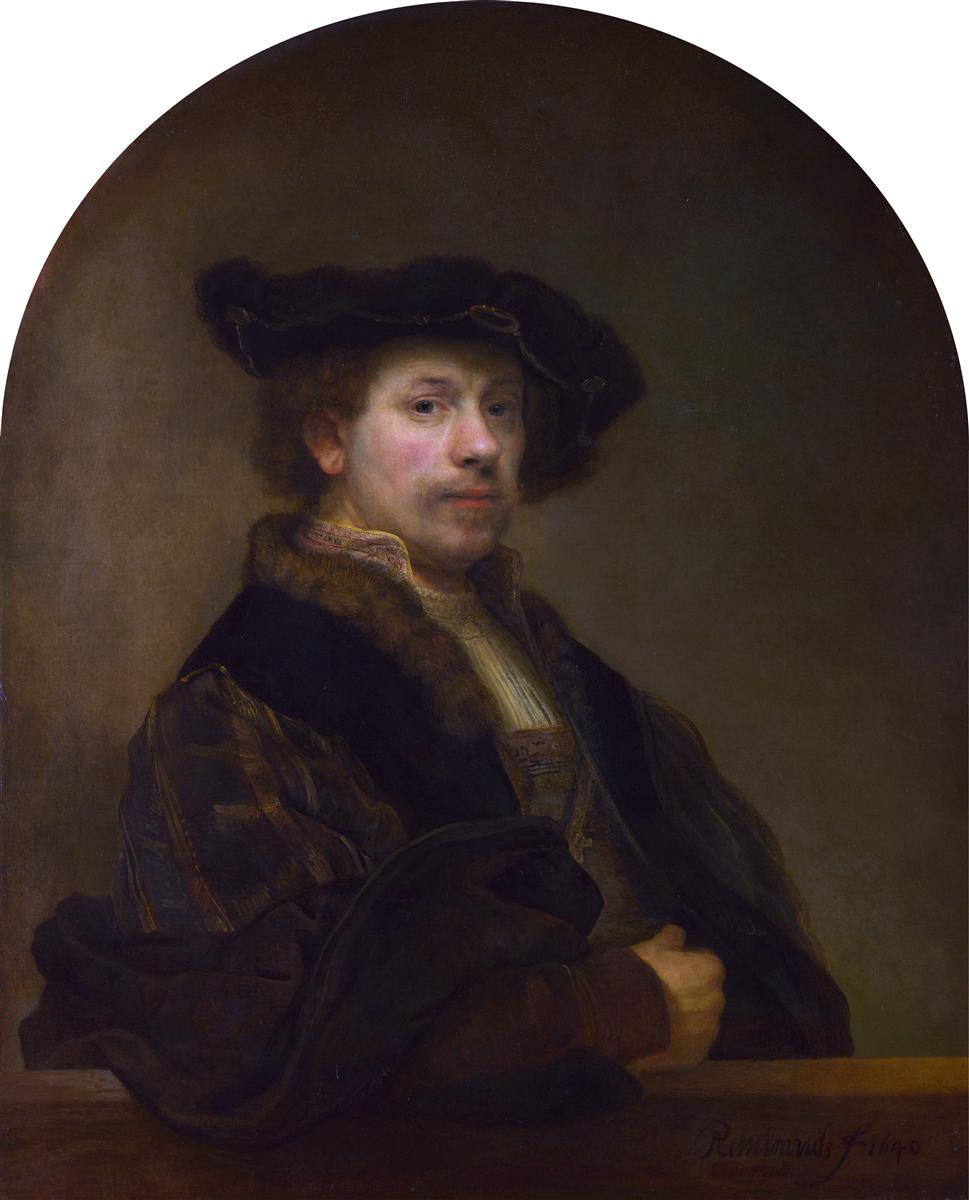
Rembrandt’s “Self-portrait at the Age of 34” (1640) arrives like a confident handshake. The painter presents himself half-length behind a stone ledge, body turned to the right, head pivoted toward us, gaze steady and assessing. He wears a velvety mantle trimmed with fur and a broad, beribboned cap; a pleated shirt and embroidered placket flash pale against the dark costume. Light blooms softly across his cheek and forehead, dissolving into the brown-gold atmosphere that fills the arched format. The signature and date declare an artist at a moment of arrival. In one compact image Rembrandt fuses observation, ambition, and memory—an essay in self-fashioning that reveals how deeply he understood portraiture’s power to shape identity.
A Moment of Arrival
At thirty-four Rembrandt was at the center of Amsterdam’s cultural life. He had married Saskia van Uylenburgh, moved into a larger house, and attracted a clientele eager for portraits, history scenes, and prints. This self-portrait acknowledges that success while testing its moral weight. The luxurious costume is not a literal record of daily wear; it is a studio wardrobe that evokes Renaissance forebears—Titian, Raphael, and the courtly half-lengths of the Italian sixteenth century. By dressing himself in historical finery, he places his own practice within a lineage of painters who dignified the human figure. The result is not mere masquerade. The costume functions like rhetoric: it announces the scale of his intention.
Composition and the Architecture of Presence
The arched top, a format Rembrandt favored for portraits of heightened gravity, wraps the figure in a dome of air. The stone ledge across the foreground is crucial. It separates our space from his while providing a platform for the hand, a visual anchor that stabilizes the triangle of torso, sleeve, and mantle. The turn of the body generates a graceful S-curve from shoulder to hip; the head sits as the calm apex of that movement. Interior diagonals—folds in the sleeve, the fur edge of the mantle—quietly guide the gaze toward the face. Nothing is cluttered; the composition is a simple machine for attention.
Light as Character
Light is the portrait’s true coauthor. It slides from the upper left, skimming cheekbone, temple, and the bridge of the nose before drifting down the pleated shirt. The cap’s dark brim gathers the upper field into a soft vignette that keeps the eyes bright but not glittering. Shadows roll gently across the far side of the face and under the chin to model volume without theatrics. This moderate chiaroscuro is deliberate. Rembrandt wants intelligence, not melodrama; he wants the viewer to feel the head’s living anatomy—skin thin over bone, thicker at the cheek, more translucent near the eye. The long, even highlight on the great sleeve tells us the cloth has depth and weight. Light in this painting confers credibility and a moral steadiness.
Costume, Memory, and Artistic Lineage
The hat with its soft brim and decorative loops, the fur collar, the embroidered placket, and the monumental sleeve evoke portraits by Titian and Raphael that Rembrandt studied through prints. He is not copying a specific picture but referencing a tradition. In doing so he claims a place in the family of artists who could interpret fabrics as convincingly as faces and who understood that clothing can be psychological architecture. Here the fur collar frames the head like a low auréole; the sleeve’s bulk acts as a pedestal; the subtle glints in the cap’s loops flicker across the upper shadow like courtly insignia. Costume becomes language, not ornament, speaking about ambition tempered by craft.
The Hand and the Ledge
Rembrandt rarely wastes a hand. Here the right hand, partially gloved by the sleeve, closes loosely as it rests along the ledge. The gesture is casual yet guarded, a token of self-possession. The ledge itself recalls the parapet in Renaissance portraits—a stone threshold implying the distance between viewer and sitter. It also rhymes with the heavy mantle, echoing weight with weight. Together, hand and ledge argue for stability: this is a man who knows where he stands and how to hold his ground without aggression.
The Face as a Field of Thought
The portrait’s authority resides in the face. Rembrandt modulates a narrow palette of warm ochres, rose, and olive grays into an extraordinary topography of awareness. The eyelids are half-lowered but focused; a delicate gleam moistens each eye. The mouth is composed, not pressed; the philtrum catches light that amplifies the sense of breath. Nasolabial folds and slight pouches beneath the eyes whisper of work and late hours rather than age. Hair, cropped and curling from beneath the cap, behaves like a living edge that softens the transition between flesh and fabric. This is the face of someone who has looked hard at other people—and at himself—in studio mirrors and urban streets.
Paint as Material Intelligence
One reason the picture feels so persuasive is the frank intelligence of its paint. Rembrandt switches registers by zone. The face is built from thin, elastic layers that allow warm ground to breathe through, creating skin’s interior glow; the shirt’s pleats are pulled with nimble impasto ridges that catch light like tiny cliffs; the fur is composed of small hooked strokes and scumbled passages that break the edge without dissolving form; the sleeve’s deep brown is a satin pool whose surface shifts as our viewpoint changes. Nothing is over-described. Edges soften and tighten in accord with how sight works, not how a craftsman might carve wood or model clay. Painting, here, is thinking.
Self-Fashioning without Vanity
Autobiographical self-portraits often risk preening or fiction. Rembrandt avoids both. He permits finery yet refuses flattery. The skin is not polished; the nose retains its irregularity; the eyes are frank. He allows mild softness under the chin and weight at the jowl—signs of a life well lived rather than symptoms of indulgence. The overall effect is self-respect, not self-congratulation. The painter faces us with the steadiness he demands of his sitters. He is present as worker and as figure of imagination, bound by the same laws of light and time as the rest of us.
Dialogue with Earlier Self-Portraits
Compared with his self-portraits of the late 1630s—in which he experiments with theatrical fancy dress and expressive grimaces—this 1640 likeness is poised and classical. The adolescent swagger has settled into adult composure. The sitter of “Self-portrait with Feathered Beret” courts drama; the thirty-four-year-old cultivates authority. This evolution does not suppress vitality; it concentrates it. The flamboyance moves from costume to gaze, from externals to the quiet pressure of consciousness. The painting reads as a hinge in the long series, announcing the mature self-portraits that will confront aging, loss, and endurance with devastating candor.
Dialogue with Titian and Raphael
The portrait forms an intentional conversation with Titian’s and Raphael’s half-lengths, particularly those in which the sitter rests an arm on a parapet and turns toward the viewer under a soft cap. Rembrandt borrows the format to claim kinship and then transforms it through his thicker paint, warmer tonality, and deeper psychological quiet. The Italians often polish; Rembrandt breathes. He acknowledges their courtly decorum and subdues it to a mercantile republic’s ethos of inward seriousness. The result is not imitation but translation: a northern humanism housed in Venetian velvet light.
The Arched Field and the Atmosphere of Time
The curved upper edge is not only elegant; it changes the air. Straight-cornered canvases can press space outward; the arch draws it inward like the top of an apse. This makes the picture feel like a chapel of self, a sanctum in which the act of looking is its own devotion. The warm brown atmosphere that fills the arch seems to carry dust, breath, and the faint passage of hours in the studio. It is as if the painting were made from time itself, condensed into vapor that supports the head.
Psychology of the Gaze
The gaze is even, assessing, and hospitable. He does not implore or defy; he neither flatters nor reprimands. The slight lift of the eyebrows and the micro-asymmetry at the corners of the mouth generate ambiguity, the mark of a living presence. This gaze can contain humor and skepticism at once; it can measure a patron or welcome a friend. Many self-portraits in art history address posterity; this one addresses you living now, whoever you are, making the encounter unrepeatable and immediate.
The Ethics of Restraint
Rembrandt’s discipline is palpable. He limits color to earths and subdued golds, keeps detail in the costume under musical control, and refuses narrative accessories. This restraint creates capacity. Because nothing screams for attention, everything can speak softly and be heard: the pleat of the shirt, the ripple at the mantle’s hem, the slight rawness along the lower lip. The ethics of restraint mirrors a moral ideal—competence without ostentation—which the Dutch Republic celebrated and which Rembrandt, even while ambitious, respected.
The Hand of History and the Signature
At the lower right, the signature and date sit just above the ledge, part of the architecture. They function like a legal attestation and like an artist’s flourish. Rembrandt marks the document of himself at the moment he claims artistic adulthood. Signatures in his self-portraits are never neutral; they are self-knowledge in ink. Here, the writing aligns with the crisp light on the shirt and with the geometry of the ledge, sealing the pact between the person and the picture.
Material and Metaphor
Beyond its descriptive truth, the painting offers a metaphor for the artist’s vocation. The heavy sleeve is the labor of making; the fur collar is the comfort earned by success; the cool pleats of the shirt are the disciplined order of craft; the cap is the pavilion under which imagination works; the stone ledge is reality; the gaze is judgment. These elements harmonize into a single persona: a maker who inhabits both the material world and the imaginary one with equal seriousness.
Why the Painting Endures
The portrait endures because it stages self-knowledge without theatrical confession. It shows how identity can be made visible through light, cloth, and the moral pressure of a look. It speaks to artists as a declaration of craft and to general viewers as a portrait of presence. It also functions as a portable studio visit across centuries: we are allowed to stand at the ledge and meet the painter at the moment he becomes fully himself. The painting’s calm magnetism invites long looking, and long looking keeps yielding more.
Conclusion
“Self-portrait at the Age of 34” is Rembrandt’s compact manifesto. With an arched field of warm air, a ledge of stone, a mantle of velvet, and a gaze that measures and welcomes, he composes a likeness that is both historical and immediate. He honors the Italian tradition while translating it into northern light; he acknowledges success while insisting on work; he dresses for the role without surrendering to vanity. The painting survives not as a costume picture but as a living conversation about what it means to be an artist and a person. The hand rests, the eyes think, and the viewer stands at the brink of a shared, wordless understanding: that attention is the true wealth of portraiture, and that light is its law.
