Image source: wikiart.org
Introduction
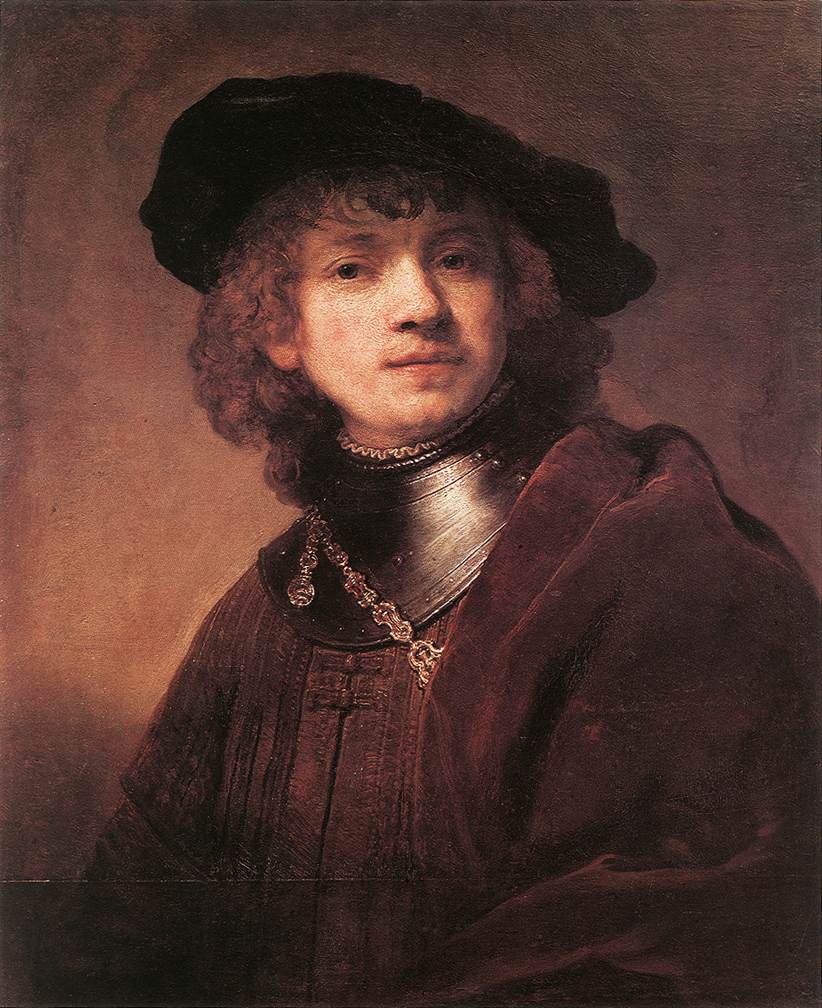
“Self-portrait as a Young Man” (1634) presents Rembrandt at roughly twenty-eight, poised between the ambitions of early success and the discoveries that would define his mature career. The artist faces us calmly, wearing a soft black beret, a richly dyed cloak, and—most arresting—a polished steel gorget at his throat, over which hangs a decorative chain. The background is an amber dusk, the light is warm and directional, and the surface is alive with decisions. Though modest in size, the portrait is grand in intent: it is a manifesto about identity, craft, and the imaginative roles an artist may inhabit.
Historical Moment
The year 1634 is a hinge in Rembrandt’s life. Having moved from Leiden to Amsterdam, he had rapidly become the city’s most sought-after portraitist. He married Saskia van Uylenburgh that same year, enlarging his social world and his studio’s clientele. Amsterdam’s wealthy burghers demanded likenesses that conveyed substance and virtue; at the same time, the art market welcomed experiments in costume and persona. This self-portrait synthesizes both impulses: a credible face, honestly modeled, framed by clothing that slips between contemporary fashion and historical fancy dress. It is a young artist’s claim to seriousness and to imaginative range.
Composition and Framing
Rembrandt composes the head as a slow, turning sphere lodged in a triangle of garment and metal. He crops the figure at the chest, keeping the eyes high in the field so that the gaze meets the viewer on level terms. The diagonals of cloak and gorget counter the horizontal slant of the beret, creating a subtle cross-brace that steadies the design. The background is unencumbered; no columns, no drapery, no props distract from the encounter. The composition is therefore both intimate and ceremonial: a bust-length likeness with the quiet authority of a bust in stone, animated by light.
Light as Architect
Illumination falls from the left and slightly above, a warm beam that grazes the cheekbone, bridge of the nose, and the curved rim of the gorget. The hat’s underside drops a soft shadow over the brow, intensifying the eyes without dramatics. Light glints along the chain and pendant, then settles into the burgundy cloak, where it becomes a low luster. This movement of light is the painting’s grammar; it builds volume, orders materials, and guides attention. The face anchors the narrative, the metal amplifies the brightness, and the garment restores quiet.
The Gorget and the Theatre of Role
The polished steel gorget is not military equipment in use; it is a studio prop. Seventeenth-century artists often donned armor in self-portraits to borrow the aura of heroism and history. Rembrandt balances that theatrical gesture with scrupulous observation. He renders the metal as a curved mirror that catches both light and shadow, notch by notch along its rolled edge. The gorget’s reflective band makes the neck feel protected, even fortified, while the youthfulness of the face resists swagger. The result is not costume alone but a meditation on how roles inflect identity without replacing it.
The Chain and Pendant
Draped over the steel sits a gold chain with a suspended medal or jewel. Rembrandt plots it with small, decisive highlights and warm glazes that describe weight and sway. The chain is both decoration and metaphor. It signals professional pride—artists were sometimes depicted with honorary chains—and it provides a rhythmic counterline that softens the gorget’s hard arc. Each tiny gleam becomes a beat in the picture’s tempo, carrying the eye from hat to face to chest and back again.
Fabric, Color, and Tonal Design
The cloak is a deep claret, a color Rembrandt often favored in early Amsterdam. He models it broadly, letting ridges of paint catch along seams and folds. Against the cool silver of the gorget and the velvety black of the hat, the warm red-brown reads like a resonant chord. Flesh tones sit between these poles: cooler at the temple and jawline, warmer at the cheek and tip of the nose, with a soft rose at the lips. Tonally, the design rests on a pyramid of values—dark hat and background, mid-tone garment, bright metal and skin—so the portrait reads clearly from across a room yet rewards close inspection.
The Face: Youth and Candor
The young Rembrandt does not flatter himself. The cheeks carry a slight flush, the eyelids are heavy enough to cast their own shade, and the mouth is set with a candid, almost inquisitive firmness. Short, translucent strokes knit the skin; tiny highlights at the lower eyelids quicken the gaze. He does not chase a virtuoso expression. Instead, he offers a steady presence, a self neither masked nor magnified, looking outward with the composure of someone who knows his powers and is learning how to wield them.
Brushwork and Surface Intelligence
Rembrandt’s handling is varied and purposeful. On the gorget he uses loaded strokes pulled smoothly along the curvature to mimic burnished metal, then breaks the surface with minute, crisp touches for reflected light. In the cloak he drags the brush in broader, textured bands to evoke plush cloth. The hat is laid in with soft, absorbent passages, absorbing light rather than reflecting it. Flesh is woven from small strokes and glazes that fuse at viewing distance. Everywhere the paint is active, so that material differences—steel, wool, hair, skin—are felt before they are named.
Background as Atmosphere
The ground is a warm, amber dusk that darkens at the edges and thins near the light source. It functions as a chamber rather than a wall, allowing edges to breathe. At the lit side of the face, the boundary dissolves into atmosphere; at the hat’s rim and the shoulder’s outer curve, the edge firms up to secure the silhouette. This dynamic background keeps the portrait timeless—no specific room or props tether it—while preserving an environment in which light seems to circulate.
Comparison with Earlier and Later Self-portraits
Compared with Rembrandt’s earlier self-portraits in theatrical grimace or fanciful headgear, this one is calmer and more dignified. Compared with later self-portraits in rich exotic dress or melancholy introspection, it is brighter and more hopeful. What unites the whole series is the investigation of identity through role, light, and material. Here, the role—youthful soldier-poet, perhaps—is held lightly, as an instrument for exploring reflections on metal and the meeting of warm flesh and cool steel.
The Ethics of Self-Presentation
Self-portraits can tilt toward vanity or toward confession. Rembrandt threads a middle path. He grants himself a bit of flourish—the chain, the gorget, the beret—but he does not surrender to display. The gaze remains human and unguarded; the features carry the small irregularities that make faces believable. In this equilibrium lies the painting’s modernity: it respects the viewer with truthfulness and respects the artist with craft.
The Psychology of the Gaze
The eyes do not challenge; they consider. There is a slight upward angle, as if the sitter were weighing the world beyond the frame rather than performing for it. That distance implies intellectual independence. The mouth’s softness avoids severity, while the set of the head—neither tilted in deference nor cocked in bravado—suggests quiet confidence. The portrait offers no allegory, yet it communicates character with clarity.
The Beret and the Artist’s Persona
The soft black beret is an old emblem of the maker. It crowns the head without pomp and throws the face into relief by shadowing the brow. Rembrandt paints its nap so that it absorbs light, making the illuminated skin and shining metal more luminous by contrast. In doing so he reinforces a theme: the artist as worker, not courtier—someone who earns radiance by shaping darkness.
Drawing with Light
A close look shows how Rembrandt “draws” the head with light rather than line. The bridge of the nose is a narrow vertical of brightness; the cheek is an oval swelling held in check by halftone; the chin rounds forward where a small reflection sits like a quiet period. Even the gorget’s reflections behave like lines in space, curving to indicate form. This sculptural thinking—modelling by planes and glints—turns paint into a tool for reasoning about structure.
Material Culture and Meaning
Armor in seventeenth-century portraiture often signaled virtue, courage, or historic reminiscence rather than literal service. Chains could denote honor or guild affiliation. Rembrandt isn’t illustrating a specific narrative; he is borrowing the gravitas of these objects and translating them into exercises of paint and light. As a result, the objects serve two masters: social meaning and visual form. They dignify the sitter while providing occasions for virtuoso description.
Tempo and Stillness
The painting is still, yet it contains time. The chain seems to have just settled; the light migrating across the metal suggests a momentary flash; the curls, tight and mobile, feel recently arranged. This quiet implication of motion keeps the portrait from ossification. It is a pause rather than a freeze, an instant within a day in the studio.
Conservation and Patina
Over centuries the reds have mellowed, and the darks have deepened, intensifying the warmth-against-shadow effect that is central to the picture. The steel retains its silver bite, a testament to the stability of the painter’s mixtures and glazes. Any subtle craquelure across the face now participates in the work’s texture, echoing the delicate patterning already present in the brushwork.
Legacy and Reception
This self-portrait is a cornerstone in the long series by which Rembrandt charted his face through time. It has served as a model for generations of artists exploring how costume can become a vehicle for investigating materials and how a portrait can be both public statement and private inquiry. Viewers continue to respond to its equilibrium: the pleasure of finery without pretension, the authority of craft without vanity, the immediacy of a face that feels seen rather than staged.
Conclusion
“Self-portrait as a Young Man” is less a costume piece than a declaration of method. Rembrandt shows how light can model truth, how metal and cloth can be translated into strokes that breathe, and how the self can be presented with dignity without losing candor. The gorget shines, the chain glints, the cloak hums, and the eyes meet ours with steady intelligence. In 1634, at the threshold of fame and marriage, he records himself not as a myth or an emblem but as a working artist who understands the drama available in a face, a few materials, and honest light.