Image source: wikiart.org
Introduction
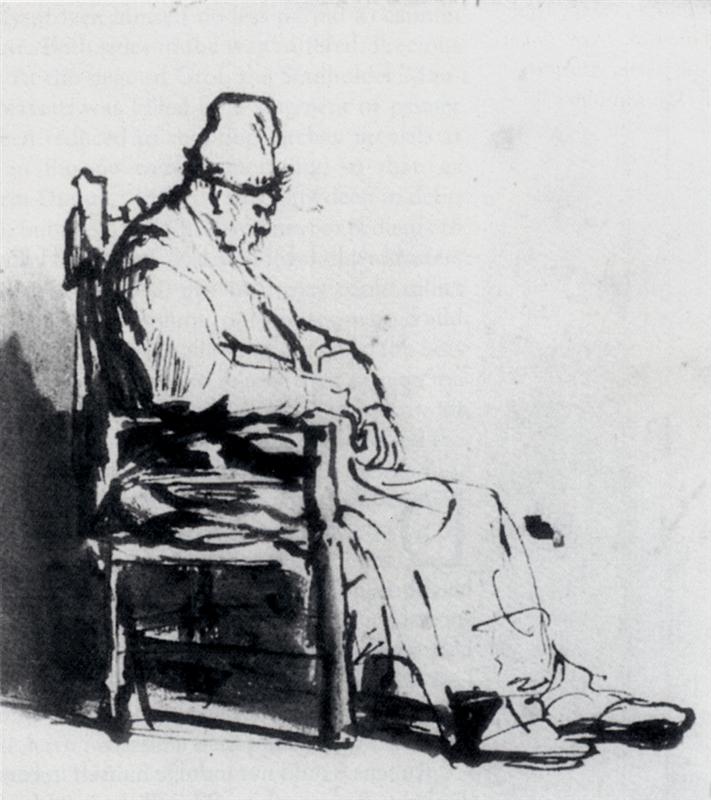
Rembrandt’s “Seated Old Man (possibly Rembrandt’s father)” is a small masterclass in economy, empathy, and the choreography of silence. Executed with swift, assertive strokes of pen and brush, the drawing presents an elderly figure in profile, sunk into a sturdy chair, the weight of his years gathered in the folds of his garment and the angle of his head. Nothing ornamental distracts from this encounter. There is only figure, chair, a wedge of ground shadow, and a vast field of unmarked paper into which the form breathes. With so little, Rembrandt gives us the density of a life.
The Architecture Of Stillness
The composition is a study in stabilizing diagonals and counterweights. The chair’s vertical posts and horizontal rails stake out a rectilinear scaffold on the left, anchoring the picture like a frame within the frame. Against this grid the old man’s body forms a long, downward diagonal from the cap’s peak through shoulder, forearm, and knee to the sloped sandals. That diagonal is checked twice: by the solid block of the chair seat and by the small, emphatic triangle of shadow pressed under the chair. The result is stillness that feels earned. The figure does not merely sit; he has settled, the way a stone finds its ground in a riverbed.
Profile As Character
Rembrandt chooses a deeply humane profile. The cap creases against the skull; the brow juts gently forward; the nose protrudes, then softens into the moustache and beard that spill toward the chest. The mouth is barely indicated, yet the posture of the head, slightly bowed and turned inward, reads as thought rather than sleep. The eye—darkened by a single thumb of ink—becomes the drawing’s smallest but most persuasive detail. That eye, nested in shadow, holds the weight of attention and makes the figure present to himself.
Line As Breath And Weight
The drawing’s lines speak in different registers. Short, dense hatchings at the shoulder articulate mass and shadow; quick, elastic contours along the robe suggest soft fabric that yields to gravity; heavier, compressed strokes build the boxy solidity of the chair. The line thickens where weight collects—the crook of the elbow, the bend of the knee—and thins where the form relaxes—along the shin and the hem’s drift. These modulations transform ink into sensation: we feel the pressure of body on seat, the drag of cloth over knee, the slack of a resting hand.
The Chair As Partner
This chair is not a prop; it is a partner in the drama of endurance. Its front rail, sketched with emphatic horizontals, takes the figure’s weight and returns it to the ground. The rear posts rise beyond the sitter’s back, bracing him without enclosing him. Rembrandt’s choice to describe the chair more completely than the surrounding space locates the old man in a material world—wood worn smooth by years of use, a seat that has known many bodies. The chair speaks of household, habit, and the daily architecture that holds a life together.
The Expressive Power Of Negative Space
Most of the sheet is untouched paper, and that blankness is eloquent. It enlarges the air around the sitter, turning a narrow interior into a contemplative room. It also frames the silhouette with clarity, so that each angle—the cap’s peak, the sleeve’s turn, the shoe’s blunt toe—reads with crisp authority. The empty expanse is not absence; it is the dimension in which time is felt. In the quiet surrounding the figure, the viewer senses the long afternoons and longer years that shape such a pose.
Gesture As Biography
Every element of the posture cues biography. The forearm rests on the chair arm with the hand relaxed, palm downward, as if repetitive tasks have taught the body to conserve effort. The other hand, barely indicated, gathers the robe at the lap—a practical gesture that doubles as self-embrace. The legs extend, feet eased into sandals whose straps Rembrandt renders with a few decisive marks. Nothing is theatrically tired. Instead, the drawing records those micro-adjustments by which an older body keeps comfort near.
A Face Made By Light
There is no modeling in the academic sense; Rembrandt does not build a face from graduated tones. Instead, he lets a few shadows imply light: the cap’s rim throws a bar over the brow; a dark accent under the nose asserts projection; the beard’s underside becomes a reservoir of ink from which the cheek, lit by paper white, emerges. The result is paradoxically luminous. Light is not painted; it is allowed to happen where the pen refrains.
The Cap, The Robe, And The Poetry Of Non-Specific Time
The cap’s soft cone and the robe’s enveloping mass place the sitter within the seventeenth-century Dutch world but refuse clerical or civic specificity. This is not the costume of office; it is the clothing of habit. Such non-specificity is central to the drawing’s power. Freed from the hierarchies of uniform and badge, the man becomes a universal elder—possibly Rembrandt’s father, plausibly any aging artisan or neighbor—an emblem not of role but of human duration.
Shadow As Shelter
The only large tone is the dark wedge that pools beneath and behind the chair. It is not an ominous void; it is sheltering shade, a cool pocket in which the chair’s legs and the hem’s edge can rest. By gathering darkness to the left, Rembrandt keeps the right side of the figure airy and open, letting the sandals extend into space with a dignity that borders on humor. The drawing thus balances gravity and lightness, acknowledging age without solemnizing it.
Speed, Decision, And The Living Touch
The drawing reads as quick, but never careless. In places the brush has been charged with ink and pressed decisively—the chair rail, the shadow under the arm—leaving thick, velvety blots. Elsewhere the pen has skittered lightly, testing the robe’s contour before committing. This alternation between bold and tentative marks documents the artist’s thinking in real time. We watch him choose what to state, what to suggest, and what to leave for the paper to say by itself.
The Psychology Of Rest
The old man is not asleep; he is resting. That distinction matters. Sleep would withdraw him from us; rest leaves him available to attention. The bowed head suggests intimacy with his own thoughts. The slight forward tilt implies alertness yoked to fatigue, the daily negotiation older bodies undertake. Rembrandt’s empathy lies in honoring that negotiation, neither romanticizing weariness nor disguising it.
Possible Portrait, Certain Affection
The tradition that identifies the sitter as Rembrandt’s father lends the drawing familial warmth, but its affection is evident regardless of identity. The strokes that describe the face are protective; they never pry. The body is given privacy, wrapped in robe and space, even as the character emerges. The drawing behaves like a son’s glance across a room—a look that confirms presence more than it seeks likeness.
The Ethics Of Restraint
Rembrandt could have elaborated the room—a wall, a window, a shelf of tools. He doesn’t. He could have polished the contour, erased exploratory lines, or spread wash to model volumes. He doesn’t. That restraint is an ethic: tell the truth of what is essential and trust the viewer to complete the rest. The drawing’s humanity depends on that trust. We are not dazzled; we are invited.
Material Evidence And The Passage Of Time
Even reproduced, the drawing’s materiality is palpable. Where the brush dragged almost dry across the paper, the texture picks up—a faint tooth becomes visible. Where the pen lingered, ink blooms slightly at the ends of strokes. These traces record time on two scales: the sitter’s long time and the artist’s quick time. Together they create a layered temporality that deepens the quiet.
Choreography For The Eye
Rembrandt composes a path for looking. The eye begins at the bright silhouette of the cap, drops to the dark slot of the eye, slides along the nose to the beard’s weight, then follows the forearm to the hand and down the hem to the sandals. From there, the chair’s front rail returns us to the seat, up the back post, and finally to the cap again. This loop is unforced, and because it can be repeated indefinitely, the drawing sustains contemplation far longer than its simplicity would suggest.
Kinship Within The Oeuvre
The sheet belongs to Rembrandt’s long conversation with age—his drawings of beggars, scholars, and apostles; his depictions of Simeon and St. Peter; the late self-portraits whose faces are maps of survival. Across those works, he measures dignity not by status but by the clarity with which a person inhabits their body. “Seated Old Man” is one of the purest statements of that credo: an elder, well observed, allowed the grace of his own quiet.
The Pedagogy Of Economy
For artists, the drawing is a manual in saying more with less. A handful of strokes establish volume; selective darks summon weight; empty paper does the work of light; a single decisive accent in the eye animates the head. The sheet teaches that conviction, not quantity, persuades. For viewers, the pedagogy is parallel: look at less, more carefully, and the world will disclose itself.
The Humor Of Truth
There is a soft humor in the sandals jutting forward, their straps dashed in with almost comic directness. It is the humor of recognition—a truthful delight in bodies as they are. Rembrandt lets that note sound without turning the sitter into a joke. The dignity of posture and the quiet of the face keep the humor companionable, not reductive.
How To Look, Slowly
Sit with the drawing as the old man sits with his chair. Let your gaze rest on the cap’s outline until the paper’s white becomes light. Drift to the dark of the eye and feel how that single mark alters the whole. Trace the beard’s edge and sense its soft weight. Follow the arm down to the hand; notice how the fingers dissolve into suggestion, as though the body were absorbing its own edges. Pause at the sandals; smile. Then begin again. The drawing will deepen with each circuit.
Human Presence As The True Subject
Titles propose identifications, but the drawing’s true subject is presence—what it feels like for a person to occupy a moment. Rembrandt captures that presence without ornament or plea. The old man is here; he has sat; he will rise again, perhaps slowly. Between those actions is the interval we share with him. That interval is the drawing’s gift.
Conclusion
“Seated Old Man (possibly Rembrandt’s father)” condenses Rembrandt’s genius into a few inches of paper: profound empathy, fearless economy, and a command of line that transforms ink into gravity, cloth, and thought. Chair and figure make an honest duet; light is the space where the duet is heard. The drawing neither flatters nor exposes. It simply attends—and in attending, it dignifies. That is why the image feels inexhaustible. We do not finish it; we join it, each time, in the same humane quiet where a life sits and breathes.