Image source: wikiart.org
Introduction
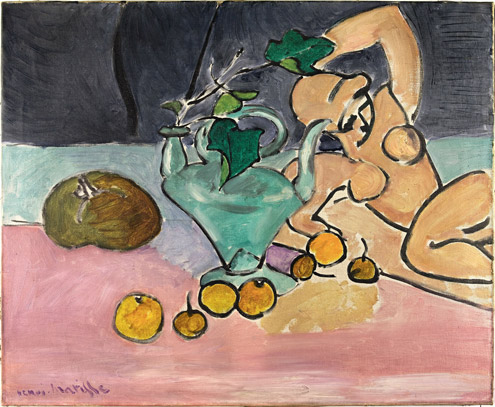
Henri Matisse’s “Sculpture and Vase of Ivy” (1916) is a compact manifesto about what painting can do when it borrows the clarity of sculpture and the freshness of living plants. On a shallow tabletop, a pale terracotta-colored figure—drawn with sweeping, calligraphic contour—reclines beside a turquoise glass vase filled with sprigs of ivy. Scattered yellow fruits punctuate the pink surface like musical notes, while a green pumpkin anchors the left edge. Behind everything, a dark, nearly featureless backdrop pushes the objects forward. The scene is domestic and intimate, yet it radiates the authority of an idea: the studio as a place where line, color, and form negotiate life and art, nature and artifact, softness and structure.
Historical Context
The painting comes from Matisse’s wartime period, 1914–1917, when he ruthlessly refined his language. After a decade of Fauvist chroma and pattern-rich interiors, he turned toward economy: broad planes, decisive drawing, and reduced palettes that let relationships carry the meaning. He painted windows as gridded abstractions, portraits as masklike presences, and still lifes that tested how few elements can sustain an image. “Sculpture and Vase of Ivy” belongs to this crucible. It also acknowledges the other half of Matisse’s practice—sculpture—which he pursued throughout his career to clarify structure and weight. Here he stages a conversation between his sculptor’s eye and his painter’s love of color.
First Impressions
At a glance, the painting reads as three horizontal bands. The upper third is a dark curtain-like field of grays and midnight blues. The middle band compresses the still life: a narrow shelf where the vase, fruit, and reclining figure sit almost flush to the picture plane. The lower band is a wide expanse of soft pink, brushed openly so that texture breathes through the color. The eye jumps first to the minty turquoise vase, catches the emerald ivy leaves, then arcs along the ocher lines of the figure’s body. A green pumpkin quietly occupies the left, and six or seven golden fruits lead the gaze in a gentle curve from the pumpkin toward the figure’s hand. The whole scene is pared to essentials, and yet it feels generous.
Composition and Pictorial Architecture
Matisse organizes the canvas around a series of counterpoints. The reclining figure forms a long, sinuous diagonal from the right edge toward the center; the vase stands upright as a vertical counterweight. The fruits create a dotted arc that binds those two forces together, and the pumpkin provides a broad counter-mass to balance the figure’s length. A seam-like horizon, just above the pink tabletop, establishes the shallow stage. The black backdrop is not an empty void but a stabilizing plane that lets the pale, matte figure and the glassy vase read with maximum legibility. Compositionally, the painting is a rectangle full of harmonized pushes and pulls: curve against straight, warm against cool, object against silhouette.
The Dialogue Between Sculpture and Painting
The figure is not a naturalistic nude; it is a sculptural sign translated into paint. Matisse outlines the body with a continuous, elastic line that thickens and thins as it turns around shoulders, hip, knee, and hand. Inside the contour he leaves large areas of warm, terracotta color nearly flat, with only the lightest shading to suggest volume. The effect is of a reclining ceramic or plaster form—an object of art—placed on the same table as the living ivy and edible fruit. Painting here behaves like drawing around a sculpture: line gives presence; color grants temperature; brevity yields clarity. The decision to make the figure read as “sculpture” transforms the still life into a studio self-portrait by other means, a record of Matisse’s double identity.
The Vase of Ivy as Counterpoint
If the figure is a vessel of structure, the vase and ivy are vessels of life. The glass form is drawn with concise, symmetrical curves, and its cool green registers as a column of water and light. From it spring flexible stems and compact, hoof-shaped leaves painted in saturated green. Matisse lets the ivy cross the figure’s contour in two places so that nature seems to reach toward art. In one gesture, the ivy leaf hovers over the figure’s face, a witty nod to the classical trope of garlands crowning sculpture, but also a statement about hierarchy: living plant over inert form, growth touching permanence. The vase’s transparency is solved with quick, luminous strokes—white seams, light refractions, and a few interior shadows—enough to make glass convincing without drowning it in detail.
The Fruit and the Color Climate
The small yellow fruits—plums or mirabelles—do not exist to demonstrate botanical truth. They exist to set the climate of the picture. Their warm yellows and ambers echo the body’s terracotta and, by repetition across the tabletop, keep heat moving through the cool territory of the vase and pumpkin. Matisse spaces them with care: a solitary fruit at the far left creates a first beat; a cluster of five builds a chord in the middle; a final pair near the figure’s hip ties warmth back to the human form. Each fruit is painted with two or three value steps and a decisive outline, so that it reads instantly as volume without fussy modeling. Together they behave like notes on a staff, keeping time for the eye’s journey.
The Green Pumpkin as Anchor
On the left, a round, ribbed pumpkin sits low and heavy. Its green is darker and duller than the vase’s mint or the ivy’s emerald, establishing a different register of the same hue. The pumpkin’s matte density counters the vase’s gloss and the figure’s airy contour. It also performs a narrative function, grounding the scene in the ordinary. The studio is not only a chamber of art; it is a room where seasonal produce, cuttings, and objects mingle. This humble mass keeps the canvas from floating away into pure abstraction or allegory.
Brushwork and the Presence of the Hand
Across the surface, Matisse allows paint to be paint. The dark backdrop is laid in with broad, diagonal strokes that leave mild ridges and thin areas, so that the ground lives rather than smothers. The pink table is scumbled in a way that reveals undercolor at the edges, especially where it meets the ocher patch beneath the fruit. The vase’s highlights are dragged wet into wet; the figure’s interior fields are thinly washed, encouraging a soft granularity that evokes plaster or unglazed clay. This variety of touch means that material differences—glass, fruit skin, gourd, sculpture—are communicated without descriptive labor. The viewer feels them through the hand’s tempo.
Drawing, Contour, and the Authority of Line
Line is the painting’s grammar. The figure’s contour is a single sentence, flowing from head to shoulder to breast to knee with minimal punctuation. Along the hand and foot, the line sharpens briefly, concentrating attention before it relaxes again. The vase is drawn with decisive bilateral symmetry, making it an architectural vertical. The fruits receive short, rounded outlines that resist perfect circles, preserving the casual feel of a tabletop. The pumpkin’s contour is slower and heavier, its ribbing suggested by few interior strokes. Everywhere the lines speak different dialects—elastic for flesh, crisp for glass, thick for squash—and together they build a syntax of materials.
Space, Depth, and the Stage of the Table
Matisse compresses depth so the scene behaves like a shallow stage. A slim seam just above the tabletop separates interior from backdrop, and there are only short cast shadows beneath the vase and fruits. Yet the picture never collapses into flatness. Overlap—ivy across figure, fruit over table, vase before backdrop—gives enough cues for spatial reading. The shallow space is a deliberate choice: it keeps the composition decorative, ensures that color remains the primary agent, and allows the figure, fruit, and vase to interact as actors within one plane rather than as occupants of different zones.
The Pink Plane and the Logic of Color Blocks
The most radical decision in the painting may be the large field of pink. This plane is not descriptive—it is a mood generator. Its warmth bathes the entire arrangement and primes the yellows of the fruit to glow. Without it the cools might dominate and the still life could slide into a somber key. Instead, the pink produces a gracious studio atmosphere and becomes a meeting ground where the body’s warmth and the vase’s coolness can reconcile. Matisse subdivides the pink with a patch of ocher where the fruits cluster, a subtle move that keeps the great field from monotony and implies a worn or stained surface with a life of its own.
Light and Value
Light in this picture is not mapped as a single source. Rather, value is assigned to clarify relations. The highest lights accrue inside the vase and on a few ivy leaves; the next-highest are the highlights on the fruits and the pale shoulders of the figure; the darkest values are restricted to the backdrop and a few accents in the pumpkin. This controlled spread of light gives the scene an even, contemplative illumination that suits the poised, experimental character of the work. It tells the viewer: attend to relations, not anecdote.
Thematic Resonances: Nature and Artifact
“Sculpture and Vase of Ivy” is a graceful meditation on nature’s cycles and art’s permanence. The living ivy, drawn from the garden and placed in water, leans toward the crafted figure whose form will not change; the seasonal fruits offer momentary sweetness; the pumpkin promises sustenance that will keep through winter. The studio becomes a place where perishable life and lasting form share a table. Matisse does not weigh the balance with rhetoric; he proposes a quiet companionship. The painting carries this theme not through symbols but through the behavior of color and contour.
Relations to Neighboring Works
The canvas speaks directly to Matisse’s 1916 still lifes and interiors. It shares the structural discipline of “Still Life with Gourds” and “The Green Pumpkin,” the shallow stage and color fields of “Still Life, Peaches and Glass,” and the concentrated drawing of his wartime portraits. It also nods to his sculpture practice: the simplified figure resembles the pared forms of his bronzes, translated into the language of outline. In the same period he returned repeatedly to plants in vases—lilacs, ivy, and other cuttings—using them as mobile, living ornaments that let him test how pattern, contour, and mass converse.
Evidence of Process and Revision
Look closely and the painting tells the story of its making. Along the figure’s hip a faint halo shows where the contour shifted; within the vase, pentimenti trace an earlier angle for the handle; the pumpkin’s highlight sits over a darker underlayer, indicating a late adjustment to lift its presence. These traces are not cleaned away. They provide the human proof that final simplicity arose from decisions, not from formula. The studio, in other words, remains visible inside the finished picture.
How to Look
Begin at the turquoise vase and let the saturated green pull you in. Follow the ivy leaves as they cross the figure’s ear and shoulder; then ride the body’s long contour down to the knee and foot, feeling the elastic pressure of the line. Step across the chain of yellow fruits to the solitary pumpkin and sense how its weight steadies the left half. Step back until the scene collapses into four or five large planes—black backdrop, pink table, green objects, terracotta figure—and then step forward to watch the brush flicker in the highlights. The painting rewards this oscillation between far and near, structure and touch.
Legacy and Relevance
A century later, “Sculpture and Vase of Ivy” remains a clear lesson for painters and designers. It shows how to reduce without impoverishing, to make a figure present with line rather than modeling, to allow a single large color field to set the climate, and to let living plants act as compositional hinges rather than decoration. It demonstrates that a studio still life can be a laboratory for thinking about time, material, and the boundaries between art and life. Above all, it affirms Matisse’s conviction that clarity—achieved through tuned relations of color and contour—can carry feeling more powerfully than excess detail.
Conclusion
“Sculpture and Vase of Ivy” is modest in subject yet monumental in argument. On one table Matisse gathers a sculptural body, a glass of water claiming green life, a handful of fruits, and a grounded gourd. He assigns each a role in a drama of balance: the vertical vase against the reclining figure, the cools of glass against the warmth of clay and pulp, the permanence of art beside the quickness of growth and ripeness. With a handful of colors and a confident line, he obtains a poised harmony that still feels freshly arranged. The studio breathes, the ivy reaches, the fruit glows, and the sculptor-painter’s double calling becomes visible in the simplest terms.