Image source: wikiart.org
Introduction
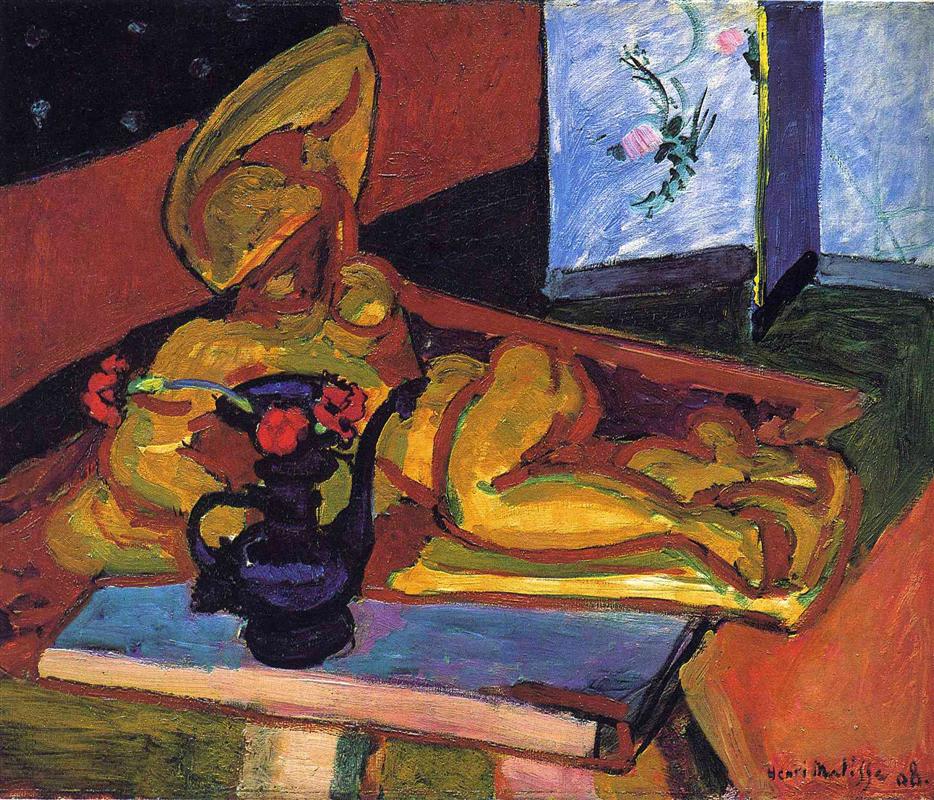
Henri Matisse’s Sculpture and Persian Vase (1908) is a blisteringly vivid studio scene that turns three familiar motifs—the reclining figure, the still-life vessel, and the window—into a compact drama about color, materials, and the act of making art. A glowing yellow-gold sculpture reclines diagonally across a shallow tray or shelf. In the foreground a dark, sinuous Persian ewer crowned with red blossoms stands like a sentinel. To the right, cool panes of blue window light flicker with a few calligraphic floral signs. Everything is bound by assertive black drawing and by the slanted geometry of the table and walls. What might have been a quiet record of beloved objects instead becomes a manifesto: painting can absorb sculpture, decoration, and interior space, and fuse them into one singing surface.
Historical Context
In 1908 Matisse was consolidating the breakthroughs of the Fauve years. The chromatic shock of 1905–1906 had already scandalized Paris; now he sought equilibrium—retaining audacious color while giving forms a new structural dignity. He was also actively sculpting, producing a series of simplified nudes whose masses and planes informed his painting. At the same time, his studio was filling with textiles, ceramics, and artifacts from the Islamic world and beyond. Sculpture and Persian Vase grows from this confluence. It is not a view “out there,” but a view of the artist’s inner world—his objects, his window, his color thinking—staged to test how far painting can orchestrate disparate materials into a single harmony.
The Studio as Theater
Matisse often treated his studio as a performance space. Here the stage is shallow and oblique: a trapezoid of ocher tabletop thrusts from the lower left toward the right edge; walls tilt in strong diagonals; a dark band cleaves the back of the room. This skewed geometry is deliberate. It abolishes academic perspective, presses the actors forward, and keeps the viewer alert to the picture plane. The protagonists—the reclining sculpture and the Persian vase—occupy distinct registers but share the same spotlight: a fierce orchestration of yellow, red, blue, and black that turns the room into a set of color-charged planes.
Composition and Spatial Design
The dominant diagonal is the sculpture itself, a luminous stripe that crosses the picture from left to right. Its tray repeats that diagonal, doubling the sense of motion. The ewer interrupts with vertical authority, its curved spout and handle countering the sculpture’s long recline. The window divides the right background into two cool rectangles whose hinge introduces a second, quieter diagonal, like a page half-turned. Matisse keeps depth extremely shallow. Overlap, not perspective, tells us where things are. The ewer sits in front because its black silhouette slices across everything else; the figure lies behind because the tray’s rim cuts underneath the ewer’s belly. Space here is a choreography of edges, not a measured box.
Color Architecture
Color is the true architect of the scene. The sculpture is built from cadmium yellows and ochers driven by green and red notes, then clamped with ebony outlines. The room around it burns in warm reds and earths, while the window glows icy violet-blue—a cooling agent that stops the canvas from overheating. The ewer is a near-black indigo, so dense it reads like a hole cut into light; its red blossoms flash the picture’s hottest accent. Matisse positions complementary couples—yellow against violet, red against green, blue against orange—so that each hue heightens its opposite. The palette is saturated but carefully parceled; every color patch is a structural decision, not mere embellishment.
Contour as Binding Force
Bold contour—thick, elastic, and visibly brushed—binds the composition. Around the sculpture the lines swell and thin like a sculptor’s chisel marks, declaring planes rather than tickling details. The ewer’s silhouette is cut with calligraphic certainty; its blackness sets the key for the whole foreground. Even the window panes wear a dark seam that keeps their cool light in place. These lines do what the lead in stained glass does: they contain radiance while making it glow harder. The dominance of contour also acknowledges Matisse’s sculptor’s eye. The body is not described by incremental shading; it is assembled from planes whose edges are decisive.
Light and Atmosphere
There is no single theatrical light source. Instead, the painting breathes a generalized luminosity that shifts with color. The window is the most literal indication of light, but it acts more as a chromatic foil than as a realistic sun. The sculptural nude shines because yellows drum against blacks and greens, not because a beam of light falls across it. The tabletop reads as illuminated because a narrow violet strip and a pale bar wrestle with the ewer’s darkness. This approach keeps the surface honest—light is not illusionist modeling but color logic—and allows atmosphere to arise from temperature contrasts rather than from cast shadows.
The Sculpture as Subject
Matisse does not depict a living model but a sculpture of a reclining nude, likely a studio cast or a piece he had at hand. This choice matters. A sculpture is already a translation of body into plane; it invites the painter to translate a translation. By painting a sculpture, Matisse doubles the act of abstraction and heightens awareness of material. The figure’s masses are planar and emphatic; the torso is a stack of convex shields, the thigh a firm cylinder, the head a compressed wedge. Seen this way, the subject is not “a woman reclining” but “a set of volumes reclining,” an education in how bodies can be built from shape alone. The golden color underscores this idea: the figure shines like cast metal, a constructed object rather than soft flesh.
The Persian Vase as Counterform
The ewer is the sculpture’s foil. Where the nude sprawls and opens, the vessel tightens and closes. Where the nude is warm and bright, the vessel is cool and nearly black. Where the nude is heavily faceted, the vessel is smooth, continuous, and emphatically hollow. Its spout points toward the reclining body like a conductor’s baton, and the two red flowers perched on the rim echo the sculpture’s warm key while remaining firmly attached to their dark base. The object is “Persian” not to exoticize the scene but to honor Matisse’s love of Islamic art, whose rich color, calligraphy, and pattern had taught him that decoration could be structure. The ewer’s silhouette behaves like a character and like a glyph at once.
The Window: Painting within the Painting
On the right, a two-pane window swings open. Instead of detailed scenery, we see a periwinkle blue field bearing a few floating floral signs. The panes thus act like small canvases inside the larger canvas, repeating Matisse’s belief that a wall, a screen, or a window can be pure color plane. Functionally, the window cools the scene; compositionally, it supplies a vertical hinge that prevents the sculpture’s diagonal from sweeping the picture off the table. The floral marks are delicate—thin greens and rose touches—proving that a few signs can stand for the world outside without breaking the painting’s modern flatness.
Brushwork and Materiality
The paint surface is rugged and frank. Thick, slashing strokes build the sculpture’s planes and leave ridges that catch light like the facets of metal. In the ewer, darker pigment is packed densely, then sliced by the brush to leave glints of violet. The tabletop is scrubbed and dragged so that its colors knit into one vibrating field. The window is laid with broader, more even passes, allowing underlayers to breathe through and keeping that zone airy. Throughout, Matisse resists polish. He wants the making to be visible, to remind us that every form is a decision, every edge a negotiation between line and color.
Ornament as Structure
Pattern enters in three places: the red blossoms on the ewer, the floating floral signs in the window, and the small, dotted sparks on the dark wall. None of these details is mere décor. The blossoms are chromatic anchors that balance the yellow figure; the window flowers bridge the inside and outside; the dots activate the black field so that it reads as depth without deadness. Matisse’s decorative imagination is always architectural. Pattern carries weight—it straps zones together and tunes their intensity—so the whole surface hums like a tapestry.
Interplay of Media: Painting Meets Sculpture
By setting a painted sculpture beside a painted vessel, Matisse stages an encounter between media. Sculpture brings the lesson of mass and plane; ceramics bring the lesson of silhouette and interior void; painting absorbs them both and adds color as its unique power. The result is a kind of “studio ecology” where each medium teaches the others. The reclining figure gains monumental credibility from sculptural logic; the ewer gains emotional resonance from painterly color; painting proves it can synthesize them into an image that is not a copy of reality but a parallel construction.
Cultural Crossings and the Ethics of Looking
The title acknowledges the Persian origin of the ewer and the floral signs in the window nod to an ornamental language not native to France. Matisse collected such objects with deep admiration, learning from their clarity of shape and their fearless color. In the painting, these references are not used to exoticize the nude but to enrich the studio’s visual vocabulary. The reclining sculpture, the Persian ewer, and the calligraphic window all become equals in a democratic field of color and line. The ethics of looking here is one of respect: attention is paid to the integrity of forms and to the systems of beauty from which they come.
Rhythm, Time, and the Diagonal
The diagonal thrust of the sculpture creates momentum, as if the studio were caught mid-breath. That rhythm is slowed by the ewer’s upright pause and by the window’s hinged calm. The viewer’s eye loops: from the ewer’s red flowers along the sculpture’s torso to the cool panes and back, catching on the bright edges where yellow meets black. Time in the picture is not narrative but musical—the repetition of forms, the return of colors, the alternation of warm and cool passages—so that perception itself becomes the story.
Comparisons within Matisse’s Oeuvre
Seen against Matisse’s 1907 canvases, Sculpture and Persian Vase is more compressed and theatrical. It shares with The Blue Nude the sculptural conviction of the figure and the authority of contour, but it swaps outdoor greenery for a highly controlled interior stage. It also foreshadows the grand interiors to come—The Red Studio and The Pink Studio—where objects from Matisse’s room stand in charged color fields like actors in suspended time. The ewer’s commanding silhouette anticipates the black arabesques that will lace his later odalisque rooms, and the window’s blue panes prefigure his habit of turning architecture into large, unmodulated planes of color.
Light Without Illusion, Depth Without Perspective
The painting shows how modern images can achieve luminosity and depth without clinging to Renaissance rules. Light is the sum of color relationships, not a beam defined by physics; depth is the sum of overlaps and tonal contrasts, not converging lines. The ewer is forward because it is darkest and most crisply bounded; the sculpture is middle distance because its yellows are modulated by greens and browns; the window recedes because its cools are least saturated and cut by a clean vertical seam. The viewer senses space, but never forgets the flatness of the canvas—an honest pact that defines Matisse’s mature practice.
Emotional Tone
Despite blazing color, the mood is contemplative. The figure, though bright, is self-contained; the ewer, though dark, is festive with flowers; the window opens to a placid, abstracted outdoors. The studio feels like a sanctuary where objects gather for soundless conversation. This tone reflects Matisse’s belief that painting should provide a kind of armchair repose, not by dulling sensation but by harmonizing it. Even the boldest contrasts here resolve into calm, the way a strong chord finally settles the ear.
Legacy and Continuing Relevance
Sculpture and Persian Vase endures as a lesson in synthesis. It demonstrates how an artist can honor multiple traditions—classical sculpture, Islamic ornament, French still life—without pastiche, fusing them into a personal grammar of color and line. It also shows how a room of everyday things can become a site for big ideas about representation: what it means to turn mass into plane, light into color, object into sign. For painters today, the canvas offers a toolkit: use contour to dignify, color to structure, pattern to bind, and diagonals to animate. For viewers, it offers the joy of seeing a world remade as rhythm.
Conclusion
Henri Matisse’s Sculpture and Persian Vase is a studio opera sung in primaries and blacks. A golden reclining figure, a midnight-blue ewer with scarlet flowers, and a cool, calligraphic window are arranged on a slanted stage where every edge matters and every color pulls its weight. The painting melds sculpture’s solidity with painting’s chromatic breath, and it turns decoration into architecture. Made in 1908, it helps define the path from early Fauvist exuberance to the poised, decorative interiors that would soon follow. It is intimate in subject and monumental in effect: a testament to how the simplest things—an object, a body, a window—can be orchestrated into a harmony that feels both timeless and fiercely modern.