Image source: wikiart.org
Introduction
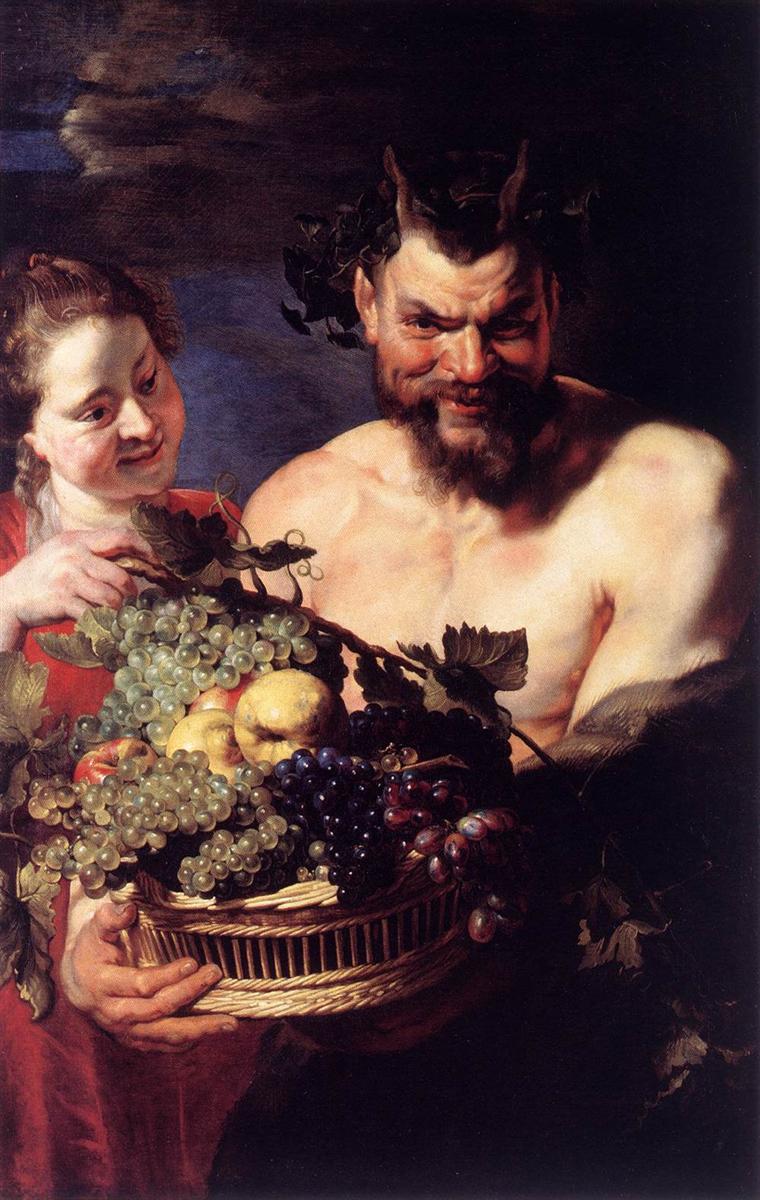
Peter Paul Rubens’s “Satyr and Girl” (1615) compresses a whole mythological world into a tightly framed half-length encounter. A vine-crowned satyr, horned and broad-chested, thrusts a wicker basket forward, its rim brimming with grapes and apples slick with light. At his shoulder a young girl in a coral red dress leans in, her eyes gleaming with humor and complicity as she fingers a sprig of vine. The sky behind is a swirl of darkening blues and storm-colored greys, yet the foreground detonates with radiance: glassy white grapes, ink-blue clusters, golden skins, and a lacquered arm that catches the sun. The picture is neither moral lecture nor simple genre scene; it is a concentrated allegory of appetite and abundance, where rustic pagan energy meets courtly painterly luxury. Rubens binds the sensual and the comic into a single, convincing gesture of offering.
A Baroque Close-Up Of Myth
Where Renaissance bacchanals scatter revelers in landscape, Rubens advances the figures to the very edge of the picture plane. The satyr’s shoulder breaks the pictorial air like a prow; the basket all but touches the viewer’s hands. This proximity is Baroque in spirit—dramatic, persuasive, and social. It turns the myth into an encounter and the viewer into a participant. The gods do not remain safely allegorical; they breathe our air, making their invitation to feast feel immediate and slightly dangerous.
Composition As A Choreographed Offering
The structure of the painting is triangular. The base runs along the basket’s wide ellipse; the apex is the satyr’s horned brow. A secondary triangle links the girl’s profile, her hand plucking vine leaves, and the satyr’s curling smile. These interlocked shapes produce a subtle centrifuge toward the fruit, the literal center of exchange. The diagonal of the satyr’s forearm delivers the basket into the viewer’s space, while the girl’s leaning head counters the thrust, keeping the composition from tumbling forward. Rubens’s choreography is half marketplace, half flirtation: an offer is made, appraised, and—at least in paint—accepted.
Light That Makes Things Edible
The light is angled from the upper left, a soft sun that turns skins to glaze and hair to gold. Transmitted highlights bead along the translucent grapes; reflected highlights spark on the apples; coarse vine leaves go matte, absorbing the brightness like felt. The satyr’s shoulder takes a broad, warm sheen, then drops into a cool shadow that defines pectoral and deltoid with sculptural clarity. On the girl’s cheek the same light slants more gently, lending her expression an inner glow. This is not theatrical chiaroscuro for its own sake; it is an edible illumination. Rubens paints light as if it were flavor, making the fruit’s sweetness palpable long before any mythic meaning comes into focus.
Color As A Climate Of Plenty
The palette is a robust chord of flesh-tones, wine reds, golds, and deep grape purples set against the stormy indigo of the sky. The girl’s dress strikes a saturated coral that rhymes with the blushes on the fruit while warming the cooler greens of the vine. The satyr’s tanned skin and black, ivy-snarled hair anchor the arrangement so that brightness has gravity. Color in the picture behaves like a harvest table: generous, varied, and balanced by the rough bread of shadow.
Satyr, Girl, And The Politics Of Looking
The two figures read like an allegory of appetite mediated by wit. The satyr looks outward with a conspiratorial grin, horns pricking the sky, eyes narrowed in mock solemnity. It is the face of rustic mischief, a master of ceremonies at the threshold between vineyard and feast. The girl, by contrast, looks sideways at him, not at the viewer, her pleasure wrapped in a more civilized delight. She is no abducted nymph; she is complicit, amused, perhaps even in charge of how the offering will be received. Their gazes set up a triangle with the basket as third point: he offers, she appraises, we desire.
Touch, Texture, And The Rhetoric Of Hands
Few painters equal Rubens in the eloquence of hands. The satyr’s left hand flexes under the basket’s weight, fingers splayed, knuckles polished by light, the fingernails catching tiny glints that make the burden believable. The right forearm, hairy and sinewed, supports the far side, its heft implied by a faint compression along the wicker rim. The girl’s fingers, in contrast, are light and articulate, teasing a vine tendril that curls like punctuation. Texture speaks: coarse hair, smooth grape, tanned skin, hard wicker. The rhetoric is not verbal but tactile; belief in the scene arrives through our skin.
Allegory Of Autumn And Exchange
Rubens’s Antwerp knew the value of seasonal plenty. This half-length myth can be read as a personification of Autumn or Vintage, where the satyr stands for the unruled force of nature and the girl for cultured enjoyment. The offer of fruit is also an offer of social exchange: the raw bounty of the field brought to the city’s table, appetite made convivial by ceremony. In an age of mercantile diplomacy and civic banquets, the painting celebrates a pact between the woodland’s exuberance and the town’s manners. It is abundance disciplined not by denial but by sharing.
The Satyr As Self-Portrait Of Earthiness
The satyr’s character is good-humored rather than predatory. Rubens avoids the leering ravisher and paints a broad, almost theatrical personality with laugh-lines, grape-stained beard, and a grin that acknowledges his own performance. The small horns and ivy crown brand him as Bacchic, but his humanity dominates. Viewers of Rubens’s time would have recognized a familiar type—the jovial guild brother pouring wine at a kermis, the vintner proud of his best basket, the uncle announced by merriment before he enters a room. The mythic mask becomes a mirror for festive sociability.
The Girl As Arbiter Of Taste
The girl’s role is critical. Her coral dress and luminous skin anchor the image in civilized delight. She is patron and guest, taster and judge. Her expression signals discernment rather than surrender; she measures ripeness, admires craft, and shares the joke. In a culture where taste—both gustatory and aesthetic—signaled status, her presence makes the offering more than rustic plenty. It becomes connoisseurship, the moment when nature meets the palate and turns into culture.
Fruits With Specific, Local Truth
Look closely at the harvest and one discovers not generic fruit but varieties a northern viewer would recognize: tight clusters of white grapes dusted with bloom, small dark grapes with reddish translucency at the edges, yellow apples carrying a greenish undertone where the skin thins, a partial apple whose bite-like notch invites the tongue. Leaves are ragged at the edges, veins traced with knowing brevity; tendrils kink into spirals that catch on fingers. Rubens paints as a gardener and shopper, not merely as an allegorist. The specificity seals the picture’s credibility.
Sky, Weather, And The Drama Of Foreground
Behind the pair, the sky swirls in storm-blue and slate, with a lighter seam near the girl’s head that lifts her profile from the darkness. The weather is not a landscape report; it is a mood device. The foreboding sky throws the warm foreground into relief, just as fasting sharpens appetite before a feast. It also reminds us that abundance is seasonal and therefore precious. Storm may come; harvest must be gathered and enjoyed together while it can. In that sense, the sky introduces a gentle memento temporis—a memory of time—against which the foreground’s plenitude glows.
Italian Memory, Northern Appetite
Rubens returned from Italy with Titian’s color and antique bodies in his eye, yet he translated those lessons into the textures of the Low Countries. The satyr’s torso possesses Venetian warmth, but the fruit and wicker are painted with Netherlandish relish for things. Caravaggist realism might be sensed in the close framing and the forward thrust of the basket, but the mood is sunnier, more civic, less moralizing than Caravaggio’s sharp tableaux. The synthesis—Italianate flesh married to Flemish still-life truth—explains the painting’s durable charm.
Painterly Method And Passages Of Virtuosity
Rubens builds flesh with semi-opaque mixtures of warm ochres and cool greys, then fuses transitions by softening with a wide, loaded brush that lays wet into wet. Brights are struck in single, confident touches: a stroke along the satyr’s brow ridge, a ping on a grape, a flick across a thumbnail. The wicker is a marvel of economy—parallel, curved strokes that tighten under the highlight and loosen in shadow, creating the illusion of weave without pedantry. The ivy crown is handled with broken, calligraphic marks so that leaves seem to tremble in the wind. Virtuosity serves persuasion: the more immediate the paint, the more immediate the offering.
Humor As Civilizing Force
What safeguards the painting from crude sensuality is its humor. The satyr’s expression is knowingly comic, the girl’s enjoyment quick and conspiratorial, the basket almost too abundant, as if the picture admitted the extravagance and smiled at itself. Rubens often uses laughter to humanize myth; here it is the moral instrument that turns appetite into sociability. We are invited to enjoy and to enjoy together.
A Half-Length That Behaves Like Portraiture
Though mythological, the painting borrows the codes of portraiture: three-quarter turn, close cropping, loaded foreground still life. One could imagine the pair stepping out of a civic portrait session and reaching for a prop basket. That hybrid identity—portrait and allegory—made the picture eminently collectible for Antwerp households, where such works decorated dining rooms and reception chambers and where guests could banter about Bacchus, vintage, and taste while also admiring the painter’s powers of likeness and matter.
The Moral Physics Of Abundance
The basket is heavy. You feel it in the tendons of the satyr’s wrist and in the way the wicker rim is driven down by the grape mass. That weight carries an ethical whisper: abundance is work. Vines are trained, grapes cut, baskets woven, wine pressed. The painting honors the labor that underwrites feast. It therefore justifies pleasure not as entitlement but as communal reward. In this, the picture aligns myth with civic virtue.
The Viewer’s Path Through The Image
A satisfying way to look is to start at the darkest grapes near the lower right, step up the rim to the translucent whites, pause at the apple’s yellow flare, and then ride the satyr’s forearm to the grinning face. From there, drift to the girl’s glance and back down through her hand to the vine tendril, completing a loop that returns to the fruit. Each circuit alternates desire, recognition, and consent—a choreography of looking that echoes the painting’s argument.
Relationship To Rubens’s Diana And Pan
In the same years, Rubens painted “Diana Presenting the Catch to Pan,” another exchange of harvests between rustic and civilized realms. “Satyr and Girl” is the chamber-scale pendant: no entourage, no landscape, just the transaction itself. The basket replaces the stag; the girl’s quick wit stands where Diana’s sovereign discipline had stood; the satyr moves from suggestive suitor to genial vintner. The reduction clarifies the theme: myth is a language for the human pleasure of giving and receiving.
Why The Picture Still Feels Fresh
The painting still works because it achieves three balances at once. It balances frank sensuality with social humor, so the image remains joyous without coarseness. It balances high artifice—the choreographed triangular composition and Venetian color—with tangible matter: baskets, grapes, skin. And it balances time: a classical past animates a recognizably early modern present, which in turn echoes our own feasting and gathering. It is a simple proposition beautifully made: the world is good; take and share.
Conclusion
“Satyr and Girl” is Rubens at his most companionable. A mythic figure and a mortal child of the vineyard stand shoulder to shoulder, united by a basket whose weight we can feel and whose sweetness we can almost taste. Light turns fruit to jewels; color creates warmth like a hearth; hands do the talking; eyes seal the pact. In this compact theater of abundance, Rubens shows how appetite, when offered and received with wit and generosity, becomes culture. The painting makes a promise that extends beyond its moment: that joy is real, and that it is best when shared.
