Image source: wikiart.org
Introduction
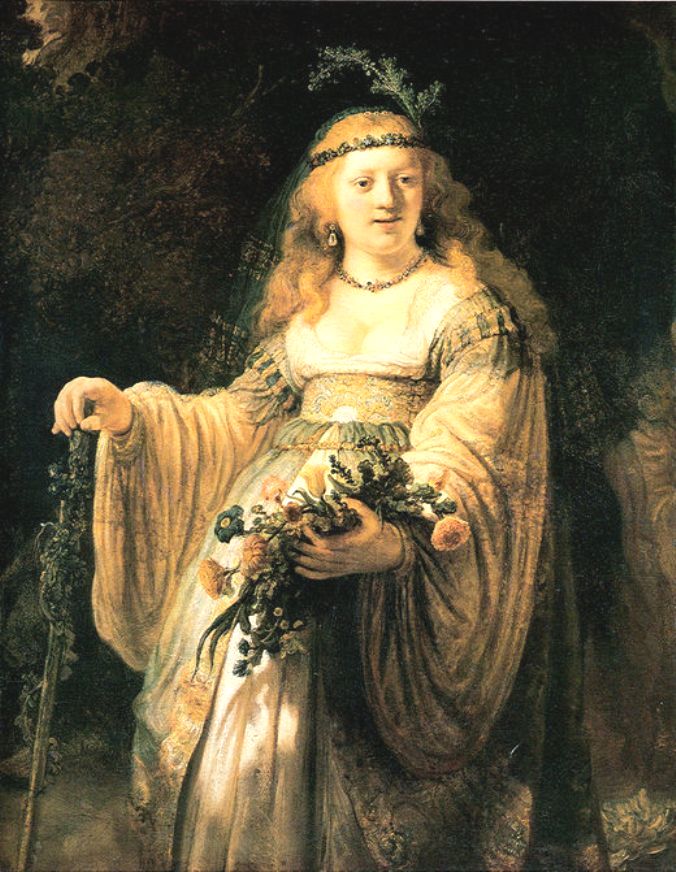
Rembrandt’s “Saskia van Uylenburgh in Arcadian Costume” (1635) is one of the most radiant love pictures of the Dutch Golden Age. Painted the year after the artist met Saskia—and the same year they would become engaged—the canvas shows her costumed as a shepherdess from the pastoral world of Arcadia. Flowers spill from her hands; a fillet and diadem crown her hair; a gauzy veil descends over a dress trimmed with gold; the staff at her side reads as both shepherd’s crook and elegant prop. The image fuses portrait and allegory, private affection and public show, theatrical splendor and psychological warmth. It is at once a celebration of Saskia’s beauty and a demonstration of Rembrandt’s early Amsterdam bravura: buttery impasto, starry highlights, and a chiaroscuro that falls like sunlight through leaves.
Arcadia in Amsterdam: Context and Ambition
In 1635 Amsterdam’s elite adored “portrait historié”—portraits of living sitters dressed as figures from myth, history, or pastoral poetry. The fashion allowed patrons to step into an ideal world while keeping their recognizable features. For Rembrandt, just twenty-nine and newly ensconced among prosperous collectors, the genre offered a perfect stage on which to show the breadth of his gifts. By clothing Saskia as a shepherdess, he connects her to the literary vogue for Arcadia—a land of innocence, music, and love—while crafting a modern image of abundance and pleasure. The painting thus functions as personal homage, stylistic calling card, and savvy participation in the culture of his day.
Allegory with a Pulse: Why Arcadian Costume?
The pastoral mask softens decorum. A respectable woman could hardly pose with a plunging neckline, flower sprays, and a trailing veil in everyday dress; as an Arcadian figure, she can. But the allegory does more than grant license for beauty. Pastoral imagery promises harmony between people and nature, between desire and virtue. Saskia’s garland, bouquet, and staff bind her to that ideal landscape. At the same time, Rembrandt keeps the allegory porous. Her face is not an abstract type; it is Saskia’s—intelligent, amused, luminous—which invites viewers to read the painting not as a mythic tableau but as a living person bathed in make-believe.
Composition: A Theater of Warm Light
Rembrandt builds a stately pyramid of forms with Saskia’s face as the apex. One arm descends to the staff; the other curves toward the cluster of blossoms that command the lower center. The triangular arrangement stabilizes the luxuriant details—sleeves, sash, veil, and bouquet—so the surface never feels crowded. Dark foliage frames the upper left, like a bower, deepening the contrast with her fair skin and gilded dress. The painter leaves pockets of darkness at the edges so that the illuminated figure seems to grow from shadow rather than stand cut out against it. This “emergence” is central to Rembrandt’s early style: light is not an afterthought but a structuring force that makes the world appear.
The Face: Warmth, Wit, and Rembrandt’s Affection
Saskia’s face carries the painting’s emotional weather. Rembrandt models it with soft planes of warm flesh tones cooled gently at the temples and under the eyes, creating the sense of skin lit by living air rather than by stage lamps. The mouth is slightly parted in what reads as a half-breath, a readiness to speak, smile, or receive. Her gaze is not distant or hieratic; it meets the viewer in friendly, almost conversational poise. When compared with his contemporary portraits of merchants and regents, this face is freer, more playful. The tenderness is unmistakable: Rembrandt is painting the person he loves.
Costume and Texture: A Symphony of Surfaces
The elaboration of costume is breathtaking. The ivory bodice and sleeves swell with satiny weight; a pale sash cinches the waist and releases into folds that capture light in ribbons; the outer gown shimmers with woven gold. Rembrandt’s brush describes every material with a different language. Feathery strokes and thin glazes give the veil transparency; short, raised touches of impasto render beads, pearls, and embroidered threads; soft scumbles suggest worn velvet and plush brocade. These material descriptions are not mere catalog; they are the visual music that makes Arcadia sensuous, a place the eye can inhabit.
Flowers and Meaning
The bouquet Saskia holds is more than pastoral décor. Dutch viewers, fluent in floral symbolism, would have read virtues in the blooms: roses for love, carnations for marital fidelity, possibly peonies or tulips for prosperity and spring’s renewal. Rembrandt, who loved still-life effects, paints the flowers with a restrained exuberance—some crisp, some already wilting—to give the bouquet the time signature of real life. Their colors, echoing the warm palette of the dress, bind the still-life passage to the portrait as if the fruitfulness of the newly promised marriage overflows into the world.
The Staff and the Gesture of Ease
In her left hand Saskia steadies a staff ornamented with ribbons and perhaps ivy. The object performs triple duty. It identifies the Arcadian persona, flirts with the ceremonial scepter of a queen, and provides a vertical that offsets the circular eddies of sleeves and bouquet. The loose grip—more caress than clutch—relaxes the figure. She is not on guard; she is at ease, as if the pastoral role fits her the way the dress does, snug in spirit and flattering to form.
Light as a Love Language
Few painters use light as intimately as Rembrandt. Here sunlight seems to sift through leaves, striking Saskia’s forehead, collarbone, and the round of her shoulder before cascading down the folds of her dress. Small highlights—minute dabs on a pearl, a glitter on the sash, a leaf’s edge—sparkle like private signals. The light is not neutral; it behaves like affection. It lingers on what the painter cares about, draping attention over face and hands before sliding off into cooler browns and greens at the periphery. This distribution of radiance draws the viewer’s focus exactly where Rembrandt wants it: Saskia’s presence before all else.
Color: Honey and Meadow
The palette glows with warm honeyed golds, creamy ivories, soft greens, and dusky pinks, with the occasional deeper note in the background to keep the orchestra grounded. These colors have narrative value. Gold speaks to celebration and plenty; green ties Saskia to the pastoral setting; ivory upholds her radiance without shouty brilliance; the pinks enliven cheek and flower, warming the myth with human life. Even the shadows remain colored and breathable, never falling to dead black. The result is a canvas that feels alive at every value—a Baroque feast without heaviness.
A Portrait of Partnership
Although the painting belongs to the public genre of allegorical portraiture, it is also a private testament. Saskia does not appear as an emblem set apart from the artist; she is Rembrandt’s partner, his chosen Arcadia. The lavishness celebrates not only her beauty but the union itself—the promise of shared prosperity and joy. When the painting is set beside Rembrandt’s many studies of Saskia—drawings at the window, etchings in cap and veil—this allegory reads like a crown on a suite of more intimate images. It tells us how he wanted the world to see her even as he treasured the quieter versions for himself.
Comparison with “Flora” and Other Pastorals
The kinship with Rembrandt’s “Flora” is obvious: both canvases show a richly dressed figure crowned with flowers and bearing a staff. But where Flora is the Roman goddess of spring and fertility, Saskia as Arcadian shepherdess is more personal and less myth-heavy. The emphases differ. Flora radiates official abundance; Saskia radiates companionable warmth. She is not enthroned but standing, mid-motion, in a woodland space. The two pictures form a dialogue about abundance—one public and mythic, the other domestic and affectionate.
Chiaroscuro and the Drama of Nearness
Baroque painters loved dramatic contrasts, but Rembrandt’s chiaroscuro is rarely mere bravura. In this work the dark keeps the eye close. Outside the halo of light surrounding Saskia, the space drops away quickly into shadow, as if the world beyond her were dimmed to serve the subject. The effect is intimacy at scale: even in a richly staged costume piece, we feel physically near her. The darkness behind is theatre curtain and forest at once, deepening the focus and multiplying associations.
The Veil and the Glow of Skin
The gauzy veil is a triumph of painting as illusion. Rembrandt sets it off with the barest of tonal shifts and quivering edge-work so that it reads as translucent air rather than opaque cloth. Through it, the glow of Saskia’s hair persists, soft and warm. That hair-light transitions seamlessly to the glow of skin at neck and chest, where the painter’s handling becomes especially tender. Highlights are small and specific, avoiding the porcelain shine seen in courtly portraits. The flesh seems to breathe, its warmth dialoguing with the cool gleam of silk and the sharper sparkle of jewels.
Ornament that Serves Character
Pearls, pendant, belt buckle, and embroidered trim supply the “Arcadian treasure” that patrons adored. But Rembrandt never allows ornament to overrule character. He places the richest clusters at the periphery—sleeve trims, belt, veil edge—so they lead the eye back to face and hands. Where he uses impasto heavily, he does so with purpose: to catch real light at the surface and animate the movement of the figure. The jewelry does not harden Saskia into a statue; it quickens her.
A Pastoral of Sound and Scent
While painting is a silent medium, Rembrandt evokes senses beyond sight. The brushy sprays of leaves imply a rustle of wind in the grove. The bouquet—roses, carnations, perhaps peonies—conjures scent. The soft folds suggest the whisper of silk. These sensory cues are part of the Arcadian promise: a world where the senses, disciplined by love, lead not to excess but to harmony. The painting communicates that harmony without didactic symbols; you feel it in the way textures, colors, and light collaborate.
The Viewer’s Role
Rembrandt composes the figure so that Saskia seems to have just turned toward us, flowers bunched, staff tilted, veil settling. The slight opening of the lips invites exchange: a greeting, a jest, a question. We are not put at the distance of a court viewer; we stand roughly at her height, a companion in the grove. That democratic placement is quintessentially Dutch and quintessentially Rembrandt. Even at his most opulent, he engineers a meeting rather than a spectacle.
Time and the Promise of Spring
Although the picture is richly present, it carries a temporal undertone. Flowers are fresh now, fragile later; youth glows now, matures later. The pastoral tradition often balances delight with awareness of change. Rembrandt lets just a touch of that memento lurk in the bouquet’s mix of blossoms—some tightly budded, others already softening at the edges. The point is not melancholy but savoring. The painting captures a season—in love and life—when abundance is new.
Technique: Impasto, Glaze, and the Breath of the Brush
Close looking reveals the craft behind the enchantment. Rembrandt alternates thin glazes with thicker, opaque passages so that light sometimes seems to rise from beneath and sometimes to sit at the surface. In places—beads, gold trim—he lays raised points of paint that catch actual light, giving the sense of sparkle as you move. Elsewhere—veils, shadows—he lets the brush drag almost dry so the ground shows through, providing air. The result is a living surface, responsive to real light, which deepens the pastoral illusion.
Reception and Legacy
Images of Saskia in costume helped establish Rembrandt’s reputation as the painter who could unite psychological truth with Baroque splendor. Later centuries would sometimes dismiss such pastorals as “theatrical,” but modern viewers have rediscovered their intimacy. The sincerity of Saskia’s presence disarms the elaborate trappings. You do not have to believe in Arcadia to believe in the affection that shaped this work. The painting remains a high note in the story of portraiture’s capacity to absorb fantasy without losing honesty.
Why the Painting Still Feels Fresh
The canvas feels fresh because it looks like a present tense. Saskia stands before us, not as a relic of myth but as a person in play—a young woman asked to dress up for her lover-artist and, in the process, discovering a new self. The bloom of the paint, the warmth of the palette, the quick spark of the highlights: all of it carries vitality rather than museum quiet. At a time when images can feel overdetermined, this one leans into joy.
Conclusion
“Saskia van Uylenburgh in Arcadian Costume” is more than a costume piece. It is a portrait of delight, of a couple inventing an image of their happiness using the visual poetry available to them—Arcadia, flowers, gold, a grove of shadow and light. Rembrandt gives the allegory a heartbeat by keeping Saskia palpably herself, by letting light behave like love, and by allowing texture and color to celebrate the world’s pleasures without drowning character. Four centuries on, the painting still invites us into its grove where affection, artistry, and the promise of spring meet and glow.