Image source: wikiart.org
An Intimate Study of Rest and Love
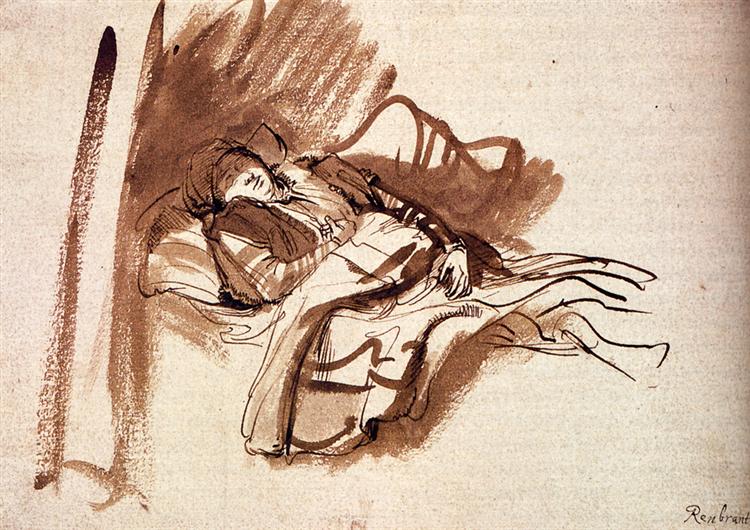
Rembrandt’s “Saskia Asleep in Bed” is one of the most disarming works from 1638: a quick pen-and-brown-ink drawing heightened with washes that records his young wife, Saskia van Uylenburgh, drifting into sleep. The subject is ordinary—a nap. The treatment is extraordinary—an artist’s eye turning domestic quiet into a scene of deep feeling. No allegory, no costume, no theatrical light; just a figure, a pillow, a handful of folds, and the soft gravity of exhaustion. The drawing reads like a whisper.
A Private Moment Made Public With Care
Unlike the grand portraits Rembrandt painted for patrons, this sheet was almost certainly made for himself. That intimacy shapes every choice. Saskia’s body lies diagonally across the page, head sinking into a thick pillow, one hand tucked up to her cheek, the other gone slack at her side. The bed rail—suggested by a looping contour—arches behind her like a gentle brace. Because nothing is formal or staged, the viewer feels invited yet not intrusive; Rembrandt’s empathy makes room for us without violating her privacy.
The Diagonal Composition and the Feeling of Falling Asleep
The drawing’s primary movement is diagonal, from the high left corner down to the low right where Saskia’s skirt dissolves into strokes. Diagonals suggest motion; here they suggest the slow slide into sleep. The tilt of her torso toward the right edge is echoed by the flung ribbons of line describing the blanket’s edge. Even the long, vertical wash at far left operates as a counterweight—like a door frame or bed post—stabilizing the swoon of the diagonal. We don’t just see sleep; we feel its pull.
Gesture That Tells the Whole Story
Rembrandt builds Saskia’s posture with a few decisive lines. The forearm under the pillow bends at a restful angle; the hand near her face curls loosely, neither gripping nor reaching; one knee rises slightly beneath the bedclothes; the other leg trails away, line thinning into suggestion. The clarity of these gestures makes the drawing legible from across a room. Up close, small corrections—repeated strokes on the sleeve, a second pass on the pillow’s outline—reveal an artist refining sensation, not anatomy.
Pen, Ink, and Wash Working Like Breath
The sheet is a demonstration of mixed media used with restraint. Rembrandt lays the figure in with quick, elastic pen lines; then he floods the shadowed zones with warm brown wash. Around the headboard a broad, dry brush scumble records the darker field behind Saskia without fussing the furniture’s specifics. Wash gathers under her arm, along the hollow of the waist, and beneath the thrown folds of the skirt, so that shadow functions like gravity. You can sense the rhythm of the hand: draw, breathe, wash, pause, and return for the telltale accents.
Chiaroscuro Without Theatrics
The drawing’s light comes from the paper itself. Rembrandt leaves highlights untouched—the small triangle on Saskia’s forehead, a flare on the nose, the white of the collar, the tops of a few folds. Washes create zones of half-tone; the inked contour deepens the essential edges. Because nothing is heavily modeled, the scene keeps the openness of daylight. Chiaroscuro here is not stagecraft; it is the way domestic light pools around a resting body.
Clothing, Folds, and the Ethics of Touch
Saskia’s dress is indicated rather than described: a bodice with simple trimming, sleeves with small ruffles, a skirt falling in long arcs. The folds at her waist form a river of line that narrows as it runs toward the foot of the bed. Rembrandt’s touch becomes more calligraphic the farther it gets from her head and hands, directing our attention where feeling concentrates. The difference between face and fabric is an ethical decision—he refuses to fetishize material and instead invests the tender parts with the most care.
A Pillow That Holds the Weight of Love
Few objects in Rembrandt’s art are as eloquent as this pillow. A few thick wash strokes make its mass; a handful of linear ripples imply seams and compressions. Where Saskia’s head rests, the pillow yields; where it lifts, the edge catches light. That small physics of weight and give becomes a metaphor for the marriage itself: presence rests on support, and support shapes itself to presence. The pillow holds the quiet drama of trust.
The Face Drawn From Life
Saskia’s face is rendered minimally yet convincingly: a curved brow, closed eyelid suggested by a short stroke, the nose rounded by a touch of wash, and lips relaxed in a soft line. The chin sinks toward the breast, compressing the neck slightly—an unmistakable sign of sleep. There is no idealization, no cosmetic correction; if anything, Rembrandt exaggerates the heaviness of rest. This honesty gives the drawing its authority. We believe the moment because he refuses to prettify it.
The Bed as a Stage of Everydayness
The bed’s structure is barely there: a vertical post at left, the wavy line of the back rail, and a few hatching strokes on the mattress. But those minimal marks establish the room as a knowable place. The bed is neither sumptuous nor poor; it is ordinary. That ordinariness is theological in Rembrandt’s world: the sacred hides in the daily, and a sleeping wife can be as worthy of attention as any saint.
Speed, Revision, and the Visible Hand
Look closely at the skirt’s hem where Rembrandt lets lines trail, some even overshooting the edge before lifting the pen. These “mistakes” are the best proof that the drawing was made in the presence of the subject, at speed. Near the hand resting on the torso he reinscribes a contour for clarity. Small accumulations of ink at the ends of strokes betray the pressure and release of the nib. The hand is visible in every centimeter, and with it, the tempo of looking.
The Paper’s Color as Atmosphere
Time has warmed the paper to a soft buff, which harmonizes with the brown ink and wash. That shared warmth wraps the scene like lamplight. Because the palette is monochrome, value does all the expressive work. The light paper plays the role of clean sheet; the mid-tone wash acts as blanket; the darkest ink grounds figure and pillow. Atmosphere arrives through hue unity and value contrast rather than through elaborate shading.
Intimacy Without Voyeurism
Depicting a sleeping woman risks voyeurism; Rembrandt avoids it by honoring boundaries. Saskia’s pose is closed and self-contained. The artist positions us above and slightly to the side, not at her eye level, avoiding the fiction of face-to-face encounter. There is tenderness in the way he shades her face and a protective humor in the calligraphic chaos of the bedclothes, like a curtain of scribble between viewer and body. The drawing loves without prying.
The Drawing as Love Letter
Read as a document of marriage, the sheet is a love letter in ink. Rembrandt records not just what Saskia looked like, but what it felt like to be near her as she slept: the hush, the soft thud of fabric settling, the ritual glance before you dim a candle. Many artists of the period produced ideal beauties; Rembrandt produced a specific person at a specific hour. That specificity is the most durable tenderness a drawing can offer.
Relationship to Rembrandt’s Other Domestic Studies
This sheet belongs to a cluster of intimate drawings from the late 1630s and early 1640s: women nursing, people reading in bed, a child learning to walk, a spouse at a window. Across them he tests a credo—ordinary life is inexhaustible subject matter. “Saskia Asleep in Bed” may be the simplest of the set, and perhaps the most distilled: gesture, light, and love reduced to the fewest lines that will still tell the truth.
What the Minimal Background Achieves
The near-blankness around the figure performs two tasks. First, it isolates Saskia so that the viewer’s attention does not drift to furnishings. Second, it turns the page into a breath of air. The unmarked paper behaves as silence, deepening the sense that the room has quieted. In a more detailed interior we might begin to narrate: a chair there, a window here. Rembrandt denies us that busywork and keeps the focus where it belongs—on sleep.
Time, Care, and a Changing Household
The year 1638 sits early in the couple’s marriage, before the tragedies that would later shadow their home. That knowledge adds poignancy but should not govern our reading. The drawing is not an elegy in advance; it is a record of an afternoon’s peace. What gives it depth is the way care permeates every decision. Even the wildest wash marks seem arranged to keep her face undisturbed.
The Sound of the Drawing
If a drawing can have sound, this one does: the faint scratch of nib on paper; the quiet drag of a loaded brush laying wash; the rustle of cloth shifting after a breath. Rembrandt’s marks cue that acoustic imagination. The heavy wash behind the bed reads like a wave of muffled room noise; the thin lines at the skirt’s edge taper the sound into silence. The sheet is nearly audible.
How to Look, Slowly
Start at Saskia’s forehead where the paper’s light is most naked. Follow the curve of the closed eyelid and trace the small shadow at the nose’s underside. Drop to the hand tucked under the cheek and feel the pillow give. Move across the bodice, noticing how a single wash pool establishes depth. Let your eye ride the long arcs of skirt and blanket to the lower right where lines feather into air. Then climb back to the bed rail’s looping contour and into the broad scumble behind it. The circuit returns you, always, to the face.
Why the Drawing Still Feels Modern
Contemporary viewers recognize in this sheet qualities prized today: economy of means, honesty, and process made visible. The quickness of line anticipates sketchbook cultures and urban reportage; the spare background and candid subject feel like a snapshot achieved with ink. Yet none of that diminishes its 17th-century tenderness. It is modern because love and rest have not outdated, and because the most truthful marks still look fresh.
What It Teaches About Drawing From Life
The lesson is clear: draw the energy, not the details. Rembrandt begins with the big shape (a diagonal body on a bed), places the weight (pillow, torso), and only then lets the pen explore the subordinate folds and accents. He does not chase every seam or button. Instead, he asks which marks are necessary for the viewer to feel the pose and which can be left to imagination. The result is a drawing that breathes—air between strokes, time between gestures.
Closing Reflection
“Saskia Asleep in Bed” is the opposite of spectacle: a private moment offered with the least number of lines that can still bear love. The drawing feels like a held breath. It affirms that the everyday—someone you cherish falling asleep—is worthy of art’s full attention. Rembrandt’s genius here is not virtuosity, though the craft is sure; it is the bravery to show humility as a subject and to make tenderness legible in ink.