Image source: wikiart.org
A Nocturne of Betrayal and Awakening
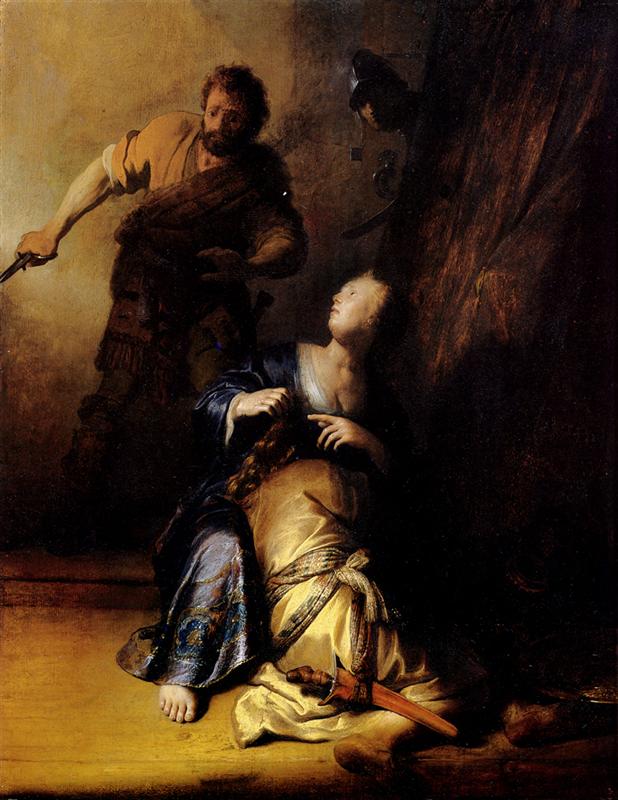
Rembrandt’s “Samson and Delilah” (1628) compresses one of the Bible’s most volatile episodes into a single, breath-held instant: the hero’s strength is being shorn, the conspirators close in, and the room itself seems to hold its breath. Delilah sits in a pool of light, blue silk cascading from her shoulder while a heavy golden cloth lies across her lap like the weight of the deed. Her left hand clasps the severed braid; her right hovers, as if surprised by its own treachery. Samson, half-risen, gropes toward his knife with one hand while the other pushes against the floor. From the shadowed doorway a Philistine soldier slides forward, iron catching the dim light like a warning. Everything is staged for maximum tension: the hush before the crash.
Choosing the Exact Moment
The Book of Judges offers several moments a painter might seize: Samson asleep; the haircut in progress; the capture; the blinding; the vengeance. Rembrandt selects the tipping point between knowledge and consequence. The main action has just happened—Delilah has finished cutting the hair—but the catastrophe has not yet struck. This timing gives the scene psychological voltage. We read Samson’s dawning awareness in his twist and reach; we register Delilah’s self-astonishment; we feel the soldier’s breath slow to avoid sound. The narrative is a single second long and therefore infinitely expandable in the viewer’s imagination.
A Theater of Light and Shadow
Light is the instrument that composes the drama. A concentrated beam pours from the right, grazing the rough wall, opening Delilah’s face and throat, and pooling on the yellow mantle in her lap. Samson lives largely in half-shadow, his strength already dimmed by the loss he has not fully understood. The Philistine is almost entirely swallowed by darkness, which lets the eye discover him a heartbeat late—the way Samson will. Rembrandt keeps the background spare so that light can behave like a character: seductive on silk, truthful on skin, pitiless on steel.
The Psychology of Each Figure
Delilah is not cast as a cackling villain. Her gaze flickers upward, away from Samson and toward the darkness that conceals the conspirators she has summoned. The gesture reads as a split allegiance: she enacts betrayal but has not yet hardened into it. Rembrandt grants her a complex inwardness—desire, calculation, and a tremor of fear—that rescues the story from simple moralizing. Samson, for his part, is still Samson. The massive forearm, the splayed bare foot, the torsioned torso all insist on brute power. Yet his sleep-loosened mouth and the confusion in his eyes make us feel the distance between strength and alertness. The soldier’s posture is a study in predation: knees bent, shoulders low, steel ready, eyes fixed. He is as careful with silence as Samson is careless with love.
Composition That Spirals Toward Catastrophe
The painting arranges its forms in a spiral that begins at the lower left with Samson’s foot, turns through his leg to the knife on the floor, loops up across Delilah’s lap to the severed braid, and then arcs into the darkness where the soldier waits. The eye completes this loop again and again, as if rehearsing the inevitable sequence from knowledge to capture. The inclined wall on the right steepens the spiral, pressing the drama forward. Rembrandt’s diagonal floorboard, barely visible, lengthens the room and turns it into a runway for the onrushing fate.
Silk, Metal, Flesh: A Young Master’s Surfaces
This is an early painting, but the textures are already fully Rembrandt. The blue robe folds into thick, luminous valleys that trap highlights like threads of quicksilver. The yellow mantle is heavy enough to suggest costly cloth yet malleable enough to drape convincingly; it becomes a visual metaphor for the golden promises Delilah traded on. Metal gleams in three keys: the cold, tight glitter of the soldier’s blade, the oiled dullness of a shield hanging on the wall, and the warm glint of Samson’s discarded weapon on the floor. Flesh is built from warm and cool halftones rather than shiny pinks, so that bodies feel inhabited, not varnished. Materials are not merely described; they participate in the meaning.
Gesture as Language
Rembrandt writes the entire story in hands. Delilah holds the cut braid delicately, thumb and forefinger forming an ambiguous circle—victory, doubt, completion. Samson’s right hand reaches instinctively for the knife, the gesture of a man used to solving problems by force; the left hand braces on the floor, announcing the coming lunge. The soldier’s hand lowers with predator patience, two fingers pinched toward the hilt. Even the sculpture-like folds of Delilah’s robe read as a pair of open hands spilling light toward the very object—the lock of hair—that will undo the hero.
The Sound of the Room
There is no literal sound, but the painting suggests it with uncanny specificity. The soft whisper of silk against stone; the scrape of Samson’s foot; the controlled exhale of the soldier; the metallic tick of a blade touching scabbard. Rembrandt achieves this “audible” quality by distributing textures and values so that the eye hears them. Silence in the dark halves, whisper in the cloth, sharpness in the metal: the room is orchestrated like a score.
The Ethics of Depicting Temptation
Many depictions of Samson and Delilah lapse into crude moral theater: the treacherous woman, the foolish man. Rembrandt’s scene refuses caricature. The erotic charge is present—bare foot, bared throat, cascade of fabrics—but it serves character rather than spectacle. Delilah’s beauty is rendered as the power to rearrange attention; Samson’s vulnerability is cast as the result of misdirected trust more than lust alone. The judgment is not prurient. It is psychological: temptation works by dimming alertness in a room that looks safe.
Pictorial Time: Before and After
Because Rembrandt chooses the hinge moment, the viewer supplies both past and future. We imagine the conspiratorial conversation that arranged the haircut, the heavy drowsiness of the hero’s sleep, the quiet scissoring of blades. We also project forward to the rush of men, the wrestling, the binding, the capture. The painting thus becomes larger than its frame; it is a time-machine anchored at the second that defines everything around it.
Influence of Lastman and Rembrandt’s Divergence
Rembrandt’s teacher Pieter Lastman loved theatrical compositions bursting with figures and props. Here the student retains Lastman’s taste for richly patterned garments and precise gestures but strips away the crowd. Three figures and a wall are enough. This reduction is Rembrandt’s signature move. It insists that human psychology, not decorative abundance, carries the weight of a story. The influence remains in the crisp silhouette of Delilah’s robe and the soldier’s stage-left entrance; the divergence lives in the moral intimacy of the light.
Color as Moral Temperature
The palette is rich yet contained: deep blues and warm golds play against earthy browns and a near-black. The blue of Delilah’s gown reads as night refined into elegance; the gold mantle radiates a honeyed warmth that seems to cover the cold decision beneath. The floor’s ochre glow has the temperature of a candlelit cave, making the darkness beyond all the more threatening. Small reds—at the soldier’s sleeve, at Samson’s knuckles—function as sparks of danger. The color never shouts; it breathes.
The Floor as Stage and Trap
Rembrandt’s plain floor is a piece of stagecraft. It offers a bright, empty plane on which the smallest objects—a knife, a bare foot, a fallen braid—become legible and significant. It is also a trap: the openness isolates Samson and Delilah, exposing them to the invading soldier. In later works, Rembrandt will use such luminous planes to similar effect, letting light simultaneously reveal and condemn.
Samson’s Humanity and the Tragic Irony
The biblical strongman often appears as a mythic giant. Rembrandt keeps him human and reachable. We feel the warmth of his skin, see the awkward angle of his wrist, notice the tender soft-shadow under his chin where sleep still lingers. This humanness intensifies the tragedy: strength perishes not because muscles fail but because attention wanders. The irony is visualized in the blade inches from Samson’s fingers—tools are useless when the mind is late.
Delilah’s Complicity Without Cartoon
Delilah’s beauty is cool, her skin illuminated with the same light that displays the evidence of betrayal. Rembrandt avoids scolding props—no coins in her hand, no caricatured smirk. The severed braid across her lap is enough. That restraint lets the viewer feel the cost on every side: Samson will be ruined; Delilah will be marked by the memory of the touch that undid him. The painting is more elegy than accusation.
The Distance Between Us and Them
We view the scene from a low, near vantage point, as if kneeling on the same floorboards. The intimacy places responsibility on our looking. We are not safe spectators; we are present. That position intensifies the suspense: we, too, could warn the hero—or we could remain a silent witness to his fall. Rembrandt often engineers this moral proximity in his early narrative pictures, binding the viewer’s conscience to the painted moment.
The Wall as Moral Surface
The rough wall that receives the beam of light acts as a witness. Its texture catches and breaks the light, turning illumination into weather. On that wall hang the emblems of force—a shield and helmet—mute participants that announce what’s coming. The composition therefore reads as a visual sentence: light finds the truth, truth calls the soldier, and the soldier brings the world’s heavy instruments to bear on private betrayal.
Technique: Edges That Decide What We Know
Edges carry meaning everywhere. Delilah’s illuminated profile is crisp, a decision made; Samson’s shadowed features are softer, a decision forming; the soldier’s outline is broken, an intention still sneaking into being. Rembrandt controls these edges with a young painter’s fearless touch—hard where the story must be unequivocal, soft where the mind is still assembling facts. The viewer’s knowledge grows as edges sharpen, a brilliant pictorial analogue for awakening.
What the Painting Says About Power
At first glance the subject seems to be the loss of physical power. Yet Rembrandt keeps directing us toward another form: the power to choose where to place trust. Delilah’s hand on the braid is the true scepter; Samson’s knife, the false one. The soldier’s sword will reap the consequences of those choices, but it does not originate them. In this hierarchy of powers—attention, seduction, steel—the painting locates tragedy in the earliest, quietest one.
How to Look Slowly
Begin at the knife near Samson’s fingertips and feel the tug of your own urge to grasp it. Climb the line of his arm to the face turning upward into knowledge. Cross to Delilah’s lap and the severed braid, luminous and heavy, then to her upward glance. Slip into the darkness and find the soldier’s profile, blade, and stealthy foot. Return along the bright floor to the knife. Repeat this circuit until the room’s silence becomes audible and the instant stretches into a narrative you can almost touch.
Enduring Resonance
“Samson and Delilah” remains convincing because it translates a sensational story into a deeply human drama told by light. The painting refuses to flatten characters into moral signs; it lets desire, trust, calculation, and fear share the same narrow room. It also announces the young Rembrandt’s program: fewer figures, richer psychology, light as the grammar of truth. From this nocturne of betrayal he will go on to craft decades of images in which the greatest actions happen not in crowds but in faces and hands, precisely where they happen in life.