Image source: wikiart.org
Introduction
Claude Monet’s Sainte-Adresse, Fishing Boats on the Shore from 1867 is a quietly compelling coastal scene that reveals a great deal about the artist at a crucial stage in his early career. At first glance, the painting may seem modest compared to the brighter, more famous marine views that often define Monet in the public imagination. Yet this work is deeply important. It shows a young painter studying light, atmosphere, labor, and place with extraordinary seriousness. It also shows Monet before Impressionism had fully solidified as a movement, when he was still shaping the visual language that would later transform modern painting.
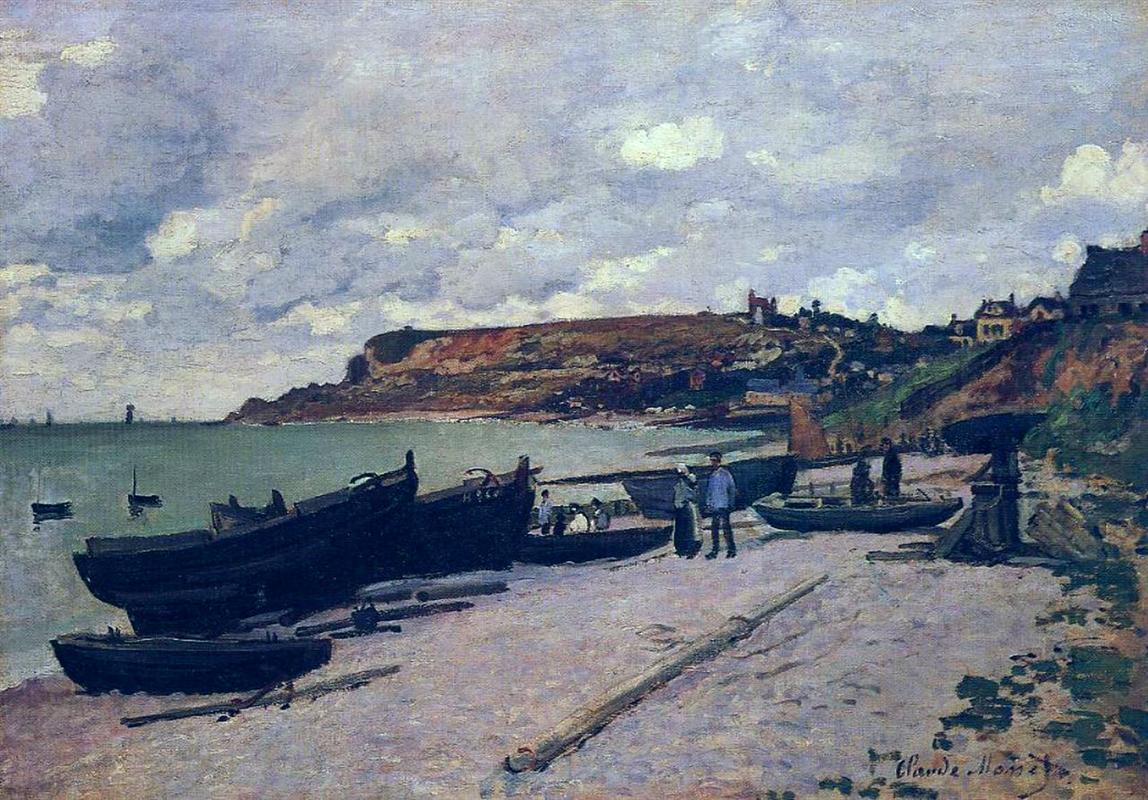
The picture presents a shoreline at Sainte-Adresse, a coastal town near Le Havre in Normandy that held personal and artistic importance for Monet. Fishing boats rest on the beach, figures gather near the water, and the land rises toward a distant settlement under a sky filled with heavy clouds. Everything in the image feels observed rather than invented. There is no theatrical drama, no heroic gesture, and no attempt to turn ordinary life into a sentimental spectacle. Instead, Monet gives the viewer a stretch of coast as it appears in lived experience, with its muted tones, broad sky, working boats, and everyday human presence.
What makes this painting so rewarding is the way it balances directness and complexity. It seems simple, but the more closely one looks, the more carefully organized it becomes. The boats are dark and weighty, the beach is pale and open, the headland anchors the distance, and the sky presses down over the scene with shifting weather. Monet transforms an ordinary shore into a meditation on observation, structure, and atmosphere. The result is a painting that captures both the material reality of a fishing village and the changing visual intelligence of an artist on the edge of a breakthrough.
Claude Monet in 1867
The year 1867 was a significant one for Claude Monet. He was still a young painter, but he had already begun to distinguish himself from academic conventions. Rather than focusing on grand historical subjects or polished studio fictions, he was increasingly drawn to modern life and the direct study of nature. Normandy, with its changing weather, coastal light, and proximity to the sea, offered him a rich environment in which to experiment. Sainte-Adresse in particular became an important site for him, both because of its visual possibilities and because it connected him to personal memories and familiar landscapes.
At this stage, Monet had not yet become the fully mature Impressionist of the 1870s and 1880s, but the foundations were clearly present. He was already interested in painting outdoors, in capturing transient conditions, and in treating light and atmosphere as central subjects rather than as background effects. He was also learning how to construct a painting that feels immediate without sacrificing formal coherence. That tension between spontaneity and control is one of the most fascinating aspects of Sainte-Adresse, Fishing Boats on the Shore.
This period of Monet’s career is especially interesting because it contains both struggle and promise. He was pushing against accepted norms while searching for artistic stability. In this painting, that search is visible. The work feels exploratory, but not uncertain. Monet is testing how much of the world can be conveyed through tonal relationships, brushwork, and visual rhythm. He is not merely recording a place. He is trying to discover how painting itself can register experience.
The Setting of Sainte-Adresse
Sainte-Adresse was more than a picturesque location for Monet. It was part of the broader Norman coast that shaped his artistic imagination. The town sits near Le Havre, where Monet spent part of his youth, and this closeness to the sea remained central to his visual world. Coastal scenes gave him access to movement, weather, changing light, and a meeting point between human life and natural forces. In a place like Sainte-Adresse, he could study working boats, tides, beaches, cliffs, and inhabited land all within a single field of vision.
In this painting, the setting is not idealized. The shore is not transformed into a dreamy paradise, and the fishing boats are not treated as romantic symbols. They are simply there, grounded in the practical life of the coast. The land in the distance is similarly unembellished. Houses and structures appear along the rising terrain, but they do not dominate the composition. Instead, they become part of a lived environment, a sign that this coast is inhabited and shaped by human activity.
That everyday realism matters. Monet is presenting a modern landscape, one defined by labor, local geography, and ordinary existence. The beach is a place of work and waiting. The boats have mass and use. The figures are small but meaningful. The town in the background suggests continuity between land and sea, between settlement and livelihood. Sainte-Adresse becomes not just a location, but a system of relationships that Monet observes with remarkable attentiveness.
Composition and Spatial Design
One of the strongest qualities of Sainte-Adresse, Fishing Boats on the Shore is its compositional intelligence. Monet organizes the painting so that the viewer’s eye moves naturally across the beach, toward the clustered boats, then outward to the water and upward to the distant headland and sky. The foreground is broad and open, creating an immediate sense of physical entry into the scene. This pale expanse of shore acts almost like a stage on which the darker boats and figures appear with greater force.
The boats are placed in a way that creates both balance and tension. The large dark vessel to the left is especially important. It grounds the composition, providing visual weight and establishing a strong contrast with the lighter beach and water. Smaller boats nearby repeat and vary this shape, creating rhythm without monotony. These repeated forms help unify the foreground and make the coastal setting feel materially specific.
The headland in the middle distance stretches across the picture and serves as a stabilizing horizontal element. It separates sea from sky and gives the painting a firm structural center. At the same time, the slope of the shore on the right introduces diagonal movement, leading the eye back toward the figures and then into the depth of the composition. Monet’s arrangement feels natural, but it is carefully controlled. Nothing appears forced, yet every major element contributes to the painting’s internal order.
This sense of order is essential because the weather and atmosphere of the scene are unsettled. The composition keeps the painting from dissolving into pure sensation. Monet allows the sky to shift and the surface to breathe, but he anchors those effects within a strong geometric framework. The result is a scene that feels alive without becoming chaotic.
The Fishing Boats as Visual and Symbolic Anchors
The boats are central to the meaning and visual force of the painting. They are not decorative accessories. They are the dark, solid bodies around which the rest of the composition turns. Their presence gives the shoreline its identity, linking the scene directly to fishing, coastal work, and the rhythms of maritime life. Monet paints them with a seriousness that emphasizes their weight and function. These are working vessels, not elegant leisure craft.
What is striking is the contrast between the boats and their surroundings. The beach is pale and relatively open, the water subdued, and the sky luminous with layered cloud. Against this setting, the boats appear almost black in places, creating a dramatic tonal opposition. This gives them great visual authority. They feel heavy, grounded, and durable, as if they bear the mark of labor and use.
At the same time, the boats contribute to the emotional atmosphere of the painting. Their stillness suggests a pause, perhaps before departure or after return. They imply human effort even when inactive. This gives the scene a quiet narrative dimension. Something has happened here, or is about to happen, but Monet does not define it. Instead, he allows the boats themselves to carry a sense of latent action.
They also help articulate Monet’s broader interest in modern reality. These are not mythical vessels or symbols of distant adventure. They belong to a specific coastal economy and to the visible present. In representing them so directly, Monet aligns himself with a modern art of observation, one that finds significance in the ordinary and the contemporary.
Light, Color, and Atmosphere
Although this painting is not among Monet’s most dazzling color statements, it demonstrates his developing mastery of atmospheric painting. The palette is restrained, dominated by cool blues, grays, muted earth tones, and soft off white passages across the shore. This restraint is one of the painting’s greatest strengths. It allows Monet to explore subtle tonal shifts and to build mood through relationships rather than through brilliance alone.
The sky is especially important in this regard. It occupies a large portion of the canvas and is filled with layered, moving cloud forms. Rather than presenting a flat backdrop, Monet turns the sky into an active field of atmospheric change. The clouds vary in density and value, and their broken structure creates a sense of weather passing across the coast. Light is diffused rather than sharp, which softens edges and contributes to the painting’s reflective mood.
The sea is treated with a corresponding sensitivity. It is calm, but not empty. Its subdued greenish and grayish tones echo the sky while also providing a quiet contrast to the pale beach. Monet avoids dramatic sparkle or intense reflections. Instead, he gives the water a still, measured presence that supports the contemplative character of the scene.
Color in this painting is deeply tied to sensation. Monet is not using it primarily for symbolic effect, but to communicate conditions of light, air, and matter. The cool palette reinforces the maritime setting, while the dark boats and touches of earth color keep the image grounded. This balance between cool atmosphere and solid form is one of the reasons the painting feels so complete.
Human Presence and Everyday Life
The figures in Sainte-Adresse, Fishing Boats on the Shore are small, but they matter. Monet includes them not as portrait subjects but as integral parts of the coastal environment. They help establish scale, animate the shoreline, and connect the boats to human use. Without them, the scene would still be visually strong, but it would lose some of its social texture.
These figures are not individualized in detail. Monet gives them enough form to register their presence and relationships, but he does not linger over facial features or elaborate costume. This is consistent with the painting’s overall approach. The focus is on the scene as a whole, on the interaction of people, objects, and setting, rather than on isolated personalities.
Their placement is also significant. Gathered near the boats and along the shore, they suggest work, conversation, waiting, or preparation. The ambiguity is part of the painting’s charm. Monet offers just enough narrative suggestion to enrich the image without narrowing its meaning. The figures become part of the rhythm of the beach, like the boats, the sloping land, and the changing sky.
In this way, the painting reflects a broader modern sensibility. Everyday people in everyday space are worthy of serious artistic attention. There is no need to idealize or sentimentalize them. Their inclusion affirms the value of ordinary life and ties the landscape to the lived realities of the coast.
Brushwork and the Transition Toward Impressionism
Monet’s brushwork in this painting reveals an artist in transition. The handling is freer than academic finish would allow, yet it remains more controlled than in some of his later Impressionist works. This makes the painting especially illuminating for anyone interested in Monet’s development. One can see him moving toward a more open, responsive surface while still maintaining strong structural coherence.
In the sky, the brushwork is varied and responsive, helping to suggest the density and movement of cloud. On the shore and in the water, strokes are broader and more economical. The boats are defined through darker masses and sharper contrasts rather than through painstaking detail. This willingness to let paint suggest rather than fully describe is central to Monet’s evolving method.
What matters here is not just looseness, but selectivity. Monet is deciding what needs to be stated clearly and what can remain approximate. He understands that a convincing painting does not require equal detail everywhere. By concentrating visual precision in certain areas and allowing other areas to remain more open, he creates a surface that feels both immediate and coherent.
This approach anticipates the logic of Impressionism. Instead of polishing every form into static clarity, Monet lets perception guide the painting. Forms emerge through light, tone, and color relationships. The world is not presented as fixed and finished, but as seen under specific conditions. In 1867, that idea was already powerful, and in this painting it is handled with remarkable intelligence.
Mood and Emotional Character
The emotional power of this painting lies in its restraint. It is not dramatic in a conventional sense, yet it has a strong mood. The cloudy sky, muted palette, still boats, and open beach combine to create an atmosphere of quiet seriousness. There is calm here, but it is not the bright calm of a summer holiday. It is a more thoughtful, weather shaped calm, touched by labor and by the vastness of sea and sky.
This mood is one reason the painting lingers in memory. Monet avoids sentimentality, but he does not eliminate feeling. Instead, feeling arises from the relation between forms. The broad sky feels expansive, the boats feel heavy, the figures feel small, and the shoreline feels exposed. Together these elements create an emotional register that is subtle but deep.
There is also a sense of pause in the painting. The boats are ashore, the people are gathered, the sea is relatively quiet. Everything seems suspended between actions. That suspended quality gives the image a contemplative tone. It invites the viewer to dwell in the scene rather than rush through it.
For modern viewers, this emotional texture can feel especially compelling. The painting offers neither spectacle nor noise. It offers observation, stillness, and attention. In that sense, its quietness becomes one of its greatest strengths.
The Painting’s Place in Monet’s Career
Sainte-Adresse, Fishing Boats on the Shore occupies an important place in Monet’s artistic evolution because it shows how much he had already achieved before the full emergence of Impressionism. It reveals a painter deeply committed to direct observation, increasingly confident in outdoor painting, and capable of transforming an ordinary coastal subject into a richly structured visual experience.
This work also helps correct a narrow view of Monet as only a painter of bright gardens, water lilies, or sparkling leisure scenes. Here we see another side of him, more subdued and perhaps more rugged. The coast is working coast, the palette is sober, and the atmosphere is dense. Yet the essential Monet qualities are already present, especially his sensitivity to light, weather, and the visual unity of a place.
The painting stands as evidence of a young artist already thinking in modern terms. He is not illustrating a story or imitating academic formulas. He is asking how painting can register the world as it is lived and seen. That question would define much of modern art, and Monet would become one of its most influential answers.
Why This Painting Still Matters
This painting still matters because it captures a turning point, not only in Monet’s career, but in the history of landscape painting. It shows the shift from composed, idealized scenery toward a more immediate and experiential vision of the world. At the same time, it remains visually satisfying on its own terms, independent of historical explanation. One does not need to know the entire story of Impressionism to respond to its forms, mood, and atmosphere.
It also matters because it honors the ordinary. A beach, a few boats, some figures, a cloudy sky, these are enough. Monet demonstrates that seriousness of vision can transform even the most familiar subject. He finds structure in the shoreline, gravity in the boats, and poetry in the weather. That capacity to reveal the richness of the everyday is one of the deepest achievements of his art.
For anyone interested in Claude Monet, Sainte-Adresse, Fishing Boats on the Shore offers a valuable glimpse of an artist becoming himself. It contains the seeds of later greatness, but it is not merely a precursor. It is a fully engaging work, one that rewards slow looking and sustained thought. Its quiet surface holds a great deal: place, labor, atmosphere, structure, and a modern way of seeing that was beginning to change painting forever.
Conclusion
Claude Monet’s Sainte-Adresse, Fishing Boats on the Shore is a remarkable coastal painting because it combines observation, atmosphere, and structure with unusual balance. Painted in 1867, it belongs to an early but highly significant phase of Monet’s career, when he was moving toward the visual language that would later define Impressionism. In this work, the ordinary shore becomes a site of artistic discovery. Boats, beach, sea, figures, and sky are woven together into a scene that feels both immediate and enduring.
The painting’s strength lies in its refusal of excess. Monet does not rely on spectacle, bright color, or dramatic narrative. Instead, he trusts the visual truth of the place before him. He lets tonal contrast, spatial design, and subtle brushwork carry the experience. The result is a painting of quiet depth, one that captures not only a stretch of Norman coast but a new way of understanding modern landscape.
Seen today, Sainte-Adresse, Fishing Boats on the Shore remains powerful because it reminds us how much can be found in close attention. Monet turns a modest coastal moment into a serious work of art, rich in mood, intelligence, and presence. It stands as an early testament to his genius and as a beautiful example of how painting can make the familiar feel newly seen.
