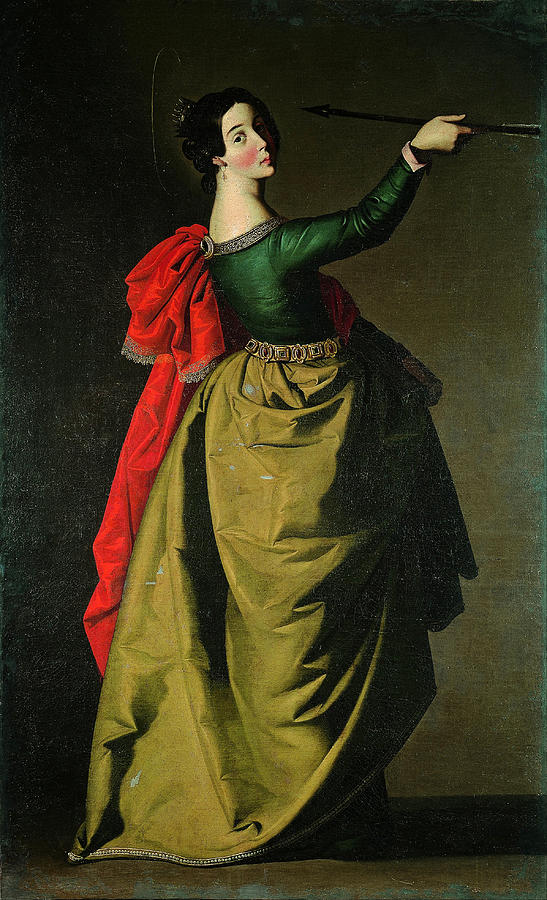
Image source: wikiart.org
Historical Context of Saint Ursula in Spanish Baroque Painting
Francisco de Zurbaran is most famous for his quiet monks and dramatic martyrs, painted during the height of the Spanish Baroque. Within this body of work, his depiction of Saint Ursula stands out as a rare and elegant image of a female martyr whose story is rooted in legend as much as in history. The saint was venerated as a royal virgin who, together with her companions, was martyred at Cologne after refusing to renounce her faith and chastity. The arrow she holds became her main attribute, symbolising the manner of her death and her steadfastness when confronted with violence.
In seventeenth century Spain, saints like Ursula served as powerful models of virtue for convents, noble households and lay confraternities. Paintings of single saints were often commissioned for altarpieces or private chapels, where they provided an image to imitate in prayer. Zurbaran, working mainly in Seville, excelled at this format, creating life sized figures that are at once realistic and idealised. His Saint Ursula is not shown in the midst of martyrdom but at a theatrical pause, turning towards the viewer with an arresting mixture of grace and resolve.
This painting belongs to a moment when Spanish artists were refining the language of sacred portraiture. Instead of crowded narrative scenes, a single figure could embody a whole legend. By giving Ursula a strong physical presence and a few carefully chosen attributes, Zurbaran condenses the entire story of her virginity, leadership and martyrdom into a single unforgettable image.
The Striking Composition and Pose
The composition is simple yet highly calculated. Saint Ursula stands almost full length against a neutral background, slightly off centre, her body forming a sweeping diagonal from the bottom left corner to the upper right where the arrow points. Her feet and the heavy golden skirt anchor her to the floor, while her torso twists in a contrary direction. This counter movement, with the lower body facing right and the upper body turning left, creates a serpentine rhythm that animates the entire figure.
Her right arm extends horizontally, holding the arrow with an almost casual firmness. The arrow leads the eye outward to the unseen aggressor, the threat that will claim her life. At the same time, her head turns back towards us, chin lifted, gaze clear and direct. This twist between arm and head is the key to the painting’s drama. It suggests that Ursula is aware of the danger, recognises the viewer as witness, and yet remains unafraid.
The background is a dark, undefined space that recedes behind her, a hallmark of Zurbaran’s mature style. This emptiness eliminates distraction and pushes the saint forward, turning the scene into a kind of sacred stage. A faint halo circles her head, barely disrupting the realistic treatment of her hair and features. The halo tells us she is a saint, but it does so quietly, leaving the emphasis on her human presence rather than on overt supernatural effects.
Colour Harmony and Textural Richness
One of the most captivating aspects of this Saint Ursula is the interplay of colour. Zurbaran orchestrates a rich triad of green, gold and red. The saint wears a deep green bodice with long sleeves, tightly fitted to her torso and arms. Around her waist lies a belt adorned with alternating links and plaques, adding a touch of refined metalwork. From the belt flows a voluminous skirt of muted gold, its large folds catching the light and casting broad, soft shadows. Draped over her left shoulder and falling behind her is a vivid red mantle that bursts like a crimson flame against the darker background.
These three colours are not arbitrary. Green suggests hope and youthful life, fitting for a young princess who chooses faith over worldly security. Gold evokes nobility and spiritual richness, hinting at the treasure of grace she carries within. Red, the colour of blood and martyrdom, foreshadows her violent death. The fact that the red mantle is thrown behind her, almost like a banner, links her martyrdom to a triumphant standard rather than to defeat.
Zurbaran pays careful attention to texture. The satin sheen of the skirt is rendered through luminous highlights along the folds and subtle gradations of shadow. The green bodice appears smoother and darker, absorbing more light and accentuating the slenderness of her upper body. The red mantle is heavier and more matte, with crisp creases. The lace trimming at the edges of her sleeves and mantle, and the intricate pattern of her belt, provide delicate details that offset the broad planes of colour.
Through this refined handling of fabric, the painter gives the viewer a palpable sense of luxury. Saint Ursula is unmistakably of noble birth. Yet this richness does not contradict her sanctity. Instead, the sumptuous garments become vehicles that proclaim how earthly nobility can be transformed into spiritual heroism.
Light and Shadow Creating Presence
Light in this painting comes from an unseen source to the left, illuminating Ursula’s face, neck, and the front of her dress. Her features are softly modeled, with rosy cheeks and bright eyes that stand out against dark hair. The light glides along the curve of her neck, catches the glitter of the belt and the lace, and then sinks into the deeper folds on the right side of the skirt.
The background remains in shadow, transitioning from a lighter tone near her head to a darker zone behind the skirt. This gradation pushes the figure forward and heightens the sense of three dimensionality. The subtle cast shadow at her feet anchors her to the ground, preventing the image from becoming weightless.
This dramatic yet controlled lighting is characteristic of Zurbaran’s use of tenebrism. Inspired by Caravaggio and his followers, he adopted strong contrasts between light and dark but softened them to suit the contemplative mood of Spanish devotional art. In Saint Ursula, the light does not produce harsh edges or theatrical spotlighting. Instead, it wraps the figure in a gentle glow that emphasises her calm dignity.
The shadows, particularly on the right side of her dress and under her arm, add depth and mystery. They hint at the unseen forces she must confront and at the interior struggles that accompany her outward courage.
The Expressive Face and Gesture
Saint Ursula’s face is one of the most expressive elements of the painting. She is no generic beauty. Her features combine a slightly elongated neck, a rounded chin, a straight nose and large, alert eyes. Her lips are parted as if she has just spoken or is about to respond to a call. The expression is not one of terror or ecstasy. Instead, it conveys a quiet surprise mixed with resolve.
Her gaze is directed slightly above the viewer, as though she is already attuned to a higher reality. This upward focus reinforces her status as a visionary and a martyr whose thoughts are fixed on heaven even as danger surrounds her. The faint halo behind her head seems almost unnecessary because her expression alone suggests saintliness.
Her left hand, largely hidden in the folds of her skirt, lightly gathers the fabric, which gives a subtle impression of movement. Her right hand, extended with the arrow, is elegantly posed. The fingers are graceful but firm, emphasising that the arrow is not merely an accessory but a symbol she accepts knowingly.
This combination of poised body and responsive face imbues Ursula with personality. She appears as a young woman caught in a decisive instant when she chooses fidelity over fear. The viewer senses her individuality and can imagine her speaking, praying or encouraging her companions. Zurbaran thus makes sanctity feel intensely personal rather than abstract.
Symbolism of the Arrow and Martyrdom
The arrow in Ursula’s hand is the key attribute that identifies her. According to her legend, she and her companions were killed by arrows shot by pagan attackers when they refused to relinquish their virginity and faith. By placing the weapon directly in her grasp, Zurbaran transforms it from an instrument of execution into a sign of willing sacrifice.
The direction of the arrow, pointing outward and slightly upward, suggests that Ursula is both acknowledging her fate and confronting it with strength. It also corresponds with her turned head, forming a line of tension between what lies behind and what lies ahead. The gesture hints that she is in the process of stepping from the realm of earthly life into the destiny of martyrdom.
There is no explicit blood or violence here. Instead, Zurbaran symbolises martyrdom through colour and gesture. The red mantle evokes spilled blood, while the arrow and her attitude convey acceptance. This approach makes the painting suitable for contemplative environments, where the faithful could meditate on courage without being distracted by graphic scenes.
The faint halo and the sumptuous clothing complete the symbolism. Ursula is a princess and a saint, someone who renounces both worldly pleasures and bodily safety for a higher calling. The painting offers her as an example for viewers who may not face literal arrows but must still confront pressures that threaten their integrity.
Zurbaran’s Treatment of Female Sanctity
Throughout his career Zurbaran painted relatively few female saints compared to male monks and martyrs. When he does depict women, however, he often grants them a unique blend of elegance and inner strength. In Saint Ursula, he avoids any overt sensuality. The neckline is modest, the sleeves are long, and her waist is defined but not accentuated by exaggeration of the body beneath.
Yet he does not suppress her femininity. The delicate face, the coiled hairstyle with small decorative elements, and the fine jewellery around her neck and waist all highlight her status as a refined young woman. This balance of modesty and beauty communicates the ideal of the virgin martyr who embodies both purity and noble dignity.
Compared with earlier medieval icons of the saint, Zurbaran’s Ursula is more individualised and psychologically engaging. She is not a remote symbol but a living person at a climactic moment. This is typical of Baroque spirituality, which aimed to engage the emotions and imagination of the faithful so that they might identify more deeply with the saints.
At the same time, the painting retains Zurbaran’s signature stillness. There is movement in the twist of the body and the sweep of the garments, but there is also a sense of quiet pause, as if time has been momentarily suspended. This contemplative stillness suggests that martyrdom is not merely a physical event but a spiritual decision made in the interior of the soul.
The Painting’s Place within Zurbaran’s Oeuvre
When seen alongside other works by Zurbaran, such as his depictions of Saint Casilda or Saint Agatha, this Saint Ursula reveals his interest in presenting female saints as solitary, statuesque figures against austere backgrounds. He uses similar strategies of strong colour contrasts, rich fabrics and focused lighting to turn these women into icons of steadfastness.
In Saint Ursula, however, the gesture with the arrow and the turned head create a slightly more dynamic composition than some of his other female portraits. The painting thus occupies an interesting place between static devotion and narrative action. It hints at the broader story of the legend while remaining entirely focused on the figure herself.
The work also illustrates how Zurbaran could adapt his Caravaggesque language of light and shadow to themes of aristocratic sanctity. Just as his white robed monks seem carved out of darkness, Ursula’s golden skirt and green bodice emerge from the background with sculptural clarity. The transition from religious austerity to noble splendour is handled seamlessly, revealing his versatility as a painter.
Conclusion The Noble Courage of Saint Ursula
Francisco de Zurbaran’s “Saint Ursula” is a powerful example of how Baroque art could compress an entire legend into a single, unforgettable figure. Through a carefully constructed pose, a rich harmony of green, gold and red, and the symbolic arrow held with graceful determination, the painting presents the saint as both a royal woman and a courageous martyr.
The dark background focuses attention on her luminous presence, while the soft yet decisive lighting models her features and garments with clarity. Her turned head and poised body capture the precise moment when she accepts her destiny, inviting viewers to contemplate their own choices in the face of danger or compromise.
In this work Zurbaran combines his mastery of fabric, his understanding of human psychology and his devotion to sacred subjects. Saint Ursula emerges as a timeless image of integrity, someone who wears nobility not only in her clothing but in the steadfastness of her faith. The painting continues to speak to modern audiences about the power of conviction and the beauty of courage lived out in a single decisive moment.