Image source: wikiart.org
Introduction to Saint Thomas of Villanueva Dividing His Clothes among Beggar Boys
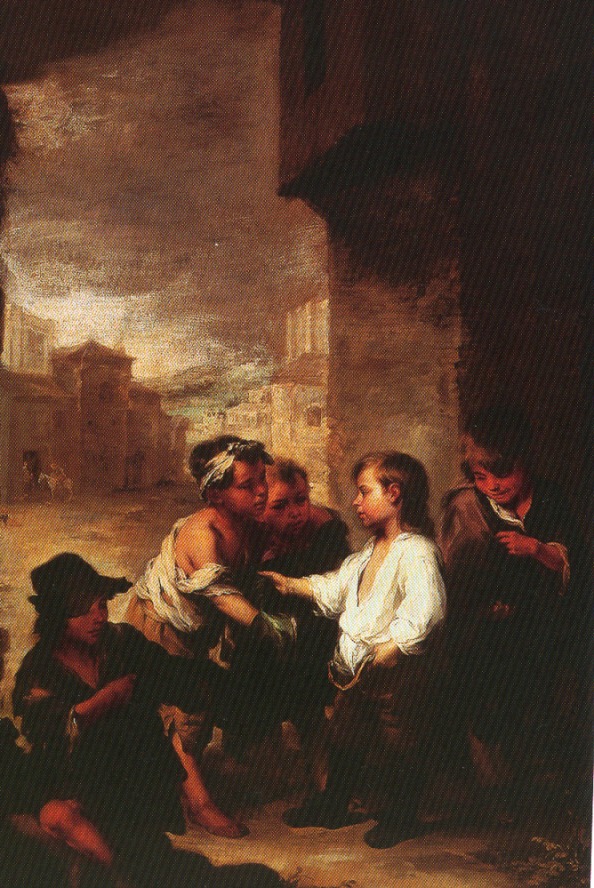
“Saint Thomas of Villanueva dividing his clothes among beggar boys,” painted by Bartolomé Esteban Murillo in 1667, is one of the most moving images of charity in seventeenth century Spanish art. Rather than showing a bishop in rich vestments distributing alms from a cathedral porch, Murillo focuses on the saint as a boy among other boys in a street scene that feels unmistakably Sevillian.
The painting captures a moment of quiet generosity. A young Thomas, dressed slightly better than the others, opens his coat and shirt while a barefoot companion in rags reaches toward the fabric. Around them, several other children watch intently, each with a different blend of hope, curiosity, and wariness. The city stretches away behind them under a cloudy sky, turning the narrow corner into a small stage on which charity becomes visible.
Murillo combines the visual language of genre painting with religious narrative, using naturalistic details to make the saint’s virtue feel achievable and real. Through his sensitive depiction of poor children, he invites viewers to consider how acts of mercy can transform ordinary life.
The Historical and Spiritual Figure of Saint Thomas of Villanueva
Saint Thomas of Villanueva was a sixteenth century Spanish Augustinian who became Archbishop of Valencia and was renowned for his love of the poor. Stories about him emphasize his habit of giving away not only money but also his own clothing, leaving himself with hardly anything. His charity was seen as a model of evangelical poverty during the Catholic Reformation.
Murillo’s painting belongs to a cycle that traces the saint’s life from childhood to episcopal office. In this canvas, the emphasis is on his early inclination toward generosity. By presenting Thomas as a boy sharing his clothes with other boys, Murillo makes the saint’s holiness look like a virtue learned young, rooted in empathy rather than duty.
For the confraternities and religious houses that commissioned such works, this representation had a didactic purpose. It suggested that sanctity begins in everyday choices and that the path to holiness is open to all, even the most humble and marginalized.
Composition and Spatial Drama
The composition is built around a strong diagonal that runs from the lower left, where one boy sits in shadow, across the standing group to the right, where the future saint appears in a luminous white shirt. The crowding of the children in the lower half of the painting contrasts with the relatively empty space of the street above them, creating a sense that the entire city is watching this small act of charity.
Murillo places the group at the corner of a building, whose dark mass cuts sharply into the sky. This architectural wedge pushes the boys toward the viewer and creates a pocket of space where the action unfolds. At the same time, the opening of the street in the distance leads the eye outwards, reminding us that this is part of a living urban environment.
The figures are arranged in a semicircle around Thomas. Two boys lean forward from the center, another sits on the ground, and yet another older child on the right half hides something in his hands while looking down. The interaction of their gazes and gestures guides our attention to the moment when Thomas extends his garment, turning the intimate exchange into the emotional focal point of the scene.
The Young Saint as Protagonist
Thomas stands almost in profile, his slender body framed by the glow of his white shirt. His hands are busy with his clothing: one reaches into his coat or purse, while the other adjusts his open shirt as if preparing to give some of it away. Even at this young age, he carries himself with a calm authority. His posture is upright but not rigid, and his expression is earnest.
Murillo avoids idealizing him too much. He looks like an ordinary boy from Seville, with thin arms, a slightly serious face, and unkempt hair. What distinguishes him is not an obvious halo or ecclesiastical symbol but his readiness to share. This approach fits Murillo’s broader habit of embedding sanctity within familiar human forms. Viewers are invited to recognize virtue through action rather than ornament.
The white of Thomas’s shirt has a symbolic resonance. It suggests purity of heart while also visually separating him from the earth toned garments of the other children. This subtle contrast helps the viewer identify him as the future saint without removing him from the social reality he shares with his companions.
The Group of Beggar Boys
The other boys represent different responses to poverty and charity. The child who stretches out his arm to receive clothing is barefoot, his chest exposed where his ragged shirt slips off his shoulder. His face is intent yet not desperate. Murillo gives him dignity, emphasizing that receiving help does not erase a person’s humanity.
Behind him, two boys press forward to see what is happening. One looks at Thomas with an expression that mixes longing and admiration, while the other seems more cautious, his features half hidden in shadow. On the far right, a slightly older youth stands apart, tilting his head downward as he inspects something in his hand. This figure may hint at the temptations that accompany poverty, such as petty theft or gambling. His separation from the central act of generosity underscores the moral choice between self interest and concern for others.
At the far left, a seated boy in a large hat gazes upward from the ground. His posture suggests both fatigue and curiosity, as if he has been on the street for hours and now observes this unexpected scene of giving. His presence anchors the lower left corner and reminds us that poverty is not a single face but a community of children living on the margins.
By carefully differentiating each boy’s reaction, Murillo shows that charity is not a simple transaction. It changes relationships. Some respond with gratitude, some with hope, others with suspicion or detachment. The painting therefore records a complex social moment rather than an idealized allegory.
Setting and Urban Atmosphere
The background presents a Spanish cityscape rendered with loose, atmospheric brushwork. Buildings recede under a cloudy sky, and the light is diffused rather than harsh. The architecture is not specific enough to identify a particular street in Seville, yet it feels authentic: worn walls, narrow lanes, a sense of age and decay.
This urban setting is crucial to Murillo’s message. The saint’s charity is not exercised in a distant monastery but in the public space of the city where poverty is visible. The tall, shadowed building that looms over the boys suggests the weight of social structures that keep them in their current state. Yet the opening of the sky above them offers a hint of transcendence, as though grace can penetrate even these cramped corners.
The earth colored palette of the streets and houses also serves to bring the warm tones of the boys’ skin and clothing into focus. Against this muted backdrop, their humanity stands out, and the act of giving becomes a beacon of light within an otherwise grim environment.
Light, Color, and Murillo’s Painterly Technique
Light in the painting comes from the left, catching the tops of the boys’ heads, glancing off the white shirt of Thomas, and illuminating parts of the street behind them. Murillo uses this light not only to describe form but also to direct attention. The brightest point is the chest and face of the young saint, drawing the eye naturally to his interaction with the boy beside him.
The color scheme is dominated by browns, ochres, and grays, yet Murillo introduces small patches of stronger color in the scarves, sashes, and skin tones. The headscarf of the recipient boy, the reddish vest of another, and the dark hat at the left add visual rhythm without distracting from the central drama.
Murillo’s brushwork is more fluid and sketchlike in the background, where buildings dissolve into soft shapes. In the figures, he tightens his handling enough to capture expressions and gestures, but he still allows a certain looseness that keeps the surface lively. This combination of soft focus surroundings and more defined characters is typical of his mature style and contributes to the emotional immediacy of the scene.
Social Commentary and Compassion
While the painting is explicitly about a saint, it also operates as a commentary on the social realities of seventeenth century Seville. The city suffered from economic crises, epidemics, and a large population of orphans and street children. Murillo was particularly sensitive to this situation, often depicting poor youths in a way that walks the line between genre painting and social witness.
By focusing on boys rather than adults, he underscores their vulnerability. Their bare feet, patched clothing, and lean bodies communicate material deprivation, yet their lively faces suggest resilience. The painting does not romanticize their condition, but it does show their capacity for community and response to kindness.
For contemporary viewers, including members of religious orders and confraternities, the canvas would have been a call to imitate the saint’s generosity. It implies that real holiness expresses itself in concrete acts of sharing with those who lack basic necessities. The absence of high ecclesiastical symbols makes that message all the more pointed, suggesting that charity is not the exclusive task of clergy or institutions but of every person who encounters the poor.
Blending Genre Painting and Sacred Narrative
One of the most striking aspects of “Saint Thomas of Villanueva dividing his clothes among beggar boys” is how seamlessly Murillo merges sacred history with the visual language of everyday life. In many ways the scene could be mistaken for a pure genre painting of street boys, similar to his works such as “The Young Beggar” or “Two Peasant Boys and a Negro Boy.” Only the title and the slightly emphasized brightness of Thomas hint at his future role as a saint.
This blending serves two purposes. First, it grounds the spiritual message in a recognizable reality, making the saint’s compassion feel practical rather than abstract. Second, it dignifies the world of poor children by giving it a central role in a sacred narrative. The street becomes a holy place because charity is enacted there.
Murillo’s approach reflects broader tendencies in Spanish Baroque art, where religious themes were often expressed through naturalistic details to engage the viewer emotionally. Yet his unique contribution lies in the tenderness with which he renders the poor. There is no caricature here, only a quiet insistence that these children matter in the eyes of God.
Emotional Impact and Viewer Engagement
The painting invites viewers to occupy several vantage points at once. We can identify with the kneeling or standing boys who hope to receive something, with Thomas who chooses to share what he has, or with an invisible passerby who witnesses the scene from a distance. Each perspective carries its own emotional charge.
If we imagine ourselves as one of the boys, the painting conveys the mixture of uncertainty and hope that accompanies asking for help. If we imagine ourselves as Thomas, it suggests the joy and gravity of giving away part of our own security. As a bystander, we feel the responsibility to respond to what we see, either with action or indifference.
Murillo’s skillful orchestration of glances intensifies this engagement. The children rarely look directly at the viewer. Instead, their eyes connect with one another across the composition, creating a closed network of relationships. This makes us feel that we are intruding on a real event, not being addressed by actors on a stage. The authenticity of that moment is what makes the painting so affecting.
Place of the Painting in Murillo’s Oeuvre
“Saint Thomas of Villanueva dividing his clothes among beggar boys” stands at the intersection of Murillo’s two main interests: religious storytelling and scenes of everyday life. Alongside his many representations of the Virgin, the Immaculate Conception, and Christ, his images of poor children formed a significant part of his artistic identity.
This canvas synthesizes those strands. It demonstrates his ability to render theological virtues like charity through human interactions rather than abstract symbols. It also shows his technical confidence in handling complex group compositions and deep urban settings without losing clarity.
In the context of the cycle on Saint Thomas of Villanueva, the painting functions as a foundational chapter, revealing the roots of the saint’s later actions as a bishop. In a broader sense, it anticipates modern concerns about social justice and the dignity of marginalized people, which makes it especially compelling to contemporary viewers.
Conclusion
Bartolomé Esteban Murillo’s “Saint Thomas of Villanueva dividing his clothes among beggar boys” is a powerful exploration of charity, childhood, and urban poverty. Through careful composition, nuanced light, and tender characterization, Murillo turns a street corner into a setting for moral revelation. The young Thomas, distinguished less by status than by generosity, offers his clothes to companions whose need is written on their bodies and faces.
The painting asks its audience to see the divine in acts of sharing and to recognize that holiness often appears in modest, unrecorded gestures. It also preserves the humanity of the beggar boys, presenting them not as anonymous recipients of charity but as individuals with their own reactions and stories.
In uniting sacred narrative with the textures of everyday life, Murillo created a work that still speaks to modern concerns about compassion and responsibility toward the poor. The canvas remains a vivid reminder that the smallest exchanges on forgotten streets can carry the weight of grace.