Image source: wikiart.org
Introduction to “Saint Teresa of Avila’s Vision of the Holy Spirit” by Peter Paul Rubens
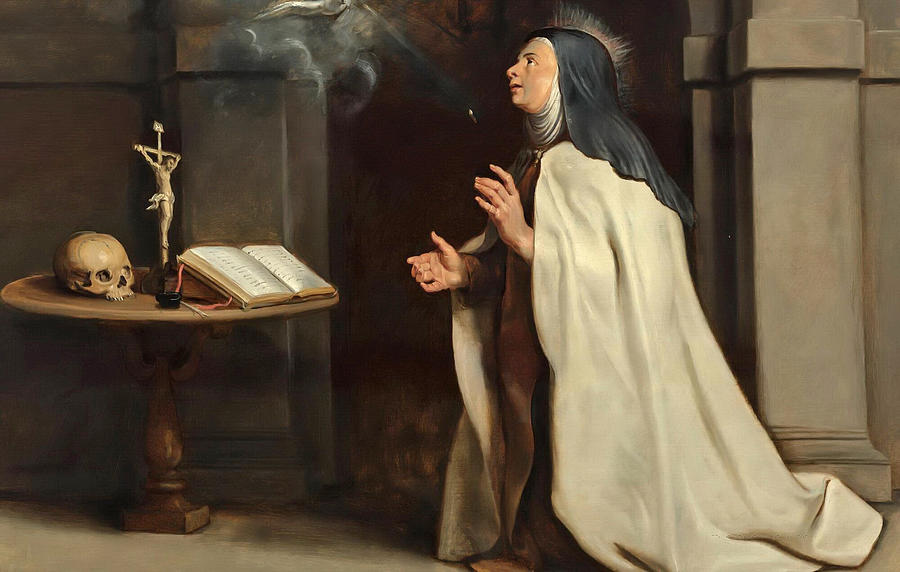
“Saint Teresa of Avila’s Vision of the Holy Spirit” presents one of the most intimate themes in Christian mysticism through the mature language of Baroque painting. Peter Paul Rubens shows the Spanish Carmelite mystic at the very instant of spiritual encounter. She kneels within a bare stone interior, hands raised in a mixture of awe and humility, while a small dove representing the Holy Spirit hovers before her. On a table nearby rest a skull, an open book, and a crucifix, creating a still life of devotion and mortality that reinforces the inner drama of the saint’s soul.
Rather than filling the scene with crowds of angels, Rubens chooses restraint. The focus lies on the relationship between Teresa and the invisible divine reality that breaks into her quiet cell. Her posture, the direction of her gaze, and the subtle modeling of her features convey the intensity of her inner experience more powerfully than any outward spectacle. The painting becomes a meditation on what it means to open oneself to God in prayer, and on how such moments transform both body and spirit.
Historical and Spiritual Background
Saint Teresa of Avila was a sixteenth century Spanish nun, writer, and reformer of the Carmelite order. Her autobiographical writings describe numerous visions and locutions in which she felt the direct presence of Christ or the Holy Spirit. These accounts circulated widely in Catholic Europe and quickly became favored subjects for painters. For devout patrons in Rubens’s time, images of Teresa were not only portraits of a saint but visual guides to a life of contemplative prayer.
Rubens, a Catholic working in the Southern Netherlands, would have known Teresa’s reputation as a Doctor of the Church and a master of interior spirituality. At the same time, he painted in an era marked by the Counter Reformation, when art was used to encourage renewed devotion and to defend Catholic teaching. This painting fits that context perfectly. It does not present a speculative allegory but a concrete example of a soul responding to the Holy Spirit. Viewers are invited to identify with Teresa’s kneeling figure and to imitate her attentiveness.
The choice of subject also reveals Baroque interest in intense emotion and personal religious experience. Teresa is not shown as a distant icon. She is a living person, caught in the midst of a vision that touches her deeply. Rubens’s task is to make that invisible encounter visible through pose, expression, and symbolic objects.
The Moment of Vision
Rubens freezes time at the exact point when the vision becomes present. Teresa’s body leans slightly forward, knees bent, hands held in front of her chest with palms gently open. This gesture signals both surrender and readiness to receive. Her head tilts upward, lips slightly parted, eyes fixed on the small glowing dove that hovers before her. She is fully absorbed, neither ecstatic to the point of unconsciousness nor merely calm. Instead she appears intensely awake to a reality beyond ordinary sight.
The dove is small compared to the monumental architecture and the voluminous folds of Teresa’s cloak, yet it commands the space. A faint trail of light or smoke seems to emanate around it, as if it enters the cell from a higher realm. The direction of Teresa’s gaze, along with the lines of her hands, draws the viewer’s eye to this modest but luminous presence. Rubens does not rely on thunderbolts or blinding beams. The miracle lies in the quiet certainty of the saint’s recognition.
By choosing this precise instant, Rubens explores the boundary between interior and exterior. Teresa’s experience is spiritual, yet it registers in her body: in the way her mouth opens as if to speak or gasp, in the tension of her fingers, in the subtle lift of her shoulders. The painting becomes an anatomy of prayer at the moment when God answers.
Composition and Spatial Organization
The composition is carefully balanced between Teresa on the right and the table with devotional objects on the left. Massive stone piers and walls frame the scene, creating a shallow stage like space. This architectural simplicity heightens the sense of enclosure and silence, turning the cell into an almost theatrical setting for divine intervention.
Teresa’s figure forms a strong diagonal that rises from the hem of her habit at the lower right through her torso up to her head and the hovering dove. This diagonal energizes the composition and leads the viewer’s eye toward the point of contact between saint and Spirit. The table, placed slightly lower and to the left, counterbalances this upward thrust with a stable horizontal. Together they form a subtle cross like structure, affirming that Teresa’s mystical life is rooted in the mystery of Christ’s crucifixion.
The open area of dark background between the table and the nun functions as a visual pause, a zone of mystery out of which the dove appears. Rubens leaves this space largely empty, resisting the temptation to fill it with decorative detail. The void helps convey the sense that the Holy Spirit enters from beyond the visible world, bridging the gap between the saint’s ordinary surroundings and divine presence.
Light, Shadow, and the Atmosphere of Revelation
Light in this painting is both natural and symbolic. A soft illumination falls from the upper left, striking Teresa’s face and the front of her white cloak. The light also touches the pages of the open book and glints off the metal crucifix and the polished skull. These highlighted areas guide the viewer through the composition and link the saint with the symbols of her devotion.
At the same time, much of the cell lies in shadow. The background behind Teresa is a deep brown, and the architectural elements recede into muted tones. This strong contrast between light and darkness is typical of Baroque art, but here it carries religious meaning. The light represents the grace of the Holy Spirit entering the darkness of the world and the interior of the soul. Teresa’s illuminated face stands out against the gloom, showing how contemplation can transform the human person into a vessel of radiance.
The smoke or vapor near the dove adds another layer of atmosphere. It suggests incense rising in worship, or the intangible nature of spiritual reality. Rubens paints this vapor with delicate transitions, letting it dissolve into the surrounding shadows. The effect is almost cinematic, as if we are watching a cloud materialize and drift. This atmospheric detail emphasizes that the vision is both real and elusive, present yet not fully graspable.
Color, Fabric, and the Carmelite Habit
Rubens pays close attention to the textures and colors of Teresa’s Carmelite habit. The heavy white mantle drapes over her shoulders and flows to the ground, forming broad, sculptural folds. Underneath we glimpse the brown tunic of the order, creating a limited but harmonious palette. The austerity of these colors matches the Carmelite ideal of poverty and simplicity.
Yet within this restraint, Rubens finds opportunities for subtle beauty. The white cloth is not a flat tone. It contains warm creams and cooler grays, with soft shadows that describe the weight and movement of the fabric. These variations make the mantle look both humble and noble. It envelops Teresa like a protective shell while also emphasizing the dignity of her vocation.
The black veil framing her face adds a strong graphic element. It creates a dark halo that separates her features from the background, intensifying the focus on her expression. At the same time, the veil’s stark color underscores her separation from worldly vanities. She is set apart for God, yet very human in her emotional response.
Symbols on the Table: Skull, Crucifix, and Book
The table to the left functions as a still life altar that encapsulates key themes of Christian spirituality. The skull is a classic memento mori, a reminder of death and the transience of earthly life. Its placement near Teresa suggests that she meditates on mortality as part of her prayer, preparing her soul for union with God. In Baroque art, skulls often accompany saints and hermits to signify their detachment from worldly concerns and their focus on eternity.
Beside the skull stands a crucifix, its small figure of Christ clearly visible. This object grounds Teresa’s mystical experiences in the concrete reality of Christ’s suffering. Her visions are not vague emotions but responses to the love revealed on the cross. The vertical line of the crucifix echoes the architectural supports in the background and subtly connects with Teresa’s upright posture of prayer.
The open book completes the triad. It likely represents Scripture or Teresa’s own writings on prayer. Its pages catch the light, indicating that the written word is a source of illumination in the spiritual life. A red marker or ribbon lies across the text, hinting at ongoing reading and meditation. Together, skull, crucifix, and book form a concise theology: remember death, contemplate Christ, and listen to the word of God. Teresa’s vision arises within this disciplined context, not in isolation from doctrine and practice.
The Presence of the Holy Spirit
The small dove that hovers before Teresa is the explicit symbol of the Holy Spirit, rooted in biblical scenes such as Christ’s baptism. Rubens’s treatment of this motif is restrained yet effective. The bird is painted in light tones, with wings slightly outstretched, as if it has just descended or is hovering in mid flight. A faint glow surrounds it, separating it from the darker background.
Although physically small, the dove commands the saint’s full attention. Its placement at the height of Teresa’s face ensures direct spiritual contact. The bird appears not terrifying but gentle, approaching her in intimate proximity. This closeness reflects Teresa’s own descriptions of the Spirit as an interior guest, one who speaks to the heart without overwhelming it.
Rubens avoids overly decorative rays or elaborate halos. By keeping the symbol modest, he emphasizes that the true miracle lies in the invisible action of grace rather than in outward spectacle. Viewers are encouraged to focus on Teresa’s response rather than on the mechanics of the apparition. The dove becomes a quiet yet powerful sign that God chooses to meet human beings within the humble realities of daily prayer.
Psychological Portrait of Saint Teresa
One of the painting’s greatest strengths is its nuanced psychological portrait of the saint. Teresa’s face is not idealized into flawless serenity. Her cheeks are slightly flushed, her mouth open, her eyes wide but not rigid. We sense both wonder and a trace of fear, the natural reaction of a finite being confronted with the infinite.
Her hands further reveal her inner state. They are neither tightly pressed in conventional prayer nor flung wide in ecstatic abandon. Instead they hover in a delicate balance between reaching out and holding back. Fingers curl slightly, ready to receive yet conscious of the mystery before her. Rubens captures this ambiguity with great sensitivity, showing that authentic spiritual experience often involves a mixture of longing and trembling awe.
At the same time, her body remains firmly grounded. The weight of her habit gathers around her feet, and her knees support her with stability. This physical rootedness suggests that Teresa’s mystical life is integrated with her earthly existence. She is not transported away into unreality but deepened within her own humanity. Rubens offers a vision of sanctity that is both exalted and profoundly human.
Rubens’s Painterly Technique and Baroque Sensibility
From a technical perspective, the painting illustrates Rubens’s mastery of oil as a medium. He builds up the forms with layered glazes that allow light to penetrate and reflect, giving a soft glow to skin and fabric. The transitions between light and shadow are smooth yet decisive, especially on Teresa’s face and hands. These subtle gradations create a convincing sense of volume and living flesh.
The background and architectural elements are handled with broader, more economical brushwork. Rubens suggests the mass of stone with simple planes and muted tones, avoiding unnecessary detail. This contrast of carefully finished central figures with more loosely treated surroundings is typical of his style. It directs visual energy toward the key areas while preserving an overall unity.
The painting also exemplifies Baroque concerns with drama and movement, even in a scene of contemplation. The diagonal flow of Teresa’s body, the billowing folds of her cloak, and the swirling vapor around the dove all contribute to a sense of dynamic presence. Yet this movement does not erupt into chaos. It is tightly controlled, mirroring the disciplined passion of the saint herself.
Themes of Contemplation, Mortality, and Love
Taken as a whole, “Saint Teresa of Avila’s Vision of the Holy Spirit” weaves together several profound themes. Contemplation is at the forefront. The painting shows that true contemplation is not quietism or mere aesthetic enjoyment. It is a focused, attentive openness to a personal God who chooses to communicate with the soul. Teresa’s posture and expression embody this active receptivity.
Mortality appears through the skull and the somber tones of the cell. The saint does not flee from the reality of death. Instead she holds it within her prayer, recognizing that life is short and that all worldly attachments must ultimately be surrendered. This awareness deepens her longing for union with God and for the gift of the Spirit.
Love underlies everything. The crucifix signifies Christ’s self giving love, and the dove represents the love of God poured into the heart by the Spirit. Teresa’s response is one of love in return. Her uplifted hands and face are not expressions of fear alone but of trust and desire. Rubens thus portrays the Christian spiritual life as a dialogue of love that transforms the person while acknowledging human fragility.
Place in Rubens’s Oeuvre and Lasting Resonance
Within Rubens’s vast body of work, this painting occupies a special niche as a quiet yet intense devotional image. Unlike his grand altarpieces filled with multiple figures, swirling clouds, and bold color, here he chooses a restrained palette and a limited number of actors. This concentration allows him to explore the subtle psychology of a mystic, demonstrating that the Baroque appetite for drama can be satisfied not only through external action but also through interior encounters.
The painting continues to resonate with modern viewers for several reasons. Its symbolic language is clear enough to be understood even by those not steeped in Catholic tradition. The skull, book, and crucifix speak universally about death, knowledge, and sacrifice. Teresa’s human reaction to an unseen presence evokes experiences of awe, inspiration, or sudden insight that people of many backgrounds can recognize.
Moreover, the work offers a counter image to the noise and distraction of contemporary life. The quiet cell, the simple furniture, and the focused attention of the saint invite viewers to imagine what it might mean to create space for contemplation in their own lives. The painting becomes not only a historical artifact but a gentle challenge to reserve time for silence, reflection, and openness to something greater than oneself.
Through its careful composition, rich symbolism, and compassionate portrayal of Saint Teresa, Rubens’s “Saint Teresa of Avila’s Vision of the Holy Spirit” stands as a moving witness to the depth of human spiritual longing and the belief that such longing can be met by a personal divine presence.