Image source: wikiart.org
Introduction to Saint Margaret, dressed as a shepherdess
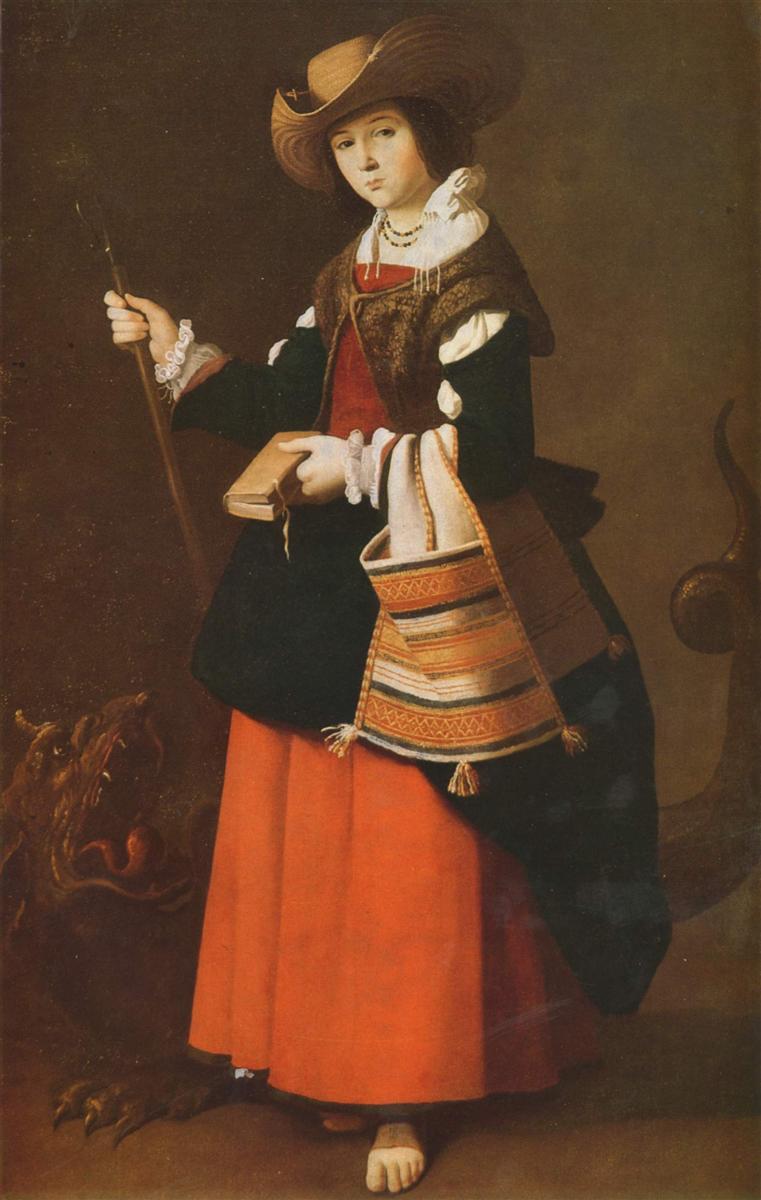
Francisco de Zurbaran’s “Saint Margaret, dressed as a shepherdess,” painted in 1631, is one of the most intriguing and unconventional depictions of a Christian martyr in seventeenth century Spanish art. Instead of appearing in armor or in the dramatic moment of martyrdom, the saint stands calmly before us in rustic costume. She wears a wide brimmed hat, a fur trimmed bodice, a long red skirt and a cloak, with a striped shepherd’s bag hanging at her side. In one hand she holds a staff, in the other a book. Only when the viewer looks carefully at the bottom edge of the painting does the dragon appear, subdued beneath her foot and partly hidden in shadow.
The painting brings together elements of portraiture, costume study and devotional image. Saint Margaret looks almost like a real young woman from Zurbaran’s world, perhaps a Sevillian girl dressed for a festival or a theatrical performance. Yet the attributes of the dragon and the book, and the quiet authority of her pose, remind us that she is a holy figure who has conquered evil through faith. This blend of everyday realism and spiritual symbolism gives the work a striking freshness that continues to captivate modern viewers.
Historical and Religious Background of Saint Margaret
Saint Margaret of Antioch, also known as Saint Marina in the Eastern tradition, was one of the popular virgin martyrs of the Middle Ages and early modern period. According to legend, she was the daughter of a pagan priest who converted to Christianity and refused to marry the Roman governor. For her steadfastness she was subjected to various tortures and finally beheaded. One of the most famous episodes in her legend tells how she was swallowed by a dragon while in prison, only to burst forth alive when the sign of the cross caused the monster to split open. This dramatic story made her a favorite patron saint of women and a symbol of victorious faith over demonic forces.
Artists typically depicted Saint Margaret as a young woman with a cross or palm of martyrdom, accompanied by a dragon. Sometimes she is shown stepping on the creature or emerging from its belly. In Zurbaran’s painting, however, the saint appears in the guise of a shepherdess, which adds another layer of meaning. The pastoral figure calls to mind biblical imagery of Christ as the Good Shepherd and of believers as guardians of their flocks. It also evokes the simplicity and humility associated with rural life. By combining the martyr saint with the shepherdess motif, Zurbaran presents Margaret as both conqueror of evil and model of gentle, watchful care.
Zurbaran and the Spanish Baroque Context
Zurbaran painted “Saint Margaret, dressed as a shepherdess” at a time when Spanish Baroque art was flourishing. Seville, where he worked, was a vibrant commercial and artistic center, deeply influenced by Counter Reformation spirituality. Religious orders, confraternities and churches commissioned paintings that would teach doctrine, inspire devotion and display the glory of the Catholic faith. Zurbaran became renowned for his ability to infuse strict realism with intense spiritual presence, particularly in images of monks, hermits and martyrs.
The painting reflects several features of Spanish Baroque style. The figure stands out against a dark, neutral background that has little detail, focusing attention on her presence and the symbolism of her attributes. The lighting is strong yet controlled, highlighting the textures of cloth, fur and leather while leaving the edges of the composition in soft shadow. At the same time, the work reveals Zurbaran’s interest in contemporary costume and in the theatrical culture of his day. The saint’s outfit resembles the costumes worn in religious plays and pastorals, suggesting that popular theater influenced how sacred figures were imagined.
Within this context, the painting can be understood as a way of making the saint accessible to viewers. By dressing Margaret in rustic clothing familiar from everyday life or from festivals, Zurbaran reduces the distance between the holy heroine of legend and the ordinary believer. She appears as a relatable young woman who also happens to be a fearless conqueror of evil.
Composition and Figure of the Shepherdess
The composition is dominated by the upright figure of Saint Margaret, who occupies almost the entire height of the canvas. She stands slightly turned to her left, her weight resting on one leg in a relaxed contrapposto, which creates a gentle S curve through her body. The staff she holds in her left hand rises diagonally, echoing the vertical line of her posture and adding a sense of stability. Her right hand holds a book, probably a reference to scripture or to the prayer book through which she meditates on God’s word.
Her head is tilted slightly, and she gazes directly at the viewer with a calm, introspective expression. This eye contact establishes an intimate relationship. She is neither distant nor overly dramatic. Instead she appears thoughtful and composed, inviting contemplation rather than shock.
The background is largely unarticulated, a warm brown that gradually darkens toward the upper corners. This restrained setting allows the figure and her costume to carry the entire narrative. At the lower left corner the dragon appears, its head twisted upward, its mouth open, and its scaly body curling into the darkness. The saint’s foot rests lightly on the creature, visually asserting her victory over it without violence or strain.
The overall effect of the composition is one of poised equilibrium. Saint Margaret is both shepherdess and warrior, yet she exudes serenity rather than aggression. The viewer senses that the battle has already been won through faith, and what remains is the quiet, dignified presence of the victor.
Costume, Textures and Color
One of the most striking aspects of the painting is the attention paid to clothing and fabric. Zurbaran delights in describing the textures of each garment, using color and light to bring them to life. The broad brimmed hat, with its curling edge, casts a gentle shadow over the saint’s face and suggests the practical needs of a shepherd exposed to the sun. The fur lined bodice around her shoulders brings a sense of warmth and rustic luxury, with subtle variations in brown and ocher tones that evoke the softness of real fur.
She wears a deep red dress that falls in straight, heavy folds to her bare feet. The red provides a strong vertical block of color at the center of the composition, symbolically associated with love, courage and martyrdom. Over this she drapes a dark cloak, possibly black or deep green, that frames her figure and sets off the lighter tones of her blouse and the fur. The white cuffs and collar, highlighted against the darker fabrics, emphasize her purity and draw attention to the delicate hands and face.
Perhaps the most decorative element is the shepherd’s bag hanging at her side. It features horizontal stripes in warm shades of yellow, orange and red, with intricate patterns woven into the cloth and tassels dangling from the corners. This object adds a note of visual richness and suggests the artisanal world of rural textiles. Zurbaran paints it with exquisite precision, showing folds, seams and the way it curves to follow the movement of her body.
The palette overall is warm and earthy, dominated by browns, reds and soft creams. This choice reinforces the pastoral character of the scene and grounds the saint in a world of soil, leather and wool rather than in the luminous heavens of more conventional hagiography. Yet the carefully modulated colors also create a harmonious and pleasing surface that rewards close, prolonged looking.
The Dragon and Symbols of Martyrdom
Although the title announces Margaret as a shepherdess, the small dragon at her feet reminds us unmistakably of her identity as a martyr who defeated the devil. Zurbaran places the beast low in the composition, partly obscured by shadow and by the saint’s skirt. Its twisting, scaly body, sharp claws and open jaws contrast with the quiet poise of the figure above. The dragon’s subdued position suggests that its power has been broken. It is dangerous in appearance but no longer a real threat.
In addition to the dragon, other symbols confirm Margaret’s sainthood. The book in her right hand points to the wisdom of scripture and to her steadfast adherence to Christian doctrine in the face of persecution. The staff she holds, though appropriate to a shepherdess, can also recall the staff of a pilgrim or the rod of authority that protects the flock. Her bare feet remind viewers of humility and renunciation of worldly comfort, echoing the tradition of saints walking unshod as a sign of poverty and closeness to the earth.
While Zurbaran does not include the palm frond that often signifies martyrdom, the deep red of her skirt fulfills a similar function, alluding to the blood she shed. The fusion of these elements produces a layered iconography. She is at once a rustic guardian of sheep, a learned woman of scripture and a triumphant martyr who stands over the defeated dragon. This complexity invites viewers to reflect on the many dimensions of Christian virtue.
Light, Shadow and the Sense of Presence
Zurbaran’s management of light and shadow contributes decisively to the painting’s atmosphere. A soft, directional light falls from the left, illuminating the saint’s face, hands and the front surfaces of her clothing. The hat casts a gentle shadow that adds depth to her features, while the folds of her garments are modeled with firm yet subtle contrasts. The dragon and the lower edges of the skirt sink into deeper shadow, enhancing the sense of recession and mystery near the ground.
The background remains largely in half shadow. There are no distracting details such as trees, buildings or landscape features. This dark void makes the figure emerge more strongly, as if spotlighted on a stage. Yet the light is not harsh. It caresses the surfaces of cloth and skin, creating a feeling of quiet presence rather than theatrical drama.
This approach to lighting is typical of Zurbaran’s religious works. He often isolates his saints against simple backgrounds, using light to suggest an inner illumination that comes from their union with God. In “Saint Margaret, dressed as a shepherdess,” the luminosity of her face and hands seems to emanate from within, reinforcing her spiritual dignity. The viewer senses that she is not merely a costumed model but a person whose soul has been transformed by grace.
Pastoral Imagery and Spiritual Meaning
The choice to depict Saint Margaret as a shepherdess carries rich spiritual implications. In Christian scripture and tradition, shepherd imagery is associated with care, guidance and sacrifice. Christ identifies himself as the Good Shepherd who lays down his life for his sheep. Pastors of the Church are called shepherds of their communities. Ordinary believers are also invited to imitate this caring role in their own sphere of life.
By dressing Margaret in shepherd’s clothing, Zurbaran emphasizes her protective role. She is not simply a passive victim of persecution. She is one who, through her faith, helps guard others from spiritual danger. Her staff suggests readiness to defend the flock, while the defeated dragon at her feet represents the evil that threatens the faithful. The painting thus becomes a visual meditation on the saint as intercessor, watching over those who invoke her aid.
At the same time, the pastoral disguise may have appealed strongly to the devotional sensibilities of Seville. Rural life, with its simplicity and closeness to nature, was often idealized as more virtuous and sincere than the complex intrigues of court and city. By presenting Margaret in this mode, Zurbaran aligns her with values of humility, honesty and closeness to God’s creation. Viewers could see in her not only a legendary martyr from a distant land but also a figure who resembled the shepherds and peasants of their own countryside.
Gender, Identity and Quiet Strength
Another compelling aspect of this painting is its treatment of gender and identity. Saint Margaret appears in clothes that, while appropriate to a female shepherd, also share certain features with masculine attire. The broad hat, the sturdy cloak and the solid stance contribute to an image of strength and self possession. She holds the staff with confidence and faces the viewer without timidity.
Yet the softness of her face, the delicate lace at her cuffs and the graceful fall of her skirt underscore her femininity. Zurbaran thus creates a balance between gentleness and firmness. She is a young woman who has confronted fearsome violence and yet remains composed. The dragon at her feet suggests the intensity of the trial she has overcome, but her features show no trace of agitation.
This quiet strength would have offered an inspiring model for women in Zurbaran’s time, particularly for nuns and devout laywomen who venerated female martyrs as examples of courage and fidelity. The painting affirms that sanctity does not erase individuality. Margaret retains a distinct personality, reflected in her thoughtful gaze and confident posture, even as she stands as a universal symbol of victorious faith.
Emotional Impact and Legacy of the Painting
“Saint Margaret, dressed as a shepherdess” leaves a lasting impression because it combines narrative richness with controlled emotion. There is no explicit representation of torture or suffering. The drama has moved to a reflective stage after the struggle is over. The viewer encounters a saint at peace, yet still equipped with staff and book, ready to continue her spiritual journey and to protect those who seek her help.
The painting’s legacy lies partly in this contemplative quality. It encourages a quiet, sustained engagement rather than a quick reaction. Viewers may find themselves drawn first to the unusual costume, then to the saint’s calm face, and finally to the dragon at her feet. Each detail opens up new layers of meaning, from pastoral symbolism to theological themes of martyrdom and grace.
Within Zurbaran’s oeuvre, the work stands as an example of his ability to merge portrait like immediacy with spiritual depth. It bridges genres, functioning as both a study of costume and a devotional image. Its understated elegance and psychological subtlety have led many to recognize it as one of his most distinctive female saint portraits.
Conclusion
Francisco de Zurbaran’s “Saint Margaret, dressed as a shepherdess,” painted in 1631, offers a compelling reinterpretation of a traditional martyr legend. By clothing the saint in rustic garments and presenting her in a poised, introspective stance, he humanizes her without diminishing her heroic status. The subdued dragon, the staff, the book and the bare feet all contribute to a complex iconography that speaks of faith, humility and spiritual victory.
The painting’s warm palette, vivid textures and carefully controlled lighting create a powerful sense of presence. Margaret appears almost as a living person from Zurbaran’s own time, yet her calm authority and the symbolism around her lift the scene into the realm of the sacred. For viewers today, the image still communicates a message of quiet courage, gentle strength and the possibility of sanctity within ordinary, pastoral imagery.
Through this remarkable work, Zurbaran demonstrates how a single figure standing against a simple background can embody rich theological themes and timeless human virtues. “Saint Margaret, dressed as a shepherdess” remains a testament to his mastery of both realism and spiritual imagination.