Image source: wikiart.org
Introduction to Saint Lucy by Francisco de Zurbaran
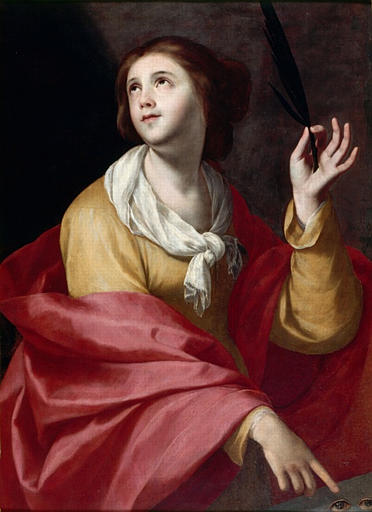
Francisco de Zurbaran’s “Saint Lucy” presents one of the most beloved virgin martyrs of Christian tradition with a blend of quiet elegance and intense spiritual emotion. Painted during the height of the Spanish Baroque, the work shows how Zurbaran could transform a single female figure into a powerful vehicle for devotion. The saint, wrapped in flowing red and golden drapery, looks upward with luminous eyes while holding a quill in one hand and pointing downward with the other.
At first glance the painting seems simple – just a half length portrait set against a neutral background. Yet the more time you spend with it, the more layers of meaning and symbolism begin to surface. Saint Lucy’s reputation as patron of eyesight, the story of her martyrdom and the Baroque fascination with inner vision all hover behind her serene gaze. Zurbaran’s careful arrangement of color, gesture and light guides viewers from the physical beauty of the figure toward a deeper contemplation of faith and sacrifice.
The Life and Symbolism of Saint Lucy
To understand the painting fully, it helps to recall who Saint Lucy is. According to Christian legend, Lucy was a young woman from Syracuse who pledged her life to Christ and refused to marry a pagan suitor. In retaliation, she was denounced as a Christian and subjected to gruesome tortures before her death. Later versions of her story describe how her eyes were torn out, only to be miraculously restored, which is why she became the patron saint of eyesight and those suffering from eye diseases.
Artists across Europe adopted several attributes to make her recognizable. She is often shown carrying a dish or platter with a pair of eyes on it, holding a palm of martyrdom, or presenting a lamp that symbolizes light and vision. Zurbaran chooses a subtler approach. In this painting the saint seems to point toward the lower corner of the canvas, where her traditional attribute would likely appear. Although the detail is partly cropped in reproductions, we can infer that the object of her gesture identifies her as Lucy and hints at the story of her sacrifice.
The quill she holds in her raised hand also suggests the act of testimony. It can be read as a symbol of writing, as if Lucy were registering her faith, signing a spiritual contract or participating in the transmission of Christian teaching. Together, the pointing hand and the quill tell viewers that her life, and particularly her suffering, have become a written witness to the light of Christ.
Composition and the Saint’s Expressive Pose
The power of “Saint Lucy” lies largely in the way Zurbaran arranges the figure within the frame. She appears in three quarter view, turned slightly to the side while her head tilts upward toward an invisible source of light. Her right arm rises elegantly, holding the feather at a diagonal angle that leads the eye toward the upper corner of the painting. Her left arm curves downward and forward, extending toward the lower edge in a mirrored diagonal.
These opposing lines create a dynamic X shaped structure that energizes the otherwise stable composition. At the crossing point of the diagonals sits Lucy’s face, which becomes the central focus of the image. The gesture of the arms suggests a conversation between heaven and earth. The raised hand opens toward the realm of inspiration, while the lowered hand reminds us of her mission and martyrdom in the world.
Zurbaran emphasizes Lucy’s upward gaze. Her eyes are wide and luminous, her lips slightly parted, giving her expression a mixture of wonder, humility and calm determination. She looks beyond the viewer, as if responding to a divine voice or inner vision. This upward look not only clarifies her holiness, it also invites the viewer to imitate her orientation toward the divine.
Color Harmony and Drapery
Color plays a crucial role in the emotional atmosphere of the painting. Zurbaran dresses Lucy in a warm golden gown, wrapped in a vibrant red mantle and accented with a soft white scarf around her neck. This triad of colors carries strong symbolic associations while also forming a harmonious visual ensemble.
The golden yellow of her tunic suggests purity and heavenly light. It pulls forward from the darker background, making Lucy appear to glow from within. Gold can also be associated with wisdom and spiritual wealth, hinting that Lucy’s true riches lie in her faith rather than in any earthly possessions.
The red cloak, draped broadly over her shoulders and across the bottom of the canvas, is a classic Baroque symbol of martyrdom and charity. Red stands for blood shed for the faith, but also for the burning love of God. By enveloping Lucy almost entirely in this color, Zurbaran reminds viewers that her whole identity is shaped by her courageous sacrifice. The red mantle flows in generous folds, giving a sense of richness and dignity to this humble saint.
The white scarf provides a third, quieter note within the color scheme. Resting close to her throat, it points to innocence, chastity and sincerity. White is the color of baptismal garments and the habit of many religious orders. Its placement here near Lucy’s voice and breath reinforces the idea that her speech and testimony remain pure.
Zurbaran’s drapery is not only symbolic but also highly tactile. The folds of the red cloak, the soft sheen of the yellow fabric and the delicate transparency of the scarf are all rendered with careful attention to texture and weight. These surfaces catch and reflect the light that falls obliquely across the figure. The result is a compelling mixture of sculptural volume and painterly richness.
Light, Shadow and Baroque Spirituality
Light is one of Zurbaran’s most powerful tools, and in “Saint Lucy” he uses it to create both physical presence and spiritual significance. The illumination appears to come from the upper left, bathing the saint’s face, neck and hands in a gentle glow. Shadows gather behind her head and along the right side of the figure, separating her clearly from the dark background.
This contrast between lit figure and shadowed ground is typical of the Spanish Baroque. It evokes the theatrical lighting of stage dramas and religious pageants, where a spotlight reveals the hero while the rest of the scene recedes into darkness. In a devotional context, such lighting suggests the grace of God shining on the believer, or the soul emerging from the obscurity of sin into the light of truth.
On Lucy’s face, the light is particularly soft and even. It smooths her features and enhances her youthful beauty without turning her into a worldly heroine. Instead she appears almost transfigured, her skin luminous and unblemished. The effect is to present holiness not as something severe or harsh, but as a gentle, attractive radiance.
The background remains intentionally vague. Rather than describing a detailed interior or landscape, Zurbaran uses an indeterminate dark ground that hints at depth without distracting the viewer. This emptiness places all attention on the saint herself. It also creates a sense that Lucy inhabits a spiritual space rather than a specific earthly location.
The Face of the Saint: Youth, Femininity and Devotion
Saint Lucy is traditionally depicted as a young woman, and Zurbaran remains faithful to that tradition. Her features are soft and rounded: full cheeks, a small straight nose, delicate lips and clear eyes. She appears in the bloom of youth, perhaps in her late teens. This age aligns with the idea of Lucy as a virgin martyr who died before marriage, preserving her body and soul entirely for God.
Zurbaran carefully balances attractiveness and modesty. Lucy’s face is undeniably beautiful, but her expression is serious, almost introspective. There is no coquettishness in her gaze, no hint of worldly seduction. Instead we sense a contemplative, interior life. This balance would have been important for Counter Reformation viewers, who valued images that inspired devotion rather than mere admiration.
Her hair is loosely pulled back but not entirely hidden, allowing a few strands to frame her face. This natural styling enhances the sense that she was a real girl before becoming a legendary saint. It also reflects Zurbaran’s interest in portraying the humanity of his holy figures. They are not distant icons but people whose lives and choices can speak directly to viewers.
Gestures and the Language of Hands
Zurbaran often pays special attention to hands. In “Saint Lucy” they carry a significant part of the painting’s meaning. The right hand, raised with the quill, is relaxed yet purposeful. The fingers curve gracefully around the feather, signaling both gentleness and resolve. The hand looks as if it could begin writing at any moment, suggesting Lucy’s readiness to record her faith or sign her confession.
The left hand, extended outward and downward, points toward the lower edge of the canvas. This gesture can be read as a quiet reference to her martyrdom, likely directing us to her attribute. It also functions compositionally, anchoring the diagonal sweep of her cloak and guiding the viewer’s eye back into the painting.
Hands in Baroque art often speak as clearly as faces. Here they tell us that Lucy’s sanctity is not only a matter of inner belief but of concrete action. She writes, she testifies, she indicates the path for others to follow. Her faith engages both mind and body.
Emotional Tone and Inner Vision
Although the story of Saint Lucy involves violence, Zurbaran chooses not to show any graphic details of her suffering. There is no blood, no instruments of torture, no display of gouged eyes. Instead he presents the saint at a moment of spiritual consolation. Her upward gaze suggests that she already sees, with the eyes of the soul, the reward promised to her in heaven.
This emphasis on inner vision is particularly appropriate for a patroness of eyesight. Lucy’s physical eyes are intact, luminous and directed toward divine light. The painting teaches that true sight lies not only in physical perception but in spiritual understanding. Even if the body should suffer, the soul can remain oriented toward God.
The emotional tone is therefore one of calm joy mixed with awe. We do not feel the terror of martyrdom but the serenity of acceptance. Zurbaran invites viewers to meditate on the peace that comes from absolute trust. The saint becomes a model of how to remain focused on divine light even amid threat and hardship.
Zurbaran’s Devotional Imagery and Female Saints
“Saint Lucy” belongs to a group of paintings in which Zurbaran portrayed female saints in rich garments, often derived from contemporary Spanish fashion rather than strict historical costume. Works such as “Saint Ursula,” “Saint Margaret of Antioch” and other virgin martyrs share similar characteristics: full length or half length figures isolated against dark backgrounds, dressed in luxurious robes, holding their attributes.
Some scholars interpret these images as reflecting the tastes of convents and lay patrons who wanted models of pious femininity that still resonated with the elegance of courtly culture. The saints wear clothes that seventeenth century viewers might recognize, suggesting that holiness can be found in their own time and place.
In “Saint Lucy,” the clothing is simplified compared to some of those full length portraits, yet the idea is similar. She is not an abstract symbol from distant antiquity, but a young woman whose appearance and demeanor could speak directly to the faithful of Zurbaran’s era. Her beauty and fine dress affirm the dignity of virginity and martyrdom, presenting them as noble vocations rather than grim punishments.
The Painting’s Place in Spanish Baroque Art
Spanish Baroque painting placed strong emphasis on religious subjects, and artists were expected to produce images that were both emotionally engaging and doctrinally correct. Zurbaran excelled at this task. His saints are intensely individual yet always aligned with the teachings of the Church.
“Saint Lucy” demonstrates how the Baroque aesthetic could be applied to a relatively small, intimate work. There is no grand architectural setting, no crowd of figures, no elaborate narrative. Everything depends on the expressive potential of a single figure. The painting encapsulates major Baroque concerns: dramatic yet focused lighting, rich color, psychological depth and a clear spiritual message.
For viewers today, the painting also offers insight into early modern attitudes toward female sanctity. It shows how a young woman who resisted social pressures and remained faithful unto death could be celebrated as a powerful intercessor. At the same time, the painting transcends historical boundaries. Its themes of courage, clarity and spiritual vision continue to resonate with audiences seeking images of quiet strength.
Conclusion
Francisco de Zurbaran’s “Saint Lucy” is a masterful combination of simplicity and depth. Through a half length portrait of a single young woman, the artist evokes the full richness of Baroque spirituality. The saint’s upward gaze, balanced gestures and luminous colors invite viewers to contemplate both her personal story and the broader themes it represents: martyrdom, inner vision and steadfast faith.
Zurbaran’s command of light and color transforms Lucy into a radiant presence against a dark ground, symbolizing the soul illuminated by grace. Her hands, one raised with a quill and one pointing downward, connect heaven and earth, testimony and sacrifice. The painting shows us a saint who listens, writes, points and guides, all while remaining rooted in serene contemplation.
In the end, “Saint Lucy” is not just a historical artifact but a living image of spiritual aspiration. It encourages anyone who looks at it to consider what true sight means, where they direct their own gaze and how they might bear witness to the light that shines even in the midst of darkness.