Image source: wikiart.org
Introduction
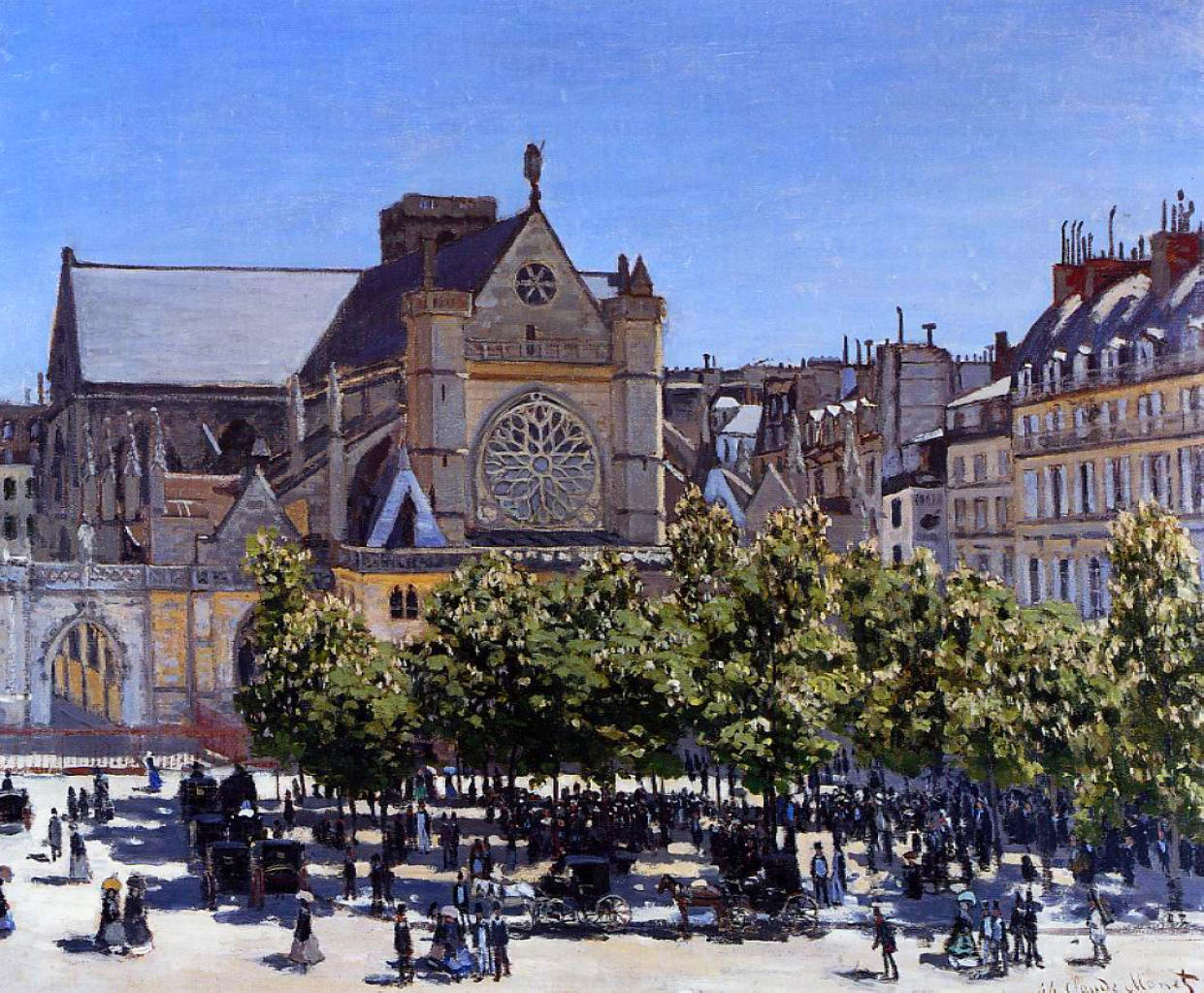
Claude Monet’s Saint Germain l’Auxerrois from 1867 is a fascinating example of how the artist could turn a city view into something alive, immediate, and deeply atmospheric. At first glance, the painting appears to present a recognizable Parisian landmark with a crowd gathered beneath trees in a bright public square. Yet the longer one looks, the less the painting feels like a rigid architectural record and the more it becomes an impression of urban life shaped by light, movement, and shifting perception. Monet is not simply showing a church. He is showing how a place feels when it is seen in a particular moment under a particular sky, surrounded by people, activity, and air.
The subject itself is important. The church of Saint Germain l’Auxerrois stands in the historic center of Paris, opposite the Louvre, and carries centuries of religious and political history. In Monet’s hands, however, the building is not treated as a frozen monument from the past. Instead, it is part of a living city. The square in front of it is full of circulation and social energy. Carriages cross the open foreground. Figures gather in clusters. Trees cast broken shadows. The pale stone of the church rises above the darker rhythm of foliage and human life below. This balance between permanence and passing experience is one of the painting’s most compelling qualities.
What makes this work especially rewarding is that it stands at a moment when Monet was sharpening the language that would soon define Impressionism. The image still contains a clear structure and a readable subject, but within that structure one can already feel his growing interest in fleeting light, optical vibration, and modern urban sensation. The painting allows viewers to see Monet thinking through how to paint not only things, but conditions: weather, sunlight, movement, atmosphere, and the visual experience of modern Paris.
The Setting and Its Urban Meaning
The choice of Saint Germain l’Auxerrois as a subject matters because it joins old Paris with new Paris. The church itself belongs to a much older city, one shaped by medieval architecture, religious memory, and historical continuity. Around it, however, Monet includes the dense fabric of urban buildings and public life that signals the city’s modern transformation. The square becomes a place where historical architecture meets everyday circulation.
This tension is central to the image. The church dominates the middle distance, but it does not overwhelm the painting in the way a traditional academic cityscape might allow. Instead, the building shares the scene with trees, pedestrians, and vehicles. The city is not being presented as a stage set for a monument. It is being presented as a dynamic environment in which monuments, streets, commerce, and daily routine coexist.
Monet’s Paris is therefore not ceremonial or theatrical. It is inhabited. That sense of habitation changes everything. The square is not empty so that the viewer can admire the architecture from a distance. It is animated by ordinary life. The church, while still monumental, becomes part of a living urban organism. This is a modern way of seeing the city. It reflects a growing interest in contemporary experience rather than purely historical grandeur.
The presence of trees is especially significant. They soften the rigid geometry of buildings and create a dense horizontal band across the center of the composition. In doing so, they mediate between architecture and human movement. They also show Monet’s sensitivity to how nature persists within the city. Paris is not only stone and masonry here. It is also foliage, shade, flickering sunlight, and seasonal presence. This blending of the organic and the built gives the painting much of its vitality.
Composition and Visual Structure
The composition of Saint Germain l’Auxerrois is carefully controlled, even though the finished effect feels spontaneous. Monet divides the painting into broad horizontal zones. The open square occupies the foreground. The dark and irregular mass of trees forms a central band. Behind them rises the church façade and surrounding buildings. Above all of this stretches a wide expanse of blue sky.
This organization gives the painting clarity. The eye first moves across the bright open foreground, then encounters the shaded complexity of the tree line, and finally rises to the architecture. The sky provides a calm visual release at the top of the canvas. The effect is balanced but not static. Each zone has a distinct texture and energy, and Monet uses those differences to guide the viewer’s experience.
The church itself anchors the scene. Its great rose window creates a clear focal point near the center, while the triangular shape of the roof and façade gives the composition vertical emphasis. Yet Monet avoids rigid symmetry. The church is framed by neighboring buildings, and the trees partially interrupt a full view of the lower architecture. This partial obstruction is important. It creates the impression that the viewer is seeing the place from life, through real visual conditions, not from an artificially cleared viewpoint.
The foreground is spacious and luminous, filled with scattered figures and vehicles that establish scale and rhythm. These small dark accents enliven the pale ground and suggest constant activity. The crowd beneath the trees becomes denser and more shadowed, creating a visual contrast with the open square. That contrast adds depth while also reflecting how people naturally gather in shade and along social edges in an urban environment.
Monet’s composition feels convincing because it is rooted in observation, but it is also painterly in the way it organizes masses, intervals, and contrasts. The painting is not a casual snapshot. It is a highly considered arrangement that still preserves the sensation of immediate seeing.
Light as the True Subject
As in so much of Monet’s work, light may be the real subject of the painting. The architecture, the square, and the crowd all matter, but what unifies them is the specific quality of illumination. Bright sunlight floods the open foreground and strikes the church façade, while the trees create pockets of shadow and broken tone. The painting is built around these contrasts.
The light has a crisp, clear quality that suggests a bright day with strong visibility. Yet Monet does not paint this light in a hard or mechanical way. He allows it to dissolve edges, flatten certain forms, and animate surfaces with subtle shifts of color. White areas are rarely just white. They carry touches of blue, lavender, cream, and gray. Stone is warmed by sunlight and cooled by adjacent shadow. Shadows themselves are not dead black zones, but active fields of bluish and purplish tone.
This treatment of light is essential to the painting’s modernity. Instead of describing every object with equal clarity, Monet lets illumination determine visibility. Some figures are almost reduced to silhouettes. Certain architectural details are clearly stated, while others melt into surrounding color. The result is closer to visual experience than to academic finish. We do not see every part of a scene equally in life, and Monet captures that truth.
The shadows under the trees are especially important. They introduce depth and complexity into the center of the image while also creating a sense of cool relief against the bright square. These darker passages are alive with flickering touches of green, blue, brown, and black. They do not read as empty darkness. They read as shade filled with people, trunks, leaves, and moving air.
The sky, meanwhile, acts as a great field of luminous stability. Its blue tone creates freshness and openness, and it sets off the pale surfaces of the church. Without this broad sky, the painting would feel heavier and more enclosed. With it, the entire scene breathes.
Color and Atmosphere
The color structure of Saint Germain l’Auxerrois is both restrained and rich. Monet does not rely on intense, saturated color for dramatic effect. Instead, he works with relationships among blue, green, cream, gray, violet, and warm earth tones. These hues are carefully balanced to create an atmosphere that feels natural and immediate.
Blue plays a dominant role, especially in the sky and in many of the shadows. This blue is not merely decorative. It cools the entire painting and helps establish the freshness of the day. It also unifies the scene, appearing not only above but within the architecture, the pavement, and the shaded figures. By allowing the sky’s color to echo throughout the composition, Monet creates a strong atmospheric coherence.
Green forms the second major color force, concentrated in the trees. These greens are varied rather than uniform. Some passages are olive, some deep and almost black, while others catch light and turn yellowish or pale. This variety gives the foliage density and motion. The trees are not flat decorative screens. They feel full, living, and responsive to the sun.
The cream and beige tones of the church and surrounding buildings bring warmth into the painting. They prevent the composition from becoming too cold and offer a solid counterweight to the fluid blues and greens. The façade of the church catches light beautifully, and Monet uses warm stone tones to make it stand out without making it appear heavy.
The atmosphere of the work comes from the interaction of these colors. Nothing is isolated. Blue influences shadow, shadow influences architecture, architecture reflects light, and foliage breaks that light into fragments. The painting’s air seems visible because color circulates through the entire surface.
Brushwork and Surface Energy
Monet’s brushwork here reveals an artist moving toward greater freedom while still maintaining enough structure to hold the scene together. The strokes are visible, lively, and varied according to the needs of each part of the composition. This variation is one of the reasons the painting feels so energetic.
In the sky, the brushwork is relatively broad and smooth, allowing the blue field to remain open and calm. In the church, the handling becomes more descriptive, though still not overly tight. Architectural forms are stated with enough clarity to be legible, but they do not harden into dry precision. The stone surfaces retain a painterly softness.
The trees show some of the most animated brushwork in the picture. Here the paint appears broken into quick touches that suggest leaves, light, and density without spelling out every detail. This method allows Monet to evoke visual complexity while keeping the surface alive. The viewer experiences foliage as a vibrating mass rather than as a collection of carefully outlined leaves.
In the foreground and crowd scenes, the brushwork becomes abbreviated and gestural. Figures are suggested through quick dark accents, small vertical marks, and touches of contrasting color. Carriages emerge through a few decisive shapes rather than meticulous detailing. This economy is powerful because it lets Monet convey social activity without freezing it.
The overall surface of the painting has a sense of immediacy. One can feel the artist responding to what he sees, adjusting, simplifying, and emphasizing according to the demands of light and perception. The visible brushwork is not a flaw to be hidden. It is part of the meaning of the painting. It reminds us that this urban scene has been translated through sensation and paint.
The Balance Between Observation and Impression
One of the most interesting aspects of this work is how it balances close observation with a more impressionistic way of seeing. The painting is rooted in a specific location, and the church is clearly identifiable. Monet has not abandoned the world of recognizable subjects. Yet he is equally committed to the visual instability of lived experience.
This balance gives the work its special tension. The architecture provides order and permanence. The crowds, trees, and shifting light provide transience. The subject can be named and located, but the experience of looking at it remains fluid. This is where the painting becomes more than a city view. It becomes a meditation on how modern life is seen.
Monet is attentive to actuality, but he does not reduce painting to documentation. He understands that a city square is never encountered as a neutral set of measured facts. It is encountered through atmosphere, movement, glare, shade, and peripheral vision. The painting embraces these conditions. Its truth is not only topographical. It is experiential.
That is why the work feels so alive. A more conventional painter might have emphasized the historical prestige of the church, sharpened every contour, and turned the square into a subordinate setting. Monet does the opposite. He allows the environment and the moment to shape the image. The church remains important, but it exists within the broader field of sensation.
In this way, Saint Germain l’Auxerrois points toward the broader goals of Impressionism. It values what is seen in a moment, but without losing contact with the physical world. It trusts light and color to carry meaning. It accepts incompleteness in detail if that incompleteness better conveys reality as it is perceived.
Human Presence and Everyday Life
The figures in the painting are small, but they are essential. Without them, the scene would feel architectural and somewhat distant. With them, the square becomes social and human. Monet populates the foreground and shaded areas with pedestrians, carriage traffic, and clusters of activity that turn the setting into a lived space.
These people are not individualized portraits. They function more as signs of movement, scale, and public rhythm. Yet their smallness is meaningful. It shows Monet’s interest in the collective life of the city rather than in heroic or sentimental narrative. The crowd is part of the atmosphere. It animates the square without dominating it.
The carriages are equally important. They introduce an element of circulation and urban routine. Their presence suggests commerce, transit, and the practical life of Paris. They also help situate the painting within a modern city rather than a timeless historical tableau. The square is active, not ceremonial. Things are happening, people are moving, and the city is functioning.
What Monet captures so well is the sense that public life unfolds beneath larger structures of architecture and light. The church towers above, the sky stretches above that, and below them ordinary people go about their day. This layered relationship between monumentality and daily life gives the painting emotional depth. It reminds the viewer that cities are made meaningful not only by buildings, but by use.
Monet’s Development in the Late 1860s
Painted in 1867, this work belongs to a formative stage in Monet’s career. He was already deeply committed to painting modern life and to working from direct observation, but he was still refining the full language that would later make him one of the defining artists of Impressionism. That makes this painting especially interesting because it shows experimentation within a recognizable structure.
There is still a certain solidity here that connects the work to earlier landscape and city painting traditions. The composition is coherent, the subject is clearly established, and the architecture carries weight. At the same time, Monet is loosening description, prioritizing light, and breaking paint into more active touches. The result is transitional in the best sense. It shows an artist moving forward.
This transitional quality should not be mistaken for incompleteness. On the contrary, it gives the painting intellectual richness. We can see Monet negotiating between inherited pictorial conventions and a new way of representing visual reality. He has not yet fully dissolved form into color and atmosphere, but he is clearly moving in that direction.
The painting also reflects his growing confidence in treating urban subjects as worthy of serious art. Instead of turning away from the city, he embraces it. Paris becomes a site of beauty, complexity, and painterly discovery. The modern city is not presented as ugly or merely functional. It becomes a place where light can transform stone, crowds, and trees into art.
Lasting Impact of the Painting
What makes Saint Germain l’Auxerrois memorable is not simply that it records a location in Paris, but that it reveals a new visual attitude. Monet treats the city as something that can be experienced with freshness. He does not separate architecture from atmosphere, or history from the present. Everything belongs to one field of perception.
The painting invites viewers to slow down and notice how much is happening in what first appears to be a straightforward city view. The shadow under the trees is full of hidden motion. The pale square is alive with reflected light. The church is both massive and softened by air. The surrounding buildings recede without disappearing. Every part of the image participates in an overall sensation of urban brightness and flow.
This is why the work still matters. It captures a city not as a static object, but as an event of seeing. It shows Monet’s remarkable ability to turn public space into something intimate and immediate. Even though the painting depicts a well known place, it feels personal because it is filtered through the artist’s perception of light, atmosphere, and lived time.
In the end, Saint Germain l’Auxerrois stands as a powerful example of Monet’s early mastery. It joins structure and spontaneity, monument and moment, clarity and vibration. It is both a portrait of Paris and a declaration of a new way of painting. Through this work, Monet demonstrates that the modern city can be as lyrical, as subtle, and as visually poetic as any landscape.
