Image source: wikiart.org
Introducing “Saint Francis of Assisi in His Tomb”
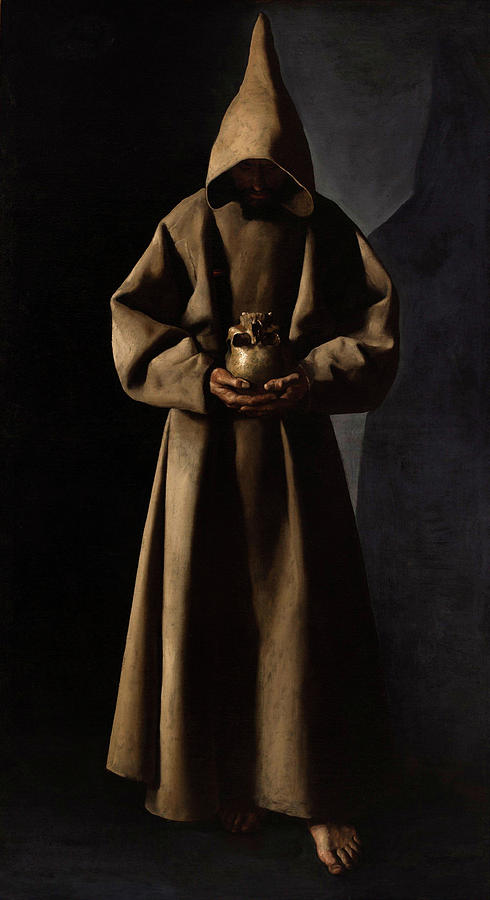
“Saint Francis of Assisi in His Tomb” by Francisco de Zurbaran is one of the most mysterious and powerful religious images of the Spanish Baroque. A solitary Franciscan friar stands against a void of darkness, wrapped in a heavy habit with a sharply pointed hood that almost completely covers his face. Bare feet emerge from the hem of the robe, planted on an unseen ground. In his hands he cradles a small skull set on a support, a stark reminder of death and human frailty.
The painting has no architectural frame, no landscape, and no narrative detail that clearly explains a story. Instead, Zurbaran creates what feels like a vision: Saint Francis standing as if he has just risen from the tomb, suspended between this world and the next. The result is a deeply contemplative work that invites viewers to meditate on mortality, humility, and the hope of eternal life.
Zurbaran And The Franciscan Imagination
Zurbaran is widely known for his intense, sober depictions of monks and saints. Working in seventeenth century Spain, he developed a unique style that combines realistic observation with a strong sense of spiritual drama. The Franciscan order, with its ideals of poverty, penance, and contemplation, offered him a perfect subject.
In many of his Franciscan images, Saint Francis appears in moments of prayer or ecstasy, receiving the stigmata or kneeling before a crucifix. In “Saint Francis of Assisi in His Tomb” the mood is different. The saint is upright and motionless, his face pressed into shadow. Instead of dynamic action, the painting offers a quiet confrontation with death and mystery. This approach reflects the Counter Reformation emphasis on meditative, interior spirituality. Viewers were encouraged to contemplate their own mortality and to model their lives on the radical humility of saints like Francis.
Composition And The Monumental Silhouette
The composition is extremely simple, yet carefully structured. Saint Francis occupies almost the entire vertical axis of the canvas, creating a long, narrow silhouette that enhances the sense of solemn stillness. His wide sleeves and long habit form a triangular shape that narrows to the pointed hood at the top. This triangular structure gives the figure an almost architectural stability, like a living column emerging from darkness.
The saint stands slightly off center, leaning ever so subtly toward the right. This small asymmetry keeps the painting from feeling rigid or mechanical. The hands form a focal point at the center of the composition. The viewer’s eye naturally moves from the pointed hood down through the vertical lines of the robe to the hands holding the skull, and then further down to the bare feet that touch the ground. The entire body becomes a visual pathway from contemplation of heaven to awareness of earth and death.
The background is overwhelmingly dark, but Zurbaran introduces a narrow wedge of muted blue gray on the right side. This plane of color might suggest a wall or a corner, but it is not detailed enough to identify clearly. Its main function is compositional. It breaks the monotony of black space and subtly frames the right side of the figure, keeping the eye focused on Saint Francis.
Light, Shadow, And The Poetics Of Darkness
Chiaroscuro, the dramatic contrast of light and shadow, is at the heart of this painting’s power. A single concentrated light source falls from the upper left, striking the front of Saint Francis’s habit and the top of his hands. The folds of the fabric catch the light along their ridges, while deep creases sink into velvety darkness.
The hood throws most of his face into shadow, leaving only a hint of nose and mouth visible. This concealment is crucial. By hiding the saint’s individual features, Zurbaran turns him into an emblem of contemplative anonymity. Viewers cannot easily read his expression, so they are drawn instead to the overall posture and the symbolic objects he holds.
The skull and the fingers that support it are among the brightest areas in the painting. Light glances off the bone structure, defining the empty eye sockets and the curve of the brow. The habit is painted in restrained earth tones, but because of the way the light falls, it seems to glow softly against the black void. The bare feet, also illuminated, remind the viewer that the saint remains of this world, even as he contemplates the next.
The surrounding darkness is not empty. It feels dense and almost physical, pressing in around the friar. That darkness can be read in several ways. It may evoke the interior of a tomb, the solitude of night prayer, or the unknown realm of death itself. Whatever interpretation a viewer adopts, the effect is the same: Saint Francis stands alone before the mystery of God.
The Franciscan Habit And The Humility Of The Saint
Zurbaran pays close attention to the Franciscan habit, which dominates the painting. The robe is long and heavy, with broad sleeves that hang low around the hands. The pointed hood gives the figure a slightly otherworldly appearance, almost like a monk-soldier or a penitent executioner of his own ego.
The fabric is rendered with subtle variations of brown and gray, capturing its rough texture without distracting from its symbolic meaning. The habit represents poverty, renunciation of worldly fashion, and a life entirely dedicated to God. By enveloping Saint Francis almost completely, it acts as a visual sign of his total surrender.
The lack of visible cord or belt further simplifies the silhouette. Nothing breaks the long vertical fall of cloth except for the small, luminous object cradled in his hands. In a sense, the habit becomes a shroud, emphasizing the theme of death. Yet it is also the garment of a living friar, suggesting that Francis’s daily life has become a continual dying to self.
The Skull And The Contemplation Of Mortality
At the center of the painting, Saint Francis holds a skull, a classic symbol of vanitas and memento mori, the reminder that all earthly life ends in death. The skull appears to rest on a small support or book, a detail that links contemplation of death with scriptural meditation.
In Franciscan spirituality, this focus on mortality is not morbid. It is meant to sharpen awareness of what truly matters. By contemplating the inevitability of death, believers are encouraged to let go of worldly attachments and to live in continual readiness for God. Zurbaran translates this spiritual practice into a single, intense image.
The way the saint holds the skull is important. His hands are not tense or fearful. They cup the small object gently, almost reverently, as if handling something precious. This gesture suggests acceptance rather than terror. Death is not an enemy to be denied but a reality to be faced calmly in the light of faith.
Because his face is hidden, the skull becomes a kind of substitute visage. It is as if Francis is literally presenting his own mortality to the viewer. We are forced to confront not only the fact that he will die, but that we too share this destiny. The painting therefore functions as a mirror for the viewer’s own spiritual reflection.
The Tomb As Interior Space
The title “Saint Francis of Assisi in His Tomb” hints that the scene may represent a vision of the saint after death, or a symbolic meditation on his burial. Yet the painting does not show an open grave or stone walls. Instead, the tomb is suggested by the overall darkness and the way the figure seems both present and unreal.
This ambiguity allows the work to operate on more than one level. On one level, it could depict Francis praying with a skull in his lifetime, standing in a dark cell or cave. On another level, it could show him after death, a spectral figure emerging from the tomb to teach the living about humility and the fleeting nature of earthly life.
The lack of clear spatial clues enhances the spiritual atmosphere. The “tomb” becomes less a physical location and more a state of contemplation, a symbolic place where one dies to the world in order to live more fully in God. In this sense, every believer is invited into the same tomb, understood as the interior chamber of the heart where conversion takes place.
Emotional Tone And The Experience Of The Viewer
Despite the grim symbol of the skull and the cemetery like darkness, the overall tone of the painting is not one of despair. Instead, it is deeply calm. There is no violent movement, no contorted expression, no chaotic backdrop. Saint Francis stands still, grounded by his bare feet. The composition communicates patience and quiet endurance.
For a viewer, the first impact is often a sense of awe or even unease, caused by the anonymity of the hooded figure and the sharp contrast of light and shadow. Yet as the eye lingers, the serenity of the pose and the gentle handling of the skull begin to dominate. The painting slows the viewer’s pace. It encourages a kind of visual silence, mirroring the silence of monastic prayer.
Many modern viewers, living in a culture that often avoids thoughts of death, may find the painting strikingly honest. Rather than decorating death with sentimental imagery, Zurbaran presents it plainly, stripped of distraction. At the same time, he surrounds it with the dignity of faith. The saint’s steady presence suggests that facing mortality can be an act of courage and trust.
Zurbaran’s Mystical Realism And Artistic Legacy
“Saint Francis of Assisi in His Tomb” is a clear example of Zurbaran’s mystical realism. He paints real cloth, real hands, and a real skull with convincing detail, yet he arranges them in such a way that they point beyond themselves to spiritual realities. The painting belongs to a broader tradition in Spanish art that sought to make theological truths tangible through simple, powerful images.
The work also showcases Zurbaran’s minimalism. While many Baroque painters filled their canvases with dramatic scenes and elaborate architecture, Zurbaran often focused on a single figure against a dark, undifferentiated background. This approach allows light, color, and gesture to deliver the full emotional weight. In this painting, the dark void becomes almost as expressive as the figure itself.
Art historians frequently note how Zurbaran’s monastic images influenced later artists interested in quiet, contemplative moods. The starkness and psychological depth seen here resonate with certain modern sensibilities. Viewers who might not share the religious beliefs of the seventeenth century can still respond to the existential questions posed by the painting.
Contemporary Reflections On The Painting
Today, “Saint Francis of Assisi in His Tomb” can be read not only as a religious work but also as a meditation on identity and loss. The hidden face evokes the idea of anonymity in the face of death. No matter how important we may be in our own eyes, mortality levels all distinctions. At the same time, the saint’s steady stance suggests an inner identity that goes beyond external appearance.
For those interested in the life of Saint Francis, the painting highlights his radical commitment to poverty and humility. He is shown not with birds or sunlit landscapes but in a setting that feels almost underground. This visual choice reminds us that Francis embraced not only joy and love of nature, but also penance and solidarity with the suffering Christ.
For others, the work might speak to the universal human desire for meaning. The skull held at the center of the painting asks an unspoken question: What is the value of a life that must end? Saint Francis answers not with words but with his posture of prayerful acceptance. For Zurbaran, that stance is the beginning of wisdom.
Conclusion
“Saint Francis of Assisi in His Tomb” is one of Francisco de Zurbaran’s most intense and unforgettable religious images. Through a single hooded friar holding a skull in his hands, the painter weaves together themes of mortality, humility, and contemplative faith. The monumental silhouette, the dramatic play of light and shadow, the heavy habit that wraps the body like a shroud, and the luminous skull at the center all contribute to a solemn yet strangely peaceful atmosphere.
The painting invites viewers into a quiet confrontation with death, but it also offers a model of how to face that reality with calm trust. In the darkness surrounding Saint Francis, there is no panic, only stillness. In his bare feet planted on the ground and his careful grip on the skull, there is a readiness to accept the limits of earthly life while hoping in something beyond.
For modern audiences, Zurbaran’s work remains a powerful reminder that art can help us approach the deepest questions of existence. “Saint Francis of Assisi in His Tomb” does not provide easy answers. Instead, it holds the viewer in a space of silence where the soul can listen, reflect, and perhaps glimpse the same mystery that absorbed the saint himself.