Image source: wikiart.org
Introduction
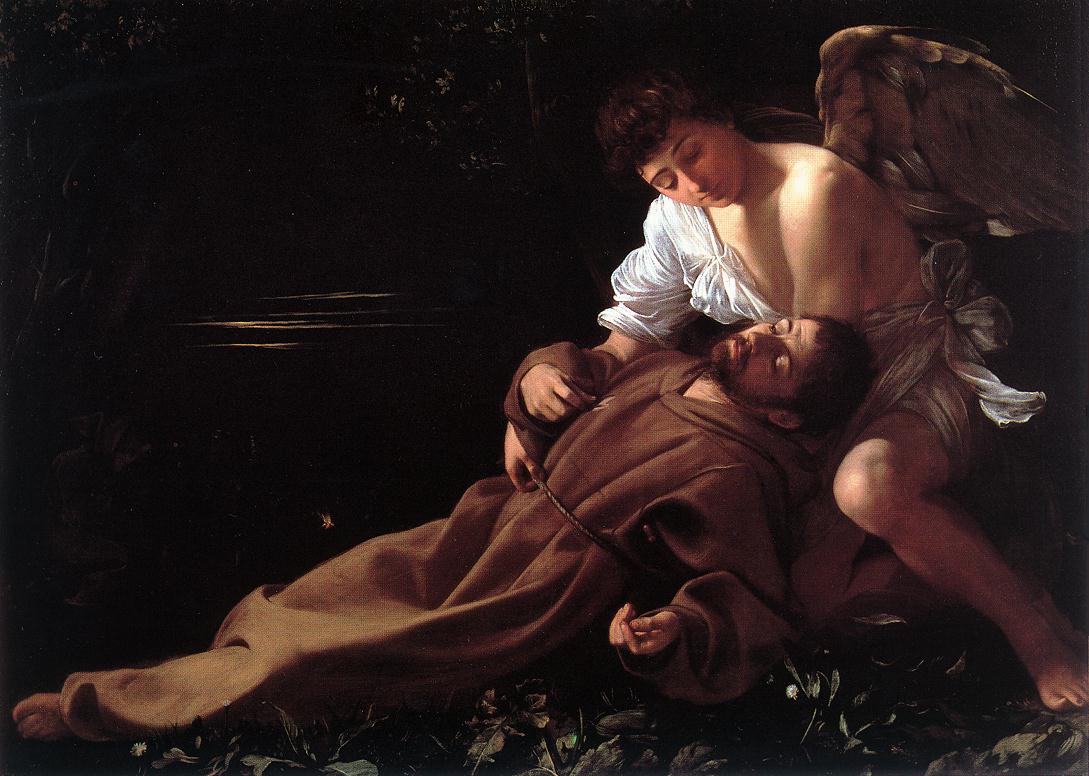
Caravaggio’s “Saint Francis of Assisi in Ecstasy” (1595) transforms the mystic’s rapture into a scene of intimate, bodily tenderness. In a moonless landscape that opens like a cave, a youthful angel cradles the saint who has gone limp in the sudden weight of divine love. The Franciscan habit gathers in heavy folds around his body; a rope cincture presses into the wool as if to remind us of earthly gravity even as his spirit lifts. A single, concentrated light arrives from the upper left and settles on bare shoulder, cheek, and hands, pinning the miracle to the present tense. Rather than dispersing the subject into distant symbolism, Caravaggio compresses it into a human encounter where touch, breath, and light carry the theology.
A New Kind Of Ecstasy
In earlier Italian painting ecstasy is often a blaze of celestial spectacle—clouds part, cherubs multiply, architecture opens. Caravaggio pares that tradition down to two figures and a darkness that feels like the inside of the world. The angel does not point upward, nor does Francis raise his eyes to heaven. Instead the saint’s head reclines into the angel’s chest, eyelids lowered, mouth parted with the stunned softness that follows an overwhelming touch. The miracle takes the shape of support. Ecstasy is not escape from the body but a fullness the body can hardly bear, and so it collapses into arms prepared to hold it. This redefinition of rapture—as collected, physical, private—makes the painting feel modern and psychologically exact.
Composition As Embrace
The composition is a diagonal cradle. Francis reclines along the lower edge from left to right, his body forming a long wedge of brown that meets the angel’s luminous torso at a protective angle. The angel kneels behind and slightly above, wings arcing outward like a sheltering canopy. The saint’s right hand opens loosely near the bottom edge, its palm catching a small share of light; his left hand rests near the angel’s forearm, completing a closed circuit of touch. The surrounding space is spare. A sliver of water glints at left, and a frill of groundcover rings the lower edge, but the world remains hushed, a stage cleared for one event. The diagonal pull toward the right generates gentle movement, as if the pair might slowly sink into the shadows if we looked away.
Light, Darkness, And The Credibility Of Grace
Caravaggio’s chiaroscuro here is both descriptive and theological. The darkness is not mere backdrop; it is the condition from which vision emerges. The light arrives externally yet feels specific, as if it fell through a window we cannot see. It touches the angel’s shoulder and cheek, grazes the saint’s face and hands, and leaves most of the habit subdued. By refusing gleam and spectacle, Caravaggio grants credibility to the supernatural. Grace is experienced as recognition, not as fireworks. The same light that could describe a still-life goblet now describes a miracle; the world’s physics remain intact even as its meaning deepens.
The Angel As Human Companion
The angel is palpably human: youthful face, soft hair, a shoulder that carries weight, an arm whose muscles flex as it supports. The wings are real but restrained—a feathery seam that grows from the scapula and curves behind the torso with convincing heft. The drapery slips from the shoulder and ties at the waist with a knot that gathers the cloth into practiced folds. These concrete details reassure the eye, allowing belief to rest not on allegorical signs but on the honesty of bodies. The angel’s gaze, lowered and inward, avoids display. He is all attention, his expression concentrated on the act of holding. Caravaggio recasts the heavenly messenger as the most intimate form of neighbor.
The Habit And The Rope: Material Signs Of Vocation
Francis’s habit is rendered with sympathy for wool’s dense fall. The hood huddles around his neck; the sleeve swallows the forearm before ceding a cuff to light; the rope belt compresses the cloth into pleats that radiate from his waist. The humble fabric is not romanticized. It lies heavy, stubborn, and faithful, like the obedience it signifies. In a picture devoted to spiritual transport, the habit keeps the saint tethered to poverty and forgiveness—the chosen weight he carries into every revelation. The garment’s earth tone establishes the painting’s ground note, so that the brief notes of flesh and wing can ring clearly above it.
Hands, Stigmata, And The Body As Script
Caravaggio avoids sensationalizing the wounds of the stigmata. The marks are present but subdued, suggested more by the readiness of the palms than by red paint. The right hand opens in a gesture between offering and surrender; the left hand curls toward the angel’s wrist, an instinctive search for steadiness. These hands narrate the event more persuasively than any bright emblem could. They tell us that the body has been written upon by love, and that the writing is legible in posture and release rather than in spectacle. The saint’s face—with its slack jaw and shadowed beard—completes the sentence: he has been overtaken and is now yielding to the arms that bear him.
Silence As Subject
No crowd witnesses the moment. No church glows in the distance. Even the landscape withdraws, offering only a bank of darkness and the slick reflection of a pool. The silence is a third actor in the scene. It allows us to hear the small noises the painting implies: a sleeve brushing wool, a breath exhaled through parted lips, a faint rustle of feathers. Caravaggio understands that intimacy amplifies belief. The fewer the distractions, the more completely the eye attends to the reality at the painting’s heart, which is the exchange between weakness and aid.
The Drama Of Weight
Much of the picture’s emotional truth arises from Caravaggio’s description of weight. Francis does not float; he sags. The angel’s thigh braces the saint; the hand under his shoulder lifts with effort; the cloth bunches realistically under the pressure of his body. Weight becomes theology: grace does not remove gravity but meets it. The ecstasy is thus not an escape into ether but a sanctification of dependence. This is a picture that dignifies being carried.
A Face At Rest
Francis’s face holds a stillness that invites contemplation. The eyes are closed but not clenched; the brow is smooth; the lips part slightly as if to receive rather than to speak. The beard shadows the jawline, returning us to the material world even as light softens the features. This is not the fire-eyed visionary of medieval legend; it is a man whose capacity for love has exceeded his physical reserves. The serenity of the expression persuades us that ecstasy can resemble sleep, and that sleep in the arms of charity is a high form of knowledge.
The Angel’s Gesture As Blessing
The angel’s right hand crosses in front of Francis’s chest, not to restrain but to stabilize. The left hand supports the saint’s back out of our direct view, implied by the rise of fabric and the counterweight of the angel’s posture. The resulting gesture reads as a benediction carried out through care. Caravaggio rejects theatrical pointing and luminous halos; he replaces them with the sacrament of steadying another person. The blessing is not performative. It is the quiet persistence of help.
The Night As Sacred Architecture
Caravaggio often uses darkness as architecture, a structure that shapes and contains events. Here the night functions like a chapel. The curved wall of shadow behind the figures echoes an apse; the glinting pool resembles a low altar rail; the groundcover at the bottom edge stands in for a stone threshold. This visual architecture redeploys the pictorial resources of altarpieces—the frame, the niche, the sanctuary—within a natural setting. The strategy links the saint’s private vision to the public spaces where such paintings would hang, and it softens the boundary between church and world.
Restraint And Believability
One reason the picture feels persuasive is its restraint. Caravaggio withholds the pyrotechnics of swirling cloud and populous heaven. He also avoids sentimental excess. The angel is beautiful but not prettified; the saint is dignified but not sanitized. The light is miraculous but acts according to optical sense. This discipline creates trust, and trust allows the viewer to follow the image into the mystery it proposes. The more exactly the painting observes the surface of things, the more confidently it points beyond them.
Echoes Of The Gospel In A Franciscan Key
Although no specific biblical scene is illustrated, the painting resonates with gospel themes: “Come to me, all you who are weary, and I will give you rest”; “He will command his angels concerning you, to guard you in all your ways.” The guardian figure who carries the exhausted saint embodies these promises without illustration. That echo matters in the context of Francis, whose vocation was to imitate Christ in poverty and compassion. The picture suggests that such imitation culminates not in triumph but in the humble willingness to be held.
The Viewer’s Place In The Scene
The composition invites the viewer to kneel at the saint’s feet. Our vantage is low and close, as if we had entered the grotto unannounced and paused, breath held, at the edge of the clearing. This proximity brings a soft ethical charge. We witness vulnerability. The painting asks for a reciprocal response: attention with reverence. Caravaggio’s realism has always been a school of looking; here it becomes a tutoring in care.
The Habit Of Mercy
Across his career Caravaggio paints mercy in concrete gestures—the calloused hand of Matthew halted by a ray of light, the knuckles of Thomas pressed into Christ’s side, the lean arm of a pilgrim reaching toward the Madonna. In “Saint Francis of Assisi in Ecstasy” mercy takes the form of bearing weight. The angel’s torso curves to the task, and the scene’s entire design is built upon that curve. The viewer is left with a memory less of spectacle than of posture. It is the memory of a body making room for another’s need.
Surface, Ground, And Brushwork
A close reading of the paint surface reveals Caravaggio’s economy. He establishes the ground in warm, absorbent browns that serve both as earth and as undertone for flesh. The habit is laid in with broad, confident passages that find the garment’s architecture without chasing every fold. The angel’s drapery receives crisper accents, the highlights laid with a quickness that stills into definition. Faces are modeled with minimal, exact strokes; the eyes of the angel are described by a shadowed lid and a small crescent of light. Everywhere the painter relies on decisive transitions rather than on elaborate blending, letting the mind knit together the final illusion.
The Plant Life At The Threshold
Along the lower edge, a ring of leaves and small flowers catches the faintest light. They are not botanical portraits but suggestions of daisies, ivy, and woodland growth. Their function is symbolic and spatial. Symbolically they recall the saint’s love of creation, the tenderness that made him brother to birds and wolves. Spatially they mark the threshold between our space and the event, anchoring the figures to the ground and sharpening the sense of nearness. The natural world is not a backdrop but a companion that witnesses and steadies.
A Quiet Corrective To Spectacle
The late sixteenth century saw a Church invested in art’s power to move hearts by grandeur. Caravaggio agrees with the aim but proposes a different method. He chooses concentration over multiplication, touch over triumph, the particular over the generic. In doing so he offers a corrective that would reshape European painting. “Saint Francis of Assisi in Ecstasy” stands as proof that the most persuasive vision may be the one that leans close and speaks softly.
Enduring Relevance
The painting endures because it captures an experience recognizable beyond confessional lines: exhaustion met by care, fear calmed by presence, the human need to be carried at the limits of strength. Its darkness feels contemporary, its light earned, its intimacy unsentimental. In an image where the miraculous arrives as gentleness, viewers find a durable form of consolation. Caravaggio’s art, grounded in the palpable world, offers a way of seeing that makes mercy believable.
Conclusion
“Saint Francis of Assisi in Ecstasy” condenses mystical theology into the grammar of bodies. A saint yields, an angel bears, and light ratifies their meeting. Every choice—the diagonal embrace, the restrained wounds, the weighted habit, the unornamented night—works toward credibility. Caravaggio persuades us that the sacred does not abolish the ordinary; it perfects it by inhabiting it. The picture remains one of the most tender achievements of the Baroque and an early manifesto for the painter’s lifelong project: to make grace visible in the simplest, most human terms.