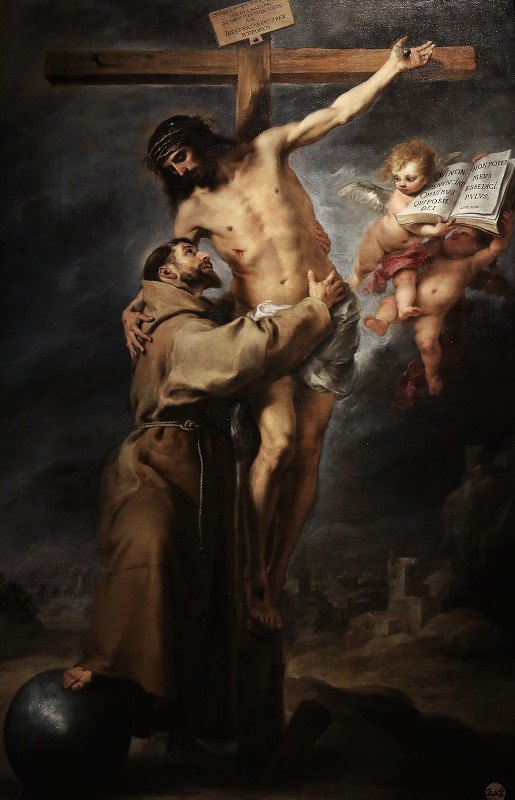
Image source: wikiart.org
Saint Francis and the Spiritual Heart of the Baroque
“Saint Francis of Assisi embracing the crucified Christ” captures one of the most intense subjects of Counter Reformation devotion. Painted in 1668, Bartolomé Esteban Murillo presents not a distant theological idea but an almost physical meeting between saint and Savior. The work blends drama, tenderness and visionary mysticism in a way that makes the viewer feel present at a private revelation.
The painting belongs to Murillo’s mature period, when he was at the height of his powers in Seville. Here he creates an image that is both emotionally overwhelming and carefully constructed. The scene is not set in a crowded narrative environment. Instead, the artist isolates Francis and Christ against a dark landscape and stormy sky, so that the encounter between them becomes the entire focus of the composition.
The result is a powerful meditation on love, sacrifice and imitation of Christ. Murillo transforms traditional Franciscan iconography into a deeply human scene, filled with gesture, touch and eye contact that readers of the seventeenth century and viewers today can easily understand.
The Vision of Saint Francis in Murillo’s Interpretation
The subject comes from a long tradition of Franciscan spirituality. Saint Francis, consumed with love for the suffering Christ, prays to share in his Lord’s passion and receives mystical experiences in which he sees or physically embraces Christ on the cross. Earlier artists often showed Francis kneeling at the foot of the crucifix, receiving the stigmata in rays of light. Murillo goes further and imagines a moment of literal embrace.
Christ still hangs upon the wooden cross, his body elongated and tilted as if he is descending toward Francis. The saint, in his coarse brown habit, wraps his arms around Christ’s waist and torso. His face presses against Christ’s ribs. Instead of the usual distance between worshipper and object of devotion, Murillo depicts an intimate contact that borders on a lover’s embrace.
To the right, a small winged angel hovers, holding a large tablet resembling a book or decree. The text is not entirely legible in reproductions, but it suggests heavenly confirmation of the saint’s union with Christ. The angel looks towards the viewer, as if inviting us to witness and reflect on this spiritual contract.
Beneath Francis’s feet lies a globe, a traditional symbol of the world. The saint’s heel rests firmly upon it, indicating his renunciation of worldly power and pleasure. The globe also anchors the composition, giving physical weight to a vision that is otherwise filled with clouds and spiritual light.
Composition and Movement in a Vertical Drama
Murillo uses the tall vertical format to express the upward pull of the scene. The cross rises almost to the top edge. Christ’s extended arms and slightly lifted torso lead the eye diagonally across the surface, while the swooping body of Francis forms a counter diagonal that converges at the point of their embrace.
The viewer’s gaze begins with Francis at the bottom, then climbs along his arm and shoulder to Christ’s torso, and finally reaches Christ’s head and the inscription above the cross. From there the eye drifts to the angel who hovers at mid height, then back down to the embracing figures. This constant circular motion keeps us engrossed in the moment of contact.
Murillo avoids any distracting architectural or narrative detail in the background. Instead he suggests a dim cityscape at the horizon, a distant reminder of the world that Christ has died to save and that Francis has renounced. The foreground is a rocky, barren ground, reinforcing the sense of spiritual desert where only faith and grace are present.
The arrangement of figures also creates a compelling rhythm. Francis leans heavily into Christ, almost pulling him downward. Christ in turn appears to support Francis with his right arm, while his left hand remains nailed to the cross. This interdependence shows that the saint does not approach Christ as an equal partner. Rather, his entire weight rests on divine mercy.
Light and Color as Carriers of Grace
As in many of Murillo’s religious works, light is the principal vehicle of theology. A concentrated glow surrounds Christ’s pale body and spreads to bathe Francis’s face and hands. This light does not appear to come from a natural source. It emanates from Christ himself, presenting him as the sun of righteousness, the central illumination in both the painting and the believer’s life.
The surrounding sky and landscape remain in deep shadow. Clouds gather and the earth seems to darken. Against this background the flesh of Christ and the habit of Francis stand out with luminous clarity. Murillo uses a limited palette of browns, warm ochres and muted blues for the environment, reserving strong contrasts for the figures.
The red of Christ’s loincloth is especially striking. It echoes the red drapery around the angel and hints at blood, love and sacrifice. This rich color forms a focal accent in an otherwise subdued composition. Francis’s habit, a simple coarse brown garment, absorbs some of the surrounding light, making him appear anchored, earthly and human, in contrast to the glowing Christ.
The angel’s rosy flesh and soft wings are painted with Murillo’s characteristic delicacy. The small figure is bathed in light similar to Christ’s, visually linking the heavenly messenger with the Savior. Though minor in scale, the angel contributes to the overall luminosity, extending the halo of grace outward.
The Emotional Core of the Painting
Murillo is a master of gentle expression. In this painting, however, he pushes emotional intensity to an almost unbearable level. The saint’s face, half hidden as he presses it against Christ’s side, conveys both reverence and desperate longing. His eyes are raised toward Christ’s chest, filled with tears and adoration. His mouth is slightly open, as if caught in the middle of a prayer or cry.
Christ’s expression is one of patient compassion. His head leans toward Francis. The usual agony of the crucifixion is softened, though not erased. The crown of thorns and nail wounds remain visible, yet his features suggest acceptance rather than torment. It is as if the moment of sacrifice is passing into a moment of union, where suffering is transformed into love.
The physical contact between the two bodies is crucial to the emotional impact. Murillo paints the grip of Francis’s hands with great sensitivity. One hand wraps around Christ’s waist, fingers clutching the cloth, while the other presses against Christ’s side. This tactile detail invites the viewer to imagine the warmth, weight and reality of Christ’s body.
At the same time, the tight embrace evokes vulnerability. Francis is not just clinging to a beloved Lord; he is surrendering his entire self, body and soul, to the crucified Christ. The viewer senses that everything in Francis’s life converges in this one embrace. Murillo captures the paradox of Franciscan spirituality: joy found in the closest possible sharing of Christ’s suffering.
Symbolism and Theological Themes
The painting is rich in symbols that would have been instantly understood by seventeenth century viewers.
The cross stands at the center as the ultimate sign of redemption. Its rough wood and the inscription at the top remind us of Christ’s historical crucifixion, but Murillo avoids a detailed depiction of blood or gore. The cross is both real and visionary, a bridge between earthly history and ongoing spiritual experience.
The globe under Francis’s feet indicates his renunciation of worldly ambition. Similar globes appear in other religious art as symbols of the world or earthly power. Here it is not a regal orb but a dark sphere, placed low and partially in shadow. Francis’s stance on the globe shows that his true support is not the world but Christ on the cross.
The angel carrying a tablet or scroll suggests the divine record of salvation. The text, though difficult to read from reproductions, likely refers to indulgences or spiritual promises associated with devotion to the cross. The angel’s presence implies that what happens in this vision has cosmic significance, not only for Francis but for all believers.
The dark city in the background can be seen as an image of the fallen world that Christ came to redeem. Its indistinct outline contrasts with the clarity of the figures in the foreground. This separation underlines the idea that authentic Christian life requires stepping away from worldly distraction to encounter Christ directly.
Murillo also emphasizes the humanity of both Christ and Francis. Their bare feet, visible veins and muscles, and the weight of their bodies create a sense of physical reality. This focus on the human body reflects Catholic teaching about the incarnation and the value of the body as an instrument of grace, particularly important during the Counter Reformation.
Murillo’s Style and the Counter Reformation Spirit
By the time Murillo painted this work, Catholic Spain was steeped in Counter Reformation ideals, which encouraged vivid and emotionally engaging religious imagery. Art was expected to move the viewer to repentance, devotion and imitation of the saints. Murillo meets this goal through a combination of dramatic composition and tender realism.
Unlike the harsher tenebrism of early Baroque painters, Murillo softens his chiaroscuro with a golden glow. The shadows are deep but warm, suggesting mystery rather than fear. His brushwork is fluid and supple, blending colors gently in the figures while allowing more expressive strokes in the clouds and background.
Murillo’s Francis is not an abstract symbol of asceticism. He appears as a living man with weathered features, rough garments and a passionate heart. This approach reflects Spanish devotion to Christ and Mary as approachable intercessors, intimately involved in the daily lives of believers.
The painting also shows Murillo’s ability to harmonize grandeur with intimacy. The scale is monumental, yet the emotional focus remains personal. Viewers of the time could imagine themselves in Francis’s place, seeking the same embrace from Christ. This capacity to invite identification is one reason Murillo’s religious works became so popular.
A Meditative Experience for Modern Viewers
For contemporary viewers, “Saint Francis of Assisi embracing the crucified Christ” remains moving even if they are not steeped in seventeenth century theology. The image presents universal themes of suffering, compassion and the desire to be fully known and loved.
The painting encourages slow contemplation. The more one looks, the more details emerge: the slight tilt of Christ’s fingers, the tension in Francis’s shoulders, the delicate feathers of the angel’s wings. These details are not mere technical displays. They function as stepping stones into prayerful reflection, inviting the viewer to ponder personal experiences of grief, guilt, hope and consolation.
From an art historical perspective, the work also illustrates how Murillo bridges the gap between high Baroque drama and the gentler sentiment of later religious art. His Christ is neither distant nor terrifying. Instead, he is a compassionate presence who allows himself to be embraced. This approach would influence later Spanish painters and devotional imagery well into the eighteenth century.
Conclusion: The Embrace as Icon of Surrender and Love
“Saint Francis of Assisi embracing the crucified Christ” is one of Murillo’s most intense spiritual visions. Through its vertical composition, luminous color, careful symbolism and profound human feeling, the painting offers more than a narrative scene. It becomes an icon of total surrender, where the saint’s longing is met by the Savior’s self giving love.
The embrace at the center of the canvas expresses what words cannot easily convey. Francis’s renunciation of the world, symbolized by the globe under his feet, is not a harsh rejection of life but a redirection of all desire toward Christ. Murillo places the viewer at the edge of this encounter, close enough to feel its emotional heat.
In doing so, he creates a work that continues to speak across centuries. Whether approached as a masterpiece of Spanish Baroque art or as a visual prayer, the painting invites us to consider what it might mean to hold on to something greater than ourselves and to be held in return.