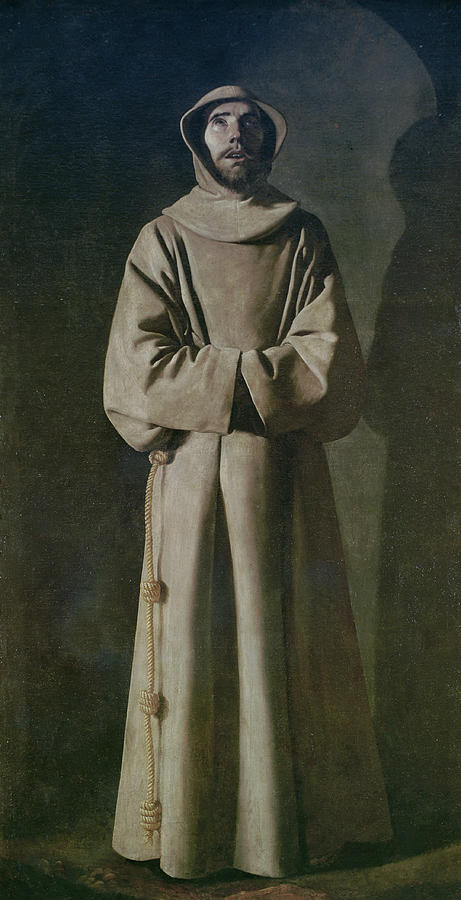
Image source: wikiart.org
Introduction to Francisco de Zurbaran’s “Saint Francis”
“Saint Francis” by Francisco de Zurbaran is one of the most hauntingly quiet images in Spanish Baroque art. A single friar stands upright, wrapped in the rough folds of a Franciscan habit, hands hidden in his sleeves, eyes lifted toward an unseen light. Around him stretches a dark, almost impenetrable background that makes his figure emerge like a vision out of shadow.
Zurbaran was a master at turning solitude into something monumental. In this painting he transforms the humble figure of Saint Francis of Assisi into an icon of interior prayer. There are no dramatic gestures, no narrative details, and no landscape to distract the eye. Yet the work radiates an intense spirituality that has captivated viewers for centuries.
The Figure Of Saint Francis And His Iconography
Saint Francis of Assisi is one of the most beloved saints in the Christian tradition, known for his poverty, simplicity, and love of creation. Artists often portray him surrounded by animals, receiving the stigmata, or embracing a crucifix. Zurbaran chooses a radically stripped down approach.
The saint stands alone in his coarse habit, tied at the waist with a rope whose knotted ends hang at his side. The habit immediately identifies him as a Franciscan friar and evokes the ideals of poverty and humility. His hood frames his face, casting light and shadow across his cheeks and forehead. There is no visible halo, yet his upward gaze and the concentrated light on his face make his sanctity unmistakable.
By omitting most of the traditional attributes, Zurbaran emphasizes Francis not as a legendary miracle worker but as a man absorbed in prayer. His identity arises from his posture and expression rather than from external symbols. The viewer is invited to meet him as a person before contemplating him as a canonized saint.
Composition And The Power Of Verticality
The composition is dominated by a strong vertical axis. Saint Francis occupies almost the entire height of the canvas, from the hem of his robe near the bottom edge to the top of his hood close to the upper frame. This vertical emphasis makes him appear taller and more monumental than an ordinary human figure.
His hands are hidden together within the sleeves, close to the center of his body. This subtle detail is crucial. It eliminates distracting gestures and keeps the viewer’s attention on the overall silhouette. The symmetry of his pose suggests stability and inner focus, much like a column in a church or a pillar of smoke rising in silent sacrifice.
The slight turn of his head breaks the strict symmetry and introduces a gentle diagonal line that leads the eye upward. This small variation prevents the figure from feeling static. It communicates that Saint Francis is engaged in a living dialogue with the divine, not frozen in stone.
The dark, nearly blank background places the friar in an undefined space. There is no floor pattern, no architectural element, and no horizon line. The only hint of spatial depth is the shadow that forms behind him, echoing his outline. This echo reinforces the verticality and further isolates the figure, making him the sole focus of contemplation.
Light And Chiaroscuro In “Saint Francis”
Zurbaran’s use of light is central to the painting’s emotional impact. A clear, directional light illuminates the left side of the saint’s face and habit, gradually fading into shadow on the right. This strong contrast, rooted in the Caravaggesque tradition, gives sculptural volume to the figure and dramatizes his presence.
The light seems to come from above and slightly to the left, suggesting a transcendent source. It does not flood the scene but falls selectively, almost tenderly, on Francis’s face and upper torso. The folds of the habit catch highlights along their ridges, while deep creases sink into darkness. As the eye moves down, the light fades, and the lower part of the robe merges with the surrounding gloom.
This distribution of light has symbolic significance. The illuminated face, turned upward, suggests the soul turned toward God. The darkened lower body and background evoke the world that Francis has renounced, or the obscurity of earthly life compared to the clarity of divine vision. The painting thus becomes a visual metaphor for spiritual ascent.
The Habit As A Second Skin
Zurbaran had an extraordinary talent for painting textiles, and the Franciscan habit in this work is a masterpiece of subtle detail. The coarse cloth is rendered with delicate variations in tone that suggest its rough, heavy texture. The seams, folds, and slight irregularities in the fabric are observed with the eye of someone who has truly studied a real garment hanging before him.
Yet this attention to material reality serves a deeper meaning. The habit appears almost like a second skin that covers and shapes the saint’s body. It hides his individual physical traits, allowing his identity to be defined instead by his vocation and his relationship with God. The rope cord, with its knotted segments, reinforces the idea of discipline and voluntary restraint.
The simplicity of the robe contrasts with the expressive force of the face. Zurbaran seems to suggest that true spiritual greatness does not require ornate dress. The habit becomes a visual shorthand for humility, obedience, and commitment to a life of poverty.
Expression, Gaze, And Interior Drama
If the habit speaks of renunciation, the face of Saint Francis reveals the intense interior life that fills the emptiness left by worldly attachments. His eyes are wide open and directed upward, as if following a light or vision invisible to the viewer. His mouth is parted slightly, suggesting breathless awe or whispered prayer.
There is a tension between vulnerability and firmness in his expression. The soft modeling of his cheeks and the shadows beneath his eyes hint at fatigue or past suffering. At the same time, his gaze is unwavering. He does not look at us, which frees the viewer to observe him without feeling scrutinized. Instead, we witness a private encounter between Francis and God.
This indirectness makes the painting particularly powerful for devotional use. Viewers are not placed in the role of judges or participants in a narrative. They are invited to stand quietly with the saint, to share the silence and perhaps to imitate his upward focus in their own inner prayer.
Silence, Solitude, And Contemplation
One of the most striking qualities of the painting is its profound sense of silence. There is no sound implied, no movement suggested by wind or gesture. The saint stands as if in a moment outside of time. This stillness reflects a key dimension of Franciscan spirituality as Zurbaran and his contemporaries understood it: the call to contemplative withdrawal from noise and distraction in order to be more fully present to God.
The dark background intensifies this impression of solitude. Saint Francis appears to stand in an empty space that could be a cave, a chapel, or the depths of the night. It is the kind of space where one meets oneself and God without intermediaries. The painting thus becomes a visual equivalent of a silent retreat.
In a broader Baroque context, many religious paintings display dramatic scenes filled with multiple characters, swirling clouds, and complex architecture. By contrast, Zurbaran’s “Saint Francis” shows how minimalism can also be deeply theatrical. The drama occurs not in external action but in the threshold between light and darkness, between earth and heaven, within the soul of one man.
Counter Reformation Spirituality And The Spanish Context
The painting emerges from the fervent religious climate of seventeenth century Spain, shaped by the Counter Reformation. Church authorities promoted images that encouraged piety, humility, and obedience. The Franciscans, with their emphasis on poverty and personal conversion, played a crucial role in this spiritual renewal.
Zurbaran was a favored painter of monastic communities, especially in Seville and other Andalusian cities. His images of monks and saints often decorated refectories, chapter houses, and chapels, where they served as constant reminders of the ideals of religious life. “Saint Francis” would have been particularly apt for such a setting, offering friars a companion and model in their own search for holiness.
The painting’s austerity reflects the Spanish taste for sobriety in religious art, sometimes called mystic realism. Rather than distracting the viewer with decorative detail, the artist strips away everything that does not serve the central spiritual message. That message here is clear: sanctity resides in total surrender to God, a surrender that is expressed by the simple posture of a man standing before his Creator.
The Shadow As Spiritual Symbol
The shadow that looms behind Saint Francis deserves special attention. It follows his outline yet expands beyond it, forming a dark backdrop that frames his head and shoulders. This shadow intensifies the brightness of the illuminated areas, but it also carries symbolic possibilities.
One interpretation is that the shadow represents the old self, the part of Francis that has died to worldly ambitions and pleasures. As he turns toward the light, he leaves this shadow behind. Another reading is that the shadow evokes the mystery of God, who cannot be fully seen or grasped. The saint is bathed in reflected light but stands before a depth of darkness that surpasses human understanding.
In either case, the interplay of figure and shadow suggests that the spiritual life always involves a tension between what is revealed and what remains hidden. Zurbaran does not resolve this tension. He simply presents it visually and allows the viewer to dwell within it.
Emotional Resonance For Contemporary Viewers
Although created centuries ago, “Saint Francis” continues to resonate with modern audiences. Many people today experience overload from constant information, noise, and visual stimuli. In this context, Zurbaran’s quiet monk, standing alone in contemplative stillness, can feel both challenging and deeply attractive.
The painting invites viewers to slow down, to attend to their inner life, and to consider what they might need to leave behind in order to be more fully themselves. The simplicity of the composition offers a kind of visual rest, while the intense expression of the saint hints at a depth of experience that cannot be reached without silence and focus.
For those interested in art history, the work also provides an exemplary case of Baroque chiaroscuro and of the Spanish approach to religious imagery. It demonstrates how a limited palette, a single figure, and careful control of light can create a work of tremendous spiritual and aesthetic power.
Conclusion
Francisco de Zurbaran’s “Saint Francis” is a masterpiece of concentrated spirituality and refined restraint. Through a solitary friar standing in a dark space, the painter conveys the essence of Franciscan devotion: humility, poverty, intense prayer, and total orientation toward God.
The monumental vertical figure, the sculptural rendering of the habit, the expressive face lifted to the unseen, and the enveloping darkness all work together to create an image that is both austere and profoundly moving. It is a painting that whispers rather than shouts, yet its quiet voice lingers in the imagination long after one has looked away.
For viewers today, the work offers not only an encounter with a major Baroque master but also a gentle reminder of the enduring human need for silence, contemplation, and a sense of the sacred. In the stillness of Zurbaran’s “Saint Francis,” many find an echo of their own search for meaning and a visual guide toward a deeper interior life.