Image source: wikiart.org
Introduction to Saint Eulalia (1885)
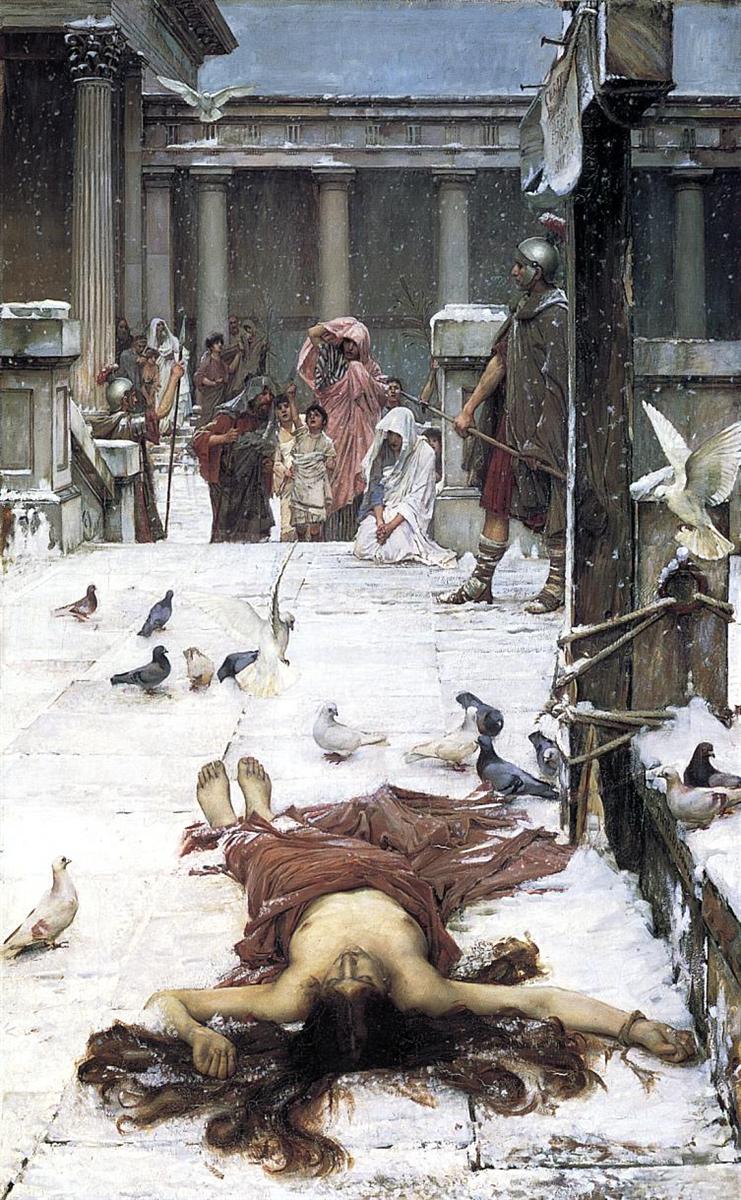
John William Waterhouse’s Saint Eulalia (1885) is a painting built on a single, devastating contrast: a young martyr’s still body lies in the snow while the machinery of public life continues around her. It is an image that feels both ancient and startlingly immediate. The setting evokes imperial Rome with its monumental columns and stone steps, yet the emotional register is recognizably human and close. Waterhouse places the viewer low and near the ground, almost at the level of the fallen figure, so that the scene reads less like distant history and more like a witnessed event.
This work sits at a fascinating point in Waterhouse’s career. It shows his attraction to classical subjects and grand narrative, but it already carries the empathy and psychological focus that would define many of his most memorable paintings. Saint Eulalia Waterhouse 1885 is not primarily about action. It is about aftermath, exposure, and the eerie quiet that follows cruelty. Snow falls softly across stone. Birds gather without fear. People look on, some shocked, some curious, some reverent. The world does not stop, and that is part of the painting’s moral weight.
The Legend of Saint Eulalia and Why It Matters Here
Saint Eulalia is traditionally remembered as a teenage Christian martyr from late Roman Spain, associated especially with Mérida. Her story, told and retold across centuries, centers on defiance in the face of imperial authority. In many versions, she refuses to renounce her faith, suffers punishment, and dies, after which a sign appears, often described as a white dove, and sometimes accompanied by snowfall that covers her body. The legend mixes brutality with tenderness, and that mixture is exactly what Waterhouse brings into focus.
What makes the subject so potent for a Victorian painter is the way it frames innocence against power. Eulalia is not shown as a triumphant saint holding a palm branch in a glowing heaven. She is shown as a young person whose vulnerability has been made public. That publicness is crucial. Martyrdom, in this telling, is not only a private suffering but a spectacle staged by authority. Waterhouse turns that spectacle back on the onlookers, and by extension, back on us.
First Impressions and the Painting’s Shock of Proximity
The composition begins with immediacy. Eulalia’s body dominates the foreground, stretched across the cold stone, arms extended, hair spilled like dark silk against the whiteness. Her drapery is a deep, earthy red brown that pools and creases, emphasizing weight and gravity. Snow gathers in soft edges along the cloth and in the cracks between paving stones. The viewpoint makes the viewer feel almost too close, as if stepping carefully so as not to disturb the hush.
Beyond her, the space opens into steps and a colonnade, and suddenly there is distance, crowd, and architecture. That shift is emotionally sharp. Near the body, everything is tactile: fabric, skin, hair, snow. Further away, people become a cluster of reactions and silhouettes framed by stone. Waterhouse uses this spatial journey to move the viewer from empathy to analysis, from feeling to social awareness. You start by seeing her, then you notice them.
Composition, Perspective, and the Road the Eye Must Travel
Waterhouse builds the painting along a powerful recession line. The paving stones form a corridor that pulls the gaze from the martyr’s body toward the crowd and the looming columns. The steps act like a stage, elevating the onlookers and turning the public square into a theatre. The result is a guided reading: foreground tragedy, middle ground authority, background society.
The right side is anchored by a tall wooden structure bound with ropes, dusted with snow, like a grim vertical counterpoint to Eulalia’s horizontal form. The soldier standing near it, helmeted and armed, is placed almost as a sentry guarding the boundary between the viewer and the crowd. His stance is casual, not frantic, which makes the moment feel institutional rather than chaotic. Violence is implied as procedure, not passion.
On the left, a massive column rises, echoing the theme of power and permanence. Stone architecture represents empire, law, and the confidence of domination. Against that, the young body appears unbearably temporary. Waterhouse makes impermanence the center of the image, and that choice is the painting’s quiet rebellion.
Snow as Atmosphere and Meaning
The snowfall is not a decorative touch. It is the painting’s emotional climate. Snow softens edges, mutes sound, and slows perception. It turns a public execution space into something like a hushed sanctuary. At the same time, it intensifies the coldness of the setting, the indifference of stone, and the loneliness of the figure in the foreground.
Symbolically, snow has long suggested purity, cleansing, and a kind of merciful covering. In the legend of Eulalia, snow can be understood as nature’s response to injustice, a gentle veil over a violated dignity. Waterhouse paints the snow as light, steady, and persistent. It does not storm. It falls with quiet certainty, as if it belongs to a different moral order than the crowd’s.
Visually, the whiteness also sets the stage for contrast. The brown red drapery and Eulalia’s warm skin tones become the only true warmth in a world of stone grays and winter air. That warmth reads as life that has only just departed, a reminder that what lies here was recently a living person, not an emblem.
Birds, Doves, and the Strange Calm of Nature
One of the most haunting features of Saint Eulalia is the presence of birds. Several gather on the paving stones near the body, and white doves appear in flight and perched at the edges of the scene. The birds do multiple jobs at once. They connect directly to the saint’s legend, where a dove can signify the soul’s release or divine witness. They also create a disturbing normality. Birds are drawn to open spaces and dropped scraps. Their calm suggests that life continues according to ordinary instincts, even when humans have committed something extraordinary.
Waterhouse paints the birds with a sharp eye for behavior: small heads angled, bodies at rest, wings caught mid motion. Their presence creates movement in an otherwise still scene. They also distribute points of white across the composition, echoing the snow and drawing attention back to the foreground. A dove becomes a visual rhyme with the snowfall, both pale, weightless, and descending.
There is an unsettling tenderness in this. If the crowd cannot give Eulalia dignity, nature offers a symbolic one. The birds become quiet witnesses, not gawkers. Their innocence throws the crowd’s moral complexity into sharper relief.
Color, Light, and the Controlled Temperature of the Palette
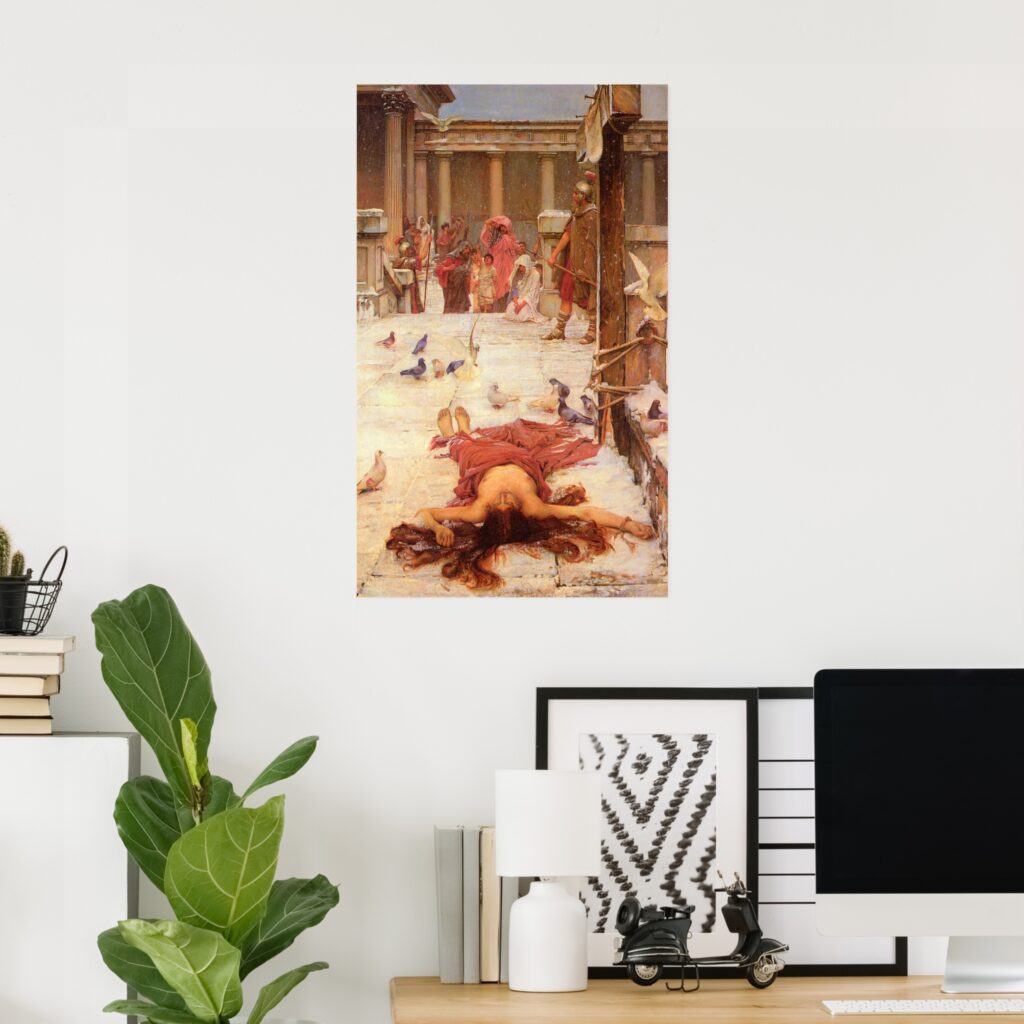
The palette is disciplined. Waterhouse avoids melodramatic color effects, choosing instead a cool range of grays, off whites, and weathered stone hues. This restraint makes the warmer notes more meaningful. The drapery’s red brown reads like dried leaves against snow, organic and mortal. In the mid ground, a figure in pinkish clothing adds a faint flush of life to the crowd, a reminder that warmth still exists beyond the foreground.
Light is diffuse, wintery, and overcast. There is no theatrical spotlight from heaven, no dramatic sunbeam. The illumination feels real, and that realism strengthens the painting’s ethical pressure. Waterhouse seems to say: this is not a myth happening in a dream. This is what cruelty looks like in daylight, under ordinary skies.
At the same time, the subtle lighting creates a gentle glow on the snow that borders on sacred. Sanctity is suggested through atmosphere rather than special effects. The holiness of Eulalia is not announced by halos. It is implied by the stillness that surrounds her.
Gesture, Crowd Psychology, and the Morality of Looking
The crowd is painted as a spectrum of response. Some figures lean in or raise hands, drawn by curiosity or shock. Others appear hesitant, half hidden by drapery and distance. A kneeling figure in pale clothing near the steps feels especially important. This person’s posture introduces mourning or prayer into the scene, an alternative to gawking. Waterhouse includes reverence as a possibility, but he does not let it dominate.
This is where the painting becomes self aware. It is a picture about spectatorship that turns the viewer into another spectator. Where do you stand: with the curious, with the indifferent, with the grieving, with the armed authority, or with the fallen? The painting does not give an easy exit. The low viewpoint makes it hard to pretend neutrality. You are close enough to see the snow on fabric, close enough to feel implicated in the publicness of her death.
The soldier’s presence is a reminder that the crowd is permitted. People are allowed to watch. That permission is part of the system. Waterhouse captures how power operates not only through force but through shaping what a society considers normal to witness.
Material Realism: Stone, Cloth, Hair, and the Weight of the Body
Waterhouse’s technical strength is clearest in textures. The stone pavement is rendered with convincing seams, chips, and a cold sheen under snow. The cloth has heft, folding into thick ridges and pulling into stretched planes that suggest the body beneath. Eulalia’s hair spreads outward in long strands that look dampened by cold, forming a dark halo that is not an emblem of glory but a physical fact.
This attention to material reality does something important: it protects the scene from becoming purely symbolic. You can read doves as spiritual signs, but you cannot ignore the cloth pressed into snow. The painting keeps returning you to the body’s presence, to the truth that martyr narratives begin with a human being.
Waterhouse also avoids sensational detail. The tragedy is communicated through posture, stillness, and exposure to cold rather than graphic depiction. The result is more disturbing, not less. The mind fills in what the eye is not forced to see. The painting’s restraint becomes a form of respect.
Architecture and Empire: A World Built to Outlast the Individual
The colonnade and classical buildings are not mere backdrop. They symbolize the weight of institutions. Columns suggest order, law, and the aesthetic confidence of empire. They also suggest repetition, the way power recreates itself through structures that look permanent. Against that, Eulalia’s body is singular, fragile, and finite.
Waterhouse places the human drama at the base of these structures, on the ground, as if the empire’s grandeur is literally built over bodies like hers. The steps are especially telling. They elevate the crowd, turning them into an audience, and they create a boundary line between the fallen saint and the continuing life of the city. To climb the steps is to return to normal social space. To remain below is to remain with the cost.
Even the snow participates in this contrast. It is temporary, falling over stone that will remain. But it temporarily transforms the scene, making the rigid world of empire look softened, as if nature can briefly rewrite the mood of power.
Waterhouse, Late Pre-Raphaelitism, and the Painting’s Emotional Strategy
Although Waterhouse is often linked with Pre-Raphaelite interests, he is also distinct from the earliest Brotherhood aesthetic. In Saint Eulalia, you can sense a blend: careful natural detail, a love of historical and literary subject matter, and a focus on a woman as the emotional center. Yet the handling feels more atmospheric and painterly than the tight, jewel like surfaces associated with some earlier Pre-Raphaelite works.
This painting also previews Waterhouse’s lifelong fascination with women caught at the edge of myth, tragedy, and society’s judgment. Here, the heroine is not a sorceress or a doomed lover but a saint, and still the emotional structure is similar. A female figure is placed in a world that watches her, defines her, and punishes her. The painting asks what that world reveals about itself.
The emotional strategy is not to show heroism as action. It is to show heroism as endurance and consequence. Eulalia’s triumph is not a visible victory. It is the fact that her stillness cannot be made into compliance. Even in death, she refuses to become merely a public lesson for the crowd.
Why Saint Eulalia Still Resonates
Saint Eulalia remains compelling because it treats history as a mirror. It is easy to locate cruelty safely in the past, to call it ancient barbarism and move on. Waterhouse refuses that comfort. By focusing on the social space around the body, he suggests that the real question is not only what the authorities did, but what everyone else did with their eyes and their presence.
The painting also resonates because it balances tenderness and indictment. Snow falls like mercy, but the mercy comes too late. Doves suggest purity, but purity is shown as vulnerable in a public square. The crowd contains grief, but grief must share space with curiosity. These contradictions feel true to how societies react to suffering, both then and now.
As an image, it lingers because it is quiet. There is no explosion of movement, no climax. Just stone, snow, birds, and a young martyr’s body stretched across the foreground like an accusation that cannot be argued away. John William Waterhouse makes stillness speak, and the silence becomes the painting’s strongest voice.