Image source: wikiart.org
Introduction to Saint Elizabeth of Thuringia
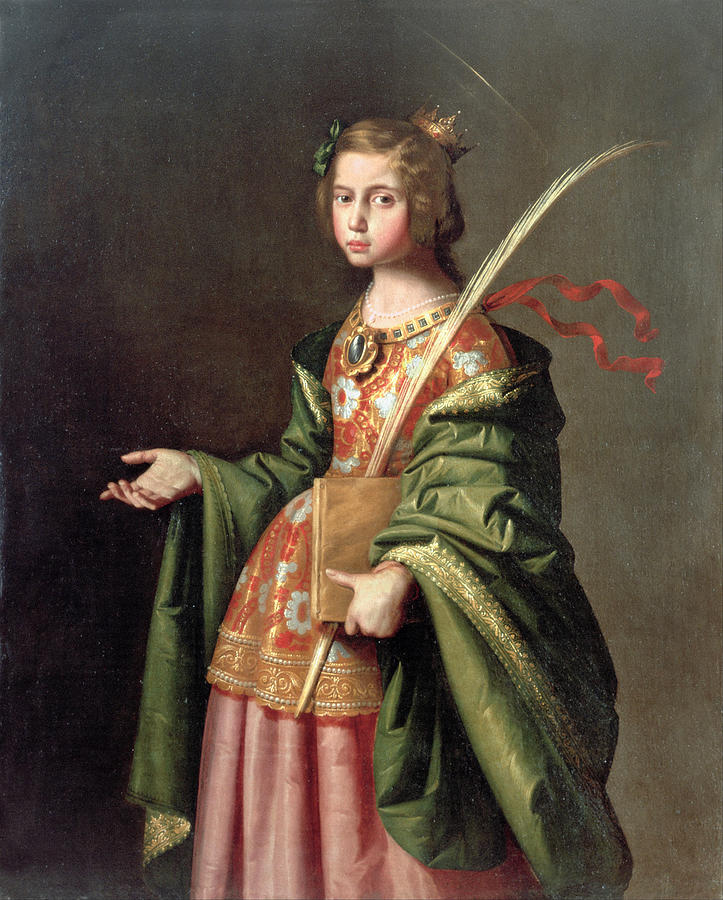
Francisco de Zurbaran’s painting “Saint Elizabeth of Thuringia” presents a young royal saint with a stillness and dignity that is immediately arresting. Rather than depicting dramatic miracles or scenes of charity, Zurbaran chooses a single, poised figure whose quiet presence carries a deep spiritual message. The work reveals how the Spanish Baroque master could translate his characteristic austerity and love of fabric into the refined elegance of a noblewoman who is also a martyr and benefactor of the poor.
The saint stands against a neutral background, fully frontal, wrapped in sumptuous fabrics. In one hand she holds a book, in the other the palm of martyrdom. A delicate crown, a faint golden halo and a large jewel at her chest mark her royal and sacred status. Yet her youthful face remains remarkably human and introspective, as if she is caught between the world of courtly privilege and the call to selfless charity that defined her life.
Historical and Devotional Background
Saint Elizabeth of Thuringia, also known as Elizabeth of Hungary, was a thirteenth century princess renowned for her radical generosity to the poor. Married into the court of Thuringia, she used her wealth to found hospitals, feed the hungry and care personally for the sick. After the death of her husband she embraced a life of religious poverty and service before dying at a young age. She was canonized not long after, becoming one of the most beloved female saints in medieval and early modern Europe.
Zurbaran painted many holy women for Spanish convents and churches that venerated virgin martyrs, royal saints and founders of religious orders. Even when depicting a northern European figure like Elizabeth, he translated her cult into the visual language familiar to Spanish viewers. The painting likely served as an image for contemplation, reminding nuns or lay faithful that true nobility lies not in rich clothing but in sacrificial love. Zurbaran’s challenge was to show at once her courtly status and her interior holiness.
First Impressions and Overall Composition
At first glance, “Saint Elizabeth of Thuringia” appears almost like a court portrait. The saint is shown three quarter length, standing with her body turned slightly while her gaze meets the viewer. She occupies most of the pictorial space, framed by the soft darkness of an undefined background. There is no narrative setting, no palace, church or landscape. This isolation of the figure focuses attention entirely on her person and symbols.
Zurbaran organizes the composition around a gentle diagonal that runs from the saint’s open left hand at the lower left up through the book and palm branch, and finally toward the small crown and halo above her head. This diagonal guides the eye from her earthly acts of teaching and charity, symbolized by the book and outstretched hand, toward her heavenly reward indicated by the palm and crown. The asymmetrical placement of her arms enlivens the otherwise static pose and gives a sense of conversation, as if she is about to speak.
The Royal Saint as a Young Girl
One of the most striking aspects of the painting is Elizabeth’s youth. Zurbaran presents her not as a mature queen but as a girl on the threshold of adulthood. Her face is round and soft, with full lips and wide, slightly melancholy eyes. This choice heightens the sense of innocence and vulnerability. It also underscores the fact that many of her acts of charity and her embrace of a demanding spiritual life began when she was very young.
Despite her youth, her expression carries gravity. She does not smile or strike a coquettish pose. Instead, her look is serious, as if she already knows the cost of discipleship. The slight tilt of her head and the firmness of her mouth suggest quiet resolve. Zurbaran manages to balance sweetness and strength in her features, a combination that matches the historical saint who turned her royal privileges into instruments of mercy.
The Language of Costume and Textile
Zurbaran was famous for his ability to paint fabric, and “Saint Elizabeth of Thuringia” is a brilliant demonstration of that gift. The saint’s attire is composed of several layers, each rendered with different textures and colors. Closest to the eye is a sumptuous overgarment of green fabric lined with gold. This cloak wraps around her shoulders and arms in broad folds, catching the light along its creases. The green surface is deep and slightly muted, while the gold edging glitters with tiny touches of brighter paint, suggesting elaborate embroidery.
Beneath the green mantle lies a red and gold bodice patterned with stylized flowers. The pattern feels almost brocade like, with metallic highlights that catch the imaginary light source. This richly decorated garment speaks of court life and princely status. Below that, a pinkish skirt falls in long vertical folds to the floor, its softer hue balancing the strong green and red of the upper garments.
The fabrics do more than display Zurbaran’s technical prowess. They embody the dual identity of Elizabeth as princess and saint. The expensive materials and carefully tailored layers announce her royal origin. At the same time, the modest cut and the way the garments envelop rather than reveal her body suggest humility and chastity. The saint stands clothed in luxury, yet her demeanor and symbols tell us that she used such wealth for the service of others.
Jewelry, Crown and Halo
In the center of her chest Elizabeth wears a large oval jewel set in a gold frame. The gem, painted with subtle reflections, acts as a focal point, drawing the viewer’s eye to the heart area. Symbolically, it can be read as a sign that her heart is precious, adorned by virtue rather than mere ornament. It also repeats the theme that inner nobility shines through outward signs.
Upon her head lies a delicate crown that nearly disappears into the surrounding light. Unlike the heavy jeweled crowns sometimes seen in royal portraits, this one is small and finely worked, more a sign of spiritual queenship than worldly power. Behind it, Zurbaran paints a faint golden halo, a simple circle that merges into the background. The halo is understated yet essential, quietly affirming her sanctity.
Together, jewel, crown and halo form a vertical axis of significance running through the upper half of the painting. They guide the eye upward from the worldly attire toward the invisible grace that transforms her into a model of Christian charity. The effect is subtle. Zurbaran avoids theatrical rays or glowing light. Instead, he lets a few carefully placed touches of gold stand in for the radiance of holiness.
The Book and Palm of Martyrdom
Elizabeth holds a closed book against her torso with her right hand. The book has a plain cover and no visible inscription, emphasizing use rather than display. In Christian iconography, a book often represents scripture or a rule of life. For Elizabeth it may refer to the Gospel message of caring for the poor, which shaped her deeds. Its closeness to her body suggests that these teachings are not merely studied but internalized.
The other key attribute is the long palm branch she carries over her left arm. In art, the palm is the standard sign of martyrdom, recalling the victory of the spirit over suffering and death. While Elizabeth of Thuringia did not die under violent persecution in the strict sense, her life of self denial and service led to early death and was often interpreted as a form of mystical martyrdom. The palm affirms that she gained the reward promised to those who lay down their life for others.
The palm curves upward and outward, its tip reaching toward the upper right corner of the canvas. A red ribbon is tied along its length, fluttering into the surrounding space. The color of the ribbon echoes the red of her bodice and also suggests the blood of sacrifice. This dynamic element introduces a sense of movement and wind into an otherwise still composition, hinting at the invisible breath of the Spirit that animates her charity.
Gesture and Silent Speech
Elizabeth’s left hand is extended with the palm facing upward, fingers slightly curved in a welcoming and giving gesture. This is one of the most expressive details in the painting. The open hand recalls the act of offering, as if she is about to give alms or share bread. It may also suggest invitation, beckoning the viewer to partner in works of mercy.
The hand is not theatrical. Zurbaran paints it with restrained realism, the knuckles and tendons visible yet softened by youth. Its position just below chest level and slightly forward draws attention without dominating. Combined with the direct yet gentle gaze of the saint, this gesture creates the feeling that we are included in her mission. She stands before us not as a distant icon but as a companion whose example challenges our own generosity.
Color Harmony and Emotional Tone
The painting’s color scheme is both rich and carefully balanced. The dominant tones are green, red and pink, harmonized by touches of gold and grounded by the neutral background. The deep green of the cloak is associated with life, hope and renewal. The warm red of the bodice suggests love and sacrifice. The softer pink of the skirt introduces gentleness and femininity.
These colors together create a mood that is sumptuous yet peaceful. There is no strong contrast of blazing light and dark as in some of Zurbaran’s more dramatic works. Instead, the light falls gently across the garments, creating rounded volume and subtle shading. The background remains a cool, smoky gray that allows the figure to emerge as if from a quiet, contemplative space.
This restrained luminosity suits the character of Elizabeth’s sanctity. Her holiness is not of the spectacular miracle or violent martyrdom but of daily service and hidden suffering. The painting’s atmosphere invites meditation rather than awe. Viewers are drawn into a space of calm where they can reflect on the meaning of true charity.
Zurbaran’s Approach to Female Sanctity
Throughout his career Zurbaran painted many images of female saints, often presenting them as young, elegantly dressed women in luxurious fabrics. Some modern viewers might initially see these works as fashionable portraits followed by halo and palm. Yet in “Saint Elizabeth of Thuringia” it becomes clear that the artist uses this format deliberately to convey a theological point.
By clothing the saint in splendid garments, Zurbaran acknowledges the historical reality of her princely status. At the same time, the serenity of her expression, her modest pose and her attributes insist that such worldly beauty finds its fulfillment in spiritual generosity. For the nuns, patrons or laypeople who prayed before this painting, Elizabeth served as a reminder that wealth and privilege are to be transformed into instruments of love.
Zurbaran’s respectful portrayal of her youth and femininity also matters. She is neither eroticized nor masculinized. Instead, her womanhood is presented as the natural vessel of her vocation as caregiver and benefactor. This reflects the Baroque Catholic ideal of the holy woman whose gentleness and compassion become powerful forces for social care.
Spiritual Meaning and Contemporary Relevance
For contemporary viewers, “Saint Elizabeth of Thuringia” continues to speak in several ways. Her calm gaze across centuries invites reflection on our own attitude toward material comfort and social responsibility. Surrounded by fabrics that proclaim wealth, she nonetheless holds a book and palm that proclaim a higher calling. The contrast prompts questions about how we use our resources, time and influence.
The painting also addresses the tension between youth and commitment. Elizabeth appears very young, yet her symbols and manner show that she has already dedicated herself to a demanding path. For viewers in modern cultures that often postpone serious responsibility, this image can be particularly challenging. It suggests that generosity and concern for the marginalized are not tasks reserved for later life but possibilities even in youth.
Finally, the open hand of the saint can be read as a visual invitation to compassion. Instead of pointing upward or inward, she directs her gesture outward, toward us and toward the world. Zurbaran captures in that small movement the essence of Christian charity: a willingness to receive from God and to give to others.
Conclusion
Francisco de Zurbaran’s “Saint Elizabeth of Thuringia” is a masterful synthesis of portrait like realism, textile virtuosity and spiritual symbolism. Through the quiet presence of a young royal saint, the painting communicates themes of charity, sacrifice and transformed nobility. Every detail, from the rich green cloak and jeweled brooch to the simple book and palm branch, serves this deeper meaning.
The work shows how Zurbaran could adapt his characteristic gravity and love of shadow to the depiction of a refined female figure without losing the spiritual intensity that marks his monastic scenes. Elizabeth stands before the viewer as both princess and servant, crowned and yet humble, wrapped in splendor yet oriented entirely toward self giving love. In her steady gaze and open hand, the painting continues to offer a visual homily on what true greatness looks like.