Image source: wikiart.org
Introduction to Saint Elizabeth of Portugal by Francisco de Zurbaran
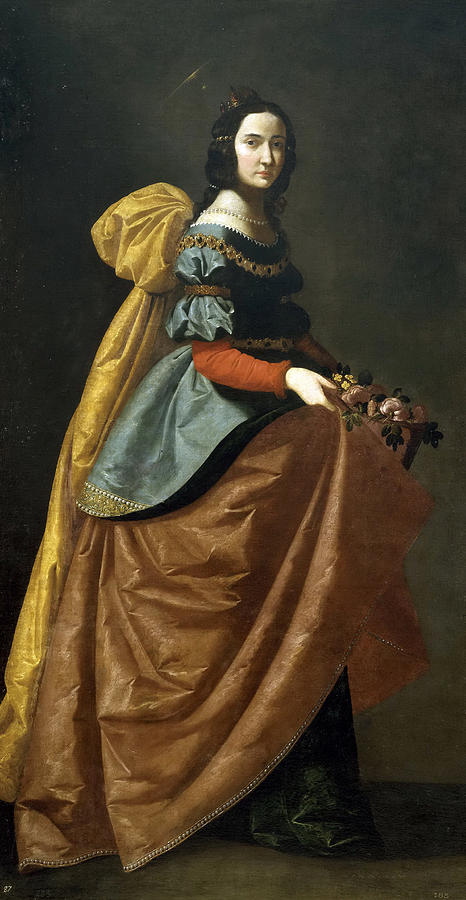
“Saint Elizabeth of Portugal” by Francisco de Zurbaran presents a regal yet contemplative figure, suspended between courtly elegance and quiet sanctity. The saint appears in three quarter view, her body turned slightly to the side while her gaze moves calmly toward the viewer. She wears a sumptuous gown of blue and rose tones, accented with a golden cloak that billows behind her. In her hands she gathers the heavy skirt, revealing a spray of roses that immediately recalls the miracle most closely associated with her story.
Zurbaran, one of the great painters of the Spanish Baroque, specialized in religious images filled with stillness and spiritual intensity. In this painting he turns to Elizabeth of Portugal, a queen celebrated for her piety, charity and skill as a peacemaker. Instead of placing her in a crowded narrative scene, he isolates her against a dark, neutral background. The result is a striking blend of court portrait and devotional image where every color, fold of fabric and detail of gesture contributes to a subtle theological message.
The Historical and Devotional Background of Saint Elizabeth of Portugal
Saint Elizabeth of Portugal, also known as Isabel of Aragon, was a fourteenth century queen famed for her generosity to the poor and her efforts to reconcile warring members of her family. Married to King Denis of Portugal, she endured a difficult marriage but consistently acted as a mediator and advocate for peace. After her husband’s death she became a tertiary of the Franciscan order, devoting herself more openly to works of charity and prayer.
Her most beloved legend tells of a day when she secretly carried bread in her cloak to distribute to the poor. Stopped by attendants who suspected her, she was asked to reveal what she was hiding. When she opened her cloak, the bread miraculously turned into roses. This story became a visual shorthand for her compassion and the divine approval of her actions.
Zurbaran’s painting captures Elizabeth not in the moment of conflict, but in a timeless pose that hints at the miracle. The roses gathered in the folds of her gown, along with her poised yet introspective expression, evoke a queen who chose mercy over protocol. For seventeenth century viewers, this image would have functioned as both inspiration and reassurance, presenting royal authority harmonized with humble charity.
Composition and the Quiet Power of the Standing Figure
The composition of “Saint Elizabeth of Portugal” is elegant and controlled. The saint stands in a slightly contrapposto pose, her weight shifted to one leg so that the long skirt cascades in diagonally arranged folds. This creates a sense of movement, as if she has just taken a step or is about to move forward. Her upper body turns gently toward the viewer, allowing Zurbaran to show both the breadth of the dress and the delicate modeling of her face.
The canvas is tall and narrow, emphasizing verticality. Elizabeth’s figure fills almost the entire height, and the viewer’s eye is drawn upward from the base of the gown to her face and the faint halo that crowns her head. The background is a deep, muted brown that contains no architectural or landscape elements. This lack of setting focuses attention on the saint herself, transforming the painting into a contemplative encounter rather than a narrative illustration.
At the same time, there is a sense of physical presence that is very typical of Zurbaran. Elizabeth seems almost sculptural, her figure solid and three dimensional. The clear contour lines around her silhouette, combined with the strong contrasts of light and shadow, make her stand out sharply against the dark field. She becomes a living monument of sanctity, a standing reminder of the virtues associated with her name.
The Language of Drapery and Courtly Splendor
One of the delights of this painting is the careful attention Zurbaran gives to the fabrics. He was renowned for his ability to paint drapery, and here he uses that skill to express both royal status and spiritual dignity. The saint wears a layered ensemble typical of a noblewoman rather than a nun. The outer skirt is a warm rose color, with a slightly metallic sheen that suggests costly silk or satin. The long folds fall in heavy undulations, catching the light along the ridges and sinking into deep shadow in the recesses.
Over this skirt she wears a shorter, blue overskirt trimmed with gold at the hem and sleeves. The cool blue not only complements the warmth of the rose but also recalls traditional Marian colors, connecting Elizabeth visually to the Virgin Mary and underscoring her role as a model of feminine holiness. Under the blue overskirt a glimpse of dark green reveals another layer, contributing to the rich harmony of colors without distracting from the main masses.
Behind her rises an enormous golden bow or gathered cloak, tied at the back and puffed out like a sculpted cloud of fabric. This element adds a touch of ceremonial drama, echoing the grand costumes worn in court festivities. The golden tone of this cloak also forms a luminous vertical accent, balancing the darker right side of the composition and framing Elizabeth’s head from behind.
Zurbaran’s rendering of material is so vivid that viewers almost feel they could reach out and touch the textures. The sheen of satin, the heavier drape of the cloak and the crisp edges of embroidered trim are all conveyed through precise variations of light and pigment. Yet this display of luxury is not purely decorative. It announces that sanctity can inhabit the garments of the world, that holiness is not confined to monastic roughness. Elizabeth’s virtues were exercised in courtly settings, and Zurbaran respects that historical reality by clothing her accordingly.
Color Harmony and Emotional Atmosphere
The color scheme of the painting is carefully balanced to produce a mood of calm majesty rather than theatrical excess. The rose skirt dominates the lower half of the canvas with its warm, glowing presence, while the blue overskirt and red sleeves introduce cool and vivid notes in the middle region. The golden cloak and the subtle highlights on the jewelry add points of brightness.
If one traces the distribution of colors, a diagonal structure becomes evident. The warm rose descends from the right side of the saint’s waist down to the lower left, while the cooler blue and dark green gather around the center. The golden cloak arcs from the upper left downward, creating a visual counterweight. This diagonal interplay of warm and cool, light and shadow, generates a gentle dynamism that keeps the eye moving across the figure.
The background’s muted gray brown tones are essential to this harmony. Without them, the vibrant colors of the clothing might appear overly strong. Against the subdued backdrop, however, the hues feel luminous rather than loud. The overall effect is one of noble reserve. Elizabeth appears radiant but not flamboyant, richly dressed yet inwardly composed.
The Face, Halo and Psychological Presence
At the heart of the painting lies the saint’s face, which Zurbaran paints with a mixture of realism and idealization. Elizabeth’s features are softly rounded, with a slightly pale complexion that stands out against her dark hair. Her gaze meets the viewer directly but calmly. There is no theatrical ecstasy here, only quiet alertness and an underlying seriousness.
Light falls gently across her forehead, nose and cheek, leaving the far side of her face in semi shadow. This subtle chiaroscuro adds depth and suggests an inner life without resorting to extreme contrasts. The faint, almost transparent halo above her head is easy to miss at first, but once noticed it confirms her identity as a saint. Zurbaran does not gild it heavily or surround it with rays. Instead he lets it float lightly, a sign of sanctity that does not overwhelm the humanity of the sitter.
Her hair is arranged in thick curls that fall over her shoulders, partially covered by a delicate headpiece. A small crown or jeweled ornament sits toward the back of her head, reminding viewers of her royal status. Yet her expression remains unpretentious. She seems more like a thoughtful young woman than an aloof monarch. This blend of intimacy and authority makes the painting especially engaging.
Hands, Roses and the Miracle of Charity
The lower half of Elizabeth’s figure tells a quieter but crucial part of the story. With her left hand she gathers the front of her skirt, lifting it slightly so that the heavy fabric creates a curved plane across the composition. Resting at the top of this fold is a cluster of roses and perhaps other flowers. Her right hand reaches toward them with a gentle, almost protective gesture.
These roses refer directly to the miracle in which the bread she carried for the poor transformed into flowers when she was confronted. By choosing to depict the flowers at rest rather than in the moment of transformation, Zurbaran emphasizes the enduring result of her charity rather than the instant of surprise. The flowers become symbols of a life shaped by generosity and divine favor.
The way in which Elizabeth holds her skirt reinforces this theme. The gathered fabric suggests both the cloak that hid the bread in the legendary story and the domestic gesture of a woman carrying something precious in her garments. The saint appears to be offering the roses outward while also guarding them. It is a visual metaphor for her role as mediator: she receives grace and passes it on, bridging the distance between the powerful and the vulnerable.
Zurbaran’s Style and the Spanish Baroque Context
“Saint Elizabeth of Portugal” belongs to a larger group of female saint portraits that Zurbaran produced, often for convents and religious houses. In these works he used contemporary dress, often of great opulence, to translate the virtues of historic and legendary women into a language familiar to seventeenth century Spaniards. The combination of intense realism with an almost sculptural stillness is a hallmark of his style.
Unlike some of his contemporaries who favored swirling compositions and dramatic gestures, Zurbaran often chose frontally or three quarter posed figures that stand quietly against dark backgrounds. The drama lies in the contrast of light and shadow, the tactile presence of objects and the psychological intensity of the sitter’s gaze. In this painting he brings that approach to bear on a figure who must embody both royal dignity and humble charity.
The painting also reflects the Counter Reformation emphasis on clear, emotionally accessible imagery. Devotional images were expected to teach and move the viewer, not confuse them. By isolating Elizabeth and her symbolic roses, Zurbaran offers a straightforward yet deeply suggestive meditation on Christian charity within the sphere of political life. The saint is not shown in a miracle filled narrative, but as a person whose character has been shaped by that miracle.
Viewing Saint Elizabeth of Portugal Today
For contemporary viewers, “Saint Elizabeth of Portugal” remains compelling on several levels. The technical mastery of the painting is immediately evident in the shimmering fabrics and the careful modeling of the figure. Art lovers are drawn to the interplay between the warm rose skirt, the blue overskirt, the golden cloak and the soft, atmospheric background. Historians may appreciate how the image reflects early modern ideas of royal sanctity, gender and power.
On a more personal level, the painting invites reflection on what it means to practice charity within structures of privilege. Elizabeth wears the signs of wealth and status, yet her hands protect the fragile roses of compassion. The viewer senses that her grandeur has not insulated her from vulnerability or responsibility. Zurbaran’s restrained mood, with its lack of overt spectacle, encourages quiet contemplation rather than mere admiration of splendor.
Placed alongside his other female saint portraits, this canvas demonstrates Zurbaran’s consistent interest in presenting holiness as something deeply human. His saints are not abstractions but particular people, rooted in specific stories yet accessible to viewers across time. Saint Elizabeth of Portugal stands as a dignified, introspective figure, her gaze steady, her dress glowing, her roses quietly testifying to a life defined by generous action.
Conclusion
Francisco de Zurbaran’s “Saint Elizabeth of Portugal” transforms a legendary queen into a powerful devotional presence. Through a considered composition, masterful handling of textiles and a subtle interplay of color and light, he presents a figure who unites regal authority and humble charity. The heavy folds of her rose colored skirt, the luminous blue and gold of her garments and the quiet halo above her head all work together to frame a face that is calm, thoughtful and resolute.
The roses nestled in the gathered fabric of her dress serve as a visual key, inviting the viewer to recall the miracle that defined her as a model of compassion. Yet the painting is not only about a single wonder. It is about a character shaped by repeated acts of generosity and the courage to follow conscience within constraining social structures.
Seen today, the work continues to resonate as an image of ethical grace. It reminds us that true nobility lies not only in outward rank but in the capacity to use power for the good of others. Through the serene presence of Saint Elizabeth of Portugal, Zurbaran offers a timeless invitation to contemplate the beauty of a life guided by mercy.