Image source: wikiart.org
Introducing Saint Dorothy full-length holding a basket of apples and roses
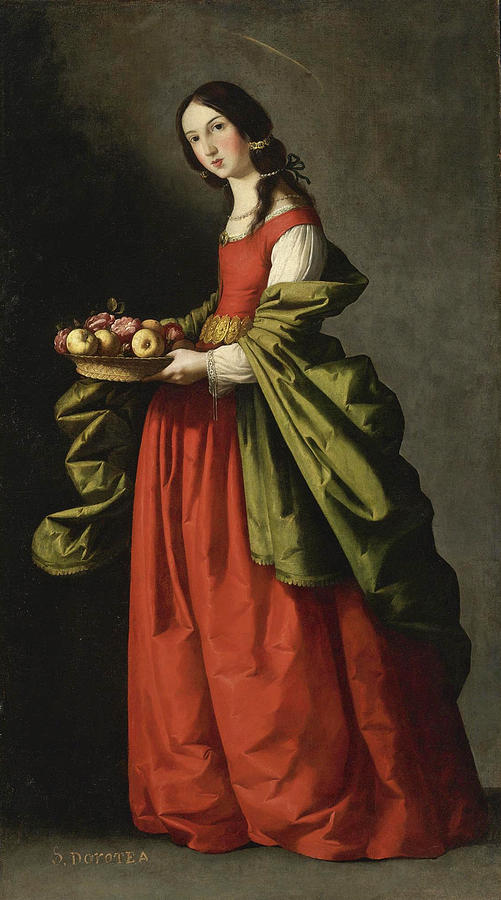
“Saint Dorothy full-length holding a basket of apples and roses” by Francisco de Zurbaran is an elegant and quietly intense portrait of one of Christianity’s early martyrs. The painting shows the young saint standing alone against a neutral background, dressed in a luminous red gown and a voluminous green mantle. She holds a woven basket brimming with apples and roses, while a faint golden halo circles her head.
At first glance the image feels surprisingly simple. There is no dramatic scene of martyrdom, no crowded landscape, no overt violence. Instead Zurbaran presents Saint Dorothy as a serene figure who appears to step forward from the shadows, bringing with her a mixture of worldly beauty and heavenly promise. This stillness is typical of the artist’s style and perfectly suits the contemplative devotion that shaped seventeenth century Spanish religious art.
The Legend of Saint Dorothy and its Meaning
To understand the significance of this painting, it helps to recall the legend of Saint Dorothy of Caesarea. According to tradition, Dorothy was a young Christian woman who lived during the Roman persecutions. Condemned to death for refusing to renounce her faith, she promised to send heavenly fruits and roses to a scoffing lawyer named Theophilus once she reached paradise. As she was being led away to execution, a mysterious child appeared with a basket of apples and roses, which was delivered to Theophilus. Struck by the miracle, he converted and became a martyr himself.
The basket in Zurbaran’s painting refers directly to this story. Instead of showing the moment of Dorothy’s death, he chooses the more subtle, symbolic moment when she holds the miraculous fruits that link earth and heaven. Apples and roses are both everyday items and potent metaphors. Apples recall the fruit of the Garden of Eden and the fall of humanity, while in a redeemed context they suggest spiritual nourishment and the sweetness of grace. Roses have long been associated with Mary and with martyrdom, their beauty and fragrance paired with thorns and blood. Together in the basket they proclaim Dorothy’s heavenly reward and the power of faith to transform suffering into glory.
Overall Composition and Full Length Format
Zurbaran arranges Saint Dorothy in a full length vertical format that emphasizes her grace and poise. She stands slightly turned, with her weight shifted gently onto one leg, and the long lines of her skirt flow downward like a pillar of red fabric. The composition is simple but carefully balanced. The basket of fruits and flowers projects to the left, while the generous folds of the green mantle billow to the right, keeping the figure visually anchored in the center.
The background is dark and unadorned, a signature element of Zurbaran’s work. There are no architectural details or narrative settings to distract from the figure. This plain backdrop works like a stage curtain that has been pulled back to reveal the saint alone, inviting the viewer to focus entirely on her presence and on the symbolic objects she carries. The empty space around her also heightens the sense of solitude that accompanies martyrdom, suggesting that she stands before God and conscience rather than before an earthly crowd.
Light, Shadow and the Baroque Atmosphere
Light plays a crucial role in the emotional impact of this painting. A soft but clear illumination falls from the left, striking Dorothy’s face, hands and the upper folds of her garments. The right side of the canvas sinks into shadow, while the background remains a muted gray. This controlled chiaroscuro is characteristic of the Spanish Baroque. It gives the saint a sculptural solidity and makes her appear almost three dimensional against the flat ground.
The glow on her cheeks and forehead draws immediate attention to her face. The same light shimmers on the golden halo, touches the rim of the basket and picks out the rounded forms of apples and roses. The drapery of the green mantle is modeled with sharp highlights and deep folds, creating a dramatic play between brightness and darkness. Yet unlike the more violent lighting in Caravaggio, Zurbaran’s contrasts feel calm and contemplative. The transitions from light to shadow are gradual, giving the impression of a supernatural radiance rather than a theatrical spotlight.
Color Harmony and Emotional Tone
Color is another key to the painting’s power. Dorothy’s dress is a vivid red that immediately commands the eye. This red is rich yet slightly softened, more akin to a deep rose than to a harsh scarlet. It suggests passion, sacrifice and love, all appropriate to a martyr. Over this, the saint wears a luxuriant green mantle lined with gold. The green has a velvety depth, and the gold edging adds a regal sparkle. The combination of red and green, complementary colors, creates a lively visual tension that makes the figure stand out strongly against the subdued background.
The white sleeves and chemise at her shoulders introduce a note of purity and innocence. They form a gentle buffer between the intense red bodice and her pale skin. Small details such as the golden belt at her waist, the jewelry at her neck and ears, and the warm tones of the apples further enrich the palette.
Overall, the color scheme moves between warmth and coolness, passion and tranquility. The red communicates the drama of martyrdom, while the green mantle and the gray background anchor the composition in a more earthly, grounded mood. This balance reflects the double nature of the saint herself: a young woman of this world who simultaneously belongs to heaven.
The Basket of Apples and Roses
The basket that Dorothy carries is the central symbol of the painting and Zurbaran devotes careful attention to its texture and contents. The woven structure is painted with precise strokes that suggest both weight and delicacy. Inside, a variety of apples and roses spill toward the viewer. Some apples are tinged with yellow, others with red. The roses vary from deep pink blooms to paler blossoms, giving the arrangement a naturalistic diversity.
The placement of the basket at waist height, presented on an open palm, makes it feel like a direct offering to the viewer. It is as if Dorothy is sharing the heavenly gifts she promised in the legend, inviting anyone who contemplates her image to partake spiritually in their sweetness. At the same time the fruit recalls still life paintings. Zurbaran was an accomplished painter of still lifes, and here he merges that genre with religious portraiture. The fruits and flowers are tangible and almost sensuous, their appeal drawing viewers closer before they realize the deeper meaning behind them.
Costume, Fabric and Zurbaran’s Love of Drapery
One of Zurbaran’s great strengths was his ability to render fabric with extraordinary realism. In this painting the drapery is almost as important as the figure itself. The red skirt falls in heavy vertical folds that pool subtly at the ground, suggesting thick, expensive material. The green mantle twists and billows around Dorothy’s arm and across her back, forming rhythmic curves and sharp creases. The artist pays attention to how the light catches on the raised ridges and glides over the smoother surfaces.
The dress is not generic. With its fitted bodice, full skirt and decorative belt, it resembles the fashionable clothing of seventeenth century Spain more than the costume of a third century martyr. This anachronism is deliberate. By dressing saints in contemporary garments, artists like Zurbaran brought holy figures closer to their viewers, making them feel like living presences rather than distant historical characters. For a Spanish viewer of the time, Dorothy might recall a noble young woman from their own society, which in turn made her example of faith more immediate and relatable.
The halo above her head is very slender, almost a mere line of gold. It does not overpower the realism of the portrait but quietly signals her sanctity. The combination of realistic clothing and subtle supernatural signs is typical of Zurbaran and of Spanish Counter Reformation art. It communicates the belief that grace transforms ordinary lives rather than existing only in an abstract spiritual realm.
Facial Expression and Inner Life
Dorothy’s face is one of the most striking aspects of the painting. She is portrayed as a youthful woman with delicate features, rosy cheeks and dark eyes. Her head tilts slightly to one side, and her gaze seems directed toward the viewer while also looking inward. There is a hint of sadness in her expression, but also a steady calm. It is the look of someone who understands the cost of her decision yet remains at peace with it.
This psychological nuance separates the painting from purely decorative portraits. Zurbaran is not simply showing an attractive woman in fine clothes. He wants us to sense the spiritual strength beneath her gentle exterior. The slightly parted lips, the soft modeling of the cheeks and the clear light on her forehead all contribute to a sense of quiet contemplation.
Her left hand supports the basket while her right hand emerges from the mantle in a relaxed yet poised gesture. The fingers are slender and carefully articulated, suggesting both refinement and control. These details of posture and gesture speak of an inner discipline that is consistent with the saint’s courage in the face of persecution.
Saint Dorothy among Zurbaran’s Female Saints
Zurbaran painted several series of female saints, often for convents and religious houses. These images share certain characteristics: full length standing figures, simple backgrounds, luxurious fabrics and calm, introspective expressions. “Saint Dorothy full-length holding a basket of apples and roses” fits perfectly within this group.
Compared with some of his other saintly portraits, Dorothy’s color scheme is particularly vibrant. While saints like Elizabeth of Portugal or Santa Casilda wear richly patterned brocades, Dorothy’s red and green combination reads with striking clarity at a distance. The simplicity of her dress design, without complex brocade patterns, focuses attention more on the color contrasts and on her face.
These female saint portraits served multiple purposes. They were devotional images that encouraged prayer and imitation of virtue. They also celebrated womanly dignity and the possibility of holiness within female vocations, whether in the world or in religious life. For nuns viewing these paintings in their cloisters, the saints offered models of fortitude and purity. For lay viewers, they presented a vision of sanctified nobility.
Dorothy’s calm beauty, modest jewelry and composed demeanor make her an image of spiritual grace rather than worldly vanity. Her finery is a sign of her royal status in heaven, not an invitation to earthly luxury. Zurbaran negotiates this balance with sensitivity, allowing the painting to be visually sumptuous while still supporting a message of humility and faithful obedience.
Spiritual Themes and Viewer Experience
At a deeper level, the painting explores themes of promise, transformation and the relationship between suffering and reward. The legend of the miraculous basket is fundamentally about how fidelity to God in a hostile world yields fruits beyond what the eye can see. Zurbaran chooses to depict the moment of promise fulfilled. Heavenly roses and apples have already been gathered and are now being offered.
For a contemplative viewer, the image suggests that true beauty lies in spiritual fruit rather than in external circumstances. Dorothy walks toward martyrdom, yet in the painting she appears radiant, carrying evidence of paradise. The apples and roses point to a future that has already begun to touch the earthly present.
The viewer is not simply an observer of this exchange between Dorothy and Theophilus. Because the lawyer is not pictured, we are invited to stand in his place. Dorothy’s slight lean forward and the positioning of the basket make it easy to imagine that she is offering these gifts to us personally. The painting thus becomes a silent encounter in which the viewer is challenged to respond with faith as Theophilus eventually did.
Legacy and Modern Appreciation
Today, “Saint Dorothy full-length holding a basket of apples and roses” can be appreciated on several levels. Art lovers admire Zurbaran’s mastery of light, color and fabric. Historians value the painting as an example of Spanish Baroque religious culture and of the role of female saints in Counter Reformation spirituality. Devotional viewers may still find in Dorothy’s calm gaze and symbolic basket a source of comfort and reflection.
For modern audiences who may not be familiar with the details of her legend, the painting still carries a universal message. It speaks of courage in the face of adversity, of the quiet strength that can exist behind youthful gentleness, and of the possibility that profound meaning may be hidden within seemingly ordinary gifts. The apples and roses remain visually compelling even when their original symbolic language is forgotten, and this visual appeal opens the door to renewed interpretation.
Zurbaran’s ability to capture both the tangible and the transcendent ensures that Saint Dorothy continues to fascinate. She stands poised between time and eternity, between this world and the next, inviting each new generation of viewers to pause, look closely and consider what fruits their own lives might bear.