Image source: wikiart.org
Introduction to “Saint Didacus of Alcalá in Ecstasy before the Cross”
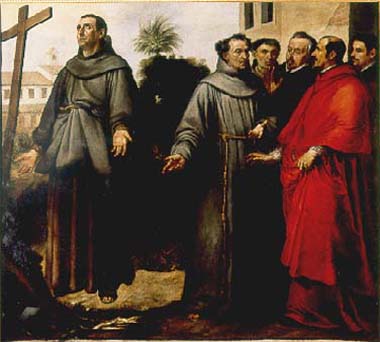
“Saint Didacus of Alcalá in Ecstasy before the Cross,” painted by Bartolomé Esteban Murillo in 1646, is a powerful vision of mystical prayer in the heart of seventeenth century Spain. The canvas shows the humble Franciscan friar, better known today as San Diego, standing before a wooden cross. His head is lifted, eyes turned upward, arms opened in a receptive gesture. Around him gathers a group of churchmen and dignitaries in rich robes, including a cardinal in vivid red.
Murillo stages the scene at the threshold between cloister and city. Buildings, a palm tree, and a distant church appear in the background, while the cross and a patch of earth in the foreground anchor the moment in real space. Yet the focus of the painting is not on buildings or costumes. It is the inner event unfolding in the saint: an ecstatic encounter with the crucified Christ that those around him can only partially understand.
The painting embodies central concerns of the Spanish Baroque. It combines strong realism with spiritual intensity, uses dramatic contrasts of light and dark, and offers viewers a model of devotion that is humble yet heroic. To explore this work is to enter a world where religious experience shapes public life and where art becomes a window into invisible grace.
Historical and Religious Background
Saint Didacus of Alcalá was a fifteenth century Franciscan lay brother who lived a life of extreme simplicity and charity. Born in Spain, he served in various friaries, including a period in the Canary Islands and in Rome. Despite limited formal education, he was revered for his deep prayer and miraculous cures. His humility and love for the poor made him a popular figure in post Tridentine Spain, where the Catholic Church promoted saints whose lives embodied obedience, poverty, and devotion.
By 1646, when Murillo created this painting, Didacus had already been canonized. Seville, Murillo’s home city, was a flourishing artistic center and a stronghold of Catholic reform. Religious orders, especially the Franciscans, commissioned images that would inspire the faithful and celebrate their saints. Works like “Saint Didacus of Alcalá in Ecstasy before the Cross” were designed to function as visual sermons. They demonstrated what true holiness looked like and encouraged viewers to imitate it.
The specific event depicted is not tied to one historically documented miracle. Instead, Murillo condenses several elements of Didacus’s reputation: his contemplative ecstasies, his love of the cross, and the recognition he received from Church authorities. The figures of the cardinal and other clerics represent institutional acknowledgment of a holiness that originates in quiet, private prayer.
Composition and Spatial Structure
Murillo structures the composition around a strong diagonal that runs from the cross on the left through the figure of Saint Didacus to the cardinal in red on the right. This diagonal organizes the action and guides the viewer’s eye across the scene.
On the far left, the wooden cross rises from the ground, slightly tilted. Its rough texture and simplicity emphasize the poverty of the Franciscan devotion. Just to the right, Saint Didacus stands slightly forward of the other figures. His body forms the central pivot of the painting. He faces the cross but lifts his head and eyes upward, as if seeing beyond the wood to the living Christ.
The group of clerics and dignitaries occupies the right side. They stand in a semi circle, their bodies turned toward the saint. Their gestures vary from curious to respectful. This clustering contrasts with the relative solitude of Didacus, whose stance is more vertical and open. Behind them rise the facades of buildings, suggesting a monastery or urban square.
By dividing the space between the solitary mystic and the observing group, Murillo creates a visual dialogue between personal experience and institutional church life. The cross at the edge of the canvas and the palm tree rising behind the figures add vertical accents that reinforce the upward movement of Didacus’s ecstasy.
The Figure of Saint Didacus
Saint Didacus is the emotional and spiritual center of the painting. Murillo portrays him in the simple grey brown habit of a Franciscan lay brother, tied with a rope belt. His feet are almost lost in shadow, which heightens the sense that he is rooted in the earth yet lifted interiorly.
His face is turned toward the heavens, illuminated by a gentle light that sets him apart from the darker tones around him. The expression is one of astonished peace. His mouth is slightly parted, not in speech but in silent receptivity. The eyes seem to look beyond ordinary sight, suggesting that he perceives a vision invisible to others.
His hands and arms are open, palms slightly upward. This gesture expresses surrender and welcome, as if he is receiving grace that pours down from the cross. At the same time, the openness of his posture contrasts with the more self contained gestures of the onlookers. While they stand with hands folded or clasped, he stands in radical availability.
Murillo’s naturalistic treatment of Didacus emphasizes that ecstasy does not remove him from his humanity. He remains a solid man with strong features and a robust body. The mystical experience takes place within the contours of an ordinary friar who walks the same streets as other people. This is typical of Murillo’s approach to sanctity, which always remains close to daily life.
The Cross and the Experience of Ecstasy
The wooden cross is a crucial element. It stands slightly apart from the figures, rooted in the ground like a signpost. There is no crucified body on it, only the bare wood. This emptiness invites viewers to imagine Christ present in spirit rather than in literal representation.
Saint Didacus stands between the cross and the group of dignitaries. He is oriented toward the cross, yet his gaze extends beyond it. In Christian mysticism the cross is both instrument of suffering and gateway to union with God. Murillo suggests that Didacus’s ecstasy has been triggered by contemplation of the cross.
The area around the saint and the cross is bathed in a softer, higher light than the rest of the foreground. It is as if an invisible radiance emanates from the cross, enveloping the friar. This light does not blaze dramatically; instead it glows quietly, matching the interior character of the experience. The painting thus shows ecstasy not as wild frenzy but as intense, focused awareness of divine love.
The Contrasting Group of Clergy and Onlookers
On the right side of the painting a group of clerics and officials looks on. Their presence grounds the scene in the world of church hierarchy and civic life. The most striking figure is the cardinal in deep red robes, whose rich garments contrast with the coarse habit of the friar. His presence suggests official recognition of Didacus’s sanctity.
The cardinal’s face is attentive, even somewhat astonished. He does not seem hostile or skeptical. Instead, he appears genuinely moved by what he witnesses. Behind him, other men in black or brown robes lean forward, mouths slightly open, as if engaged in conversation about the event. One figure closer to Didacus, perhaps a Franciscan superior, gestures toward the saint with an open hand, as though presenting him to the cardinal.
This group expresses a spectrum of reactions: amazement, admiration, curiosity. None of them share in the ecstatic state; they remain observers. Murillo uses this contrast to highlight the uniqueness of mystical experience. At the same time, he shows that such experience can touch and transform community. The witnessing of sanctity by authorities is part of how the Church recognizes and canonizes saints.
The rich red of the cardinal’s robes serves a visual purpose as well. It draws the eye, balancing the composition so that the painting does not lean entirely toward the cross and the friar. The warm color also contributes to the sense of drama characteristic of Baroque painting.
Color, Light, and Atmosphere
Murillo’s color palette in “Saint Didacus of Alcalá in Ecstasy before the Cross” is dominated by earth tones, greys, and deep reds. The friar’s habit blends with the soil at his feet, emphasizing his humility. The clerics’ dark clothing and the neutral tones of the architecture keep the focus on the cardinal’s red and the subtle illumination around Didacus.
Light functions as an interpretive tool. The upper part of the canvas is brighter, especially near the cross and the sky above. Clouds and a patch of pale sky open behind the palm tree, hinting at the heavenly realm. The foreground, where the onlookers stand, is more shadowed. This distribution of light guides the viewer toward the area of spiritual intensity.
Murillo’s handling of light is less theatrical than that of Italian masters like Caravaggio, yet it still follows Baroque interest in strong contrasts. The difference is that Murillo often softens transitions, using light to create gentle atmosphere rather than harsh spotlighting. In this painting, the glow around the saint suggests a presence that is real but not fully visible.
The atmosphere feels outdoor yet enclosed, like a small courtyard or cloister garden. The palm tree, distant church, and architectural walls provide a sense of place without overwhelming the narrative. The setting evokes the convent life of the Franciscans and anchors the miracle in the world of stone cloisters and urban streets.
Murillo’s Baroque Spirituality
This painting reveals many traits of Murillo’s spiritual and artistic vision. Unlike some Baroque artists who emphasized violent martyrdom or intense physical suffering, Murillo often focused on gentle, contemplative scenes. His saints experience deep emotion, but their faces are typically serene rather than contorted.
In “Saint Didacus of Alcalá in Ecstasy before the Cross,” the ecstasy is interior. There is no levitation, no ray of light directly connecting heaven and earth. The miracle lies in the transformation of Didacus’s face and posture. Murillo invites viewers to imagine what the saint sees, rather than forcing that vision into view. This approach respects the mystery of prayer and leaves room for personal meditation.
At the same time, Murillo is attentive to social realities. He includes the cardinal and other dignitaries to show that holiness is recognized within the structures of the Church. The painting thus reflects Counter Reformation ideals of harmony between personal mysticism and ecclesial authority. Devotion is not a private escape but a gift to the community.
Emotional and Devotional Impact
For seventeenth century viewers, this image would have had strong devotional impact. The humble friar lost in contemplation of the cross offers a model for believers who may not have high education or social standing. His rope belt and simple sandals signal a path of holiness available to ordinary people.
At the same time, the presence of the cardinal reassures viewers that the Church endorses such prayer. The painting encourages both personal intimacy with Christ and obedience to ecclesial structures. It invites viewers to place themselves in the scene, either as Didacus, who prays, or as one of the witnesses, who learns from his example.
Even today, the painting speaks to those who seek a balance between interior spirituality and engagement with the world. Didacus’s open gesture can be read as a call to openness in our own lives. The cross, plain and unadorned, reminds us that transformative encounters often come through simple fidelity to daily prayer and service.
Contemporary Relevance
In a modern context, “Saint Didacus of Alcalá in Ecstasy before the Cross” can resonate on several levels. It presents a vision of holiness that is not reserved for elite intellectuals or dramatic martyrs. Instead, it centers on a lay brother whose primary qualities are humility and love. For viewers concerned with social justice and care for the poor, Didacus offers an inspiring example.
The painting also raises questions about how communities recognize spiritual depth. The group of onlookers stands for institutions, families, and societies that sometimes struggle to understand or appreciate contemplative individuals. Murillo suggests that such recognition is possible and important. Society benefits when it acknowledges those who dedicate their lives to prayer and service.
Finally, the canvas invites reflection on the role of art itself. Murillo’s image mediates between the historical saint and the viewer, just as Saint Thomas mediates for Fray Lauterio in another of his works. The painting becomes a space where past and present meet, where viewers can contemplate their own response to the cross and to the call to holiness.
Conclusion
“Saint Didacus of Alcalá in Ecstasy before the Cross” by Bartolomé Esteban Murillo is a richly layered work that unites narrative realism and spiritual depth. Through a carefully balanced composition, subtle use of light, and expressive characterization, Murillo portrays a moment of mystical prayer that radiates outward to touch church authorities and viewers alike.
Saint Didacus stands as a humble figure whose openness to the cross draws down a quiet radiance. The cross itself, simple and unadorned, anchors the painting in the central mystery of Christian faith. The cardinal and other clerics reveal how personal sanctity can influence and inspire the wider Church.
In this canvas Murillo offers more than a historical illustration. He presents a visual meditation on the transformative power of contemplation, the value of humility, and the ongoing relationship between individual spirituality and communal recognition. Centuries after its creation, the painting continues to invite viewers to stand with Saint Didacus before the cross and to let that encounter shape their own lives.