Image source: wikiart.org
Introduction
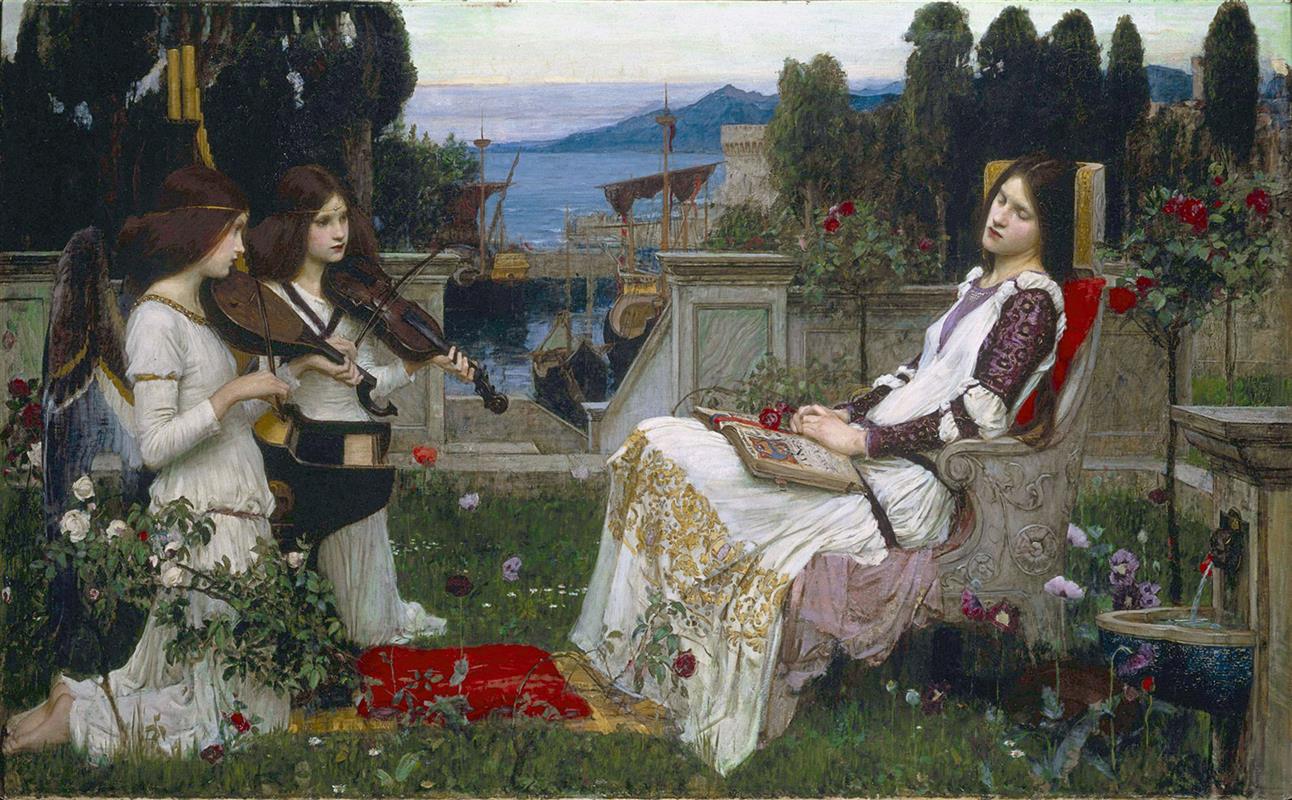
John William Waterhouse’s Saint Cecilia (1895) turns a familiar saintly subject into something quietly theatrical and intensely intimate. Instead of placing Cecilia at an organ in a church, Waterhouse situates her outdoors on a stone terrace above a harbor, as if sanctity has drifted into the everyday world and settled there like music lingering after the last note. The scene feels suspended between waking and dreaming. A richly dressed young woman reclines in an ornate chair, eyes closed, her head tilted in a pose that suggests rapture, exhaustion, or a private inward listening. Nearby, two female musicians, one angelic and winged, perform for her. It is a devotional image, but not in the strict sense of religious illustration. Waterhouse paints devotion as a mood and a state of attention.
The painting invites you to read it in layers: as a narrative moment, as an allegory of music’s power, and as a meditation on distance, whether spiritual distance or emotional distance. There is a soft paradox at the heart of the work. Cecilia is the patron saint of music, yet she does not actively play. She receives. Waterhouse makes reception the most dramatic act of all, suggesting that the truest music happens where sound meets the soul.
The Setting as a Stage for Reverie
The terrace setting is not merely decorative. It functions like a stage that frames the figures and directs the viewer’s gaze outward and back again. Behind the musicians and the resting saint, the harbor opens into a luminous band of sea and distant mountains. Ships sit at anchor, their masts and sails rising like vertical notes against the horizon. This maritime vista carries connotations of travel, longing, and the passage of time. The sea is calm, but it is never still in meaning. It suggests a world in motion beyond the private performance unfolding in the foreground.
Stone balustrades and garden walls add a sense of enclosure, as though the terrace is a protected pocket of quiet within a larger, busier port city. The tall, dark trees, likely cypress, intensify that feeling. They read as solemn silhouettes, almost funereal, balancing the sweetness of flowers and the softness of Cecilia’s pose with a hint of gravity. Waterhouse is careful with thresholds: wall and open sky, garden and sea, sound and silence. The entire environment becomes an instrument that amplifies the emotional pitch of the scene.
Composition and the Flow of Attention
Waterhouse builds the composition on a strong left to right movement that mirrors the act of listening. On the left, the two performers lean inward, their bodies angled toward Cecilia. Their faces are attentive, focused, and calm. Their instruments create diagonal lines that point toward the reclining figure, guiding the eye across the grass and the red textile on the ground. On the right, Cecilia’s body forms a long, luminous shape, draped in white fabric that catches the light and becomes the compositional anchor.
The most telling structural choice is the separation between performer and listener. There is space between them, but it is not empty. It is filled with low flowers, grass, and the suggestion of sound traveling through air. This open middle ground becomes the invisible bridge of music. Waterhouse also places the harbor opening near the center, so the viewer senses two kinds of distance at once: the distance that music crosses to reach Cecilia, and the distance that the sea represents beyond the terrace.
Cecilia’s chair is carved and monumental, almost like a throne or a relic, giving her a ceremonial weight even in repose. The musicians remain grounded on the grass, lower and closer to the earth. The hierarchy is gentle rather than blunt, but it is there: the saint elevated, the music offered upward.
Color, Light, and the Quiet Drama of Contrast
The color design of Saint Cecilia is restrained, but it is not muted. Waterhouse orchestrates a measured harmony of cool blues and greens with sudden, resonant accents of red and gold. The sea and sky create a pale, cool atmosphere in the background, while the garden foreground deepens into earthy greens. Against this, Cecilia’s white garments shine with a soft radiance, making her feel like a figure formed out of light rather than simple cloth.
Red appears in crucial places: roses near Cecilia, blossoms along the terrace, and a striking red textile on the ground near the musicians. These reds punctuate the scene like musical climaxes. They also carry symbolic weight, as red can suggest love, sacrifice, and spiritual fervor. Gold embroidery along Cecilia’s dress adds another register, introducing a sacred glow that hints at iconography without turning the painting into a rigid icon.
Waterhouse’s light is even and gentle, as if filtered through high clouds. Nothing is harsh. That matters because the painting is about an inner event. Strong shadows would externalize the drama. Instead, the lighting keeps everything calm, allowing the intensity to remain psychological and spiritual rather than physical.
Saint Cecilia as Listener and Vision
Cecilia’s expression is the emotional center of the work. Her closed eyes, slightly parted lips, and relaxed hands suggest surrender to sound. She seems both present and elsewhere, as though the music has opened a private doorway inside her. Waterhouse paints her not as a triumphant saint performing miracles, but as a human figure experiencing transcendence through attention. This is a subtle but powerful shift. The holiness in Saint Cecilia is not announced through spectacle. It is conveyed through vulnerability.
Her posture, reclining in a stone chair with a red cushion, combines comfort with ceremony. The chair’s sculpted form, with its curling motifs, gives the impression of tradition and permanence, while Cecilia’s soft drapery and tilted head read as fleeting, momentary, and alive. Waterhouse likes this tension: enduring forms paired with transient states of feeling.
An open book rests on Cecilia’s lap, richly decorated like an illuminated manuscript. Whether read as a music book or devotional text, it reinforces her identity as someone whose spirituality is intimately tied to art, learning, and ritual. A rose placed upon the pages suggests that beauty itself has become an offering, and that reading, like listening, can be a sacred act.
The Musicians and the Presence of the Angelic
On the left, the performers form a small ensemble that blends earthly artistry with supernatural suggestion. One figure is clearly winged, kneeling in white with a delicate trim. The wings, patterned in darker tones, declare that this is not a purely realistic scene. Waterhouse brings the angel down to ground level, placing her among rose bushes and grass, as if the divine has quietly stepped into the garden without fanfare.
The other musician plays a violin, her gaze directed toward Cecilia. The violin’s curved body echoes the curves of the chair and the folds of fabric, creating a visual rhyme between instrument and listener. The musicians do not look like entertainers seeking applause. They look like attendants performing a rite. Their calm concentration gives the music weight, as though it is meant to heal, consecrate, or transport.
A set of vertical golden pipes rises behind the winged figure, hinting at an organ and reinforcing Cecilia’s traditional association with sacred music. Waterhouse compresses multiple musical references into one scene: string music, choral or organ connotations, manuscript, and the saint who gathers them all into meaning.
Flowers, Water, and the Language of Symbols
Waterhouse loads the foreground with flowers that function as emotional cues. Roses appear repeatedly, clustering near Cecilia and along the terrace. Roses can imply love, martyrdom, and the fragility of beauty. Their presence near the saint suggests that her sanctity is intertwined with sensual richness rather than opposed to it. This is typical of Waterhouse, who often makes spirituality feel tactile, embodied, and human.
At the far right, a small fountain pours water into a dark blue basin. This detail is easy to overlook, but it deepens the painting’s symbolism. Water can signify purification, renewal, and the continuous flow of grace. In a composition about music, the fountain also acts as a parallel sound source, a quiet, constant accompaniment to the violin. Where music is structured and intentional, water is spontaneous and ceaseless. Together they suggest two kinds of beauty: crafted beauty and natural beauty, both capable of carrying the mind beyond itself.
The red ribbon tied near the fountain adds a note of human touch, as if someone has marked this place as special. Waterhouse’s symbols are rarely blunt. They are placed like gentle hints, encouraging the viewer to feel connections rather than solve a puzzle.
The Harbor and the Idea of Distance
The maritime background is more than scenery. It introduces the idea of distance as a psychological condition. The ships and the horizon imply travel, departure, and the allure of worlds beyond the present moment. Cecilia, eyes closed, looks as though she is traveling inward, while the harbor offers a vision of outward travel. Waterhouse aligns inner and outer journeys, suggesting that music can be a vessel.
The ships’ vertical masts and the geometry of the terrace walls provide a calm architectural framework, but the sea softens everything with its breadth and atmospheric haze. This balance between structure and openness mirrors the balance between music’s order and its emotional freedom. The distant mountains give the scene a timeless, almost mythic scale, implying that Cecilia’s experience is not only personal but archetypal: the human longing to touch something larger than oneself.
This is where Waterhouse’s romantic sensibility shows most clearly. He does not present holiness as a set of rules. He presents it as longing refined into beauty.
Waterhouse, Pre-Raphaelite Echoes, and Victorian Medievalism
Although painted in 1895, Saint Cecilia carries strong echoes of Pre-Raphaelite ideals and the broader Victorian fascination with the medieval and the legendary. Waterhouse often merges historical styling with psychological immediacy. The costumes, the illuminated book, and the stone terrace create a timeless past that is more poetic than archaeological. This is a “medieval” world as the nineteenth century imagined it: saturated with beauty, ritual, and emotional intensity.
At the same time, the painting feels distinctly modern in its emphasis on inner experience. Cecilia is not shown preaching, converting, or acting outwardly. She is shown listening, receiving, and being changed by art. That focus aligns with late Victorian anxieties and hopes around art’s purpose. Can beauty be morally serious? Can aesthetic experience become spiritual experience? Waterhouse answers by painting aesthetic absorption as an almost sacred trance.
The angel’s presence underscores the point: art itself becomes a messenger between worlds. The painting suggests that music does not merely decorate life. It blesses it.
Brushwork, Texture, and the Sense of Stillness
Waterhouse’s surface treatment supports the painting’s theme of suspended time. The background sea and sky are handled with soft transitions, creating atmospheric depth without drawing attention to technique. In the foreground, textiles and embroidery are rendered with careful specificity. Cecilia’s dress has weight, sheen, and intricate ornament, while the chair’s carved stone looks cool and enduring. These tactile contrasts make the scene feel physically believable, even as its symbolism leans toward the visionary.
The flowers and grass are painted with a patient attentiveness that rewards lingering. They create a visual equivalent of musical detail, small variations that accumulate into harmony. The musicians’ faces are calm and idealized, but not blank. Waterhouse gives them the still concentration of performers who are fully inside the piece they are playing.
The overall stillness is crucial. Nothing appears hurried. Even the harbor seems paused. The painting suggests that music has altered time, stretching a moment into something spacious enough to hold reverie, devotion, and memory all at once.
Interpreting the Emotional Core of Saint Cecilia
Ultimately, Saint Cecilia is a painting about the vulnerability of receptivity. Cecilia’s holiness is expressed through openness. She is not armored. She is not posed in triumph. She is shown in a state that many viewers recognize: the private moment when a work of art pierces the day and makes the world feel deeper.
The musicians, including the angel, can be read as external figures, but they can also be read as aspects of Cecilia’s inner life. The angel could symbolize inspiration itself, the part of the mind that brings music into being. The violinist could symbolize discipline and human craft. Cecilia’s closed eyes suggest that the true performance takes place within her, where sound becomes meaning.
The garden, with its roses and fountain, becomes a sensory paradise, while the harbor introduces the tug of distance and fate. Between these spaces, Cecilia rests in a threshold state, half in the world, half beyond it. Waterhouse makes sanctity feel like an intensified form of listening, and he invites the viewer to join her, to look longer, to hear the hush behind the painted scene.