Image source: wikiart.org
Introduction to Rubens’s “Saint Catherine of Alexandria”
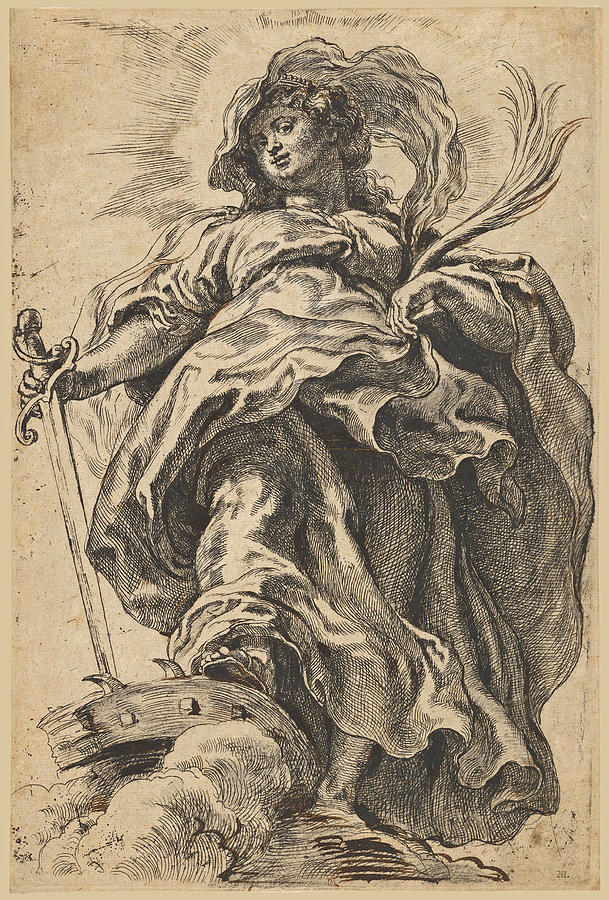
“Saint Catherine of Alexandria” by Peter Paul Rubens presents the legendary philosopher-martyr as a towering, dynamic figure who strides through a realm of clouds and ruins. Instead of a quiet, devotional saint, Rubens gives us a powerful woman in motion. Her long, swirling robes fill the image with energy; a sword is held in one hand, the palm of martyrdom in the other. Viewed from a low angle, she appears monumental, almost colossal, an embodiment of courage and divine wisdom.
Although this work survives as a monochrome image, likely based on a drawing or print design, it carries all the hallmarks of Rubens’s Baroque style: vigorous line, complex drapery, and a sense of dramatic movement that seems to break beyond the frame. The saint’s body twists in a serpentine curve, the skies roil around her, and architectural fragments beneath her feet hint at the collapsed power of the tyrant she defied. Through these elements Rubens transforms a traditional saint’s portrait into a vivid narrative of victory through faith.
The Legend of Saint Catherine and Its Visual Symbols
Catherine of Alexandria was celebrated in medieval and early modern Europe as a princess, scholar, and martyr. According to tradition, she confronted the pagan emperor Maxentius with her Christian faith, debated and converted his philosophers, and was sentenced to death on a spiked wheel that miraculously shattered. Eventually she was beheaded, and her cult spread through both East and West as a symbol of learned piety and fearless witness.
Rubens condenses this rich legend into a few potent symbols. The sword she holds refers to her final execution by beheading. The palm frond in her other hand is a traditional sign of martyrdom, indicating spiritual triumph over death. Beneath her feet we glimpse a broken wheel or an architectural fragment suggestive of ruined imperial power, recalling the failed torture device and the defeat of her persecutors.
Her head is topped with a crown or diadem, a reminder of her royal birth and intellectual nobility. Catherine was often invoked as the patron saint of scholars and philosophers; in Rubens’s image, her confident stance and upward gaze convey not only physical bravery but also intellectual and spiritual elevation. The swirling mantle framing her body suggests both earthly garments and an almost celestial aura, enveloping her in a wind of divine favor.
Composition and the Heroic Low Viewpoint
One of the most striking aspects of this depiction is the extreme low viewpoint. The viewer looks up at Saint Catherine from below, as if standing at the foot of a pedestal or at the base of a cloud-borne apparition. This perspective lengthens her figure and makes her appear larger than life. Her legs stride across the clouds, and her flowing cloak seems to billow out into the space above us, emphasizing her heroic stature.
The figure occupies almost the entire height of the sheet, stretching from the bottom edge to the very top. There is little empty space; everything is filled with the swirling rhythms of drapery and vapor. Catherine’s body forms a strong diagonal rising from lower left to upper right, reinforced by the angle of her sword and the sweep of the palm frond. This diagonal thrust is a hallmark of Baroque composition, conveying action and emotional intensity rather than static serenity.
Rubens balances this dynamic diagonal with counter-movements in the drapery. Folds sweep in opposite directions, creating internal eddies of motion that keep the eye moving. The result is a composition that feels both unified and restless, mirroring the saint’s dramatic story and the spiritual forces at work around her.
Line, Hatching, and the Graphic Energy of the Image
Because the work is executed in line, Rubens must rely on contour, hatching and texture rather than color to convey form. He uses a vigorous, almost calligraphic line to describe the outlines of Catherine’s body and garments. The contours are not rigid; they swell and taper, echoing the rhythm of the drapery and lending the figure a sense of organic life.
Within these outlines Rubens employs dense hatching and cross-hatching to create light and shadow. The interior of the cloak, the recesses under folds, and the lower portions of the skirt are built up with networks of closely spaced parallel lines. These darker areas contrast with more open, lightly hatched zones on the upper surfaces, giving the impression of strong illumination from above. The technique is highly expressive: rather than mechanically even shading, the hatching carries the energy of the artist’s hand, vibrating with movement.
The clouds and architectural fragments at Catherine’s feet are rendered with looser, more irregular strokes. This contrast sets the solid, purposeful figure of the saint against the unstable world she treads. The background is kept relatively simple, with just enough lines to suggest atmospheric turbulence, ensuring that the viewer’s attention remains on the central figure.
Drapery as a Vehicle for Baroque Drama
Rubens’s mastery of drapery is on full display in this image. Catherine’s garments are not static coverings but active participants in the drama. The wide sleeves, billowing cloak, and layered skirts catch an invisible wind, swirling around her in broad, sweeping arcs. These movements amplify the sense of spiritual and physical power radiating from the saint.
The drapery also serves to model the body beneath. Although we do not see detailed anatomy, the folds of cloth trace the curve of her leg, the rotation of her hips, and the twist of her torso. The fabric at her waist bunches and tightens, indicating the turning motion of her body. This subtle revelation of structure beneath surface is characteristic of Rubens, who studied the human figure intensively and used drapery to enhance, rather than conceal, its dynamism.
Symbolically, the animated clothing may suggest Catherine’s engagement in spiritual struggle. She is not a remote, passive figure but an active combatant in the conflict between faith and tyranny. The whipping lines of her garments echo the turbulence of history and the martyr’s spiritual courage amid persecution.
Facial Expression and Spiritual Presence
Despite the vigorous movement of body and drapery, Rubens gives Catherine a composed, dignified face. Her head is turned slightly over her shoulder, her gaze directed upward and away from the viewer, perhaps toward heaven or a divine vision. The expression is serene yet alert, combining contemplation with resolve.
The upward gaze is a common motif in Baroque religious imagery, signifying the saint’s connection to the divine. In this case it also has narrative resonance, as Catherine according to legend received visions of Christ and the Virgin. Rubens suggests that while her body strides forward in the world, her mind and heart are oriented toward another realm.
The framing of her head by windswept hair and a fluttering veil adds to the sense of spiritual aura. Light seems to fall on her face more directly than on the rest of the figure, giving it a focal luminosity amid the intricate hatching. This visual emphasis reinforces her status as a bearer of divine wisdom and courage.
The Sword, Palm and Broken Wheel
Three core attributes communicate Catherine’s martyrdom and victory: the sword, the palm, and the broken wheel or ruin beneath her feet.
She holds the sword in a relaxed yet secure grip, with the blade angling diagonally downward. The sword’s presence recalls the mode of her death but also suggests spiritual weaponry, the “sword of the Spirit” in Christian symbolism. It is not brandished aggressively but carried with assurance, indicating fearless acceptance of her fate and her role as defender of the faith.
In the other hand she lifts a palm frond, the classic symbol of martyrdom that marks those who have triumphed over death. The long, feathery leaves echo the flowing lines of her garments and hair, integrating the attribute seamlessly into the composition. As the palm sweeps upward, it reinforces the overall rising motion of the figure, leading the eye toward her head and the unseen heavenly realm beyond the frame.
At her feet, the suggestion of a broken wheel or fragmented architecture completes the narrative. If read as the shattered torture device, it proclaims the impotence of the emperor’s cruelty against divine protection. If perceived as a ruin, it can be understood more broadly as the collapse of pagan power before Christian truth. In either case, Catherine’s foot planted upon it symbolizes victory. She stands literally and metaphorically above the forces that sought to destroy her.
Gender, Power and the Baroque Heroine
Rubens’s image of Saint Catherine participates in a broader Baroque fascination with strong female figures, both sacred and mythological. Rather than diminishing Catherine’s agency, he highlights it. She is not depicted as a victim at the moment of suffering, but as a victorious heroine striding across the clouds after the trial has been overcome.
Her body is fully clothed, emphasizing dignity and movement rather than sensual display. The robust modeling of her limbs conveys physical strength, while the crown and attributes underline her intellectual and spiritual authority. This combination of virtues makes her an appealing model for early modern viewers, especially women who saw in Catherine a patron of learning and moral courage.
At the same time, Rubens retains a sense of grace and femininity. The flowing curves of her figure, the delicate features of her face, and the elegant handling of her hair keep the image from slipping into purely masculine heroism. Instead, the work presents a synthesis: a woman whose strength arises precisely from her fidelity and wisdom, not from brute force.
Function, Devotion and the World of Prints
Because this work is a linear image, it was likely intended either as a print design or closely related to one. In the seventeenth century, printed images of saints circulated widely, serving both as private devotional objects and as models for painters and sculptors. A print of Saint Catherine by Rubens or after his design would have reached a broad audience beyond the patrons who could commission large altarpieces.
As a devotional image, this composition would have encouraged viewers to meditate on Catherine’s virtues. The upward gaze invites imitation of her heavenly focus; the stride and attributes call believers to stand firm in their own faith. The low viewpoint, which elevates her above the viewer, reinforces reverence while also allowing the faithful to imagine her as a powerful intercessor looking down in protection.
The graphic medium also suits Catherine’s role as patron of learning and intellectual clarity. The precise lines and carefully structured hatching echo the discipline of scholarship, while the dramatic composition conveys the passion of conviction. For early modern scholars, students and craftspeople alike, such an image would have been a visual companion to prayers and readings about the saint.
Rubens’s Style and Influence in This Work
Although the sheet is monochrome and relatively small, its style is unmistakably Rubensian. The robust, twisting figure, the swirling drapery, and the energetic line all recall his major painted altarpieces and mythological scenes. Rubens had studied Italian masters such as Michelangelo and Titian, and their influence is visible in the heroic scale of the figure and the sculptural modeling of forms.
At the same time, the fluidity of the line and the lively hatching show his sensitivity to the graphic arts. Rubens collaborated with engravers and often prepared designs that others would translate into prints. In “Saint Catherine of Alexandria,” we see how his painterly vision adapts to a linear medium without losing its dynamism. He uses line not merely to describe but to energize the figure, turning the saint into a living force rather than a static emblem.
The image would influence later artists who sought to depict Catherine and other martyrs as active, heroic personalities. The low vantage point, in particular, becomes a recurring device in Baroque religious art, used to emphasize the exaltation of saints and the viewer’s position as humble witness. Rubens’s Catherine thus stands at the origin of a powerful visual language for depicting spiritual courage.
Contemporary Resonance and Interpretation
For modern viewers, Rubens’s “Saint Catherine of Alexandria” continues to resonate on several levels. The image can be read as a celebration of intellectual integrity in the face of oppressive power, a theme that remains relevant. Catherine’s confident stance and upward focus suggest a person who will not be silenced, whose convictions remain firm even under threat.
The work also offers a compelling example of powerful female representation in historical art. At a time when women’s roles were often constrained, Catherine appears as a learned, authoritative figure who stands above the ruins of unjust authority. This makes her an appealing icon for contemporary discussions of gender, courage and faith.
Visually, the piece demonstrates how line alone can create a sense of mass, movement and energy that rivals fully colored paintings. Artists and designers today can learn from Rubens’s mastery of contour and hatching, seeing how expressive drawing can be when used with confidence and structural understanding.
Conclusion
“Saint Catherine of Alexandria” by Peter Paul Rubens is a compact yet monumental celebration of a legendary martyr’s strength, wisdom and victory. Through a low viewpoint, whirling drapery, expressive line and potent symbols, Rubens transforms the traditional saint into a dynamic Baroque heroine who strides across clouds and ruins with sword and palm in hand.
The image distills Catherine’s complex legend into a single, powerful moment: not her suffering, but her triumph. She stands crowned and steadfast, gaze lifted toward heaven, her foot planted on the broken instruments of oppression. The composition’s energy, the interplay of light and shadow through hatching, and the integration of symbolic attributes all contribute to a work that is at once devotional, dramatic and deeply human.
Centuries after its creation, this portrayal of Saint Catherine continues to inspire. It invites viewers to contemplate the courage required to uphold truth, the dignity of intellectual and spiritual conviction, and the enduring power of art to embody ideals. In Rubens’s hands, line becomes a vehicle for faith and heroism, and Saint Catherine of Alexandria emerges as an unforgettable figure of steadfast grace.