Image source: wikiart.org
Introduction to Saint Catherine of Alexandria
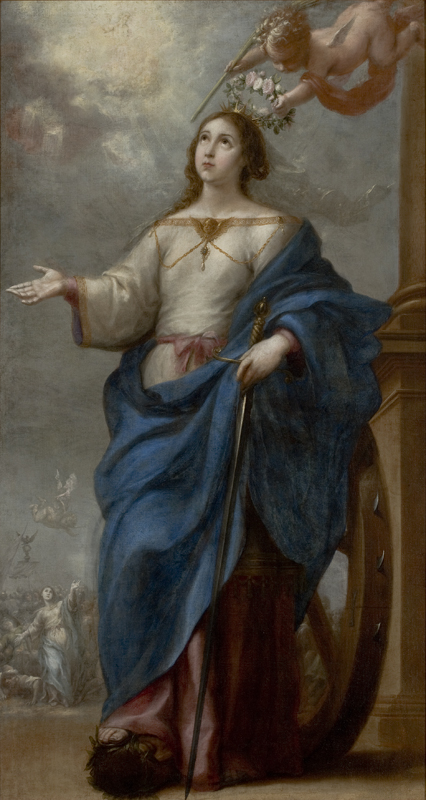
“Saint Catherine of Alexandria,” painted by Bartolome Esteban Murillo around 1655, is a luminous tribute to one of the most revered virgin martyrs of Christian tradition. In this vertical composition the saint stands tall and elegant, crowned with flowers by a hovering putto, a sword in her hand and the infamous spiked wheel at her side. Her gaze turns upward toward the heavens, as if already engaged in conversation with the divine.
Murillo, a leading master of the Spanish Baroque, was renowned for his tender religious imagery and his ability to breathe warmth and humanity into sacred subjects. In this painting he takes a figure associated with learned debate and heroic martyrdom and presents her as both noble princess and contemplative mystic. The result is an image that celebrates intellectual courage, spiritual beauty and serene faith in the face of persecution.
Catherine of Alexandria and Seventeenth Century Devotion
Saint Catherine of Alexandria was believed to be a princess and scholar who lived in the early fourth century. According to legend, she confronted the Roman emperor Maxentius, arguing persuasively against pagan worship and converting many philosophers sent to debate her. When she refused to renounce her Christian faith or accept the emperor’s marriage proposal, she was condemned to death on a spiked breaking wheel. The wheel shattered miraculously, so she was finally beheaded.
This blend of learning, purity and miraculous endurance made Catherine a popular saint in Catholic Europe. She became patroness of philosophers, students and young women. In seventeenth century Spain, where universities and convent schools flourished, she provided a powerful model of female intelligence and piety.
Murillo’s painting emerges from this atmosphere of strong Catherine devotion. Commissioned most likely for a religious institution, it would have served both as a didactic image and as an object of veneration. By emphasizing her royal bearing, contemplative expression and the instruments of her martyrdom, Murillo presents Catherine as an ideal of Christian womanhood who combines beauty, wisdom and unwavering faith.
Composition and Monumental Presence
The painting’s tall format allows Murillo to present Saint Catherine in almost life sized scale. She stands near the center of the canvas, slightly turned, in a pose that is both relaxed and dignified. Her left hand extends outward in an open gesture, as if welcoming divine grace or responding to a heavenly call. Her right hand lightly holds the hilt of the sword that rests against her robe.
Behind her to the right rises the large spiked wheel associated with her attempted execution. A sturdy column or architectural element provides a vertical anchor and suggests the palace or arena where her trial took place. At her feet, the head of a crowned ruler, probably the defeated emperor Maxentius, appears beneath the hem of her dress, symbolizing her victory over earthly power.
Above her head, a cherub or small angel leans down from a cloud, placing a crown of flowers upon her hair. This crowning gesture, combined with the pale golden light around her head, emphasizes her status as a heavenly bride and glorified martyr.
Murillo arranges all these elements in a stable triangular composition. The base of the triangle is formed by her long robes and the wheel, while the apex is the floral crown. This geometry gives the painting structural harmony and underlines Catherine’s central importance.
Light, Atmosphere and the Sense of Vision
Light plays a crucial role in creating the painting’s contemplative atmosphere. The background is a soft, hazy sky filled with clouds that range from cool gray to warm beige. This vaporous setting feels almost dreamlike, as if the scene occupies a threshold between earth and heaven.
A gentle light falls from the upper left, illuminating Catherine’s face, hands and the broad surfaces of her robe. No harsh contrasts break the serenity of the scene. The transitions between light and shadow are smooth, consistent with Murillo’s characteristically soft handling of paint. The effect is to bathe the saint in a quiet radiance that suggests grace rather than theatrical drama.
Catherine’s uplifted gaze reinforces the sense of vision. She does not look at the viewer or at the objects around her. Instead she fixes her eyes on an unseen point above, perhaps Christ himself or the Virgin. Her expression is calm and slightly awed, as if she beholds something of great beauty and significance. Through her gaze, viewers are invited to imagine the same vision and to lift their own thoughts heavenward.
Color, Costume and Regal Identity
Murillo’s color choices underscore Saint Catherine’s identity as both royal princess and consecrated virgin. She wears a long undergown in muted pink, girded at the waist with a soft ribbon. Over it falls a cream colored tunic, decorated with delicate golden trim that suggests refined fabric without overwhelming the simplicity of the garment. Draped across her shoulders and wrapped around her body is a magnificent blue mantle that cascades down to her feet.
The combination of white, pink and blue evokes purity, love and heavenly grace. The subtle gold accents hint at her noble birth while also suggesting the radiance of sanctity. Murillo avoids the heavy luxury of brocade or jewels, favoring instead a restrained elegance that suits her spiritual calling.
The floral crown placed on her head by the cherub is composed of light colored blossoms, perhaps roses and other symbolic flowers. This crown, more delicate than metal, reinforces the idea of virginity and spiritual beauty. At the same time, it echoes traditional royal crowns, merging earthly and heavenly forms of honor.
The Sword and the Wheel as Symbols of Martyrdom
Two prominent attributes identify the figure unmistakably as Saint Catherine: the sword and the wheel. Murillo integrates these symbols into the composition with both narrative clarity and visual grace.
The sword, associated with her eventual beheading, is held lightly by her right hand. It is long and slender, its dark shaft contrasting with the pale folds of her robe. Rather than brandishing it aggressively, Catherine lets it rest beside her, almost as if it were a staff. This gentle handling transforms the weapon into a sign of willingness to accept martyrdom rather than a tool of violence.
The large spiked wheel stands behind her, partially hidden by the blue mantle but still clearly visible. Its sharp metal spikes catch small glints of light, reminding viewers of the cruelty of the intended torture. By placing the wheel behind her and the sword at her side, Murillo suggests that these instruments no longer threaten her. They have become emblems of triumph rather than fear.
The head of the ruler crushed under her foot reinforces this message. Catherine’s victory is not merely spiritual. In the legend she defeats the emperor’s arguments and undermines his authority by converting his philosophers and soldiers. Standing on his crowned head, she appears as a conqueror of unjust power and idolatry.
Gesture, Expression and Interior Life
Murillo was highly skilled at using gesture and expression to convey inner states of soul. In “Saint Catherine of Alexandria” every movement contributes to the sense of contemplative surrender.
Her left arm extends outward with palm open and slightly turned upward. This gesture can be read as one of acceptance, praise or modest offering. It is as if she is saying “Here I am” or “Into your hands I commend myself.” The openness of the hand implies trust, not resistance.
Her right hand, resting on the sword, creates a vertical line that leads from the instrument of death up to her heart and then to her face. This arrangement symbolically links the external event of martyrdom to the inner act of faithful love. She does not cling tightly to the sword but touches it with gentle steadiness, suggesting readiness more than anxiety.
Her face, illuminated softly, is youthful and serene. The slightly parted lips and wide, upward looking eyes communicate awe and quiet joy. Murillo avoids any suggestion of grim heroics or morbid fascination with torture. Catherine’s spiritual strength lies in her peaceful confidence in God rather than in outward bravado.
Narrative Hints in the Background
Although the main figure dominates the composition, Murillo includes small narrative scenes in the lower left of the painting. There, almost ghostlike against the subdued landscape, we see distant figures and forms that appear to recount episodes from Catherine’s legend.
One can discern a group of people around a kind of arena or open space, with faint signs of turmoil. Above them an angelic figure descends, perhaps recalling the miraculous shattering of the wheel. These tiny vignettes provide context for the saint’s martyrdom without distracting from her monumental presence.
By relegating these scenes to the distance, Murillo suggests that the historical events are now in the past, absorbed into the larger spiritual reality that Catherine contemplates. The viewer is reminded of the story yet drawn primarily into the present moment of her heavenly dialogue.
Murillo’s Style and the Spanish Baroque Ideal
This painting showcases many features that define Murillo’s mature style. Unlike some Baroque contemporaries who emphasized intense drama and sharp contrasts, Murillo tends toward gentle transitions, warm atmospheres and an emphasis on tenderness. His figures often exude sweetness and approachable beauty, even when they depict martyrs or penitents.
In “Saint Catherine of Alexandria” the soft modeling of flesh, the delicate treatment of fabrics and the quiet radiance of the light all contribute to a contemplative mood. The saint’s face has the same youthful charm seen in Murillo’s Madonnas and female saints, yet it is paired with the resolute symbolism of sword and wheel. This balance between softness and strength reflects an ideal of sanctity dear to seventeenth century Spanish spirituality.
The painting also illustrates the Counter Reformation goal of making saints vivid and attractive models for the faithful. Catherine appears not as a remote icon but as a woman of real feeling. Her pose and expression suggest that she is a living person whose virtues can be imitated, even by those who are not called to martyrdom.
Devotional Function and Viewer Experience
For viewers in Murillo’s time, this image of Saint Catherine would have served as a focus of prayer and inspiration. Monastic communities, confraternities or classrooms dedicated to her patronage might have gathered before it on her feast day or in daily devotions. The painting’s vertical composition invites viewers to stand and look upward along with the saint, echoing her gesture with their own hearts.
The symbolism of the wheel, sword and crushed tyrant encourages reflection on the cost of discipleship and the victory of truth over oppression. Students could see in Catherine a patroness of intellectual courage, reminding them that learning is meant to serve truth and faith. Young women might find in her a model of integrity and strength in a world that often limited their public voice.
Even today, the painting speaks across centuries. Viewers may respond to Catherine’s peaceful courage in the face of pressure to conform, or to her combination of intelligence and piety. Murillo’s gentle realism helps people imagine her not as a distant legend but as a companion in their own struggles for faithfulness and integrity.
Conclusion
“Saint Catherine of Alexandria” by Bartolome Esteban Murillo is a masterful fusion of biography, symbolism and spiritual emotion. Through graceful composition, subtle light and a refined palette, Murillo presents the learned virgin martyr as a serene and radiant figure who has already transcended the violence meant to crush her.
Standing with one foot on the head of a defeated tyrant, backed by the broken wheel and holding the sword of her martyrdom, Catherine appears not as a victim but as a victor. The floral crown placed by the cherub and the upward turn of her gaze emphasize her new dignity as a heavenly bride.
For the viewer, the painting offers more than an illustration of a legend. It serves as a meditation on courage, purity and the power of intellectual faith. Murillo invites us to stand beside Catherine, to open our hands as she does, and to look toward the same light that fills her face with quiet joy.