Image source: wikiart.org
Historical Context of Saint Benedict
Francisco de Zurbaran’s “Saint Benedict” belongs to the rich tradition of Counter Reformation art that sought to present saints as vivid models for devotion. Saint Benedict of Nursia, who lived in the sixth century, is revered as the father of Western monasticism. His Rule provided a balanced path of prayer, work and community life that shaped countless religious houses across Europe.
In seventeenth century Spain, Benedictine monasteries were important centers of learning, hospitality and spiritual renewal. Patrons commissioned large altarpieces and series of monastic portraits to decorate cloisters, chapter rooms and refectories. Zurbaran, based in Seville, became one of the primary painters of such imagery. He was known for his intense spiritual realism, his monumental figures and his ability to communicate the interior life of religious subjects.
Although the exact date of “Saint Benedict” is unknown, stylistically it fits within Zurbaran’s mature period when he produced numerous standing saints for monastic patrons. The tall vertical format, the solitary figure and the dramatic landscape backdrop all reveal an artist deeply engaged with the question of how holiness can be made visible on canvas. In this work, Zurbaran offers not a narrative scene but a full length spiritual portrait that encourages contemplation of Benedict as teacher, intercessor and example of radical commitment to God.
Composition and Overall Structure
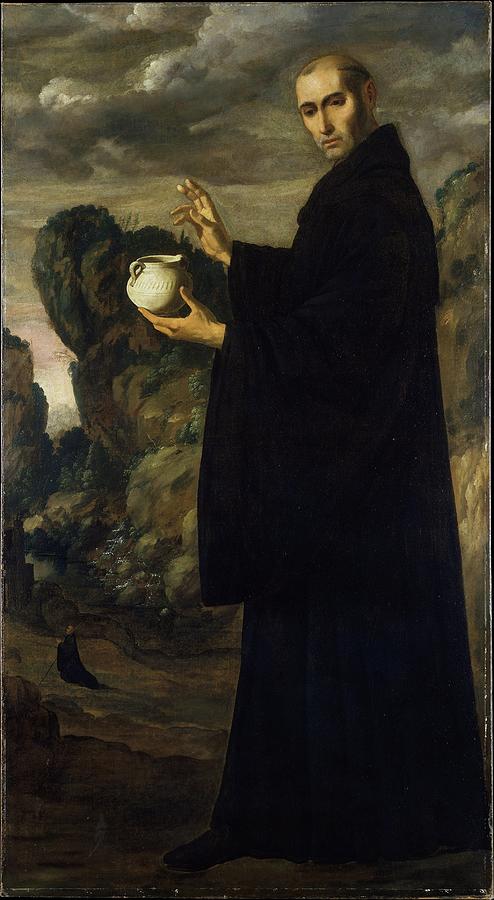
The composition is strikingly simple yet powerful. Saint Benedict stands tall and almost rigid in the right half of the canvas, occupying nearly the full height of the image. He turns slightly toward the viewer, his body oriented in profile while his face looks outward with a calm, searching gaze. The saint’s black habit forms a dark vertical mass that anchors the composition and contrasts strongly with the lighter, jagged landscape at his left.
Zurbaran places Benedict in an open rocky valley. Behind him rise craggy cliffs covered in patches of greenery. A stream or narrow path winds between the rocks, guiding the eye toward a tiny figure dressed in a similar black habit who appears kneeling in the distance. Above, heavy clouds churn across the sky, creating a moody, contemplative atmosphere.
The figure of Benedict is placed just off center, leaving enough room for the landscape to breathe while keeping him clearly dominant. His feet touch the extreme lower edge of the canvas, reinforcing his earthly presence, yet his head nearly reaches the top, suggesting spiritual elevation. The vertical format underscores the idea of a path that leads from the ground toward the heavens.
The Figure of Saint Benedict
Benedict is portrayed as a middle aged man with a shaved head and closely cropped hair at the sides, in keeping with monastic tonsure. His features are sharp but not severe. Strong eyebrows, a straight nose and a delicate mouth give him a look that combines intellectual concentration and quiet compassion. Zurbaran avoids overt emotion. Instead, Benedict’s expression is one of steady inward attention.
He wears a simple, voluminous black habit that swallows almost any hint of the body underneath. The garment falls in heavy folds, forming broad planes of shadow that absorb light rather than reflecting it. This austere clothing speaks of renunciation and humility. There is no ornament, no decorative belt or embroidered trim. The monastic cowl at his neck frames his face like a dark halo, drawing attention to the thoughtful eyes.
His posture is poised and controlled. One foot is slightly forward, as if he has paused in mid step. The left arm holds a white ceramic jar, while the right hand is raised in a delicate gesture of blessing. The contrast between the massive stillness of his body and the precise movement of his hand and fingers gives the figure a sense of disciplined vitality. Benedict seems to be caught at the moment of performing a quiet miracle or pronouncing a solemn benediction.
The Jar and the Gesture of Blessing
The white jar held by Benedict is the most prominent object in the composition, and it carries deep symbolic meaning. According to one of the best known legends, jealous monks once attempted to poison Benedict by offering him a cup of wine. Sensing the danger, he made the sign of the cross over the cup, which immediately shattered. The jar in Zurbaran’s painting likely alludes to this story, representing both the danger that threatened the saint and the divine protection he enjoyed.
Zurbaran paints the vessel with careful realism. Its rounded form and pale glaze catch the light, standing out against the darker rocks and robes. A simple handle curves elegantly from its side, and a lid or cloth covers the opening. The jar appears fragile compared to the solidity of Benedict’s hand and the rugged cliffs behind, suggesting how easily human malice can be overcome when confronted with spiritual authority.
Benedict’s right hand, raised near his chest, forms a traditional blessing gesture. Two fingers are extended while the others bend gently, a sign associated with both priestly blessing and the transmission of teaching. The hand is painted with long, slender fingers that seem almost luminous against the dark sleeve. This combination of jar and gesture communicates both the miraculous protection of God and the saint’s role as a channel of that grace.
The Dramatic Landscape Setting
Zurbaran situates Saint Benedict in a wild, rocky landscape rather than in the interior of a monastery. This choice recalls the early years of Benedict’s life, when he withdrew to a cave near Subiaco to live as a hermit. The cliffs, winding path and secluded valley evoke that environment of solitude and spiritual struggle.
The rocks rise in irregular shapes, their surfaces modeled with earthy browns, greens and grays. Vegetation clings to their sides in small patches, hinting at the possibility of life in even the harshest surroundings. The landscape recedes into the distance, where the tiny figure of another monk kneels. This distant companion could symbolize Benedict’s disciples who sought him out in his retreat, or it may represent a pilgrim seeking guidance. Its small scale reinforces the sense of vastness and isolation.
Above, the clouds are heavy and restless. They swirl in layers of gray and muted blue, creating an unsettled sky that contrasts with Benedict’s inner calm. Light filters through in places, casting pale highlights on the rocks and on parts of the saint’s face and jar. This interplay of dark and light gives the painting a sense of spiritual drama, as if heaven itself is pushing through the turbulence of the world to shine on the man who has given himself entirely to God.
Light, Shadow and Color
Light plays a crucial role in emphasizing the spiritual themes of the painting. The main illumination comes from the left, bathing Benedict’s face, hand and the jar in a cool, diffused glow. It creates soft highlights along the edges of his habit, allowing the viewer to discern the volume of the fabric without revealing too much detail. The shadows are deep but not impenetrable, suggesting mystery rather than menace.
The color palette is restrained and earthy. Blacks, grays, browns and muted greens dominate the canvas. The only areas of strong light are Benedict’s skin and the white jar, which become focal points amid the somber tones. This limited palette contributes to the overall mood of austerity and seriousness appropriate to a monk known for discipline and humility.
Zurbaran’s mastery of chiaroscuro, the contrast between light and dark, is evident. The strong vertical of the black habit stands out against the rugged landscape, making Benedict visually separate from the world even as he stands within it. The subtle light on his face suggests inner illumination, the spiritual clarity that guides monastic life. The overall effect is one of quiet intensity, where nothing is flashy but everything is suffused with contemplative energy.
Psychological and Spiritual Presence
One of the hallmarks of Zurbaran’s religious painting is his ability to depict saints as psychologically present and spiritually alive. In “Saint Benedict” this presence is communicated through the eyes and the slight turn of the head. Benedict does not look directly at the jar or at the distant landscape. Instead, he turns his gaze outward, meeting the viewer with calm seriousness.
This direct gaze invites a personal encounter. The viewer stands in the position of the pilgrim or disciple, receiving Benedict’s blessing and perhaps his admonition. His expression is not stern but searching, as if he weighs the viewer’s intentions. He appears ready to guide anyone willing to embrace the discipline of monastic life or, more broadly, a life centered on God.
The small kneeling figure in the distance reinforces this impression. The viewer, like that monk, is invited to approach Benedict as a spiritual father. Yet Zurbaran’s composition keeps some distance. Benedict is elevated physically, his full height emphasized by the vertical canvas, and he stands apart from the rugged ground. This separation mirrors the saint’s spiritual elevation while maintaining his human accessibility.
Symbolism of Habit and Solitude
The black habit worn by Benedict is not just a historical detail but a potent symbol. Black in monastic tradition often signifies death to the world, humility and constancy. By enveloping Benedict in this color, Zurbaran shows that he is completely absorbed in his vocation. There is no hint of worldly status or individuality in the clothing. It could belong to any monk, which highlights that sanctity arises not from outward distinctions but from inner fidelity.
The solitude of the landscape also carries symbolic meaning. Benedict stands alone with God, facing the elements and the vastness of creation. In monastic spirituality, such isolation is not loneliness but a privileged space for encounter with the divine. The absence of bustling activity, architecture or decorative objects keeps the viewer’s attention fixed on the saint’s relationship with God and with the unseen powers that have both tested and protected him.
At the same time, the presence of the tiny kneeling figure suggests that solitude is not selfish withdrawal but the foundation of service. From the quiet of his contemplation, Benedict will later write a Rule that shapes the lives of countless others. Zurbaran thus portrays solitude and community as two sides of the same monastic coin.
Zurbaran’s Artistic Approach to Monastic Saints
“Saint Benedict” fits within a broader series of Zurbaran’s monastic portraits where individual saints or anonymous friars are presented in full length, often against simple or rugged backgrounds. In these works, he treats the habit almost like architecture. The large blocks of fabric become visual equivalents of the stone cloisters in which monks live. They shelter the inner life of prayer, just as walls shelter the community.
Zurbaran does not idealize Benedict with lavish attributes or supernatural phenomena. Instead, he conveys sanctity through restraint, clarity and seriousness. This approach reflects the spirituality of many Spanish monasteries in his time, which valued interiority, silence and penance. Viewers are invited not to marvel at spectacular miracles but to respect the quiet heroism of a life completely ordered toward God.
The painting also shows Zurbaran’s skill in merging portraiture and symbolism. Benedict’s face is individualized enough to feel like a real person, yet the gestures and objects around him make him a theological figure. He is at once Benedict the historical monk and Benedict the archetype of disciplined spiritual leadership.
Devotional Function and Contemporary Resonance
For the original monastic viewers, this painting would have functioned as a constant reminder of their founder’s example. Passing it in a cloister corridor or praying near it in a chapter room, monks would see in Benedict a mirror of their own calling. His raised hand might encourage them to seek his intercession, while his solitary stance in the wilderness would strengthen their resolve to persevere in their own deserts of trial and temptation.
Today the painting retains its power, even for viewers outside monastic life. In an age of distraction and noise, Benedict’s stillness and focus offer an alternative vision of what it means to live well. The dark habit, the fragile jar and the looming cliffs can be read as images of integrity, vulnerability and the rough terrain of the spiritual journey. Benedict’s composed gaze suggests that it is possible to navigate this terrain with wisdom and peace.
The painting also speaks to contemporary spiritual seekers who long for depth amid fragmentation. Zurbaran’s Benedict does not promise quick solutions. Instead, he embodies a long fidelity to prayer, study and obedience. His presence on the canvas invites viewers to consider where they stand in relation to the demands of conscience and the call of God.
Conclusion
Francisco de Zurbaran’s “Saint Benedict” is a masterful blend of portraiture, symbolism and spiritual drama. Through a solitary monk standing in a rocky landscape and holding a simple white jar, the artist evokes the entire legacy of Benedictine monasticism. The dark habit, the blessing hand, the fragile vessel and the turbulent sky all work together to communicate themes of renunciation, divine protection and interior strength.
Zurbaran’s restrained color palette, careful use of light and monumental composition create an atmosphere of austere beauty. Benedict appears both deeply human and quietly transfigured, a man whose life has been shaped completely by his response to God. The painting invites viewers into a contemplative relationship with the saint, presenting him as a guide through the wilderness of life toward the peace that lies beyond.
Centuries after it was painted, “Saint Benedict” continues to speak with clarity. It reminds us that true greatness may be found not in outward success or noise but in the steady, hidden work of the soul. Through Zurbaran’s brush, the ancient monk of Nursia stands before us as a living presence, blessing our own journey and calling us to a deeper fidelity.