Image source: wikiart.org
Introduction to Saint Anthony of Padua with the Infant Christ
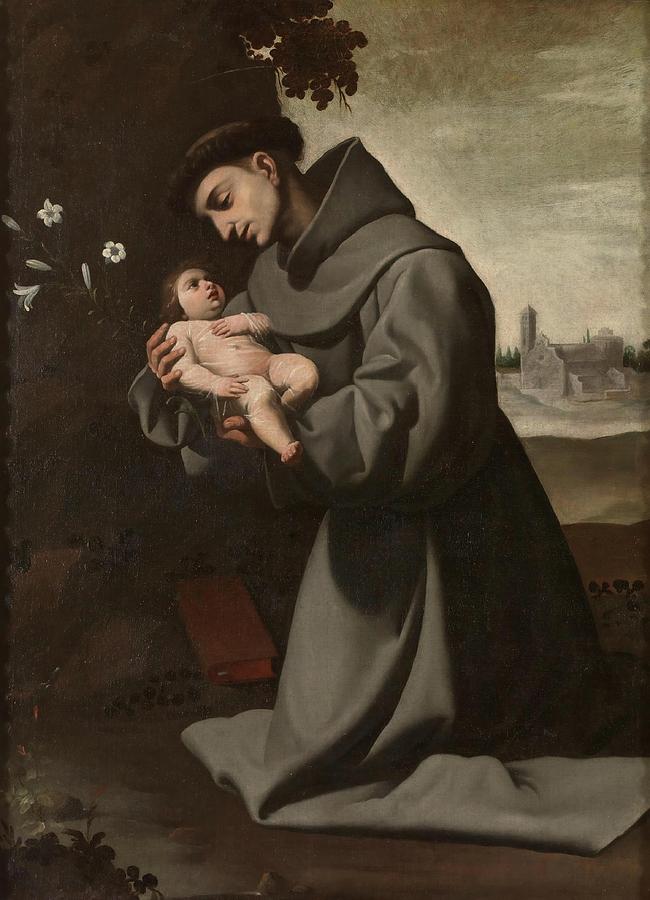
Francisco de Zurbaran’s “Saint Anthony of Padua with the Infant Christ” is a deeply tender vision of mystical encounter. A young Franciscan friar kneels on the ground, his body wrapped in the heavy folds of a gray habit, as he cradles the Christ Child in his arms. The landscape around them is sparse, with a distant church and a simple patch of earth underfoot, yet the quiet radiance of the figures fills the entire scene.
Rather than dramatizing miracles with thunderous skies or crowds of witnesses, Zurbaran chooses an intimate, almost domestic moment. The Child lies relaxed in Anthony’s arms, looking outward with bright, alert eyes, while the saint bends his head in reverent affection. It is a painting about proximity – the astonishing closeness between human and divine, monk and Savior, earthly tenderness and heavenly mystery.
The Legend of Saint Anthony and the Child
The painting draws on a popular episode from the life of Saint Anthony of Padua, a thirteenth century Franciscan preacher renowned for his knowledge of Scripture and his compassion for the poor. According to devotional tradition, Anthony was once visited in his cell by the Christ Child, who appeared to him in a vision. The saint held the Child in his arms, lost in adoration, while the Child embraced him in return.
This story, though apocryphal, became central to Anthony’s iconography. Artists across Europe portrayed him with the Infant Christ as a symbol of his extraordinary intimacy with God and his role as a teacher of divine wisdom. By the time Zurbaran painted this canvas, the motif was well established but still offered room for personal interpretation.
Zurbaran chooses to show the moment not as a spectacular miracle witnessed by others, but as a private encounter in a secluded landscape. The result is a scene that encourages quiet contemplation rather than dramatic awe.
A Carefully Structured Composition
The composition is built around a sweeping diagonal created by Anthony’s kneeling figure. His body forms an elegant curve that begins at the hem of his habit on the ground, rises along his bent leg and torso, and culminates in his bowed head. This diagonal is balanced by the small, compact form of the Child, whose body lies almost horizontally across the saint’s arms.
The figures occupy the left center of the vertical canvas, leaving a generous portion of sky and landscape open to the right. This negative space gives the encounter room to breathe. It also emphasizes that the miraculous visitation takes place within the ordinary world, under the same luminous sky and above the same earth that the viewer knows.
The tree trunk behind Anthony and the spray of lilies to the left act as framing devices that gently enclose the figures. In the distance, the small church and buildings anchor the scene, suggesting that this meeting takes place near a monastery or village, in a recognizable corner of everyday life.
Saint Anthony’s Youthful Face and Devotional Posture
Zurbaran presents Anthony as a young and sensitive friar. His face is smooth and almost boyish, with soft features, dark hair, and a contemplative expression. This youthfulness is important. It underscores the freshness of his love and the vulnerability of his devotion.
Anthony is shown kneeling on both knees, his habit spreading around him on the ground in heavy folds. He leans forward slightly, bending over the Child, almost like a parent checking on a sleeping infant. Yet his eyes are open and focused, not on himself but on the Child he holds. The tilt of his head speaks of humility and awe, but also of tenderness.
His hands support the Child firmly yet gently, one hand under the back, the other under the legs. There is no sense of strain or clumsiness. The saint’s body appears entirely adapted to the task of holding and presenting Christ, as if his whole life has been shaped for this one act of loving attention.
The Infant Christ – Both Vulnerable and Regal
The Christ Child is painted with the same realism and care that Zurbaran brings to his adult saints. He lies in Anthony’s arms in a relaxed pose, one arm slightly lifted, the other resting near his chest. His legs are bent and crossed in a natural infantile way, and his body is wrapped in a simple pale garment that leaves his arms and feet exposed.
What is most striking is his gaze. Unlike other depictions where the Child looks exclusively at the saint, here he turns his head outward, engaging the viewer directly. His wide eyes and slightly parted lips suggest a lively awareness. In this way, the painting invites the viewer into the circle of intimacy. Anthony holds the Child, but the Child’s attention spills beyond him, reaching out to those who contemplate the painting.
At the same time, the Child’s small halo and the luminous quality of his skin mark him as more than a human infant. His vulnerability is not denied, yet there is a quiet regal presence in the way he is held and in the central place he occupies in the composition.
The Expressive Power of the Franciscan Habit
Zurbaran’s mastery of drapery is on full display in the gray habit that envelops Anthony. The cloth is heavy and coarse, with broad planes and deep folds that respond dramatically to the light. The habit spreads over the ground like a gray sea, emphasizing the saint’s rootedness and stability.
The large cowl folds around his shoulders, and the broad sleeves swallow his arms, making his hands appear small in comparison. This contrast suggests that the religious vocation can be overwhelming, yet within it there is space for delicate acts of care, such as holding the Child.
The plain, uniform color of the habit reflects the Franciscan vow of poverty. There is no ornament, no color contrast, no decorative stitching. Yet the way light plays over its surface turns the habit into a landscape of soft shadows and highlights, transforming simplicity into visual richness. Through this garment, Zurbaran conveys the beauty of a life stripped of luxury but filled with meaning.
Light, Shadow, and the Atmosphere of Grace
Light in this painting has a gentle, enveloping quality rather than the harsh drama seen in some of Zurbaran’s earlier works. A soft illumination falls from the upper left, bathing Anthony’s face, hands, and the Child’s body, while leaving other areas in muted shadow.
This light appears almost tangible, as if it were a quiet manifestation of divine grace. It does not dazzle or overwhelm. Instead, it reveals surfaces calmly, emphasizing the tender modeling of faces and the smooth flesh of the infant. The way the light gathers on the Child’s limbs and Anthony’s cheek suggests a shared radiance, a bond of divinity and humanity.
The background remains subdued, with pale gray sky and brown earth tones. This restrained palette ensures that the figures remain the focus. It also creates an atmosphere of early morning or late afternoon, times traditionally associated with prayer and contemplation.
Symbolic Details – Lilies, Book, Tree, and Distant Church
Several symbolic elements enrich the scene without distracting from its central focus.
To the left of Anthony’s head, a stem of white lilies emerges. Lilies are traditional symbols of purity and chastity, often associated with the Virgin Mary but also with saints known for their innocence. Placing lilies near Anthony emphasizes his commitment to purity of heart and intention. The flowers bend slightly toward the saint and Child, almost as if participating in their devotion.
Near Anthony’s knees, a closed red book lies on the ground. This object alludes to his fame as a preacher and teacher of Scripture. Painted in bright red, the book stands out against the subdued earth tones, reminding viewers that Anthony’s mystical experience is rooted in a life of study and proclamation of the word of God.
Above Anthony’s head, a cluster of dark leaves and perhaps grapes hangs from a tree. Grapes often symbolize the Eucharist and the blood of Christ. Their presence hints that the Child in Anthony’s arms is the same Christ who will later offer himself in the sacrament.
In the distance to the right, a small church complex or monastery rises against the horizon. It suggests the institutional home of Anthony’s vocation and provides a geographical anchor for the vision. The architecture is modest yet solid, affirming that this gentle miracle unfolds within the context of the Church and its sacramental life.
Emotional Tone – Quiet Joy and Protective Tenderness
The emotional tone of the painting is one of quiet joy rather than ecstatic rapture. Anthony’s face is serene, touched by a faint smile that appears only in the softened lines of his mouth and eyes. There is a sense of wonder, but it is inward and peaceful.
The way he holds the Child communicates protective tenderness. His arms create a cradle, and his body leans around the infant like a shelter. This posture conveys not only adoration but responsibility. Anthony is portrayed as a guardian of Christ, just as all believers are called to guard the presence of Christ within their hearts and communities.
At the same time, the Child’s alert gaze and relaxed limbs speak of trust. There is no fear or stiffness. The relationship between saint and infant is reciprocal: Anthony worships and protects, while the Child loves and blesses.
Zurbaran’s Devotional Style in Maturity
This painting belongs stylistically to Zurbaran’s mature period, when his art moved toward gentler light and more lyrical compositions. Compared to his severe early images of monks and martyrs, “Saint Anthony of Padua with the Infant Christ” feels warmer and more approachable. The austerity remains – there are no lavish fabrics or ornate objects – yet it is balanced by a newfound tenderness.
Zurbaran had a special ability to combine realism with spiritual symbolism. Here, the naturalistic rendering of the Child’s weight in Anthony’s arms, the folds of the habit, and the details of the lilies anchor the scene in recognizable physical reality. At the same time, the composition, light, and expressions direct the viewer beyond the visible toward contemplative meaning.
The painting encapsulates what Spanish Baroque devotional art aimed to achieve: to offer viewers a clear, emotionally resonant image that could aid prayer, inspire imitation of the saints, and deepen awareness of Christ’s presence.
Contemporary Resonance of the Painting
For modern viewers, “Saint Anthony of Padua with the Infant Christ” continues to hold a quiet power. In a world where spiritual experiences are often imagined as dramatic or extraordinary, the painting reminds us that the deepest encounters may be simple and tender. A kneeling monk and a small child in a sparse landscape convey more than any crowded spectacle could.
The image also speaks to universal human experiences: caring for the vulnerable, holding a child, finding meaning in humble tasks. Even viewers who do not share the painting’s religious background can recognize the authenticity of the affection between Anthony and the Child. The painting suggests that genuine love, especially when directed toward the small and fragile, is itself a form of revelation.
In an age of distraction, the focused attention of Anthony, who looks at nothing but the Child in his arms, offers a model of presence. He embodies a way of relating to others – and to the divine – that is wholehearted and undivided.
Conclusion – A Vision of Intimate Holiness
“Saint Anthony of Padua with the Infant Christ” by Francisco de Zurbaran is a gentle but profound exploration of intimacy between saint and Savior. Through a carefully structured composition, nuanced light, and symbolic details like lilies, book, and distant church, the artist transforms a legendary vision into a deeply human and accessible scene.
The painting celebrates the Franciscan virtues of humility, poverty, and love, not in abstract terms but in the concrete act of holding and contemplating a child. Anthony’s gray habit, heavy and plain, becomes a vessel of tenderness. The Child, small yet luminous, draws both the saint and the viewer into a shared space of wonder.
More than three centuries after its creation, this work remains a powerful invitation to consider how the divine might be encountered in gentleness rather than grandeur, in quiet attention rather than noise, and in the simple act of caring for another.