Image source: wikiart.org
Introduction to Murillo’s “Saint Anthony of Padua Adoring the Child”
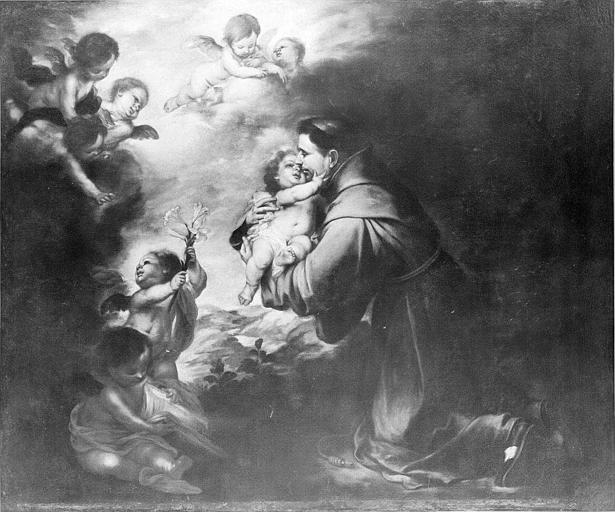
“Saint Anthony of Padua Adoring the Child,” painted by Bartolomé Esteban Murillo, is one of the most tender and atmospheric visions of mystical encounter in the Spanish Baroque. The scene shows the Franciscan saint kneeling in rapt devotion as the Christ Child appears in his arms, surrounded by a host of playful yet reverent angels. Heaven seems to descend into the shadows of the earthly world, bathing the figures in soft light and transforming a moment of prayer into an intimate embrace between saint and Savior.
Murillo was celebrated in seventeenth century Seville for his ability to translate complex theological ideas into images filled with warmth and humanity. In this painting he depicts not a distant miracle but an encounter that feels close, almost domestic. Saint Anthony leans forward with simple, almost fatherly affection, while the Child presses His cheek to the friar’s, one small hand resting on the saint’s shoulder. Around them, a swirl of cherubs hovers in clouds of light, as if all of heaven rejoices at their meeting.
The work draws on a popular legend: during a night of study and prayer, Saint Anthony received a vision of the Infant Christ, who appeared upon his book or in his arms. Murillo’s interpretation emphasizes love more than spectacle, aiming to move the heart of the viewer toward devotion and trust.
Saint Anthony of Padua and the Meaning of the Vision
Saint Anthony of Padua, a thirteenth century Franciscan preacher, was renowned for his eloquence, learning, and compassion for the poor. In Catholic devotion he is often invoked as a helper in finding lost things, but older traditions highlight his deep intimacy with Christ and his love for the Incarnation. According to one legend, while lodging in a nobleman’s house, Anthony was found bathed in supernatural light, holding the Infant Jesus in his arms. The vision became one of his most enduring iconographic themes.
Murillo’s painting captures precisely this mystical visitation. Anthony’s posture reveals both astonishment and acceptance. He is not startled in terror but caught in a reverent amazement that quickly turns to adoration. His Franciscan habit, bound with a cord at the waist, grounds him in the world of poverty, obedience, and humility. Yet the presence of the Child in his arms shows that such humility is the very path by which God draws near.
For seventeenth century viewers in Seville, the image would have served as an invitation to imitate Anthony’s contemplative love. Through meditation and prayer, the faithful were encouraged to welcome Christ into their hearts as intimately as the saint welcomes Him into his embrace.
Composition and Spatial Movement
The composition unfolds in a gentle diagonal that guides the viewer’s gaze from the lower left corner up toward the radiant center of the canvas. At ground level, putti kneel and sit on the earth, their bodies half turned toward Saint Anthony. One points upward or lifts lilies, another gazes absorbedly at the Child, and a third may strum a small instrument or hold a symbolic object. Their gestures and glances form a visual pathway that leads directly to the focal point: the saint and the Child locked in an embrace at the right.
From this central group the composition rises into the cloud-filled sky, where more cherubs fly and hover. Their bodies form a loose circular movement across the upper half of the painting, enclosing the miracle in a halo of lively forms. The swirling clouds and curved poses of the angels create a sense of gentle, continuous motion, as if heaven itself is leaning down to witness and celebrate the event.
Murillo balances this dynamic movement with the stable verticality of Saint Anthony’s figure. Though slightly bent forward, the friar’s body forms a strong axis that anchors the composition. His long habit falls in heavy folds to the ground, creating a triangular base of warm, shadowed tones. Against this stability, the Child’s smaller body, bright and animated, becomes a living flame of light.
The negative space of the darker clouds around the saint intensifies the focus on the illuminated figures. There is no distracting architecture, no elaborate background setting. Instead, the den is replaced by a kind of spiritual landscape: a vague ground and a sky that opens into luminous mystery.
Light and Atmosphere
As in many of Murillo’s mature works, light is the true protagonist of the scene. The brightest area of the painting surrounds the Christ Child, whose skin and loose drapery seem to emit a warm, golden radiance. This light spills over onto Saint Anthony’s face, the folds of his habit, and the nearby cherubs. The saint’s features are modeled by this glow, so that his holiness appears not as something he produces but as something he receives.
The light has no obvious natural source. It is not the sun or a candle. Instead, it reads as an inner illumination, a visible sign of divine presence. Murillo uses subtle gradations of brightness to create a halo-like atmosphere around the central embrace. As the eye moves outward, the intensity of light decreases, dissolving gradually into the soft grays and browns of the clouds.
The lower part of the painting retains more shadow, especially around the saint’s feet and the ground where the putti sit. This darker zone emphasizes the earthly realm. The gradual transition from heavy shadow below to luminous clouds above mirrors the transition from the ordinary world of prayer to the extraordinary realm of mystical experience.
Murillo’s handling of atmosphere is delicate. The edges of forms are often softened, especially in the clouds and angels, giving the impression that they are emerging from or dissolving into mist. This softness creates a dreamlike quality appropriate to a vision. It also allows the viewer’s eye to move easily from one figure to another without jarring interruptions.
The Figures of Saint Anthony and the Christ Child
The emotional heart of the painting lies in the interaction between Saint Anthony and the Child. Murillo presents Anthony as a youthful, gentle friar with a slightly rounded face, short hair, and a calm expression. His eyes are half closed, as if overwhelmed by the sweetness of the vision. His mouth softens into a faint smile that combines reverence and tender affection.
He holds the Child very close, pressing Him to his chest with both arms. One hand supports the Child’s back, the other cradles His legs. The posture is not formal; it is the natural way a loving adult would hold a small child. Through this gesture, Murillo emphasizes the humanity of both saint and Savior. Anthony is not simply a distant worshiper; he is a spiritual father whose heart has become Christ’s resting place.
The Christ Child, for His part, responds with equal intimacy. He turns his body toward Anthony, wrapping one arm around the friar’s neck while the other reaches playfully or affectionately toward his face. His expression is bright, trusting, and lively, capturing the vital energy of a toddler. Yet his radiant glow and the reverence of the surrounding angels mark Him as divine.
Murillo’s ability to combine believable childlike behavior with theological symbolism is one of his greatest strengths. The Child’s embrace suggests that Christ actively seeks and delights in the love of His saints. His vulnerability underscores the mystery of the Incarnation: God comes near in the form of a child, inviting not fear but tenderness.
The Role of the Angels and Putti
The angels that populate the scene serve multiple functions. They act as witnesses, musicians, and silent commentators. Their presence confirms that this is not a mere dream but a heavenly visitation. They also show the joy of heaven at the union between Christ and the saint.
In the upper sky, flying cherubs rush toward the central light or look down with delight. Their bodies twist gracefully in the air, and their small wings, though improbable in size, are painted with delicate attention. Murillo uses them to fill the upper part of the canvas with movement and to emphasize the vertical connection between heaven and earth.
The putti on the ground play more active roles. One holds lilies, a traditional symbol of purity associated with Saint Anthony. Another might carry an open book, reminding viewers of the saint’s learning and his habit of studying Scripture late into the night. A third engages with the lily or the book, or simply watches the miracle unfolding before him.
These children balance the composition visually and emotionally. Their playful innocence echoes the childlikeness of Christ and underlines the theme that holiness is closely tied to simplicity of heart. Their cherubic forms also connect this painting to Murillo’s many works featuring street children and angels, in which he blended natural observation with spiritual significance.
Symbolism of Saint Anthony’s Attributes
Several traditional attributes help identify Saint Anthony and enrich the painting’s meaning. The Franciscan habit, tied with a simple cord whose three knots represent poverty, chastity, and obedience, situates him firmly within the order of Saint Francis. His entire life is built upon these vows, and it is precisely this humble lifestyle that prepares him for the extraordinary grace of the vision.
The lilies, carried by an angel, symbolize purity and chastity. In devotional literature, Anthony was praised for his virtuous life and for calling others to conversion. The lilies near the Child suggest that true purity is a gift that blossoms in the presence of Christ.
The book, often shown in depictions of Anthony, alludes to his role as a preacher and theologian. According to the legend, it was while reading this book that the Child appeared. In Murillo’s painting, the physical book may not be prominent, but the presence of book-bearing angels or the scholarly demeanor of the saint evokes this association. The message is that study and prayer, when undertaken in humility, become doors through which God enters the soul.
The Child Himself is the ultimate attribute. In many images of saints, symbols remain external. Here, the symbol is alive. Anthony does not merely hold an emblem; he holds Christ. This underscores the central idea that sanctity is not about achievements or honors but about union with the living God.
Emotional Tone and Devotional Purpose
The tone of “Saint Anthony of Padua Adoring the Child” is one of quiet exultation. There is joy, but it is not noisy. The soft, enveloping light and the tender expressions create a mood of peaceful ecstasy. Viewers sense that time has stopped for the saint; he is suspended in a moment of love that feels eternal.
For its original audience, the painting would have served as more than decoration. It functioned as a visual aid to prayer, inviting viewers to step into Anthony’s place. By contemplating the saint’s posture and expression, they were encouraged to imagine themselves holding Christ in the center of their lives.
The composition also suggests a path of spiritual progression. The lower zone, where cherubs sit on the ground, corresponds to the earthly life of work and study. The middle zone, where Anthony embraces the Child, symbolizes the soul encountering God in contemplative prayer. The upper zone, filled with radiant angels, hints at the heavenly joy that awaits those who persevere. In this way, the painting outlines a spiritual journey from earth to heaven through love.
Murillo’s Style and the Spanish Baroque Context
Murillo’s approach in this painting exemplifies the softer side of the Spanish Baroque. While other artists of the era, such as Ribera or Zurbarán, often emphasized stark contrasts and ascetic severity, Murillo tended toward warmth, gentle light, and human tenderness. His figures are approachable, with rounded forms and expressive faces that invite empathy.
In “Saint Anthony of Padua Adoring the Child,” this style is fully evident. The modeling of the saint’s habit is rich and tactile, yet the overall atmosphere remains light and airy. The angels, though numerous, never clutter the scene; their soft edges and harmonious positions reveal Murillo’s mastery of composition.
The painting also reflects the Counter Reformation emphasis on images that move the heart. Rather than focusing on complex theological allegories, Murillo presents a simple, emotionally resonant encounter that draws viewers into devotion. The combination of credible human affection and supernatural radiance made his works particularly effective in churches and convents, where they encouraged heartfelt prayer.
Legacy and Contemporary Resonance
Today, “Saint Anthony of Padua Adoring the Child” continues to appeal to viewers across time and culture. Even those unfamiliar with the saint’s legend can respond to the palpable tenderness between the adult and the child, the embrace that captures a universal experience of love and trust.
For art historians, the painting is an important example of how Murillo integrated genre-like observation of children with high religious subject matter. The playful cherubs bear a strong resemblance to the real children he observed in Seville, yet here they inhabit a celestial realm. This fusion of the everyday and the divine is one of his distinctive contributions to Baroque art.
For contemporary believers, the image still serves its original purpose: it invites a personal response. Anthony’s expression, full of wonder and gratitude, prompts viewers to consider how they welcome the presence of the sacred in their own lives. The painting suggests that holiness is not distant or inaccessible but as intimate as a child resting in one’s arms.
Conclusion
“Saint Anthony of Padua Adoring the Child” is a luminous synthesis of legend, theology, and human feeling. Through a carefully balanced composition, subtle chiaroscuro, and deeply affectionate figures, Bartolomé Esteban Murillo transforms a mystical vision into an image that feels tenderly real.
The saint’s humble habit, the lilies of purity, the hovering angels, and above all the radiant Christ Child all converge to express a single idea: God delights in drawing near to the humble heart. Murillo’s painting continues to invite viewers into that mystery, encouraging them to join Saint Anthony in a prayerful embrace of the Child who is both vulnerable and divine.