Image source: wikiart.org
Introduction
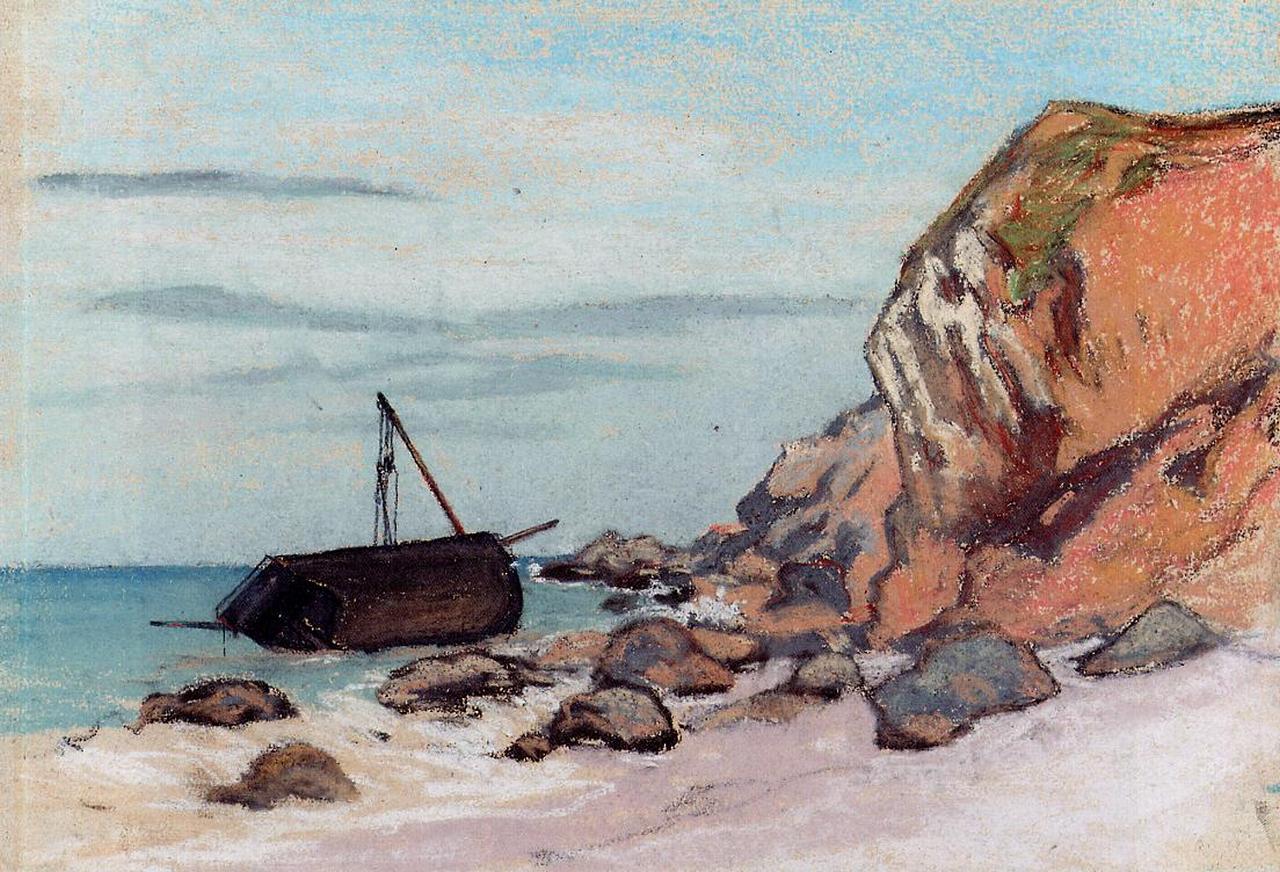
Claude Monet’s Saint-Adresse, Beached Sailboat from 1865 is a quiet, observational coastal painting that reveals much about the young artist before Impressionism fully took shape in his mature work. At first glance, the subject seems simple. A dark sailboat rests near the shoreline. Large rocks lie scattered across the beach. A massive cliff rises at the right, dominating the composition with warm earthy tones. Beyond it all, the sea stretches calmly beneath a pale sky washed with soft clouds. Yet the painting’s apparent simplicity is exactly what makes it so compelling. Monet takes an ordinary maritime view and turns it into a study of light, structure, atmosphere, and stillness.
This painting belongs to an important moment in Monet’s development. In the mid 1860s, he was still refining the methods that would later make him one of the defining figures of modern art. Here, we can already see his attraction to direct observation, natural light, and transient weather conditions. At the same time, the work still retains a degree of solidity and descriptive clarity that links it to earlier landscape traditions. That tension between careful structure and fleeting sensation gives the painting much of its character.
Saint-Adresse, Beached Sailboat is not dramatic in the conventional sense. There is no storm, no bustling harbor, no grand historical narrative. Instead, Monet offers a suspended moment on the Norman coast, where sea, stone, and human craft coexist in temporary balance. The boat appears stranded or resting, the water barely stirred, and the sky open but subdued. This calm is not empty. It is full of attention. Monet invites the viewer to slow down and notice the relationship between forms, colors, and textures that make the scene feel alive.
The Coastal Setting at Saint-Adresse
Saint-Adresse, near Le Havre in Normandy, was a meaningful location for Monet. The coast there provided exactly the kind of environment that suited his artistic interests: open air, changing weather, reflective water, rocky formations, and everyday maritime life. Rather than choosing an idealized or invented landscape, Monet focused on a real place with specific visual qualities. This decision reflects one of the most important directions in his early art. He was not interested in turning nature into a theatrical stage. He wanted to look at it directly and respond to what he saw.
In this painting, the site itself matters enormously. The cliff on the right is not a decorative backdrop. It is the main physical presence in the composition, almost like a living force pressing against the edge of the image. Its rugged face, warm coloration, and irregular surface give the painting weight and permanence. By contrast, the sea is flatter, cooler, and quieter. The beached sailboat occupies a middle position between these natural elements. It is man made, yet it has been reduced to stillness by the conditions of the shore. In this way, the setting becomes more than scenery. It becomes a structure of relationships among land, water, and human activity.
Saint-Adresse also carries associations with leisure, fishing, and coastal labor, but Monet does not emphasize anecdote. There are no visible figures busily working the vessel, no social crowd, and no narrative clue explaining why the boat is there. That restraint allows the location to feel both specific and universal. It is clearly a real shoreline, but it also becomes an image of pause and reflection. Monet is interested less in what happened here than in how the place looks and feels at this particular moment.
The setting suggests a day of mild weather, with no harsh sunlight and no violent wind. The atmosphere is cool but not bleak. Even the cliff, which could have appeared severe, is softened by the artist’s handling of pastel like tones. As a result, the coast of Saint-Adresse appears as a place of contemplation rather than danger. It is a working shore, but Monet turns it into a poetic field of visual observation.
Composition and Spatial Design
One of the most striking features of Saint-Adresse, Beached Sailboat is the way Monet organizes the scene. The composition is asymmetrical, yet carefully balanced. The largest mass, the cliff, occupies the entire right side of the painting and rises steeply upward. This could have made the image feel heavy or crowded, but Monet offsets that weight by opening the left side toward the horizon and the water. The empty sky and calm sea create breathing room, giving the composition a sense of spaciousness despite the imposing geology.
The sailboat is placed left of center, low in the composition, where land and water meet. It acts as a visual anchor, drawing the eye immediately. Its dark hull stands out sharply against the pale water and sand, making it the most emphatic object in the scene. At the same time, the boat is relatively small when compared with the cliff. This contrast in scale reinforces the sense that human presence is minor beside the enduring forms of nature.
The rocks scattered across the foreground play an essential compositional role. They create a path for the viewer’s eye, leading inward from the lower edge toward the boat and then along the coastline toward the distant rock formations. Without these stones, the beach might feel too empty. With them, the foreground gains rhythm, texture, and depth. Each rock is placed in relation to the others, forming a loose chain of visual stepping stones that connect the painting’s major elements.
Monet also makes excellent use of diagonals. The shoreline angles gently into the distance, while the cliff face introduces sharper directional movement. These slanting forms keep the image dynamic even though the mood is calm. The result is a composition that feels natural rather than rigid, but still strongly constructed. This balance between spontaneity and order is one of the hallmarks of Monet’s developing style.
Another notable aspect of the design is the horizon line, which sits fairly low and gives prominence to the sky and cliff. The viewer is placed close to the beach, almost as though standing a short distance from the boat. This viewpoint creates intimacy. We are not looking at a panoramic coastal vista from afar. We are within the scene, close enough to sense the roughness of the shore and the stillness of the stranded vessel.
Color and Light
Color is central to the painting’s effect, even though the palette is relatively restrained. Monet avoids brilliant contrasts or theatrical illumination. Instead, he builds the image from soft blues, muted grays, warm ochres, pinkish earth tones, and deep browns. The sea is a pale turquoise blue, quiet and cool. The sky echoes similar tones but with greater softness, creating a subtle harmony between water and air. This connection helps unify the left side of the composition, where distinctions between sea and sky are gentle rather than abrupt.
The cliff introduces a warmer register. Its oranges, pinks, browns, and touches of green give the painting a grounded, earthy strength. These colors are not lush or saturated in the later Impressionist manner. They are tempered, dry, and mineral. They make the cliff feel sun touched but not brightly lit, as though the light is diffused through cloud cover. This restrained warmth is important because it prevents the painting from becoming too cool or monotonous.
The boat, by contrast, is almost black in places, with reddish brown hints in its rigging and structure. This darkness is crucial. It acts as a visual counterweight to the airy sky and pale water, giving the composition a center of gravity. The boat’s color also makes it seem weathered and worn, as though it has absorbed the labor and exposure of coastal life.
Monet’s light here is atmospheric rather than dramatic. There is no single blazing source, no sharp cast shadow that dominates the scene. Instead, light seems spread across the entire surface, touching each object according to its material. The water reflects it softly. The rocks absorb it unevenly. The cliff holds it in broad passages of warm and cool variation. This kind of distributed light is one of the qualities that would become increasingly important in Monet’s art. He was already attentive not simply to objects themselves, but to the conditions under which they are seen.
The overall tonality of the work creates a mood of calm observation. Nothing flashes or dazzles. Yet the painting never feels dull. Monet keeps the surface alive through subtle shifts in hue and value. A bluish gray cloud band, a pink tone in the sand, a green patch near the cliff top, a soft white edge of surf: these details enrich the scene and make its quietness visually rewarding.
Brushwork and Surface
Although Saint-Adresse, Beached Sailboat predates Monet’s most famous Impressionist paintings, his brushwork already shows a desire to capture sensation rather than finish every detail with academic precision. The painting does not read as highly polished. Instead, it has a freshness that suggests direct study from nature. Forms are recognizable, but they are not overdescribed. The rocks, for instance, are built with broad, economical strokes that establish volume and placement without laboring over every contour.
The cliff is especially revealing in this respect. Monet does not render its surface with geological exactitude. He suggests the structure of the rock through broken color and varied touches that convey texture and slope. This allows the cliff to feel both solid and painterly. We understand it as a real formation, yet we remain aware of the artist’s hand moving across the canvas.
The sky is handled more gently, with thin, soft transitions that create a sense of air and distance. The clouds are not fully modeled masses. They float as horizontal bands, lightly placed, contributing to the painting’s calm rhythm. The sea, too, is described with relative simplicity. Rather than focusing on sparkling reflections or animated waves, Monet gives us a smooth, almost hushed expanse whose slight tonal changes suggest shallow movement.
The boat’s darker, firmer strokes provide an important contrast to the more delicate surrounding passages. It appears denser and more linear, especially in the mast and rigging. This sharper handling helps distinguish the vessel from the softer natural environment. It also emphasizes the boat’s physical construction, reminding us that it is an object made for use, not just a shape in the landscape.
What makes the brushwork especially interesting is the way it supports the painting’s mood. Monet does not try to overwhelm the viewer with virtuosity. He paints with enough freedom to keep the scene alive, but enough control to preserve clarity. The surface feels observed, responsive, and unforced. This quality is part of the painting’s charm. It lets us sense a young artist learning how to trust perception without abandoning structure.
Mood and Meaning
The emotional atmosphere of Saint-Adresse, Beached Sailboat is one of stillness, pause, and quiet endurance. The beached boat is central to this feeling. A sailboat normally implies movement, travel, and dependence on wind and tide. Here, however, it is motionless, resting awkwardly near the shore. That contrast between the boat’s intended purpose and its present state gives the image a gentle tension. It is not a wreck in the fully tragic sense, but it does suggest interruption. Something has paused. Labor, journey, or routine has been suspended.
At the same time, the painting does not feel anxious. The calm sea and pale sky soften any sense of misfortune. The stranded boat becomes less a symbol of disaster than a sign of temporary stillness within the rhythm of coastal life. Boats are hauled up, grounded, repaired, and left waiting. Monet seems interested in that ordinary reality. He finds poetry not in catastrophe, but in a moment when activity gives way to silence.
The cliff contributes another layer of meaning. Its size and permanence contrast with the boat’s vulnerability. Nature here is not violent, but it is immense and indifferent. The human made object seems small against the long history of rock and sea. This is a recurring truth in landscape painting, yet Monet presents it without grand rhetoric. He lets scale and placement do the work.
There is also a meditative quality in the absence of figures. Because no people appear, the viewer is left alone with the environment. The scene becomes less about narrative and more about presence. We are encouraged to look slowly, to register the relationships between softness and hardness, motion and stillness, near and far. In that sense, the painting offers not only a view of the coast but a way of seeing it.
The mood may also reflect Monet’s early attraction to transient, unspectacular moments. He does not wait for an extraordinary event to justify painting. A grounded boat on a quiet shore is enough. This choice reveals a modern sensibility. Beauty is not limited to the heroic or the picturesque. It can be found in ordinary conditions, provided the artist truly sees them.
Monet’s Early Development
Because the painting dates from 1865, it belongs to a formative period in Monet’s career. He had not yet reached the fully liberated Impressionist style associated with works of the 1870s and 1880s, but many of the essential concerns are already present. He is clearly attentive to changing outdoor light, to the specific atmosphere of a place, and to the act of painting directly from nature rather than relying solely on studio conventions.
At the same time, this early work retains more structural firmness than some of his later paintings. The forms are easier to define, the composition more grounded, and the brushwork somewhat more controlled. This makes Saint-Adresse, Beached Sailboat especially valuable for understanding Monet’s evolution. We can see him balancing inherited landscape traditions with a new desire to capture immediate visual experience.
Normandy was crucial to this development. The coast provided subjects that allowed Monet to study reflections, weather, cliffs, boats, and shoreline geometry in real conditions. Such motifs helped train his eye for the complex interaction of color and light in the natural world. Even in this relatively quiet painting, he is already solving problems that would shape his mature art. How does one paint air? How can water be made present without overdefining it? How can a landscape feel momentary yet stable?
This painting also shows Monet’s instinct for modern subject matter. He does not turn to mythological seascapes or grand moral allegories. He paints a contemporary coast, an ordinary vessel, and a real stretch of shoreline. That commitment to modern life, even in a modest form, aligns him with broader changes in nineteenth century French painting.
What is especially moving about this stage of Monet’s work is its combination of ambition and humility. He is clearly reaching toward a new kind of seeing, but he does so through careful attention to a single observed motif. The result is not a manifesto, but a beautifully resolved coastal study that contains the seeds of later innovation.
Why the Painting Endures
Saint-Adresse, Beached Sailboat endures because it transforms a modest subject into a rich visual experience. It does not rely on spectacle, sentimentality, or symbolic excess. Its strength lies in observation, balance, and restraint. Monet makes us feel the cool openness of the shore, the rough presence of rock, and the quiet awkwardness of the grounded boat. He gives the scene enough specificity to feel real and enough painterly freedom to make it memorable.
The painting also appeals because it captures a threshold moment in art history. It belongs to the years when modern landscape painting was finding a new language. In this work, viewers can sense Monet moving toward the radical freshness that would later define him, while still working within a more solid, recognizable framework. That combination makes the painting both accessible and historically fascinating.
Its mood is another reason for its lasting appeal. Many coastal paintings emphasize energy, weather, or human drama. Monet chooses stillness. In a world often drawn to noise and intensity, that stillness feels powerful. The painting does not demand attention through force. It rewards patience. The longer one looks, the more its relationships become meaningful: the dark boat against pale water, the warm cliff against cool sky, the scattered stones linking foreground to distance.
Ultimately, Saint-Adresse, Beached Sailboat shows how deeply Monet understood that painting could turn an ordinary place into an event of perception. Nothing extraordinary happens in this image, and yet everything matters. The shore, the rocks, the boat, the sea, and the sky are all held together by an artist learning to see with unusual sensitivity. That is why the painting remains engaging. It is not merely a record of a location in 1865. It is a demonstration of how attention itself can become art.
