Image source: wikiart.org
Claude Monet and the World of Sailboats
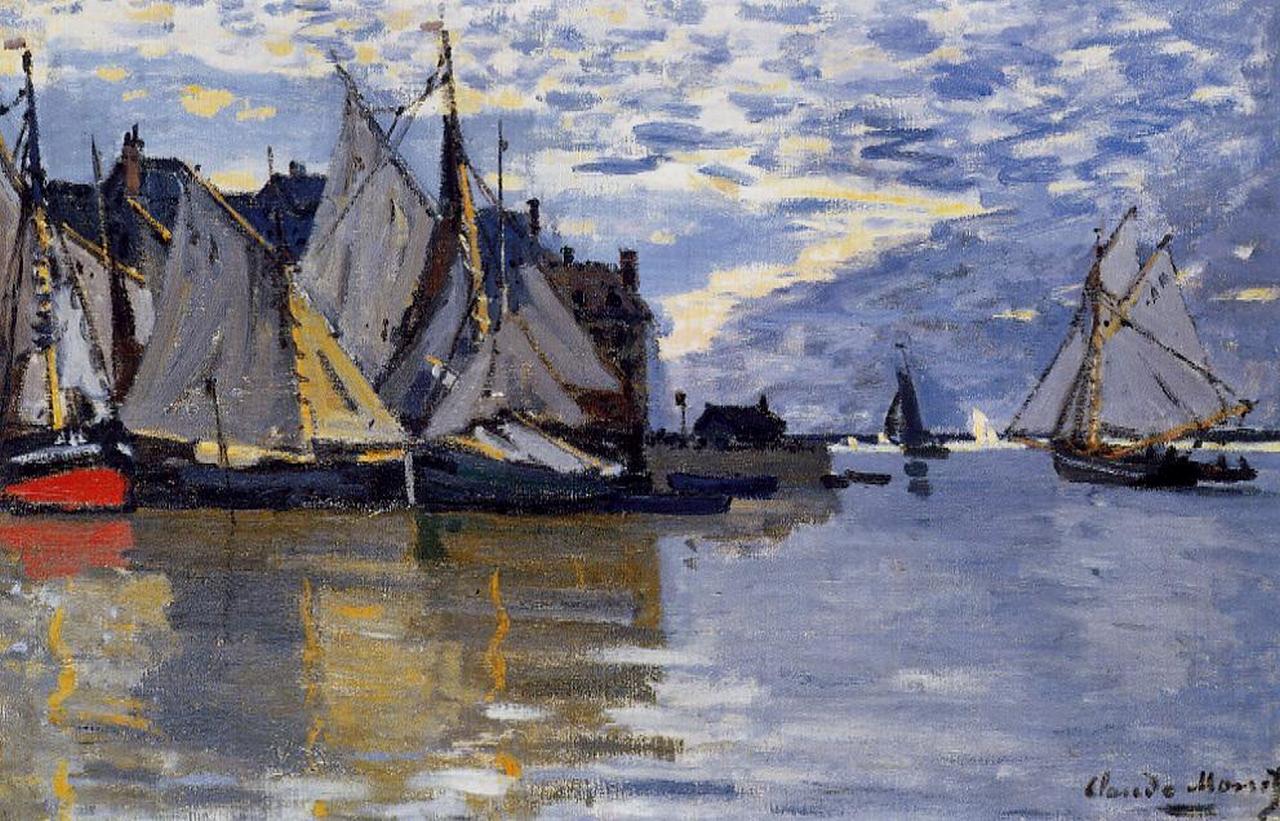
Claude Monet’s Sailboats from 1866 offers a compelling view into the artist’s early fascination with water, light, and shifting atmosphere. Even at this relatively early stage of his career, Monet shows an extraordinary sensitivity to the fleeting character of natural light and its effect on the visible world. The painting captures a harbor scene filled with anchored and passing boats, but it is far more than a simple record of maritime life. It is an exploration of reflection, stillness, movement, and mood.
What first stands out in this painting is its balance between structure and openness. The left side is crowded with tall sailboats whose masts and sails create a vertical rhythm, while the right side opens into calm water and distant forms. This contrast immediately gives the composition energy. The painting does not feel static, even though most of the boats appear to be at rest. Instead, it feels suspended in a moment of transition, as though the harbor is quietly waiting for the next shift in wind, light, or tide.
Monet transforms an ordinary coastal setting into something deeply poetic. He does not rely on grand drama or theatrical gesture. Instead, he finds beauty in the everyday. The boats, the harbor buildings, the cloudy sky, and the mirrored surface of the water all become part of a unified visual experience. In this way, Sailboats reveals one of Monet’s lasting gifts as an artist, his ability to make an observed moment feel both immediate and timeless.
The Harbor as a Place of Calm and Activity
The setting of Sailboats is a harbor, a space that naturally carries a dual identity. A harbor is both a place of safety and a place of departure. It is where boats rest, but also where journeys begin and end. Monet seems drawn to this layered meaning. The boats clustered near the shore suggest stillness and shelter, while the more distant sails hint at movement and possibility. The result is a scene that feels quiet but never lifeless.
The painting captures this subtle tension beautifully. The large sails on the left seem almost monumental, rising above the water and partially obscuring the buildings behind them. These boats dominate the foreground and anchor the composition. At the same time, smaller vessels in the distance pull the eye outward toward open space and the horizon. This movement from the enclosed harbor toward the broader water gives the painting a quiet narrative flow.
There is also a social dimension to the scene, even though human figures are not strongly emphasized. The boats themselves imply work, travel, commerce, and daily life. Monet does not need to fill the canvas with detailed people in order to suggest human presence. The harbor is shaped by human use, and the viewer senses that behind the stillness of the moment lies an ongoing rhythm of labor and movement.
This quality helps explain why the painting feels so alive. Monet is not simply painting objects. He is painting a place shaped by time, weather, and human activity. The harbor is not treated as a backdrop. It is the central subject, alive with quiet meaning.
Composition and the Art of Balance
One of the most impressive features of Sailboats is its composition. Monet arranges the elements in a way that feels natural, yet carefully controlled. The painting is built around asymmetry. The left side is visually dense, filled with masts, sails, dark hulls, and clustered architecture. The right side is far more open, with only a few boats occupying the broad expanse of water and sky. This imbalance creates harmony rather than disorder.
The crowded left side gives the painting weight. The tall sails act almost like a curtain, introducing the viewer to the scene through large geometric shapes. Their triangular forms are softened by loose brushwork, but they still provide a strong sense of order. The eye is first drawn to these sails because of their size and pale color, then moves across the water toward the smaller boats in the distance.
This progression is essential to the painting’s success. Monet guides the viewer gently, without making the structure feel rigid. The open water in the center and right serves as a visual pause, allowing the eye to rest before returning to the more complex forms on the left. Reflection also plays a role in this compositional flow. The mirrored shapes in the water extend the boats downward and create a second, softer version of the scene below the horizon line.
The skyline of buildings behind the boats adds another layer of depth. Though rendered in dark and simplified forms, these buildings prevent the painting from becoming only a study of sails and reflections. They ground the harbor in a real place and help establish spatial relationships between foreground and background.
Monet’s ability to make this arrangement feel spontaneous is part of his brilliance. The scene looks observed rather than designed, yet its balance is extremely refined. That tension between natural appearance and formal control is a hallmark of great painting.
Light as the True Subject
As in so many of Monet’s works, light is the true subject of Sailboats. The boats and harbor provide the structure, but the emotional life of the painting comes from the way light moves across the scene. The sky is full of broken cloud patterns, allowing patches of brightness to emerge between cooler blue and gray passages. This changing sky creates an atmosphere that feels unstable in the most beautiful sense, as though the weather could shift at any moment.
The sails capture and reflect this light in especially subtle ways. They are not painted as flat white shapes. Instead, they are filled with cool shadows, pale gray tones, and touches of warm cream or yellow. This gives them volume and softness. They seem to breathe with the air around them rather than stand apart from it.
The water is equally important. Monet uses the surface of the harbor to echo and transform the light above. Reflections are not treated as precise mirror images. They are broken, blurred, and dissolved into brushstrokes. This makes the water feel real, alive, and gently moving. The light on the water is quieter than the light in the sky, but it carries the same sense of instability and transience.
What makes this so compelling is Monet’s refusal to simplify. He does not divide the world into clearly separate zones of light and shadow. Instead, he shows how every surface contains variations. The boats, the water, the sky, and even the distant shoreline are all affected by subtle changes in illumination. This attention to optical experience is one of the qualities that would later define Impressionism, and it is already powerfully present here.
Color and Tonal Subtlety
The color palette of Sailboats is restrained, but it is far from dull. Monet relies heavily on cool blues, grays, muted whites, and earthy browns, but he punctuates these tones with carefully placed accents of warmer color. Small flashes of gold, ochre, and even red animate the scene and prevent it from becoming monotonous.
The most noticeable warm accent appears near the lower left, where a vivid red shape interrupts the cooler harmony of the harbor. This small detail has an outsized effect. It draws the eye, energizes the lower portion of the composition, and reinforces the sense that Monet is thinking in terms of color relationships rather than literal description alone. Elsewhere, touches of yellow along the sails and in the reflections add warmth without overwhelming the general mood.
Monet’s tonal control is equally impressive. The painting is built on delicate contrasts rather than harsh oppositions. Dark hulls and building silhouettes provide structure, but they are never so black that they crush the light around them. Pale sails glow against the darker forms, but they do not appear unnaturally bright. Everything is calibrated to preserve atmosphere.
This sensitivity to tonal balance allows Monet to convey both solidity and softness at the same time. The boats feel present and substantial, yet the overall image retains an airy, fluid quality. That is not easy to achieve. Many harbor scenes can feel either too stiff or too vague. Sailboats avoids both extremes by making tone and color work together.
The emotional effect of the palette is one of cool serenity touched by warmth. The blues and grays suggest calm, distance, and contemplation, while the warmer notes keep the painting from becoming cold. Monet creates a mood that is reflective rather than melancholy, peaceful rather than empty.
Brushwork and Monet’s Early Style
Looking closely at Sailboats, one can already see the qualities that would make Monet one of the most influential painters in modern art. His brushwork is loose, responsive, and attentive to sensation. He does not try to smooth every form into polished clarity. Instead, he allows the marks of the brush to remain visible, giving the painting energy and immediacy.
In the sky, the brushstrokes are broken and layered, creating a textured pattern of cloud and atmosphere. In the water, the strokes become softer and more horizontal, reinforcing the calm spread of the harbor surface. In the sails and hulls, Monet varies his handling to suggest material differences without becoming overly descriptive. This flexibility is one of the painting’s great strengths.
What is remarkable is how much Monet can suggest with relatively economical means. The boats are not rendered with the meticulous precision of academic marine painting. Yet they are entirely convincing. Their mass, angle, and presence are established through carefully placed strokes and tonal contrasts. The viewer does not need every rope or plank to be described. The essence of the forms is enough.
This approach signals Monet’s growing commitment to direct visual experience. Rather than constructing a scene through elaborate finish, he allows the act of seeing to guide the act of painting. The brushwork feels quick in places, but not careless. It is searching, alert, and purposeful.
Because this work dates from 1866, it occupies an interesting place in Monet’s development. It still carries some of the solidity and compositional clarity associated with more traditional landscape painting, yet it also points strongly toward the freer, more light driven manner that would later define him. In this sense, Sailboats is both an accomplished painting in its own right and an important sign of artistic transformation.
Water, Reflection, and the Poetry of Surface
The water in Sailboats is one of the painting’s most beautiful achievements. Monet understood that water is never simply transparent or flat. It reflects, absorbs, distorts, and transforms everything around it. In this harbor scene, the water becomes a second field of vision, a place where the world above is reinterpreted.
The reflections of the sails are especially striking. They descend into the water in elongated, wavering passages of pale yellow, gray, and blue. These reflections are not exact copies. They are broken by ripples and softened by the movement of the surface. This gives the painting a dreamlike quality, as though reality itself is gently dissolving.
At the same time, the water provides a sense of calm. Its broad, open surface counterbalances the density of the boats and buildings. Without it, the composition would feel cramped. With it, the painting breathes. The harbor opens outward, and the eye is given space to move.
Monet’s treatment of water also deepens the emotional effect of the scene. Reflections often carry associations of memory, instability, and passing time. In Sailboats, they reinforce the idea that the moment is fleeting. The boats may appear still, but their mirrored forms are already shifting. The scene is quiet, yet never fixed.
This is one reason Monet’s marine and harbor subjects remain so appealing. He does not paint water merely as scenery. He paints it as a living presence, an element that changes the meaning of everything it touches.
Atmosphere and the Suggestion of Time
The painting seems to capture a particular time of day, likely early morning or late afternoon, when the light is cool but touched with warmth. The sky is not dramatically lit, yet it carries enough variation to suggest a transient moment. Clouds move across the upper portion of the canvas, filtering the light and giving the whole scene a gentle luminosity.
Monet is especially skilled at conveying atmosphere without relying on obvious effects. There is no storm, no blazing sunset, no theatrical weather. Instead, he gives the viewer something subtler and more believable, the quiet instability of a real sky over water. That subtlety is central to the painting’s power. It invites close looking.
The distant forms in the harbor help create this atmospheric perspective. Boats and structures become darker, smaller, and less detailed as they recede. This not only establishes depth, but also reinforces the softness of the air between viewer and horizon. Space in the painting is not empty. It is filled with weather and light.
The overall impression is of a moment suspended between clarity and change. The scene feels observed from life, as though Monet stood before the harbor and responded to the exact conditions of that day. This immediacy is one of the painting’s greatest strengths. It turns the work into more than a composed image. It becomes a record of perception.
The Human Presence Without Portraiture
Although Sailboats does not emphasize individual figures, human presence is felt everywhere. The boats are evidence of labor, travel, and craft. The harbor buildings suggest habitation and commerce. The masts, sails, and moorings all point to systems of use and routine. Monet creates a world shaped by people without making people the central focus.
This choice is significant. By minimizing anecdotal detail, Monet allows the atmosphere of the place to take precedence. The viewer is not distracted by a narrative scene or specific characters. Instead, one experiences the harbor as a total environment. Human life is present, but absorbed into a larger harmony of water, sky, and built form.
That approach makes the painting feel both intimate and expansive. It is intimate because it records a real, ordinary setting. It is expansive because it reaches beyond the specific details of that setting toward broader themes of passage, stillness, and observation.
Why This Painting Still Matters
Sailboats remains compelling because it demonstrates how much emotional and visual richness can be found in a modest subject. Monet does not need spectacle to create a memorable image. A harbor, a few boats, shifting light, and quiet water are enough. Through sensitivity to composition, color, and atmosphere, he turns an everyday scene into something enduring.
The painting also matters because it reveals Monet at an important moment in his artistic journey. One can see both discipline and experimentation here. The forms are grounded, the composition is strong, but the handling of light and surface already points toward the radical freshness that would later transform modern painting.
Most of all, Sailboats matters because it invites the viewer into an experience of looking. It slows the eye down. It encourages attention to nuance, to reflection, to the subtle dialogue between solidity and change. In a world that often rewards speed and spectacle, this kind of painting offers a different kind of value. It reminds us that beauty can be quiet, and that a single observed moment can contain enormous depth.
Conclusion
Claude Monet’s Sailboats from 1866 is a quietly beautiful harbor scene that reveals the artist’s early mastery of light, atmosphere, and compositional balance. The painting combines solidity and softness, structure and openness, rest and movement. Its anchored boats and reflective water create a mood of calm observation, while its shifting sky and broken reflections suggest the fleeting nature of the moment.
Through restrained color, sensitive brushwork, and careful spatial design, Monet transforms a simple maritime subject into a rich visual meditation. The harbor becomes a place not only of boats and buildings, but of light, time, and perception. Even before the full emergence of Impressionism, Monet shows here that he was already committed to painting the world as it is seen and felt, not merely as it is described.
That is what gives Sailboats its lasting power. It is not only a view of a harbor in 1866. It is a painting about the act of seeing, about the quiet beauty of ordinary life, and about the changing surface of the world itself.
