Image source: wikiart.org
Introduction
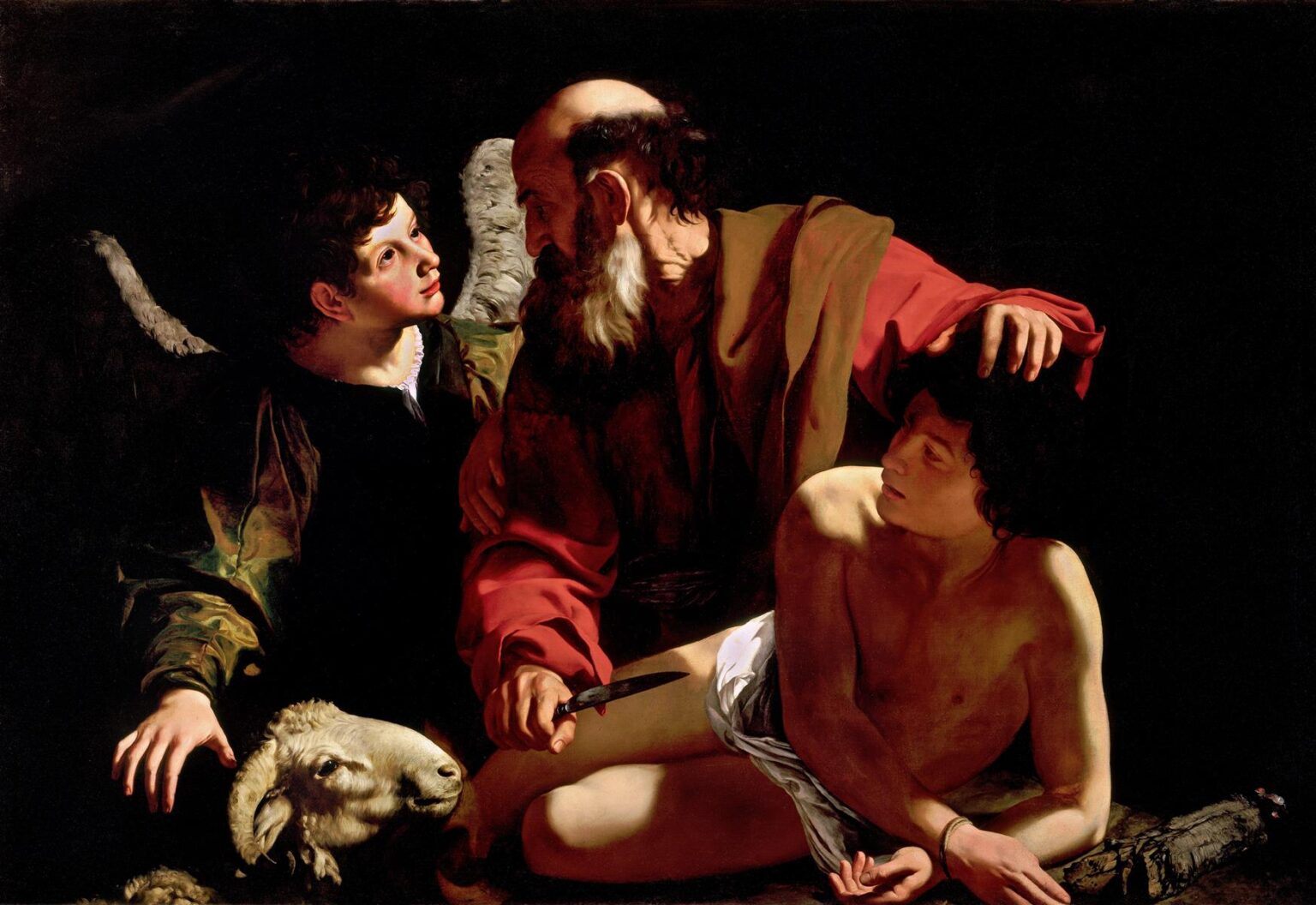
Caravaggio’s “Sacrifice of Isaac,” painted in 1598, compresses one of Scripture’s most disquieting stories into a single, breathless instant. Abraham’s knife has already been drawn. His forearm, corded with age and resolve, pins his son. Isaac, bound and twisting, turns his face upward with a mixture of fear and bewilderment. A ram presses into the scene, and an angel, young and urgent, bursts from the left with a look that arrests the patriarch’s movement more surely than any physical restraint. The background is almost absolute darkness, so that every gesture, every vein and eyelid, is illuminated with operatic focus. Caravaggio captures obedience, terror, and reprieve in a triangle of looks and hands, giving the early Baroque one of its most psychologically exact depictions of a divine test.
Historical Context
By the late 1590s, Caravaggio had established a new pictorial language in Rome: figures modeled by directional light against shallow, tenebrous grounds; sacred narratives rendered with contemporary faces; emotions measured in the body rather than in allegorical flourishes. “Sacrifice of Isaac” belongs to this formative period when the painter was still experimenting with open compositions while sharpening the chiaroscuro that would define his mature art. The Counter-Reformation demanded clarity, immediacy, and ethical force in religious images. Caravaggio answers not with tidy moralizing but with a scene in which faith, fear, and mercy can be read in skin and sinew.
Subject and Narrative Instant
The Book of Genesis tells that God asked Abraham to sacrifice his son Isaac, only to stay his hand at the last moment and provide a ram in the thicket. Caravaggio chooses the peak of tension: the exact second when the angel intervenes and the father’s intention meets heaven’s correction. There is no background landscape, no altar dressed for ritual. The stage is a slab of light edged by blackness. The economy concentrates the narrative. Abraham’s knife hovers above living flesh; the angel’s eyes lock with his; Isaac’s bound hands announce helplessness; the ram’s horn curves into the lower corner like punctuation. The viewer is not a distant spectator but a participant standing within arm’s reach of decision.
Composition and the Geometry of Rescue
The composition organizes itself around a triangle whose vertices are Abraham’s face, the angel’s face, and Isaac’s face. Their gazes move in a tight circuit: the angel to Abraham, Abraham back to the angel, Isaac upward toward his father. This triangle is buttressed by a second, material one: the diagonal of Abraham’s right arm and knife, the line of Isaac’s torqued torso, and the angel’s forearm that grips Abraham’s wrist. The ram and the bundle of wood anchor the lower corners, stabilizing the violence with heavy forms. The entire image reads as a momentary knot in which lines of intention, flesh, and divine interruption are tied and, in the next breath, will be untied.
Chiaroscuro and the Allocation of Meaning
Light in this painting is moral architecture. It strikes Isaac’s torso, shoulders, and face with the intensity of exposure—he is the innocent placed on the stage of obedience. It ignites the angel’s cheek and eyes, so that compassion appears as illumination. Abraham sits half in darkness, his features riven by shadow; he belongs to a threshold zone where human purpose meets a higher command. The background is almost pure tenebrae, a negative space that erases distraction and turns the figures into sculptural assertions. The knife blade catches a sharp glint, as does the wet rim of the ram’s eye, each small highlight reminding us how close the story leans toward irrevocable action.
Abraham’s Body as Ethical Engine
Caravaggio’s Abraham is an old man built of decisions. The bald pate, coarse beard, and gnarled hands speak of decades of labor and responsibility. His left arm wraps Isaac with the confidence of one who knows how to lift and restrain; his right hand holds the knife in an unambiguous grip. Yet the eyes do not blaze with fanatic certainty; they flick, mid-motion, toward the angel who has seized his wrist. Caravaggio reduces faith to muscular facts: a man has raised a blade because he believes, and now he must learn to believe differently. The painting finds grandeur not in rhetoric but in the body’s submission to a new command.
Isaac’s Youth and the Human Cost
Isaac is painted with the unidealized vulnerability that characterizes Caravaggio’s most moving figures. His bare skin carries the warmth of life; his wrists are bound by a simple cord; his mouth opens as if to speak or gasp. He is no mere symbol of sacrifice. He is a particular son with adolescent limbs and a face old enough to understand danger but young enough to trust. His eyes turn toward Abraham, not toward heaven. That gaze implicates the viewer in the ethical difficulty of the story: obedience is never abstract; it falls across relationships like light across flesh.
The Angel as Force of Correction
Unlike ethereal Renaissance messengers, Caravaggio’s angel is a palpable presence with weight and breath. The figure leans in from the left, one hand clamping Abraham’s wrist, the other resting across the patriarch’s shoulder in a gesture both restraining and consoling. The angel’s expression amasses urgency and tenderness. The youth’s wings occupy little space, dim and pushed back; what persuades here is not feathers but face. This angel is the incarnation of a word—stop—and Caravaggio models the miracle as a human touch powerful enough to redirect an old man’s will.
The Ram and the Theology of Substitution
At the lower left, a ram nudges into the frame, its curling horns and blunt snout modeled in leathery light. It is not a distant symbol sitting prettily in foliage; it is present, available, and solid. The animal’s glance seems to address the viewer, as if volunteering. In biblical logic the ram stands for the provision that ends human sacrifice and inaugurates a sacrificial system oriented toward mercy. Caravaggio’s placement—so close to Isaac’s bound hands that the animal almost grazes them—turns doctrine into proximity. The alternative is at hand.
Color and Texture as Emotional Weather
The palette is limited and deliberate. Abraham’s cloak carries a deep, ruddy orange that absorbs light like coals in a hearth; it is the color of heat moderated, not frenzy. Isaac’s skin reads as a field of vulnerable gold amid the surrounding darks; it is a target and a treasure. The angel’s garments introduce cooler greens and umbers, hues of intervention and peace. The ram’s fleece and the tied bundle of sticks are rendered with earthy browns, reminding us that sacrifice is a matter of wood, rope, and animal—materials of the world, not abstractions. Caravaggio’s textures are exact: the knife blade is hard and reflective; the wool is matte and dense; skin is tender and luminous. These differences make the scene not only visible but tangible.
Gesture, Hands, and the Language of Decision
Hands tell the painting’s story even if one never looks at the faces. The angel’s left hand is a vise on Abraham’s wrist; all four fingers press decisively into aged flesh. Abraham’s right hand answers with reluctant strength, the knuckles pale around the knife’s handle. His left hand splay-holds Isaac’s head, not in cruelty but in the paradox of protective restraint. Isaac’s own hands, bound but open, ride the foreground like a plea that has not yet learned to clench. Every hand is an argument, and the painting brings them to stalemate at the instant when mercy arrives.
Space, Proximity, and the Viewer’s Involvement
Caravaggio’s shallow stage pushes the action to the picture plane. The viewer’s nose is nearly at the level of the knife. There is no distracting horizon, no vista of Mount Moriah. The darkness around the figures functions like a room filled with quiet witnesses. This proximity intensifies empathy and compels self-interrogation. One cannot stand far away and admire composition alone; one must feel the question in one’s chest: what would obedience look like in my hands, and how would I recognize the angel’s interruption?
Time and the Double Pulse of the Scene
The painting holds two opposing times at once. In Abraham’s arm, momentum flows forward; in the angel’s grip, it arrests. Isaac’s twist reads as the recoil of fear; the ram’s forward nudge reads as an approach. Caravaggio stretches this single second so that we can read both futures—the plunge of the knife and its withdrawal—before the resolution becomes history. This dilation of time is central to the painting’s emotional logic. Mercy must be felt as rescue, which means the danger must be allowed to fill the room.
Theological Resonances Without Slogans
The “Sacrifice of Isaac” has generated centuries of theological reflection on faith, obedience, and divine character. Caravaggio offers no textual inscriptions and no preaching emblems. He allows doctrine to inhabit gesture. Faith appears as the willingness to act; revelation appears as interruption; providence appears as a ram that actually touches the narrative space. The result is an image that believers can receive devotionally and that secular viewers can read as a profound study of human choice under transcendent demand.
Technique and Paint Handling
Caravaggio builds forms with broad tonal masses, then forms edges where light breaks on volume. Flesh is laid in thin, translucent layers that keep warmth beneath cool highlights. Cloth is constructed with denser body color and pulled into folds that catch the directional light. Small accents—the glint on the blade, the moistness at the ram’s nostril, the wet inner corner of Isaac’s eye—are placed with surgical economy. The angel’s wing is largely a silhouette with a few feathered strokes, a reminder that the painter refuses ornamental excess when emotion suffices. This disciplined handling keeps the surface alive and the drama concentrated.
Comparisons and Influence
Caravaggio’s treatment differs sharply from earlier Renaissance versions that place the figures in expansive landscapes or emphasize idealized beauty. His focus on immediacy—three figures and a ram wedged into a pocket of light—redefined how the subject could be painted. Later Baroque artists absorbed this grammar of intervention, staging crucial biblical instants with compressed space, powerful light, and human gestures readable at a glance. The painting also prefigures cinematic close-ups in which the decisive action happens in the grip of a hand and the flicker of an eye.
The Human Question at the Painting’s Core
Beyond theology and technique, the image confronts the viewer with a human question: how do we live when our convictions bring us to actions that terrify those we love? Abraham’s face, caught between duty and sudden reprieve, communicates the cost of belief. Isaac’s body communicates the cost borne by others. The angel’s touch proposes an answer: revelation does not abolish human feeling; it corrects it at the last responsible moment and returns the knife to its sheath. Caravaggio does not dictate how to resolve such tensions beyond this story; he insists only that they be seen.
How to Look
Begin at the knife and follow the arm back to Abraham’s shoulder and weathered face. Let your eye jump to the angel’s hand on the wrist, then to the angel’s eyes, bright with insistence. Drop to Isaac’s bound hands and climb his torso to his turned head; feel the twist of the spine implied by the tilt of the chin. Find the ram’s eye near the lower edge and notice how its dull gleam answers the sharp light on the blade. Step back and receive the triangle of faces embedded in a slab of light, the entire composition held inside a darkness that feels like the hush between decision and mercy. The painting deepens each time the eye retraces this route.
Conclusion
“Sacrifice of Isaac” condenses an ancient story into a present tense forged from light, flesh, and touch. Caravaggio refuses distance and allegory. Instead he brings us to the brink, lets us feel the pulse of danger, and shows mercy arriving as a hand and a look. The work stands as a cornerstone of early Baroque drama and as one of painting’s most persuasive meditations on what it means to obey and to be spared. In this pocket of darkness, decision and reprieve balance on the edge of a blade, and the viewer learns how attention itself can be a form of reverence.