Image source: wikiart.org
Introduction to “Rubens, His Wife Helena Fourment, and Their Son Peter Paul”
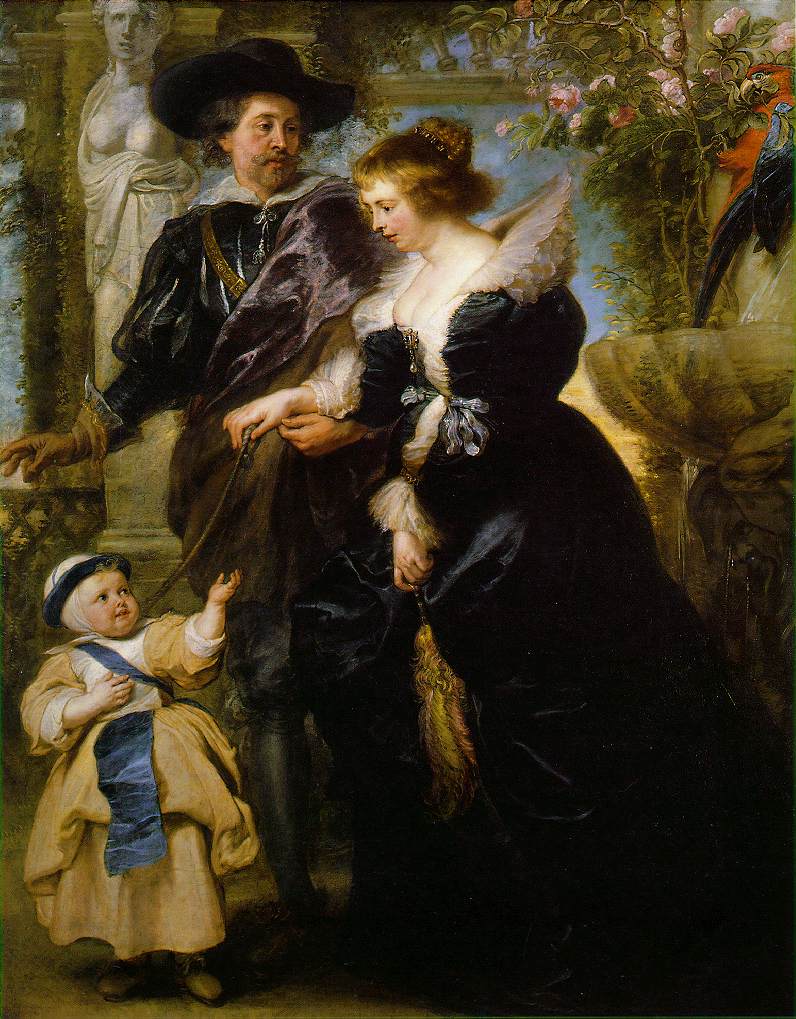
“Rubens, his wife Helena Fourment, and their son Peter Paul” is one of Peter Paul Rubens’ most personal and tender paintings. Completed around 1639, near the end of the artist’s life, it shows Rubens not as the grand court painter of Europe, but as a husband and father walking in a garden with his young family. The composition brings together the mature artist, his much younger second wife Helena, and their toddler son in an elegant yet intimate setting filled with sculpture, flowers, and a brilliantly colored parrot.
This work is more than a family snapshot in oils. It is a carefully constructed image about love, social status, artistic self-consciousness, and the idea of the garden as a private paradise. Rubens uses the language of Baroque portraiture—rich fabrics, architectural backdrops, and symbolic accessories—to celebrate domestic happiness while subtly meditating on age, beauty, and the passing of time.
Historical Context and Rubens’ Second Marriage
When Rubens married Helena Fourment in 1630 he was over fifty, a widower and renowned painter who had served princes and kings. Helena was only sixteen, the daughter of a wealthy Antwerp merchant. Their marriage brought him renewed joy and is often credited with the softer, more lyrical tone of many of his late works. They had several children together, and Rubens frequently used Helena and the children as models in mythological scenes and domestic portraits.
By 1639 Rubens was suffering from gout and spending more time at his country estate, Steen. These later years were marked by a mix of physical pain, political disillusionment, and deep contentment in family life. “Rubens, his wife Helena Fourment, and their son Peter Paul” belongs to this final phase. It presents the artist as country gentleman and devoted father, integrating his professional identity with his private role.
Composition: A Triangular Family Group
The composition is organized around a gentle triangular structure formed by the three figures. Rubens stands to the left, Helena occupies the center, and the child stands to the lower left, slightly in front of his parents. Their gazes and gestures create a subtle circulation of attention: Rubens looks at Helena, Helena looks affectionately toward the child, and the child reaches up toward his mother while glancing outward. This triangular interaction visually confirms their emotional connection as a family.
Helena’s placement at the center establishes her as the compositional and emotional anchor. Draped in a luminous dark gown with a white fur stole, she holds her husband’s hand lightly as if he is guiding her forward. Her body turns toward the child, but the gentle tilt of her head and the soft expression on her face suggest she is equally aware of her husband’s presence. Rubens slightly overlaps his figure behind her, allowing his broad hat and cloak to frame her in a protective arc.
The child, little Peter Paul, stands with one foot poised mid-step, his chubby arm reaching up with trusting eagerness. He grounds the scene in everyday reality, yet his placement at the bottom of the triangular arrangement also symbolizes new life growing from the union of his parents.
Rubens’ Self-Portrayal: Gentleman, Artist, and Husband
Rubens paints himself with the assurance of a man who has achieved professional and social success. He wears a wide-brimmed black hat, a dark doublet with white collar, and a voluminous cloak of rich brownish-purple. A gold chain or sash slants across his chest, hinting at honors received from noble patrons. His posture is relaxed but dignified: one arm rests on the stone balustrade, the other reaches out to Helena’s hand.
His face, framed by graying beard and mustache, shows signs of age and experience. Rubens looks not at the viewer but at his wife, his expression combining pride, affection, and perhaps a touch of admiration. This sideways gaze shifts the painting’s focus from the artist himself to the relationship he shares with Helena. While many self-portraits emphasize the painter’s profession through brushes or palettes, here Rubens presents himself instead as a companion and protector.
At the same time, the choice of setting—a cultivated garden with classical sculpture and architectural elements—reinforces his identity as a learned, cultured gentleman. He positions himself not in a studio but in a refined environment that suggests estate ownership and humanist taste. The painting thus functions partly as a statement of social status, showing that Rubens has risen from artisan to landed gentleman.
Helena Fourment: Beauty, Poise, and Domestic Grace
Helena appears in many of Rubens’ late works, often as the embodiment of feminine beauty, sensuality, and fertility. In this painting she is presented not as a mythological goddess but as an elegant young wife. Her dress of deep, glossy black contrasts dramatically with her pale skin and the feathery white trim at her neckline and sleeves. The bodice opens slightly to reveal her décolletage, a characteristic feature of Rubens’ female portraits that communicates both fashion and healthy vitality.
Her hair is gathered in a refined updo, adorned with pearls that echo the light glimmering on her jewelry. Helena’s posture is modest yet confident: she leans forward slightly toward her child, her hands clasped lightly over Rubens’ hand as though they are in mid-conversation or mid-stroll. Despite the formal costume, there is nothing stiff about her; the soft modeling of her face and the warm, slightly amused expression give her a lively presence.
By placing Helena between himself and their son, Rubens visually acknowledges her as the bond linking generations. She is both the beloved wife he admires and the nurturing mother he trusts. The painting celebrates her role not only as a beauty but as the heart of family life.
The Child Peter Paul: Innocence and Future Promise
Little Peter Paul, dressed in a cream-colored outfit with blue sash and hat, injects youthful energy into the composition. His round cheeks, wide eyes, and sturdy little body are painted with affectionate realism. He reaches up with one hand, perhaps asking for something or trying to attract his mother’s attention, while the other hand clutches a small object—often interpreted as a fruit or toy.
The child’s gesture and open expression create a dynamic contrast to the composed elegance of his parents. He seems to step into the viewer’s space, bringing us closer to the family. At the same time, his presence symbolizes continuity and hope. The name he shares with his father suggests the passing on of legacy, while his cheerful curiosity represents a future that extends beyond the aging artist’s lifetime.
Rubens’ tender portrayal of his son underscores the personal nature of the painting. This is not a generic representation of childhood; it is the artist’s own child, rendered with the same care and love that he applies to the grand commissions of princes.
The Garden Setting: A Private Arcadia
The family stands within a lush garden, framed by classical architecture and abundant foliage. To the left, a stone statue of a female figure on a pedestal rises behind Rubens, suggesting the presence of ancient art and the sculptural tradition that he admired. Behind Helena, a balustrade leads the eye into the distance where we glimpse more greenery and a pale sky. At the right, a stone urn brims with flowering plants, and a brilliantly colored parrot perches nearby.
This garden functions as a private Arcadia, a cultivated corner of nature that reflects the family’s prosperity and taste. It is both real—likely inspired by Rubens’ own estate gardens—and symbolic. Gardens in seventeenth-century art often represent love, fertility, and the delights of domestic life. By placing his family in such a setting, Rubens suggests that his marriage and children are the fruits of a well-tended life.
The parrot adds an exotic touch and may carry additional meanings. Parrots were luxury pets associated with wealth and worldliness; they also appear in religious paintings, sometimes as symbols of the Virgin or of eloquence. Here the bird’s vibrant plumage complements Helena’s beauty and the colorful blossoms, contributing to an atmosphere of lively abundance.
Costumes, Textures, and Social Status
One of Rubens’ great pleasures as a painter was rendering textures: velvet, satin, fur, lace, and soft flesh. In this family portrait he indulges that pleasure while using clothing to signal social rank. Rubens’ dark, slightly understated costume marks him as a gentleman, while Helena’s gown is a showpiece of Baroque fashion.
The black fabric of her dress catches highlights along its folds, creating deep, lustrous waves that cascade to the ground. The white fur trimming her sleeves and neckline appears soft and feathery, subtly echoing the wings of the parrot and the petals of the flowers. Pearls glimmer at her ears and along her hair, and a faint shimmer on her bodice hints at fine embroidery or jeweled accents.
The child’s outfit, though simpler, is carefully observed: the cream-colored fabric bunches around his sturdy legs, and the blue sash introduces a playful note of color. These details emphasize that even in a domestic moment, this is a family of means and refinement.
Through these luxurious costumes, Rubens asserts his family’s place within the upper echelons of Antwerp society. At the same time, the warmth of their interaction prevents the painting from becoming mere display.
Light, Color, and Atmosphere
Rubens bathes the scene in soft, golden light that seems to filter through the foliage. This light gently illuminates faces, hands, and fabrics, creating an atmosphere of late afternoon calm. Helena’s face and décolletage catch the brightest highlights, making her the luminous center of the composition. Rubens’ face is slightly more shadowed, reflecting both his darker clothing and his more introspective role.
The color palette balances rich earth tones with fresh greens and bright accents. The deep blacks and purples of the clothing anchor the scene, while the greens of the garden, the pinks of the flowers, and the vivid red and blue of the parrot invigorate it. Flesh tones are modeled in warm pinks and creams, giving the figures a lifelike presence against the cooler background.
Rubens’ brushwork in this late painting is fluid and confident. Background foliage and stonework are suggested with broader, more atmospheric strokes, while faces and hands receive more precise attention. This difference in treatment helps to keep the viewer’s focus on the family while still offering a believable environment around them.
Emotional Tone and Psychological Depth
Despite the formal setting, the emotional tone of the painting is relaxed and affectionate. The way Rubens and Helena lightly clasp hands suggests mutual trust and companionship. There is no rigid pose or theatrical gesture; instead, we sense a moment caught during a leisurely walk in the garden. Rubens’ sidelong gaze at his wife expresses admiration and perhaps gratitude, while Helena’s slight smile and attentive posture show her engagement with both husband and child.
Psychologically, the painting hints at the dynamics of age and youth. Rubens, older and more contemplative, stands back slightly, his body turned more toward the viewer’s left. Helena, younger and radiant, occupies the center, leaning toward the future in the person of their son. The composition thus visualizes a gentle transfer of focus from the aging artist to the new generation, mediated by the loving presence of his wife.
Unlike some stiff dynastic portraits, this image invites viewers to feel the warmth of family life. It shows that behind the public persona of a celebrated painter and diplomat was a man deeply invested in his private relationships.
Comparison with Other Family and Marriage Portraits
Rubens painted Helena and their children several times, and comparing this work to others clarifies its distinctive qualities. In the more formal “Helena Fourment in a Fur Wrap,” Helena appears alone, sensuous and almost mythic in her nudity. In “Rubens and Helena Fourment in the Garden,” the couple stands as a married pair, the emphasis on marital companionship. In the present painting, the addition of their son shifts the focus toward familial continuity and domestic happiness.
Compared with aristocratic family portraits by contemporaries like Van Dyck, Rubens’ work feels more physically and emotionally grounded. Van Dyck often emphasizes elegance and aristocratic reserve; Rubens, though aware of such conventions, allows more warmth and informality. His own presence within the scene also sets the painting apart; it is both a self-portrait and a family portrait, blending professional image-making with personal affection.
Rubens’ Late Style and Legacy
Painted only a year before Rubens’ death, “Rubens, his wife Helena Fourment, and their son Peter Paul” encapsulates his late style: broader brushwork, gentler contrasts, and a preference for luminous atmospheres over sharp drama. The colors are rich but not overly saturated, and the overall effect is one of balanced harmony rather than theatrical intensity.
This family portrait also exemplifies Rubens’ lasting influence on European portraiture. Later artists would emulate his ability to fuse status and intimacy, combining grand settings and rich costumes with believable human interactions. The painting stands as a template for the “conversation piece” genre that flourished in the eighteenth century, where families are shown in garden settings engaged in relaxed activity.
For modern viewers, the work offers a rare glimpse into the private world of a major artist. It humanizes Rubens, reminding us that behind the large altarpieces and dynamic mythological scenes was a man who delighted in his spouse and children, who saw in his own domestic life a subject worthy of grand painting.
Conclusion
“Rubens, his wife Helena Fourment, and their son Peter Paul” is a luminous celebration of love, family, and fulfilled life. Set in a cultivated garden filled with sculpture, flowers, and an exotic parrot, the painting unites the roles of Rubens as artist, gentleman, husband, and father. Through delicate gestures, nuanced expressions, and rich yet harmonious color, Rubens conveys the warmth of his bond with Helena and their young son, while subtly reflecting on age, legacy, and the continuity of generations.
As one of the last major works he created, this family portrait serves as a kind of visual testament. It shows what mattered most to him at the end of a brilliant career: not only honors and commissions, but the simple joy of walking through a garden hand in hand with those he loved.