Image source: wikiart.org
Introduction
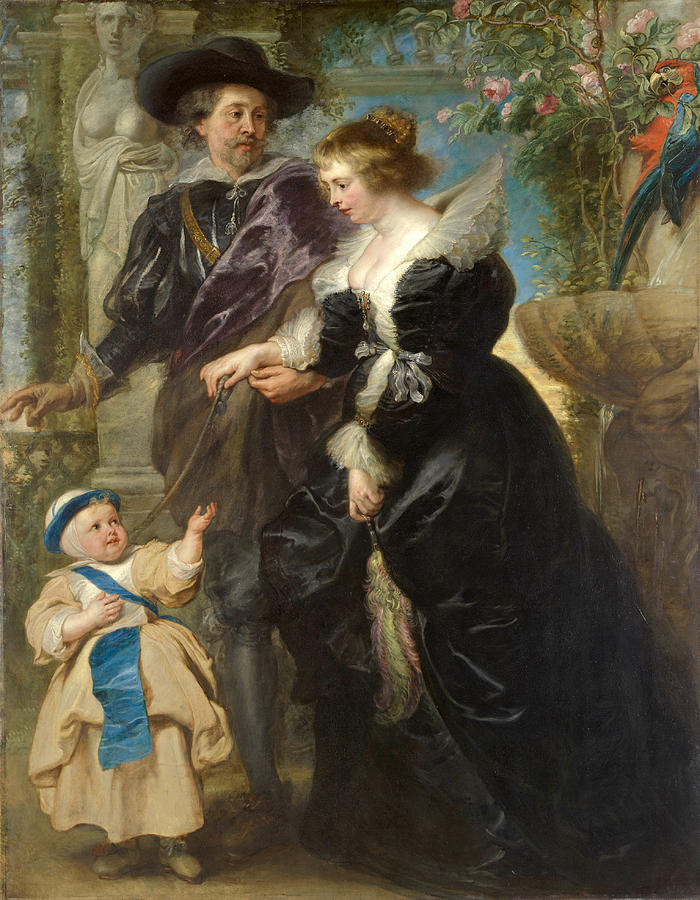
“Rubens, His Wife Helena Fourment and Their Son Frans” is one of the most dazzling family portraits of the seventeenth century. Painted by Peter Paul Rubens in the later years of his life, it stages the artist, his young second wife Helena, and their toddler Frans within a luxuriant garden filled with stone architecture, roses, and a brilliant parrot. More than a likeness, the picture is a manifesto of prosperity, affection, taste, and painterly bravura. It combines courtly elegance with domestic tenderness, revealing how Rubens fashioned his public identity not only through mythological and diplomatic triumphs but also through the theater of family life.
A Family Portrait That Performs
From the first glance, the painting reads like a performance. The three figures are caught mid-movement: Rubens slightly turned, baton in hand like a gentleman out for a promenade; Helena pivoting gracefully toward their son; little Frans reaching up in a burst of toddler urgency. Their gestures weave a continuous line that carries the viewer’s eye from left to right and back again, binding the group into a living triangle.
Unlike many sober family portraits of the period, this one is openly conversational. No one stares stiffly at the spectator; the drama lies in the glances exchanged among the figures and in the choreography of hands. Rubens looks at Helena with a quiet, proprietary pride. Helena lowers her gaze toward the child while sustaining the artist’s attention—she is both wife and mother in a single poised turn. Frans, with his small, outstretched hand and open mouth, animates the lower left corner like a spark.
The Garden as Social Stage
The setting is not a private parlor but a classical garden, a space of cultivation and display. Marble statuary, stone balustrades, urns, and clipped greenery signal taste and wealth. Roses bloom at the upper right, their pinks and corals echoing the delicate tones in Helena’s face; a fountain or basin glints behind the couple; and the sky opens in cool blue passages that air the composition. This garden is both Arcadia and Antwerp—an emblem of refined domesticity where nature is artfully controlled and family virtues are meant to be seen.
Rubens had country properties and took pride in their design. The architecture here acts as a moral frame: sturdy columns for stability, sculpted figures for classical learning, and terraces that extend the space like a stage set. The family processes through this cultured landscape as if through a public promenade, demonstrating that domestic happiness is itself a form of civic virtue.
Costumes as Character
Clothing in this portrait is not mere adornment; it is character. Rubens wears a broad-brimmed hat, black doublet with silver highlights, soft boots, and a lavender mantle slung with easy authority. The outfit proclaims him a gentleman rather than a mere artisan, a status Rubens carefully cultivated through diplomatic service and aristocratic connections. The baton in his hand reads as a cane for walking, but by association it also evokes the conductor’s baton or the painter’s brush—an instrument of command.
Helena is a miracle of satin and fur. Her black gown falls in heavy, lustrous folds that catch the light like moonlit water. The white lace at the collar and cuffs flickers crisply, and a small muff or fur trimming by her wrist adds a tactile counterpoint to the silk. The narrow waist, swelling skirts, and low neckline conform to contemporary fashion while giving Rubens a banquet of textures to paint. A curling ostrich feather hangs from her waist, a fashionable trifle that adds a vertical accent and a note of flirtatious grace.
Frans wears a toddler’s smock and cap with a brilliant blue sash that slices diagonally across his body. The sash echoes Helena’s feather and the parrot’s plumage, weaving the child into the color scheme. His soft leather shoes and bunched fabric are rendered with affectionate realism; Rubens loves the sturdiness of little legs learning to walk.
Light, Color, and the Baroque Atmosphere
Illumination comes in broad, warm swaths, as if late afternoon sun were abiding across the garden. The black of Helena’s dress is never flat; it is a galaxy of greens, violets, and steel-blue reflections. Rubens’s famous “living black” demonstrates how darkness can hold chromatic life when bathed in light. Her skin glows like ivory warmed by blood, a delicate counterpoint to the cool satin.
Rubens modulates color to guide emotion. The lavender of his cloak harmonizes with the roses overhead; the blue sash of the child leaps forward, the freshest note in the whole chord; the parrot’s scarlet and teal punctuate the right edge like a fanfare. Throughout, warm flesh tones play against cool stone and foliage, creating that Baroque sensation of air circulating around bodies, of figures truly occupying space.
The Parrot and the Garden Lore
At the upper right, a splendid parrot grips a branch beside a marble urn. In Rubens’s sacred pictures, parrots can stand for Marian praise or the reversal of “Eva” to “Ave.” In this secular context the bird’s symbolism expands: it is an emblem of the exotic, of worldly reach, of a household supplied by global trade. Parrots also signal eloquence and mimicry—apt metaphors for painting itself, the art that imitates and speaks through images. Its alert profile and brilliant feathers add wit and color, but they also hint that this cultivated family participates in a global, learned culture.
The Statue and the Classical Genealogy
Behind Rubens rises a sculpted female figure. She may be a Venus or a nymph, and her presence does quiet work. She places Helena—Rubens’s beloved muse—within a classical genealogy of beauty while simultaneously proclaiming the painter’s allegiance to antiquity. The stone goddess is cold and motionless; Helena, by contrast, is warm and alive. Painting outdoes sculpture by giving life to beauty: this is the old paragone rephrased as a family boast.
Gesture as Narrative
The portrait is built out of gestures. Rubens’s left hand, emerging from his mantle, seems about to guide Helena forward; his right hand lightly rests on a sword hilt or walking stick, a signal of protective masculinity. Helena’s right hand offers her fingers to her husband as if to accept his escort; her left hand steadies the small muff and feather, an elegant balance between social display and maternal steadiness. The child’s raised hand, mouth open in call or question, is the spark that sets all these gestures into motion. He is the reason the couple move as they do, their orbit defined by parental attention.
The Psychology of Glances
Baroque portraits often enlist glances to construct meaning. Here, Rubens gazes toward Helena rather than outward, announcing that his attention is domestic and affectionate. Helena looks downward toward the boy with a half-smile that is maternal but tinged with coy formality, mindful of her role as the elegant lady of the garden. Frans looks up, knitting the triangle. The viewer, drawn by these lines of sight, becomes a fourth participant, standing at toddler height and receiving the group’s benevolent attention.
Brushwork and the Pleasure of Paint
Seen up close, the surface is a festival of brushwork. The fur tufts at Helena’s cuff are flicked in with loaded strokes; the rose leaves are scumbled and glazed until they tremble in humid air; the satin is built through long, confident sweeps that toggle between highlight and shadow. Rubens’s method fuses speed with control: he suggests where a lesser painter would spell out, trusting the eye to complete the sensation of gloss, down, velvet, and flesh. The painting is not only about family; it is about painting’s capacity to make tactile the textures of a flourishing life.
Marriage, Age, and Reputation
Rubens married Helena Fourment when he was in his fifties and she around sixteen—a union that drew attention in Antwerp society and has intrigued viewers ever since. In this portrait the age difference is acknowledged and transmuted into harmony. Rubens presents himself as vigorous, urbane, and protective; Helena appears luminous and self-possessed, far from a mere ornament. The child cements the union not only biologically but socially, transforming private affection into a dynastic claim.
This public display mattered. Rubens was more than a painter; he was a diplomat and landowner whose personal image intersected with civic and courtly networks. To show himself as a cultured patriarch in a classical garden was to stake a claim to lasting reputation. The portrait therefore functions as a social document: an image of status built on artistic achievement, good marriage, and fertile household.
Intimacy within Splendor
Despite the grandeur, the scene feels genuinely tender. Helena’s posture inclines toward the child even as she offers her hand to her husband; Frans’s lifted arm elicits her smile more than any courtly observer’s praise. The splendor of costumes and setting does not smother this warmth. Instead, it frames it, as if the world of wealth and taste existed to protect a private core of affection.
Rubens was a master at letting public and private intermingle. His figures occupy roles—gentleman, lady, heir—but their bodies breathe, their faces glow with subtle personality. The soft parting of Helena’s lips, the half-squint of Rubens’s eyes under the hat brim, the toddler’s earnest reach—all are observed from life and preserved with loving accuracy.
Time, Motion, and the Walk
The picture implies a story: the family is on a walk. The diagonal of the path, the open garden beyond, and the forward cant of the figures suggest movement just paused. That pause is essential to portraiture—it holds time still long enough for likeness to form—but Rubens leaves time humming around it. We feel that in a moment Helena will advance, Rubens will guide her, and Frans will either be scooped up or granted the prize toward which he reaches.
This temporal quality gives the painting narrative charm without any explicit anecdote. It’s a day in a prosperous household, made memorable by the artist’s brush and by the awareness that such days—mild, fragrant, untroubled—are the very fabric of happiness.
Echoes of Court Masques and Theater
Theatrical culture saturated Rubens’s world, and the portrait borrows its language. The garden resembles a stage, the costumes gleam like masque attire, and the parrot plays the role of bright interlude. Yet the actors are a real family, and their script is written by affection. The blending of masque and life aligns Rubens with the Baroque ideal in which art heightens reality without falsifying it.
Comparisons within Rubens’s Oeuvre
Rubens painted Helena often—alone, as a mythic heroine, and with children. Compared to the more intimate “Helena Fourment in a Fur Wrap,” this family portrait is outward looking and civic in tone. Compared to his more formal self-portraits, it is relaxed and conversational. It stands near the end of a career in which Rubens made a specialty of grand narratives; here the grand narrative is marriage and continuity. The work is both culmination and confession: the painter’s late style turns toward the pleasures of home.
The Child as Center of Gravity
Although Helena’s dress dominates the surface and Rubens’s hat anchors the left, the composition’s emotional center is the child. Frans links hands and eyes, slows the walk, and magnetizes the adults’ attention. His blue sash is the brightest ribbon of cool color in the picture, and his small body forms the vertex where diagonals meet. He embodies futurity—promise, inheritance, and the continuation of love beyond the lifespan of the parents.
Material Culture and Global Horizons
The portrait is also a catalogue of seventeenth-century material culture: glossy satins from European looms, lace that required prodigious labor, dyed feathers sourced through global trade, parrots imported from overseas colonies, stone gardens shaped by classical taste. Rubens locates his family in a world economy of goods and ideas, suggesting that art, commerce, and domestic life were intertwined in Baroque Antwerp.
Final Impressions
What ultimately lingers is the sense of fullness: full skirts, full foliage, full hearts. The painting offers a vision of abundance that avoids vulgarity through grace. Rubens trusts paint to carry sensation—silk’s whisper, leather’s creak, the soft heft of a child’s smock, the coolness of evening air after heat. In this harmony of textures and affections, the artist inscribes his most persuasive claim: that the good life is a well-painted life, and that beauty reaches its highest pitch when it frames and preserves love.