Image source: wikiart.org
Introduction to Rough Sea at Etretat by Claude Monet
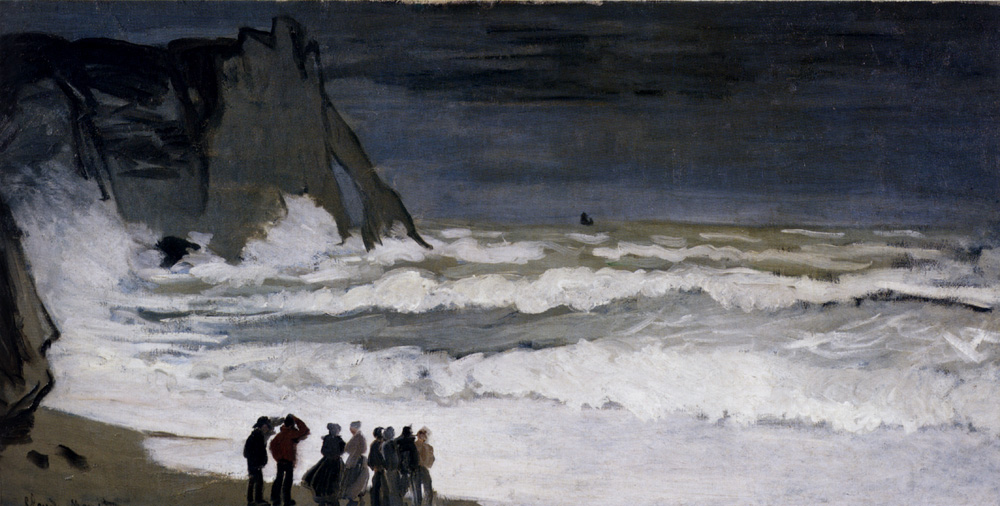
Claude Monet’s “Rough Sea at Etretat” from 1869 is one of the most compelling early examples of his fascination with the meeting point between land, water, weather, and human perception. The painting does not present the Normandy coast as a calm tourist view or a polished seascape arranged for decorative pleasure. Instead, it shows Étretat as a place of restless force, where the cliffs rise in dark, heavy shapes and the sea breaks against the shore in bands of white foam. The viewer is placed close to the beach, almost at the level of the people who stand watching the waves, and this low vantage point gives the painting an immediacy that feels strikingly modern.
The scene is simple at first glance. A group of figures gathers on the shore. Before them stretches a broad, turbulent sea. To the left, the cliff and natural arch of Étretat loom like a dark monument. Above, the sky is deep, muted, and heavy, pressing down on the water. Yet within this simplicity, Monet creates a powerful study of movement, atmosphere, and scale. The painting captures not only a place but also a sensation: the chill of damp air, the roar of waves, the pull of the horizon, and the smallness of human bodies before nature’s force.
Painted in 1869, before the first Impressionist exhibition of 1874, “Rough Sea at Etretat” reveals Monet at a crucial stage in his artistic development. He was already moving away from academic finish and toward a freer, more direct response to visual experience. The brushwork is loose, the forms are simplified, and the atmosphere matters as much as the subject itself. This is not merely a picture of a famous coastal landmark. It is a painting about seeing, standing, and feeling in the presence of a changing sea.
The Setting of Etretat and Its Artistic Appeal
Étretat, located on the Normandy coast of France, became one of the most recognizable seaside subjects in nineteenth-century art. Its dramatic chalk cliffs, natural arches, and shifting coastal weather made it especially attractive to painters who wanted to combine landscape with spectacle. Unlike a harbor scene or a gentle beach view, Étretat offered a more theatrical encounter with nature. The cliffs seemed sculptural, the sea was unpredictable, and the sky often changed rapidly from brightness to storm.
For Monet, this setting was ideal. He was drawn to places where light and atmosphere transformed familiar forms. Étretat gave him cliffs that could be solid and ghostly at the same time, depending on the weather. It gave him water that could be blue, gray, green, silver, or white within the same scene. It gave him a shoreline where human figures could appear as observers rather than central actors. In “Rough Sea at Etretat,” the famous cliff is present, but it is not described with architectural precision. It is absorbed into the dark mood of the scene, becoming part of the painting’s emotional weather.
The coast also had social meaning. By the mid-nineteenth century, seaside tourism was growing in France, and places like Étretat attracted visitors who came to watch the sea, stroll along the shore, and experience the drama of the coast. Monet includes a group of spectators at the bottom of the painting, reminding us that this is not an untouched wilderness. It is a modern leisure site, yet nature remains dominant. The people have come to look, but the sea is not arranged for them. It surges, crashes, and spreads across the canvas with a force that exceeds human control.
First Impression and Emotional Atmosphere
The first impression of “Rough Sea at Etretat” is one of darkness, energy, and cold movement. Monet uses a restrained palette of deep blues, grays, blacks, whites, and muted earth tones. The mood is not sunny or picturesque. Instead, the painting feels damp, windy, and almost nocturnal, even though it may represent a stormy daytime scene. The horizon is dim. The sky and sea seem to merge into one broad field of blue-gray darkness. Against this shadowed background, the white foam of the waves becomes the painting’s most active and luminous element.
The emotional effect is powerful because Monet avoids melodrama. There are no shipwrecked sailors, no heroic rescue, no dramatic narrative of danger. The figures on the beach simply watch. Their stillness intensifies the motion of the sea. They seem drawn to the spectacle but also cautious before it. Their dark silhouettes create a human point of entry into the scene, yet they remain small, almost fragile, beside the vast horizontal sweep of water.
This emotional restraint is one of the painting’s strengths. Monet does not tell the viewer what to feel. Instead, he builds an atmosphere so convincing that the viewer senses the scene physically. The surf appears loud. The air seems wet. The cliffs appear heavy with shadow. The painting becomes an experience of looking outward at nature while remaining aware of one’s own vulnerability on the shore.
Composition and the Power of Horizontal Movement
The composition of “Rough Sea at Etretat” is built around the tension between horizontal bands and vertical masses. The sea stretches across the canvas in layered strips of foam, water, and spray. These horizontal bands guide the eye from left to right, creating a sense of repeated wave motion. The large cliff on the left interrupts this movement, anchoring the painting with a dark, irregular form. This contrast gives the scene its structure. The sea moves, the cliff resists, and the human figures stand between them as witnesses.
The painting’s format emphasizes breadth. The long horizontal canvas suits the subject perfectly, because the viewer’s eye must travel across the shoreline just as waves travel toward the beach. The image does not feel centered around a single object. Instead, it is organized as an atmospheric field. The famous arch and cliff are important, but they do not dominate in the traditional sense. The sea, especially the white surf, occupies the central emotional space of the work.
The placement of the figures near the lower edge is also significant. Monet does not give them much room. They stand at the threshold between land and water, near the border of the painting itself. This makes the viewer feel as though they are also standing on the beach, just behind or beside them. The composition invites participation without turning the scene into a sentimental anecdote. We are observers of observers, watching people watch the sea.
The Cliffs as Monument and Shadow
The cliffs of Étretat are among the most famous natural forms in French landscape painting, but in this work Monet treats them with unusual darkness and restraint. The cliff on the left rises as a heavy, almost abstract silhouette. Its surface is not carefully modeled with delicate detail. Instead, Monet uses dark masses and rough tonal transitions to suggest damp stone, shadow, and geological weight. The natural arch is visible, but it appears partially swallowed by darkness and spray.
This handling gives the cliff a mysterious presence. It is not simply a landmark; it becomes a force in the composition. Its shape presses inward from the left, while the sea pushes outward across the center. The cliff seems ancient and immovable, but Monet’s brushwork makes even stone feel unstable. Its edges are softened by atmosphere, and the boundary between cliff, shadow, and water is not always sharp. This uncertainty is central to Monet’s vision. He is less interested in naming each detail than in showing how forms appear under specific conditions of light and weather.
The dark cliff also intensifies the whiteness of the surf. By placing the foam against areas of deep shadow, Monet creates strong visual contrast without relying on bright color. The result is dramatic but not theatrical in an academic way. The drama comes from nature’s own contrasts: black rock, white foam, gray water, and blue-black sky.
The Sea as the Main Subject
Although the painting includes cliffs and figures, the sea is the true subject of “Rough Sea at Etretat.” Monet devotes much of the canvas to the restless surface of the water. The waves are not carefully outlined. Instead, they are built from broad strokes, smears, and broken touches of white, gray, and greenish tones. This looseness allows the water to feel alive. The sea does not sit still for description, and Monet’s technique respects that instability.
The foam is especially important. It appears in thick, bright bands that cross the painting, creating rhythm and depth. Some areas are dense and opaque, while others are thinner and more transparent. This variation suggests the different textures of breaking waves, wet spray, and receding water. Monet does not paint every wave individually. He captures the general behavior of rough water, its repetition, disorder, and force.
The sea also creates a sense of scale. Because the figures are so small, the waves appear enormous even though they are not shown as towering walls of water. Their power comes from accumulation. Band after band of white surf fills the middle and foreground, making the shoreline feel overwhelmed by motion. The viewer senses that the sea is not a background but an active presence pressing toward the land.
Color, Light, and Tonal Restraint
The color palette of “Rough Sea at Etretat” is restrained, yet it is far from simple. Monet uses a narrow range of dark blues, smoky grays, chalky whites, muted greens, and earthy browns. This limited palette gives the painting unity and seriousness. The scene feels cold and heavy, as if sunlight has been absorbed by cloud, water, and cliff.
The most striking use of light appears in the white foam. These pale strokes carry much of the visual energy of the painting. They are not pure decorative highlights. They represent movement, pressure, and the breaking of water against the shore. Because the surrounding tones are so dark, the foam seems to glow with a subdued natural brightness. It is the painting’s main source of luminosity.
The sky is handled with broad, dark strokes that suggest depth rather than clear weather. Monet avoids a clean separation between sky and sea. The horizon is present, but it is softened. This creates a moody continuity between air and water, as if the whole scene is governed by the same stormy atmosphere. The result is not a bright coastal view but an immersive study of weather, where light is filtered through dampness and shadow.
Brushwork and the Move Toward Impressionism
“Rough Sea at Etretat” is especially important because it shows Monet moving toward the brushwork that would later define Impressionism. The surface is not highly polished. Forms are suggested through energetic marks rather than finished contours. The waves, cliffs, and sky are painted with visible strokes that preserve the speed and pressure of the artist’s hand. This gives the painting a feeling of direct observation, even if parts of it were completed or adjusted in the studio.
The brushwork is not random. Monet uses different kinds of marks for different visual effects. The sea foam is dragged and layered in quick pale strokes. The sky is broader and more atmospheric. The cliffs are heavier, darker, and more compact. The figures are reduced to small accents, painted with economical touches that convey posture and clothing without detailed faces. This variety shows Monet’s control. He simplifies forms not because he cannot describe them, but because he wants to capture the experience of seeing them quickly and under changing conditions.
This approach challenges the older expectation that landscape painting should be smooth, detailed, and carefully finished. Monet’s rougher surface makes the painting feel more immediate. The viewer is not simply looking at a scene; the viewer is aware of the act of painting itself. The brushwork becomes part of the subject, especially in the sea, where the movement of paint echoes the movement of water.
The Human Figures on the Shore
The small group of figures at the bottom of the painting plays a crucial role. Without them, the scene would still be powerful, but it would be more purely elemental. With them, Monet introduces human response. The figures gather together, dressed in dark clothing, facing the waves. Some appear to lean forward or turn slightly, as if speaking or reacting to the rough sea. Their bodies are small, but their presence changes the meaning of the painting.
They remind us that nature is also a spectacle. Étretat is not only a geological site; it is a place people visit, observe, and remember. The spectators stand at a safe distance, yet they are close enough to feel the sea’s force. Their dark shapes contrast sharply with the white surf behind them, making them visually noticeable despite their small size.
Monet does not individualize them. They are not portraits. They function more like a collective human presence. Their anonymity allows the viewer to identify with them. We do not need to know who they are. We understand their role because we have all experienced the impulse to stop before a powerful natural scene and look. In this way, the figures become a bridge between the viewer and the landscape.
A Modern View of Nature
One of the most interesting aspects of “Rough Sea at Etretat” is its modernity. Traditional seascapes often used storms as settings for dramatic stories of danger, shipwreck, or divine power. Monet removes most of that narrative framework. There is no clear moral lesson. There is no heroic event. There is simply a group of people watching the sea under dramatic weather conditions.
This makes the painting feel modern because it focuses on perception rather than story. The subject is not what happens, but how the scene appears and how it feels to stand before it. Monet is interested in the momentary conditions of atmosphere, the changing relationship between light and surface, and the way a familiar place can become strange under rough weather.
The painting also reflects a modern leisure culture. The people on the shore are not fishermen at work or peasants embedded in rural life. They seem more like visitors, spectators, or townspeople drawn to the coast. Their presence suggests the nineteenth-century transformation of the seaside into a place of travel and viewing. Yet Monet does not make the scene comfortable. Nature remains larger than tourism. The sea cannot be possessed by the viewer, the traveler, or the painter. It can only be observed in passing.
Monet’s Early Development in 1869
The year 1869 was an important period in Monet’s artistic development. He was still a young painter, but he had already begun to define the concerns that would shape his mature career. He was interested in outdoor light, water, weather, and the changing appearance of the same subject under different conditions. “Rough Sea at Etretat” belongs to this early search for a new kind of landscape painting, one based on immediacy rather than idealization.
Compared with Monet’s later works, this painting is darker and more tonal. It does not yet have the high-keyed color associated with many Impressionist canvases of the 1870s and 1880s. Yet the essential direction is already visible. Monet is less concerned with exact detail than with the total sensation of the scene. He uses broken brushwork, simplified shapes, and atmospheric unity to create a vivid impression.
The painting also reveals Monet’s confidence in choosing an unconventional mood. A more commercial artist might have emphasized the beauty of Étretat in clear light, with the famous cliffs presented as a picturesque attraction. Monet chooses a rougher and more somber view. This decision shows his interest in truth of experience. The coast is beautiful, but its beauty is tied to instability, darkness, and force.
The Role of Scale and Human Vulnerability
Scale is one of the painting’s central themes. The figures are small, the cliff is massive, and the sea is broad and restless. Monet does not exaggerate the scene with fantasy or theatrical distortion. Instead, he achieves scale through placement and contrast. The people are gathered low in the composition, while the cliff and waves occupy the main visual field. The result is a quiet but powerful reminder of human vulnerability.
This vulnerability is not presented as terror. The figures are not fleeing. They are watching. Their calmness suggests fascination rather than panic. This makes the scene more complex. Human beings are small before nature, but they are also curious, reflective, and capable of finding beauty in forces beyond their control. The painting captures that balance between humility and attraction.
The sea’s roughness also suggests the limits of human order. The spectators stand in a cluster, forming a small social group. The waves, by contrast, are disorderly and uncontained. The painting places human society at the edge of a natural world that cannot be fully organized. Monet’s composition makes this relationship visible without needing symbolism. The image itself carries the meaning.
The Drama of Weather
Weather is not a backdrop in “Rough Sea at Etretat.” It is one of the main agents of the painting. The dark sky, churning surf, and shadowed cliffs all suggest a specific atmospheric moment. Monet’s interest in weather would become one of the defining features of his art, and this work shows that interest already strongly developed.
The weather changes the identity of the place. Étretat in sunlight might appear elegant, open, and inviting. Here it appears severe, almost monumental. The cliff loses some of its tourist charm and becomes a dark geological presence. The sea loses decorative sparkle and becomes heavy with movement. The sky loses distance and seems to press close to the water. Monet shows that a landscape is never fixed. It is remade by light, weather, and time.
This sensitivity to atmosphere is one of the reasons the painting feels alive. The viewer does not sense a timeless, frozen view. Instead, the scene feels temporary. The waves will change in seconds. The foam will dissolve. The sky may darken or clear. The figures may leave the shore. Monet captures an unstable moment and gives it lasting form.
Why Rough Sea at Etretat Remains Powerful
“Rough Sea at Etretat” remains powerful because it combines direct visual experience with emotional depth. It is not one of Monet’s brightest or most decorative paintings, but it is one of his most atmospheric early seascapes. Its force comes from restraint: limited color, simplified forms, small figures, and broad movement. Monet trusts the subject and allows the sea to dominate.
The painting also offers a valuable view of Monet before the full emergence of Impressionism. It shows him experimenting with loose brushwork, modern subject matter, and atmospheric perception while still using a darker palette rooted in earlier landscape traditions. This combination makes the work especially interesting. It stands between the drama of Romantic seascape and the optical freedom of Impressionism.
For viewers today, the painting speaks to the enduring experience of standing before rough water. The details of fashion and tourism belong to the nineteenth century, but the emotional situation remains familiar. People gather at the edge of the sea, watching waves break under a dark sky, aware of beauty and danger at the same time. Monet turns that moment into art without overexplaining it. He gives us the coast as sensation, memory, and movement.
Conclusion
Claude Monet’s “Rough Sea at Etretat” is a remarkable early painting that reveals the artist’s developing mastery of atmosphere, movement, and modern landscape vision. Painted in 1869, it presents the Normandy coast not as a calm scenic view but as a living encounter between sea, cliff, weather, and human perception. The dark cliffs of Étretat, the sweeping bands of white foam, the brooding sky, and the small figures on the shore all work together to create a scene of intense visual and emotional presence.
The painting’s greatness lies in its ability to make the viewer feel the instability of nature. The water moves across the canvas in restless layers. The cliff stands firm but shadowed. The people watch from the edge, small but attentive. Monet transforms a coastal landmark into an experience of scale, atmosphere, and passing time.
Although “Rough Sea at Etretat” belongs to Monet’s early career, it already contains many of the qualities that would define his later work: sensitivity to changing light, interest in water, visible brushwork, and the desire to paint perception itself. It is a seascape, but it is also a study of looking. Through its somber tones and energetic surface, Monet invites us to stand on the shore with the spectators and witness the rough sea as something both beautiful and beyond control.
