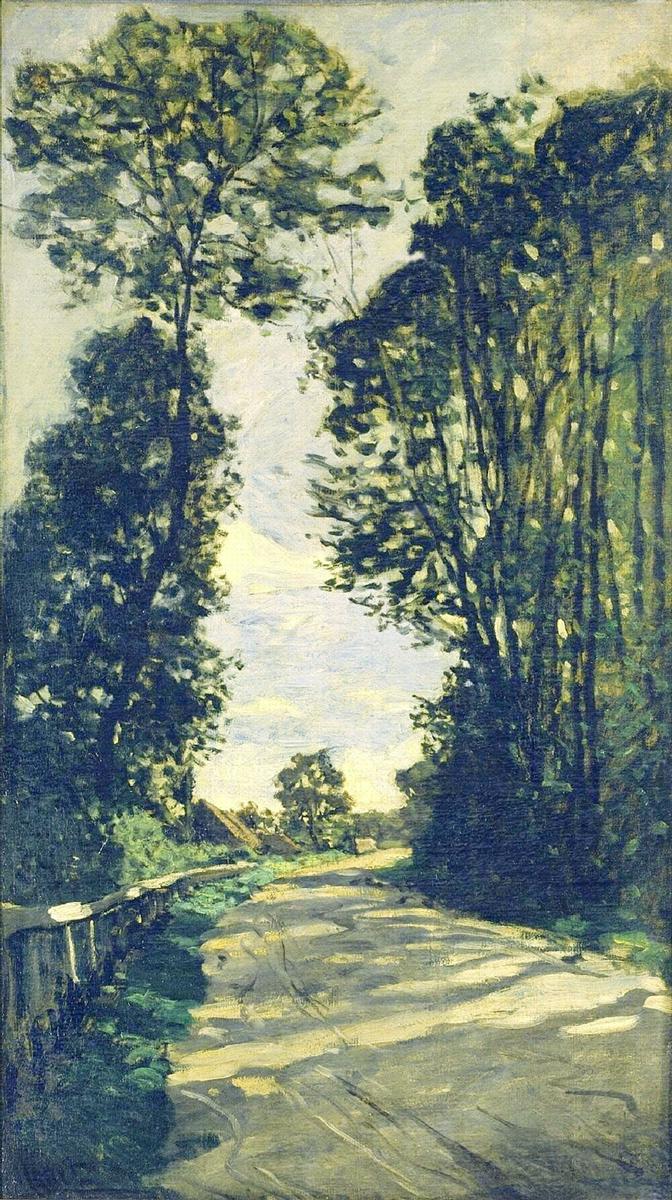
Image source: wikiart.org
Introduction
Claude Monet’s Road to the Saint-Simeon Farm from 1864 belongs to an important early moment in the artist’s development, when he was still shaping the visual language that would later make him one of the defining painters of modern art. Even at this relatively early stage, the painting reveals many of the qualities that would become central to his mature work. It shows an ordinary rural path rather than a grand historical scene, a passing effect of daylight rather than a staged narrative, and a landscape experienced through atmosphere, movement, and sensation rather than through polished academic finish. The result is a picture that feels immediate, fresh, and deeply attentive to the way the world appears in a fleeting moment.
At first glance, the scene seems simple. A road stretches into the distance beneath a pale sky. Tall trees rise on both sides, creating a kind of natural corridor that guides the eye inward. The forms are loose, the color is restrained, and the handling is far from the smooth surfaces expected in traditional Salon painting. Yet this simplicity is deceptive. The painting is full of subtle contrasts between light and shadow, openness and enclosure, structure and softness. Monet turns a quiet country road into a study of perception itself, inviting the viewer to feel how light dissolves solidity and how atmosphere binds every part of the landscape together.
What makes this work especially compelling is that it stands between traditions. It still carries traces of nineteenth century landscape conventions, especially in its vertical format and carefully organized recession into space, but it also moves toward a freer and more modern vision. Monet is less concerned with describing every botanical detail than with recording the living relationship between trees, road, sky, and air. The painting does not merely show a place. It evokes the experience of being there, looking down the road as sunlight touches the ground and dark foliage frames the view.
Historical Context and Monet’s Early Career
In 1864, Monet was a young artist still finding his place in the French art world. He had already been exposed to landscape painting outside the studio and had begun to reject the rigid formulas of academic art. This period was crucial because he was studying nature directly and working through the possibilities of painting modern life and modern vision. The countryside around Honfleur and the Normandy coast offered him rich subject matter, not only because of their beauty but because they allowed him to observe changing weather, shifting light, and the textures of land and sky in a direct way.
The Saint-Simeon area held particular importance for painters of the time. It was associated with artistic exchange, open air practice, and a growing interest in landscape as an independent subject. For Monet, such places were not merely picturesque destinations. They were laboratories of observation. In works like this one, he was learning how to translate natural sensation into paint, how to simplify forms without losing their vitality, and how to create depth through tonal relationships rather than through strict linear precision alone.
This context matters because Road to the Saint-Simeon Farm shows Monet before the full flowering of Impressionism, yet already moving toward it. The painting still has a certain gravity and tonal density that differs from some of his later, brighter works. The shadows are strong, the trees are weighty, and the scene is anchored by dark masses. But the brushwork already breaks away from hard finish. The paint surface suggests seeing in process. It feels as though the image is emerging in real time, built through observation rather than through formula.
Composition and the Experience of Space
One of the most striking features of this painting is its composition. Monet uses the road as the main organizing element, placing it in the center so that it leads the viewer gently into the distance. This gives the painting a clear structure, yet the scene never feels rigid. The road curves slightly and narrows as it recedes, drawing the eye toward the far horizon where the land opens out and a smaller tree appears in the middle distance. This distant point provides a visual pause after the dense framing of the foreground.
The tall trees on either side act like vertical borders, but they are not symmetrical. On the left, a single tall tree rises distinctly, its crown spreading against the sky. On the right, a heavier cluster of trunks and foliage creates a denser wall of shadow. This imbalance is important because it makes the composition feel natural rather than staged. The viewer senses that Monet is responding to the actual arrangement of the landscape rather than forcing it into an artificially balanced design.
The vertical format enhances the effect of the trees. It emphasizes height and creates a feeling of standing on the road and looking upward as well as forward. The sky is visible through the opening between the trees, but it is partly enclosed by their silhouettes. This produces a subtle tension between spaciousness and confinement. The road promises movement and openness, while the dark foliage gives the scene an intimate, sheltered mood.
Monet also uses the road surface as a space of light. It reflects the brightness of the sky and contrasts with the darker masses of vegetation. Because the road occupies so much of the lower half of the painting, it becomes more than a pathway. It becomes a luminous field that catches and distributes light through the composition. This contrast between the bright ground and the shadowy trees is one of the main reasons the painting feels so vivid despite its limited palette.
Color, Tone, and the Mood of the Landscape
The palette of Road to the Saint-Simeon Farm is relatively restrained, but within that restraint Monet achieves extraordinary nuance. Much of the painting is built from cool blues, blue greens, grays, and muted creams. These tones give the picture a quiet, contemplative atmosphere. Rather than using strong local color, Monet lets color emerge through relations of light and shadow. The trees are not simply green, the road is not simply brown, and the sky is not simply blue. Everything is modified by the surrounding air and by the changing conditions of light.
The dominance of cool tones is especially important. The foliage is rendered with deep blue green shadows that give the trees both substance and softness. These cooler passages make the pale sky appear brighter, even though the sky itself is subdued. The road, painted in light gray and off white tones, picks up the atmosphere of the sky and creates a reflective path that seems touched by shifting daylight. There are also small warmer notes in the distant rooftops or earth, but they remain understated. Monet avoids strong color contrast in favor of tonal harmony.
This harmony contributes to the painting’s mood. The scene feels calm, but not static. It has the atmosphere of an observed moment when the light is gentle and the air seems still. At the same time, the varied brushwork suggests movement within stillness. Leaves tremble, shadows flicker, and the road surface appears alive with patches of light. The emotional effect is subtle but powerful. Monet is not trying to dramatize the landscape. He is showing how profound an ordinary rural moment can be when seen with full attention.
The cool tonality also gives the work a poetic seriousness. This is not the bright, festive side of nature often associated with later Impressionism. Instead, it is a reflective and somewhat inward looking vision. The dark trees framing the composition add gravity, while the pale opening in the center offers release. The painting seems to breathe between these two moods, enclosure and openness, shadow and illumination.
Brushwork and Surface
Monet’s brushwork in this painting is one of the clearest signs of his emerging modernism. The forms are recognizable, yet they are not tightly finished. The leaves, trunks, road, and sky are all suggested through energetic, visible strokes. This gives the painting a sense of immediacy, as though Monet is translating what he sees directly onto the surface without overworking it into polish.
In the trees, the brushwork is layered and varied. Some areas are made of loose dabs and patches that suggest clusters of leaves, while others are marked by vertical strokes that indicate trunks and branches. The foliage is dense but not immobile. Because Monet does not define every edge, the trees seem to merge with the surrounding air. Their outlines are porous, constantly dissolving into the sky. This refusal of hard contour is fundamental to the painting’s freshness. Nature is presented as something living and unstable, not as a fixed arrangement of objects.
The road is handled differently but with equal sensitivity. Broad, sweeping strokes create a surface that feels uneven and responsive to light. Rather than describing every stone or rut in detail, Monet uses rhythmic marks to suggest texture and reflection. The result is convincing not because it is exact in a photographic sense, but because it captures how the road would appear to an attentive eye in changing daylight.
The sky, too, is animated by brushwork. It is not a flat backdrop but an active part of the painting. Soft horizontal and broken strokes create an atmosphere that feels luminous and open. Through this treatment, Monet makes the sky into a source of diffusion. Its light travels into the road and softens the edges of the trees. The whole painting is connected by the movement of the brush.
This visible surface is crucial to the work’s meaning. It reminds the viewer that painting is not simply imitation but interpretation. Monet is not hiding the act of painting. He allows us to see how the image is made, stroke by stroke, perception by perception. That openness would become one of the defining features of Impressionist art.
Nature Without Narrative
One of the most modern aspects of Road to the Saint-Simeon Farm is its lack of overt narrative. There are no prominent figures, no anecdotal details, no dramatic event unfolding on the road. The subject is simply a place, observed with care. In earlier academic traditions, landscape often served as a stage for mythological, historical, or rural genre scenes. Here, the landscape stands on its own.
This does not mean the painting is empty. On the contrary, its meaning comes from presence rather than story. The viewer is invited to attend to atmosphere, light, and structure. The road becomes a way of entering the scene imaginatively. It suggests travel and passage, but Monet does not specify who might be traveling or why. That openness allows the painting to function less as an illustration and more as an experience.
The absence of narrative also heightens the painting’s emotional subtlety. Instead of directing the viewer toward a specific lesson or event, Monet creates a space for contemplation. The quiet road, the dark trees, and the pale sky evoke a mood that remains open to interpretation. Some viewers may find serenity in it, others solitude, others the gentle melancholy of a passing day. Because the picture does not close down meaning with a fixed story, it remains expansive.
This quality helps explain why Monet’s landscapes feel so modern. They trust the visual world itself to carry significance. A road, a stand of trees, and a patch of sky are enough. What matters is not symbolic elaboration but the truth of the seen moment.
The Role of Light
Light is the central force that animates this painting. Even though the composition depends on strong tree masses and a clear road, what truly unifies the scene is the movement of light across forms. The sky provides a soft source of illumination that filters through the opening between the trees and falls onto the road. That light does not remain isolated. It seems to spread through the atmosphere, modifying every surface it touches.
What is remarkable is that Monet treats light not as a separate effect added afterward but as the very substance of the scene. The road appears bright because it receives and reflects light. The foliage appears deep and cool because it absorbs and contrasts with that brightness. The sky is pale but active, its luminosity echoed in the ground below. This network of relationships creates a dynamic whole.
The painting suggests a specific time of day, probably one in which sunlight is present but soft rather than harsh. The shadows are substantial, yet the scene is not gloomy. Instead, Monet finds beauty in the balance between shade and light. The trees are not obstacles to illumination. They make illumination visible. Without their dark masses, the luminous opening in the center would not feel so compelling.
This sensitivity to light points forward to Monet’s later achievements. In his mature work, he would often devote entire series to changing light conditions. Here, the approach is less systematic but already deeply intuitive. He is exploring how light shapes perception and how painting can register that shaping directly.
A Transitional Work in Monet’s Development
Road to the Saint-Simeon Farm is especially valuable because it reveals Monet in transition. It is not yet the fully radiant Monet of the 1870s and beyond, but neither is it a conventional early study trapped within academic norms. Instead, it occupies a fertile middle ground where new possibilities are becoming visible.
The darker tonal structure recalls earlier landscape traditions, including the Barbizon painters and other artists who emphasized mood, earthiness, and direct engagement with nature. Yet Monet pushes beyond that inheritance through the looseness of his handling and the freshness of his vision. He does not seek picturesque finish. He seeks immediacy. He does not idealize the landscape into timeless perfection. He records it as a living, changing environment.
This transitional quality gives the painting historical and artistic importance. It allows viewers to see how innovation often happens, not through sudden rupture, but through gradual rethinking. Monet is testing how much detail can be omitted, how form can remain open, how color can be subordinated to atmosphere, and how a humble subject can sustain a serious painting. In doing so, he is preparing the ground for the radical developments that would soon transform modern art.
Why the Painting Still Matters
This painting continues to resonate because it captures something universal in a deeply specific way. Almost everyone understands the feeling of a quiet road lined with trees, of light opening in the distance, of being surrounded by shadow while looking toward brightness. Monet turns that familiar sensation into art without stripping it of its ordinariness. The scene remains accessible, yet it also feels elevated by the intensity of looking.
Its relevance also lies in its patience. In a culture that often prizes spectacle, Road to the Saint-Simeon Farm reminds viewers that close attention can reveal richness in the most modest subject. The painting asks us to slow down. It asks us to notice tonal shifts, spatial rhythms, and the delicate balance between structure and atmosphere. In return, it offers a form of visual stillness that feels restorative.
There is also something moving about seeing Monet before full fame and certainty, already in possession of great sensitivity but still experimenting. The painting lets us witness artistic becoming. We see a young painter learning how to trust vision, how to trust nature, and how to trust paint itself. That sense of discovery gives the work a freshness that remains alive today.
Conclusion
Claude Monet’s Road to the Saint-Simeon Farm is a quiet but powerful early landscape that reveals the foundations of his later art. Through a simple rural subject, he explores space, atmosphere, brushwork, and light with remarkable sensitivity. The tall trees, luminous road, and pale sky are arranged with care, yet they never feel artificial. Instead, they convey the lived experience of standing in a real place at a particular moment.
The painting’s restrained color, open surface, and lack of overt narrative give it a contemplative character. It does not seek drama through story or grand gesture. Its drama lies in perception itself, in the way light falls, shadows gather, and space unfolds between dark foliage and distant sky. That focus on visual truth marks Monet’s movement toward modern landscape painting.
At the same time, the work retains the gravity of an early career experiment. It stands at an important threshold, carrying elements of older landscape traditions while pointing toward a new art of immediacy and sensation. That makes it not only beautiful in its own right but also revealing within Monet’s broader development.
Ultimately, Road to the Saint-Simeon Farm shows that Monet’s greatness did not begin only with his most famous later canvases. It was already present in this attentive, searching vision of a country road. In this painting, the ordinary becomes luminous, and a modest path through trees becomes a meditation on how the world is seen, felt, and remembered.